
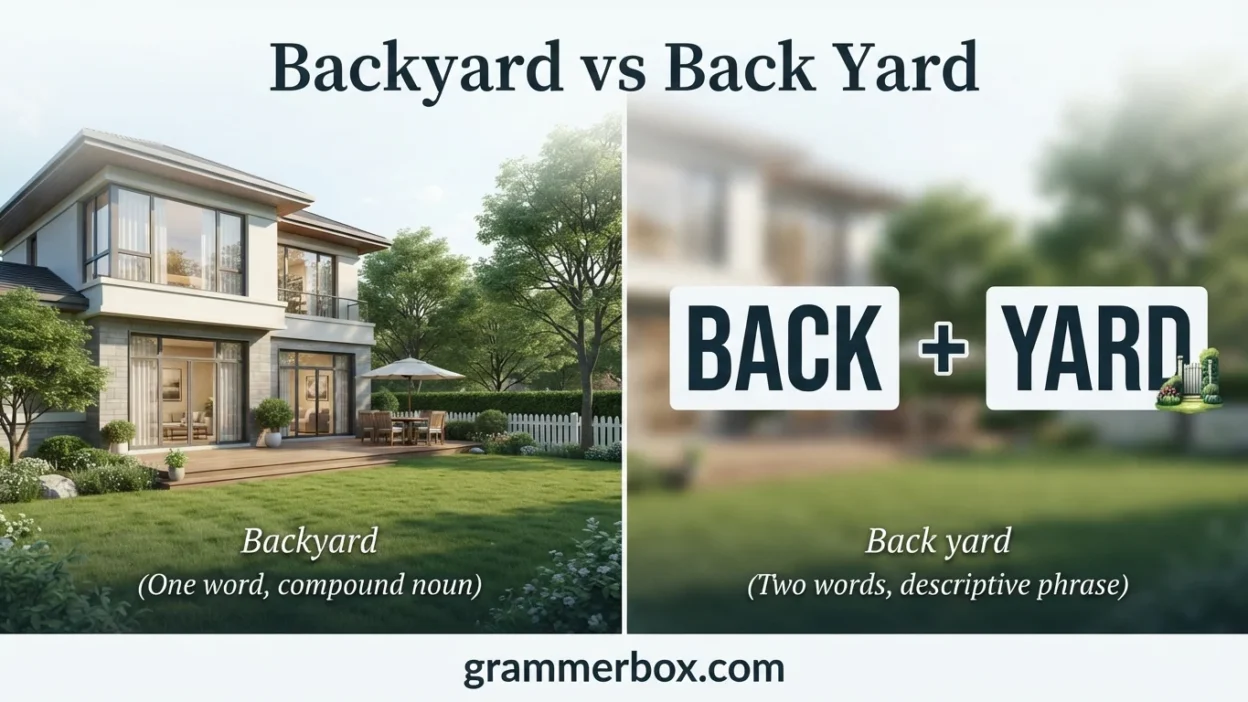
The words backyard and back yard look almost identical, so it is easy to wonder whether they mean the same thing or whether one spelling is incorrect. The good news is that both forms can be correct, but their grammatical roles are slightly different. Understanding when to use the closed compound backyard and when to write the two-word phrase back yard can make your writing clearer and more natural.
In everyday English, backyard is far more common when you are talking about the area behind a house. However, back yard can still appear when back directly describes yard in a particular sentence or when the writer wants to emphasize the two separate words. This guide explains the difference between backyard vs back yard, shows practical examples, covers American and British usage, and gives you a simple memory trick to choose the right form confidently.
Quick Answer
Backyard is usually the standard spelling when referring to the area behind a house, especially when used as a noun or adjective. Back yard is also possible when back and yard function as separate words. In modern everyday English, backyard is generally the more common choice.
Why People Confuse It
The confusion comes from the fact that backyard began as two separate words but is now commonly treated as a compound word.
Both forms contain the same two words:
- Back — the rear or opposite side of something
- Yard — an outdoor area, often around a house
When these words work together as a familiar compound noun, they are normally written as backyard.
For example:
We planted flowers in the backyard.
Here, backyard refers to one specific area of a home.
First Word: Backyard
Backyard is a compound noun meaning the outdoor area at the rear of a house or property.
It can also work as an adjective before another noun.
As a noun
The children are playing in the backyard.
Here, backyard names the outdoor space behind the house.
As an adjective
We installed a backyard swimming pool.
In this sentence, backyard describes the location of the swimming pool.
Common expressions include:
- backyard garden
- backyard barbecue
- backyard pool
- backyard fence
- backyard chickens
- backyard playground
In most ordinary writing, backyard is the form you will want.
Second Word: Back Yard
Back yard is the open form consisting of the adjective back and the noun yard.
Although less common as the ordinary name for the area behind a house, the two-word form can occur when the writer is treating back and yard as separate words.
For example:
The back yard was smaller than the front yard.
Here, the writer presents back as a modifier of yard.
However, in contemporary standard usage, backyard is generally preferred when the phrase functions as the established compound noun.
Comparison Table
| Feature | Backyard | Back yard |
| Form | One word | Two words |
| Meaning | Area behind a house | A yard at the back |
| Commonness | More common | Less common |
| Typical role | Noun/adjective | Separate adjective + noun |
| Example | The dog is in the backyard. | The back yard is fenced. |
| Everyday recommendation | Usually preferred | Used in specific contexts |
When to Use Each
Use “backyard” when:
Use backyard when you mean the familiar outdoor area behind a house.
We had lunch in the backyard.
It is also common when backyard modifies another noun:
She built a backyard greenhouse.
Use “back yard” when:
Use back yard when the sentence specifically treats back as a separate modifier of yard, although this usage is less common in modern standard writing.
The back yard and front yard were separated by a fence.
If you are simply naming the area behind your home, backyard is normally the safest and most natural choice.
Examples of Backyard vs Back Yard
Here are practical examples showing how the forms can appear in sentences:
- The children are playing in the backyard.
- We planted a vegetable garden in our backyard.
- Our backyard has a large oak tree.
- They built a small shed in the backyard.
- The dog escaped through the backyard gate.
- We are planning a backyard barbecue this weekend.
- She turned her backyard into a beautiful garden.
- The house has a spacious backyard.
- The back yard was separated from the front yard by a fence.
- The back yard receives less sunlight than the front yard.
- They installed lights around the backyard patio.
- The children created a play area in the backyard.
These examples show why backyard is generally the natural choice when referring to the outdoor space behind a home.
Common Mistakes
1. Assuming “back yard” is always wrong
It is not necessarily wrong. English compounds can sometimes appear in open, hyphenated, or closed forms depending on usage and context.
2. Using “backyard” as two words every time
If you are simply talking about the area behind a house, backyard is usually the more familiar form.
3. Confusing “backyard” with “backyard’s”
The possessive form is:
The backyard’s fence needs repair.
Here, backyard’s means something belongs to or is associated with the backyard.
4. Confusing “backyard” with “back yard” in compound phrases
When backyard modifies another noun, it is normally written as one word:
backyard garden
backyard pool
backyard party
Memory Trick
Think of backyard as the name of one familiar place.
If you can replace it with “the area behind the house,” use:
BACKYARD
We relaxed in the backyard.
= We relaxed in the area behind the house.
This simple substitution will help you remember the standard form in most everyday sentences.
American vs British English
Backyard is widely recognized in both American and British English, although vocabulary and compound-word preferences can vary between varieties of English.
In American English, backyard is extremely common for the area behind a house.
British English also uses back garden very commonly for this meaning:
American English: backyard
British English: back garden
That does not mean British speakers cannot understand or use backyard. It simply reflects a common vocabulary difference between the two varieties.
Similar Words
If you are learning vocabulary related to backyard, these words and phrases are useful:
- Front yard — the outdoor area at the front of a house
- Back garden — commonly used in British English
- Garden — an area where plants are grown
- Lawn — an area covered mainly with grass
- Courtyard — an open area surrounded partly or completely by buildings
- Patio — a paved outdoor area beside a house
- Yard — an outdoor area surrounding a building
- Garden yard — a yard containing plants or garden features
These words are related, but they are not always interchangeable.
FAQs:
Is “backyard” one word or two?
Backyard is normally written as one word when it refers to the area behind a house. The two-word form back yard can occur in certain contexts.
Is “back yard” grammatically correct?
Yes, back yard can be grammatically possible when back and yard function as separate words. However, backyard is generally more common for the established compound noun.
Which is more common: backyard or back yard?
Backyard is generally more common in modern everyday English, particularly in American English.
Should I write “backyard garden” or “back yard garden”?
Backyard garden is the more natural modern spelling when you mean a garden located behind a house.
Is backyard a noun or adjective?
Backyard can be a noun or an attributive adjective. For example, “The backyard is large” uses it as a noun, while “a backyard garden” uses it to modify garden.
Do British people say backyard?
Yes. Backyard is understood in British English, but back garden is a very common British expression for the outdoor area behind a house.
What is the opposite of a backyard?
The corresponding area at the front of a house is usually called the front yard in American English.
Remember This
Backyard = the usual one-word spelling for the area behind a house.
Back yard = two separate words, possible in specific grammatical contexts.
When in doubt, write backyard for the ordinary residential outdoor area.
Conclusion
The difference between backyard and back yard is mainly about compound-word usage rather than a major difference in meaning. Backyard is the standard, familiar form used by most writers when referring to the area behind a home. It can also appear before another noun, as in backyard garden or backyard pool.
Although back yard can appear when back and yard are treated separately, it is less common for the ordinary meaning. Learning the common compound form will help you write naturally and avoid unnecessary spelling confusion.