
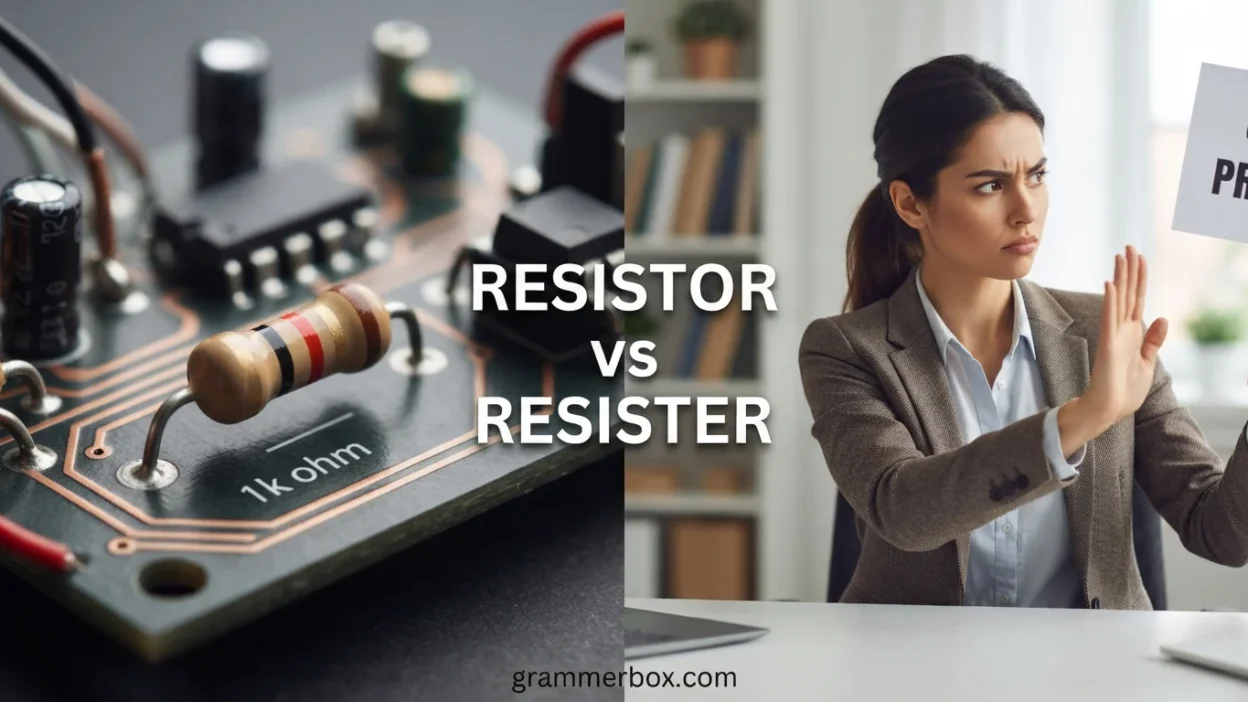
Have you ever wondered whether the correct word is resistor or resister? Although these two words look and sound almost identical, they have different meanings and are used in completely different contexts. One is an essential component in electrical circuits, while the other describes a person who opposes something or refuses to accept it. Understanding the difference between resistor vs resister can help you avoid spelling mistakes and choose the right word for your writing.
These words can be confusing for students, writers, electricians, engineers, and English learners because they differ by only one letter. However, using the wrong term can change the meaning of a sentence entirely. For example, an electrician might discuss a resistor when repairing a circuit, whereas a writer might describe someone as a resister when discussing resistance to authority. In this guide, you will learn the meanings, grammatical uses, examples, and common mistakes associated with both words. By the end, you will know exactly when to use resistor and when resister is the better choice.
Quick Answer
Resistor is an electronic component that limits or controls the flow of electric current in a circuit. Resister refers to a person or thing that resists, opposes, or refuses to accept something. Use resistor for electronics and resister for opposition or resistance.
Why People Confuse It
People confuse resistor and resister because they share almost the same spelling and pronunciation. Both words are related to the idea of resistance, but their meanings differ according to context.
Here are the main reasons for the confusion:
- Similar spelling: Both words contain the letters resist, making them easy to mix up.
- Related meanings: Both are connected to the concept of resistance.
- Different contexts: Resistor belongs mainly to electronics, while resister usually describes someone who opposes something.
- Typing errors: Replacing the letter o with e can change the intended meaning.
The easiest way to distinguish them is to identify the subject of your sentence. If you are discussing electrical components, resistor is usually correct. If you are describing a person who fights against pressure, rules, or authority, resister may be appropriate.
First Word: Resistor
A resistor is an electronic component designed to oppose the flow of electric current in a circuit. It helps control current, divide voltage, and protect sensitive electronic components from excessive current.
Resistors are commonly found in computers, televisions, mobile devices, chargers, and many other electrical and electronic systems.
Definition of Resistor
According to its technical meaning, a resistor is a passive electronic component that provides electrical resistance. Its resistance is measured in ohms, represented by the Greek letter omega (Ω).
For example:
- The technician replaced the damaged resistor on the circuit board.
- This resistor limits the current flowing through the LED.
- The engineer selected a 220-ohm resistor for the project.
Resistor in a Sentence
Here are additional examples showing how resistor works in everyday technical writing:
- Every beginner should learn how to identify a resistor.
- The circuit requires a resistor to protect the LED.
- A high-value resistor can limit current in an appropriate circuit.
- The electrician checked the resistor with a multimeter.
- The student connected the resistor to the breadboard.
When Is Resistor Used?
Use resistor when discussing:
- Electrical and electronic circuits
- Circuit design and repair
- Electronic components
- Resistance measurements
- Current control and voltage division
- Engineering and physics projects
Remember: A resistor is a component, not a person who disagrees with something.
Second Word: Resister
A resister is a person or, less commonly, an entity that resists, opposes, or refuses to accept something. The word comes from the verb resist, which means to oppose an action, force, influence, or demand.
Although resister is a valid English word, it is less common than resistor in technical writing and less common than phrases such as person who resists in everyday conversation.
Definition of Resister
A resister is someone who pushes back against a particular action, rule, demand, or authority. Depending on the context, the word can describe a protester, an opponent, or someone who refuses to comply.
For example:
- The resister refused to obey the unfair order.
- She became a resister against the oppressive government.
- The novel follows a young resister who challenges an unjust system.
Resister in a Sentence
Consider these additional examples:
- The resister continued to speak out against injustice.
- Every resister in the movement risked facing punishment.
- He was remembered as a brave resister during the occupation.
- The story portrays a resister who refuses to surrender.
- The authorities attempted to silence each resister.
When Is Resister Used?
Use resister when referring to:
- A person who opposes authority
- Someone who refuses to follow a demand
- An individual who resists political oppression
- A person who fights against an unwanted change
- Someone who opposes pressure or influence
Remember: A resister is generally someone who resists, while a resistor is an electronic component.
Comparison Table
| Feature | Resistor | Resister |
| Meaning | An electronic component that provides resistance | A person or entity that resists |
| Part of speech | Noun | Noun |
| Main context | Electronics and engineering | Opposition and resistance |
| Related word | Resistance | Resist |
| Common example | A resistor in a circuit | A resister against injustice |
| Measurement | Resistance is measured in ohms | No standard electrical measurement |
| Common usage | Frequent in electronics | Less common in everyday English |
The main difference is the context. A resistor belongs to an electrical circuit, whereas a resister describes someone or something that opposes an action or force.
When to Use Each
Choosing between resistor and resister becomes easy when you understand what your sentence describes.
Use Resistor for Electronic Components
Choose resistor when your sentence discusses circuits, current, voltage, or electrical engineering.
Examples:
- The resistor became hot during the experiment.
- We need another resistor to complete the circuit.
- The engineer calculated the resistance of the component.
Use Resister for Someone Who Opposes Something
Choose resister when describing a person who refuses to cooperate, challenges authority, or opposes a particular action.
Examples:
- The resister stood firmly against the unjust policy.
- History remembers her as a courageous resister.
- The resister refused to abandon the peaceful protest.
A Simple Context Test
Ask yourself: Am I talking about electronics or opposition?
- Electronics → Resistor
- A person who resists → Resister
This quick test will help you choose the correct spelling in most situations.
Examples: Resistor vs Resister in Sentences
The following examples demonstrate the difference between the two words in practical contexts.
Examples Using Resistor
- The electrician installed a new resistor in the circuit.
- A resistor helps limit the current passing through an LED.
- The student measured the resistor using a digital multimeter.
- This circuit needs a resistor with the correct resistance value.
- The damaged resistor caused the electronic device to malfunction.
- We studied how a resistor affects current and voltage.
- The engineer selected a suitable resistor for the design.
- Each beginner received a resistor for the electronics experiment.
- The technician checked the resistor before replacing the circuit board.
- A resistor can help create a voltage divider in an electronic circuit.
Examples Using Resister
- The resister refused to follow the unfair command.
- She became a resister against the authoritarian government.
- The resister continued to challenge the oppressive system.
- The historical account honored every courageous resister.
- The young resister refused to remain silent.
- Each resister faced pressure from the authorities.
- The film tells the story of a resister during wartime.
- He was known as a resister who opposed forced conformity.
- The resister defended the community’s right to speak freely.
- The movement attracted many people who identified as resisters.
Examples Showing Both Words
- The engineer repaired the resistor while the resister organized a peaceful protest.
- A resistor controls electrical current, but a resister opposes an action or demand.
These examples show why spelling matters. Even though the words look similar, their meanings are not interchangeable.
Common Mistakes
Writers sometimes use resistor and resister incorrectly because they overlook the difference between their meanings.
Mistake 1: Using Resister for an Electronic Component
Incorrect: The technician replaced the resister in the circuit.
Correct: The technician replaced the resistor in the circuit.
Why? The sentence refers to an electronic component, so resistor is the correct word.
Mistake 2: Using Resistor for a Person Who Opposes Authority
Incorrect: The protester was a brave resistor against oppression.
Better: The protester was a brave resister against oppression.
Why? Resister describes a person who resists. In everyday writing, opponent or person who resisted may sound more natural, depending on the sentence.
Mistake 3: Assuming Resister Is Always a Spelling Error
Incorrect assumption: Resister is not a real English word.
Correct understanding: Resister is a valid noun, although it is less common than resistor in technical contexts and less common than some alternative expressions in everyday conversation.
Mistake 4: Choosing a Word Without Checking Context
Incorrect: The student discussed the resister’s ohm rating.
Correct: The student discussed the resistor’s ohm rating.
Why? Ohms measure electrical resistance, so the sentence requires resistor.
Memory Trick
Use this simple memory trick to remember resistor vs resister:
ResistOR = electrONics.
The letter O in resistor can remind you of ohms (Ω), the unit used to measure electrical resistance.
ResistER = a pERson who resistS.
The letter E in resister can remind you of a person who opposes something.
Here is another quick way to remember:
- Resistor: Think of a circuit board.
- Resister: Think of a person standing against an unfair rule.
For example, if you are writing about a 100-ohm component, choose resistor. If you are writing about someone who resisted an unjust order, resister may be correct.
American vs British English
There is no major American-versus-British spelling difference between resistor and resister. Both forms are recognized in American and British English, and their meanings remain essentially the same.
| English variety | Electronic component | Person who resists |
| American English | Resistor | Resister |
| British English | Resistor | Resister |
| Canadian English | Resistor | Resister |
| Australian English | Resistor | Resister |
In both American and British technical writing, resistor is the standard term for the electrical component.
Resister is also used in both varieties when referring to a person who resists, particularly in political, historical, or social contexts.
Therefore, you do not need to change either spelling based on your target audience. Instead, focus on selecting the word that accurately expresses your intended meaning.
Similar Words
Understanding related words can make the distinction between resistor and resister even clearer.
1. Resistance
Resistance is the act of opposing something or the property of opposing electrical current.
Examples:
- The circuit has a resistance of 220 ohms.
- The community showed resistance to the proposed changes.
2. Resist
Resist is a verb meaning to oppose, withstand, or refuse to accept something.
Examples:
- The metal can resist corrosion.
- She decided to resist the unfair demand.
3. Resisting
Resisting is the present participle or gerund form of resist.
Examples:
- The material is resisting the applied force.
- Resisting pressure can sometimes require courage.
4. Resistant
Resistant is an adjective describing something that can withstand or oppose a particular effect.
Examples:
- The coating is resistant to water.
- The bacteria became resistant to the treatment.
5. Electrical Resistance
Electrical resistance describes how strongly a material or component opposes the flow of electric current.
Example:
- The engineer calculated the electrical resistance of the component.
6. Opponent
An opponent is someone who disagrees with or competes against another person, group, or idea.
Example:
- The opponent challenged the proposed law.
Unlike resister, opponent does not necessarily imply active resistance to authority or pressure.
FAQs:
1. What is the difference between resistor and resister?
A resistor is an electronic component that limits or controls current in a circuit. A resister is a person or entity that resists, opposes, or refuses to accept something.
2. Is resister a real word?
Yes, resister is a valid English noun. It describes someone or something that resists. However, it is much less common than resistor in electronics-related writing.
3. Is resistor the correct spelling in electronics?
Yes. Resistor is the standard spelling for the electronic component used to provide electrical resistance in a circuit.
4. Can resister refer to a person?
Yes. A resister can refer to someone who opposes authority, refuses to comply with a demand, or resists an unwanted action.
5. Why are resistor and resister confused?
They are confused because they look and sound similar and share the root word resist. Their meanings, however, depend on the context in which they are used.
6. Is there a British spelling difference between resistor and resister?
No. Both words are spelled the same way in American and British English. The distinction is based on meaning rather than regional spelling.
7. How can I remember the difference between resistor and resister?
Associate resistor with ohms and electronic circuits. Associate resister with a person who resists something. This simple connection makes the correct choice easier to remember.
Final Verdict
The difference between resistor vs resister comes down to meaning and context. Resistor is the correct term for an electronic component that provides resistance in a circuit. Resister refers to a person or entity that opposes, withstands, or refuses to accept something. Although the two words share a similar spelling, they are not interchangeable.
When writing about electrical engineering, circuit boards, current, voltage, or ohms, use resistor. When describing someone who challenges authority or refuses to comply with a demand, resister may be appropriate. Remembering this distinction will help you improve your spelling accuracy, write clearer sentences, and avoid confusion in academic, professional, and everyday communication.
Remember This
- Resistor: An electronic component used in electrical circuits.
- Resister: A person or entity that resists or opposes something.
- American vs British English: Both spellings remain the same in both varieties.
- Quick tip: Think of ohms when you see resistor and opposition when you see resister.
Choose the word that matches your meaning, and you will use both terms correctly.