When comparing two people, things, places, ideas, or situations, many English speakers wonder whether they should write “better than” or “better then.” These expressions sound almost identical when spoken, but they have completely different meanings and grammatical functions. Choosing the wrong one can make an otherwise clear sentence look incorrect.
The good news is that the difference is simple once you understand what than and then actually do. Than is mainly used for comparisons, while then usually refers to time, sequence, or a result. In this guide, you’ll learn when to use each word, see clear examples, review common mistakes, and discover an easy memory trick.
If you’re writing an essay, email, social media post, or everyday message, this explanation will help you confidently choose between better than and better then.
Quick Answer
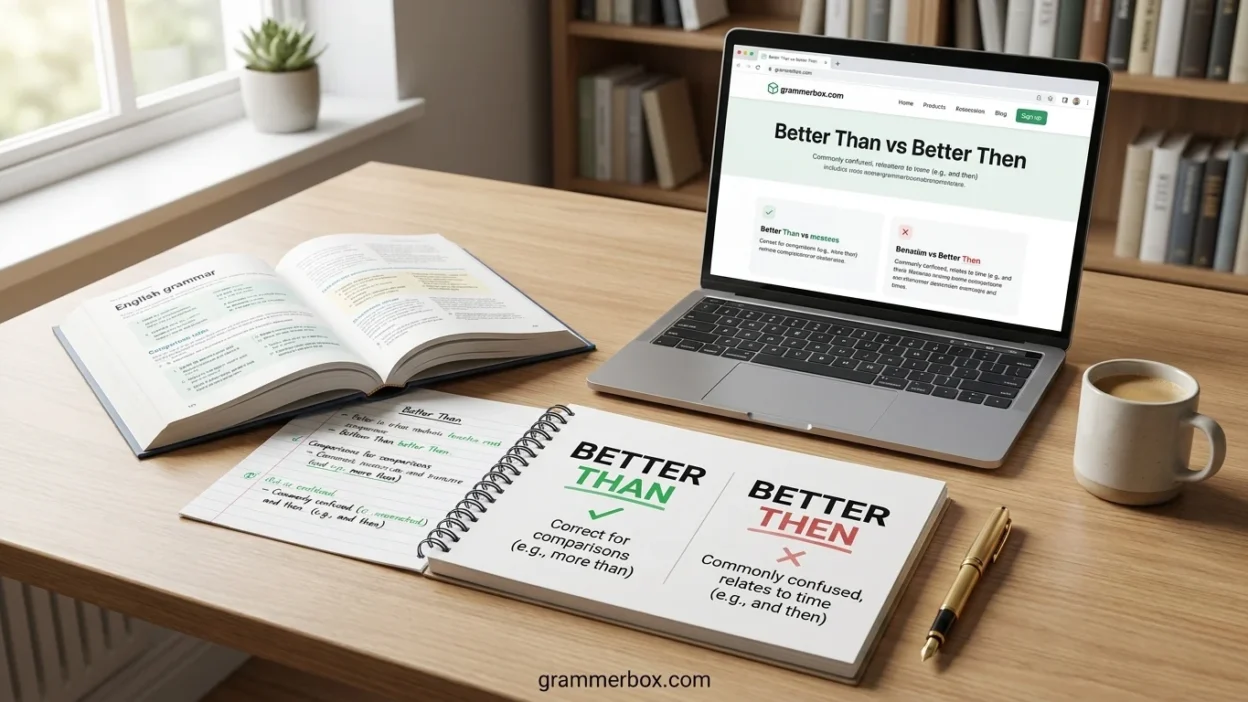
“Better than” is correct when making a comparison. For example, “This book is better than that one.” “Better then” is generally incorrect when you mean a comparison. Then refers to time, sequence, or consequence, not comparison.
Why People Confuse It
The main reason people confuse than and then is pronunciation.
In many varieties of English, the words can sound very similar in casual speech. When people write what they hear, it is easy to choose the wrong spelling.
However, their grammatical jobs are different:
- Than = used to compare things.
- Then = used for time, sequence, or consequence.
- Better than = a comparison.
- Better then = usually a spelling or word-choice mistake when intended as a comparison.
For example:
My new laptop is better than my old one.
Here, than connects two things being compared.
Compare that with:
I finished my work, then I went home.
Here, then shows what happened next.
Understanding the function of each word is more reliable than trying to remember how they sound.
First Word: Better Than
Better than is the standard and correct phrase when you want to compare something with something else.
Better is the comparative form of good, and than introduces the person or thing being compared.
Examples
- This restaurant is better than the one we visited yesterday.
- She is better than me at chess.
- This phone is better than my previous phone.
- Walking is better than sitting all day.
- His second presentation was better than his first.
- I think this solution is better than the original one.
The basic structure is:
Subject + be + better + than + comparison
For example:
This movie is better than that movie.
You can also use better than with verbs:
She sings better than I do.
In both cases, than signals a comparison.
Second Word: Better Then
“Better then” is not normally correct when you are trying to say that one thing is superior to another.
The problem is that then does not normally introduce a comparison. Instead, then is an adverb that can describe:
- What happens next
- A particular time
- A consequence
- A previous situation
For example:
First, finish your homework, then watch TV.
Here, then means something like “after that.”
You can technically have the words better and then in the same sentence, but they perform separate grammatical functions:
If you feel better then, you can return to work.
In this sentence, better describes someone’s condition, while then refers to a future time.
So the issue is not that the two words can never appear together. The issue is that “better then” is incorrect when used as a substitute for “better than.”
Comparison Table
| Expression | Correct? | Meaning | Example |
|---|---|---|---|
| Better than | ✅ Yes | Makes a comparison | This option is better than that one. |
| Better then | ❌ Usually incorrect for comparison | Does not mean “better than” | This option is better then that one. |
| Better | ✅ Yes | Comparative/superior condition | I feel better today. |
| Then | ✅ Yes | Time or sequence | We ate dinner, then left. |
| Than | ✅ Yes | Introduces a comparison | She runs faster than I do. |
When to Use Each
Use “than” for comparisons
Choose than whenever you are comparing two or more things.
Common patterns include:
- better than
- faster than
- taller than
- smaller than
- more useful than
- less expensive than
- more interesting than
Examples:
This method is better than the old method.
Sarah is taller than her sister.
The blue car is more expensive than the red one.
Use “then” for sequence or time
Choose then when you mean “after that,” “at that time,” or something similar.
Examples:
Finish your dinner, then wash the dishes.
I lived in London then.
If you study hard, then you may pass the exam.
A simple test is to ask yourself what you mean.
If you mean “compared with”, use than.
If you mean “after that” or “at that time”, use then.
Better Than vs Better Then: 12 Examples
Here are some practical examples showing the correct usage.
- This computer is better than my old one.
“Than” introduces the comparison. - She is better than me at mathematics.
The sentence compares two people’s abilities. - Today feels better than yesterday.
Two days are being compared. - This book is better than I expected.
“Than” introduces the comparison with expectations. - He performed better than he did last year.
The sentence compares his performances. - Working from home is better than commuting every day.
Two situations are being compared. - I feel better now than I did this morning.
“Than” connects two conditions for comparison. - First, check the instructions, then begin the exercise.
“Then” means “after that.” - I was living there then.
“Then” refers to a particular time. - Finish this task, then send me the report.
“Then” shows the order of actions. - If you feel better then, you can join us.
“Then” refers to a future time. - This plan is better than the one we discussed yesterday.
“Than” correctly introduces the comparison.
Notice that whenever the meaning is “superior compared with something else,” the correct word is than.
Common Mistakes
Mistake 1: Writing “better then” for a comparison
❌ This laptop is better then mine.
✅ This laptop is better than mine.
The sentence compares two laptops, so than is required.
Mistake 2: Assuming “then” means comparison
Because then sounds similar to than, writers sometimes use it automatically.
Remember that then is connected to time and sequence, not standard comparisons.
Mistake 3: Confusing pronunciation with spelling
English contains many words that sound alike or nearly alike but have different meanings.
Than and then are especially easy to mix up because their pronunciation is similar in everyday speech.
Mistake 4: Thinking “better then” can never appear
It can appear when better and then have separate functions.
For example:
I hope you feel better then.
Here, better describes a condition and then refers to a time.
So the problem is specifically using then where than is required for comparison.
Memory Trick
Here is an easy way to remember the difference:
THAN = Comparison
Think:
Better than → compare
THEN = Time or sequence
Think:
First this, then that.
Another useful trick is to associate the A in than with comparison:
THAN → Compare
And associate THEN with Next:
THEN → Next
So:
Better than = better in comparison.
Do this, then do that = sequence.
If you’re unsure while writing, ask:
“Am I comparing something?”
If the answer is yes, choose than.
American vs British English
There is no meaningful American-versus-British English difference in this particular rule.
Both American English and British English use than for comparisons and then for time, sequence, or related meanings.
For example, both varieties use:
This option is better than the other one.
And both use:
We had dinner, then went home.
Differences between American and British English can affect vocabulary, spelling, punctuation, and pronunciation, but the basic distinction between than and then remains the same.
Similar Words
Several other commonly confused words follow the same pattern: they may sound similar but perform different grammatical jobs.
Than vs Then
- Than = comparison
- Then = time or sequence
Your vs You’re
- Your = belonging to you
- You’re = you are
Example:
Your car is faster than mine.
You’re better at driving than I am.
Its vs It’s
- Its = belonging to it
- It’s = it is or it has
Their vs There vs They’re
- Their = possession
- There = place
- They’re = they are
Learning these distinctions can significantly improve grammar accuracy, especially in formal writing.
Final Verdict
The correct phrase for a comparison is “better than.”
Use than when you want to show that one person, thing, action, or situation is superior to another:
This method is better than the previous one.
Use then when referring to time, order, or what happens next:
Finish your work, then take a break.
Therefore, if you’re asking whether “better than” or “better then” is correct for a comparison, the answer is clear: better than.
FAQs:
1. Is “better than” correct?
Yes. Better than is the correct phrase when making a comparison between people, things, actions, or situations.
2. Is “better then” grammatically correct?
Not when you intend to make a comparison. In that situation, use better than. However, “better” and “then” can appear together when they have separate meanings.
3. Why do people write “better then”?
The words than and then sound very similar, especially in casual speech. This can lead to spelling and word-choice mistakes.
4. Should I say “better than me” or “better then me”?
Use “better than me.” For example:
She is better than me at tennis.
In more formal contexts, you may also encounter “better than I am.”
5. What is the difference between than and then?
Than is primarily used for comparisons, while then usually refers to time, sequence, or a consequence.
6. Is “better than before” correct?
Yes. “Better than before” is a common and grammatically correct comparison.
Example:
The new version is better than before.
7. How can I remember than vs then?
Remember: THAN = comparison and THEN = next/time. If you’re comparing two things, choose than.
Remember This
Better than is correct when comparing two things.
Then is used for time or sequence.
Better than = comparison
Then = next / at that time
If you can replace the word with “compared with,” use than.
This is better than that.
If you can replace it with “after that,” use then.
Finish this, then start the next task.
Conclusion
The difference between better than vs better then becomes easy once you focus on meaning rather than pronunciation. Than is the word you need for comparisons, making “better than” the correct choice when saying that one thing is superior to another. Then, on the other hand, deals with time, order, or sequence.
Whenever you are writing and hesitate between these two words, pause and identify the relationship in your sentence. Are you comparing two things? Choose than. Are you describing what happens next or referring to a particular time? Choose then. This small distinction can make your English writing clearer, more accurate, and more professional.