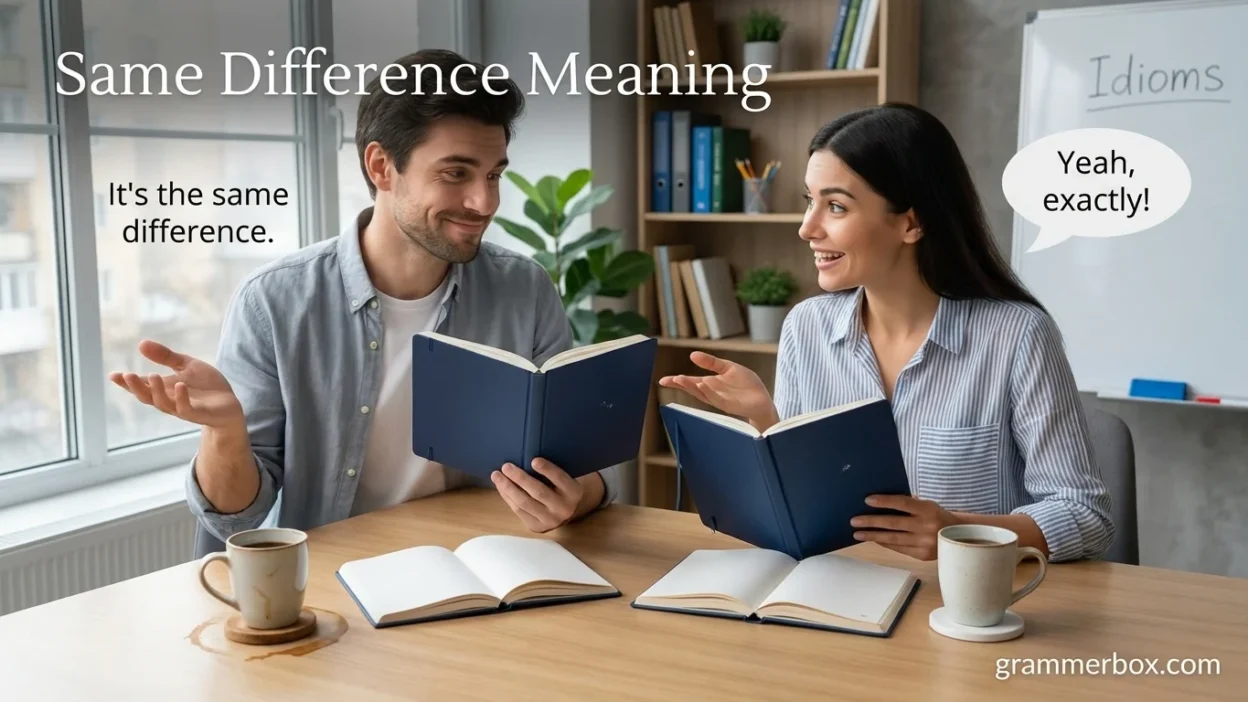
When someone says “same difference,” it can sound confusing at first. After all, same and difference seem to describe opposite ideas. Yet this unusual expression is common in casual English, especially in conversations where two choices, descriptions, or outcomes are considered practically equal. Understanding the same difference meaning can help you recognize the phrase in everyday speech, movies, social media, and informal writing.
The expression is usually used to dismiss a distinction between two things because the speaker thinks the distinction does not matter. It can also be used humorously or sarcastically when two alternatives lead to essentially the same result. In this guide, you’ll learn what “same difference” means, how to use it naturally, common mistakes to avoid, and how it compares with similar expressions such as six of one, half a dozen of the other and it makes no difference.
Quick Answer
“Same difference” is an informal expression meaning that two apparently different things are effectively the same in the situation being discussed. It often suggests that the distinction is unimportant, unnecessary, or has no practical effect. It can also sound humorous or sarcastic.
Why People Confuse “Same Difference”
The main reason people find “same difference” confusing is that the two words appear contradictory.
- Same means identical or alike.
- Difference means a way in which things are unlike.
- Together, “same difference” creates a deliberately paradoxical expression.
The phrase does not normally mean that two things are literally identical.
Instead, it suggests that the difference between them does not matter.
For example:
“We can meet at 6:00 or 6:15. Same difference.”
The speaker means that either time is acceptable and the small distinction is not important.
What Does “Same” Mean?
Same is an adjective, pronoun, or determiner referring to something that is identical or very similar.
Examples:
- We wore the same shoes.
- They ordered the same meal.
- I had the same idea.
- We live in the same neighborhood.
In the expression “same difference,” however, same contributes to the idea that two alternatives are effectively equivalent.
What Does “Difference” Mean?
Difference is a noun referring to the way in which two or more things are not alike.
Examples:
- There is a big difference between the two cars.
- Can you see the difference?
- The price difference is only five dollars.
- Experience can make a difference.
In “same difference,” the word difference refers to the distinction between the choices being discussed.
Same Difference: Comparison Table
| Expression | Meaning | Typical Use | Formality |
|---|---|---|---|
| Same difference | The distinction doesn’t really matter | Casual conversation | Informal |
| It makes no difference | The alternatives have equal importance/effect | General conversation | Neutral |
| No difference | There is no meaningful distinction | General use | Neutral |
| Either way | Both choices lead to an acceptable outcome | Conversation | Neutral |
| Six of one, half a dozen of the other | Two alternatives are essentially equivalent | Informal | Informal |
| Much the same | Very similar | Conversation/writing | Neutral |
When to Use “Same Difference”
Use “same difference” when you want to say that a distinction between two things is not important in the current situation.
It works especially well when:
- Two options produce essentially the same result.
- A distinction is technically real but practically unimportant.
- You want to sound casual.
- You are joking or being slightly sarcastic.
- Someone is focusing on a minor distinction.
Example
“Do you want to take the highway or the expressway?”
“Same difference. They both get us there.”
The roads may technically be different, but the speaker does not consider that distinction important.
Is “Same Difference” Formal?
No. “Same difference” is informal and conversational.
For professional or academic writing, clearer alternatives include:
- It makes no significant difference.
- The distinction is not important in this context.
- The two options are effectively equivalent.
- There is little practical difference.
“Same Difference” Examples
Here are natural examples showing how the phrase works in everyday English:
- “Should I call you tonight or tomorrow morning?”
“Same difference. Whenever you have time.” - “Do we need to start at 8:00 or 8:15?”
“Same difference to me.” - “You called it a mistake, and I called it an error. Same difference.”
- “We can take the bus or the train. Same difference; they’ll both get us downtown.”
- “Is it a ten-minute walk or twelve minutes?”
“Same difference.” - “You can save the file as a PDF or print it directly. Same difference for this assignment.”
- “He said he was tired, while she said she was exhausted. Same difference.”
- “Do you want pizza or pasta?”
“Same difference. I’m happy with either.” - “You can describe him as quiet or reserved. Same difference in this context.”
- “We arrived five minutes early or ten minutes late, depending on how you look at it. Same difference.”
- “Is the meeting on Tuesday or Wednesday?”
“Same difference for me. I’m free both days.” - “You call it luck; I call it good timing. Same difference.”
Notice that the phrase often appears after two alternatives have been mentioned.
Common Mistakes
1. Thinking It Means “Exactly the Same”
“Same difference” does not necessarily mean that two things are identical.
It usually means the distinction doesn’t matter practically.
2. Using It in Formal Academic Writing
Although the expression is understandable, it is highly conversational.
Instead of:
“The two theories produce the same difference.”
Use:
“The distinction between the two theories is not significant.”
3. Confusing It With “Make a Difference”
“Make a difference” means to have an effect or importance.
Example:
“Your advice made a difference.”
“Same difference” means that a distinction between alternatives is not important.
4. Assuming It Is Always Serious
The expression can be humorous, dismissive, or sarcastic depending on tone.
For example:
“You said Monday, I said Tuesday. Same difference.”
The speaker may be joking rather than making a precise logical claim.
Memory Trick
Think of “same difference” as:
A simple formula is:
A ≠ B technically, but A ≈ B practically → “same difference.”
For example:
Bus vs. train → both get you there → same difference.
Remember: the phrase focuses less on whether things are literally identical and more on whether their difference matters.
American vs. British English
“Same difference” is understood in both American and British English.
It is primarily an informal conversational expression, rather than a phrase strongly associated with only one variety of English.
You may hear it in:
- Everyday conversations
- Television and movies
- Informal discussions
- Online conversations
- Social media
However, speakers in both American and British English may choose more straightforward alternatives in formal situations, such as “it makes no difference,” “either way,” or “there is no meaningful difference.”
Similar Words and Expressions
Several expressions communicate a similar idea.
It Makes No Difference
This is one of the closest alternatives.
“We can leave now or in ten minutes. It makes no difference to me.”
Either Way
This means both options are acceptable or lead to the same relevant outcome.
“We can drive or take the train. Either way, we’ll arrive before noon.”
No Matter
This emphasizes that the result does not depend on the choice.
“No matter which route we take, we’ll get there.”
Six of One, Half a Dozen of the Other
This colorful idiom means that two alternatives are essentially equivalent.
“You can call it a fee or a charge—six of one, half a dozen of the other.”
Much the Same
This means two things are very similar.
“The two plans are much the same.”
Final Verdict
“Same difference” is an informal English expression used when two things are technically different but the distinction is considered unimportant or practically irrelevant.
It is often used casually, humorously, or sarcastically. The phrase is especially natural in spoken English when discussing two choices, descriptions, or outcomes.
For formal writing, choose clearer alternatives such as “it makes no difference,” “either way,” or “the distinction is insignificant.”
FAQs:
What does “same difference” mean?
“Same difference” means that two things may be different, but the difference between them does not matter in the situation. It is an informal expression.
Is “same difference” an oxymoron?
It can be viewed as a paradoxical or humorous expression because same and difference appear contradictory. The phrase works by suggesting that the difference itself is insignificant.
Is “same difference” grammatically correct?
Yes, “same difference” is an established informal expression. It is grammatically understandable, although it is not normally appropriate for formal or academic writing.
Is “same difference” rude?
Not necessarily. Its tone depends on context. It can sound neutral, humorous, dismissive, or sarcastic depending on how it is said.
Can I use “same difference” in an essay?
It is better to avoid it in formal essays. Use phrases such as “there is no significant difference” or “the distinction is not important in this context.”
What is another way to say “same difference”?
Good alternatives include “it makes no difference,” “either way,” “no matter,” “much the same,” and “six of one, half a dozen of the other.”
Is “same difference” used in American English?
Yes. It is understood and used in American English, as well as British English, primarily in informal conversation.
Conclusion
The same difference meaning is simple once you look beyond the apparent contradiction: two things can be different while that difference remains unimportant. When someone says “same difference,” they are usually saying that either option, description, or outcome is effectively the same for the matter at hand.
Because it is informal, “same difference” works best in casual conversations and humorous situations. In professional, academic, or formal writing, expressions such as “it makes no difference” or “there is no significant distinction” are safer and clearer.
Remember This
Same difference = technically different, but practically it doesn’t matter.