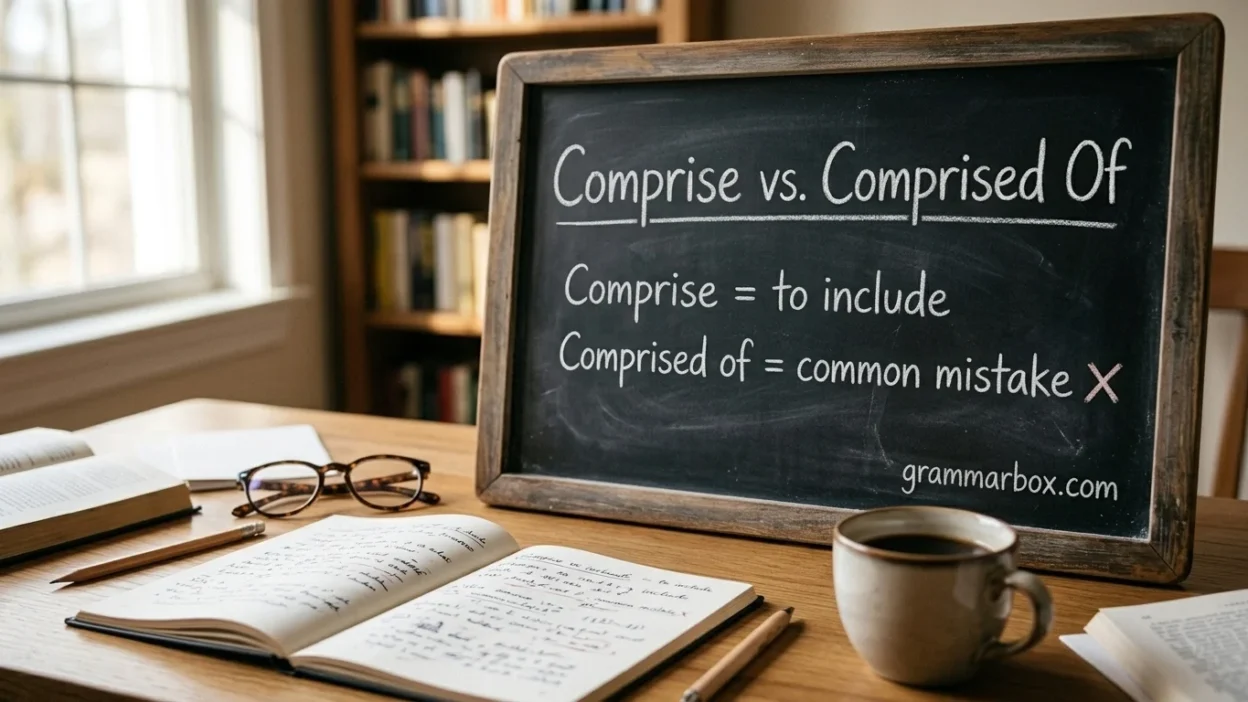
Understanding the difference between comprise vs. comprised of can help you write clearer, more natural English. These expressions describe how different parts form a complete group, organization, system, or whole. However, they follow different grammatical patterns, and choosing the right one can be confusing for students, ESL learners, and even experienced writers. The main challenge is knowing when to use comprise directly and when to use be comprised of to describe the parts of something.
The good news is that you can learn this grammar rule with a few simple examples. Traditionally, grammarians recommend using comprise without of, as in “The team comprises eleven players.” The expression is comprised of is also widely used in modern English, although some traditional style guides discourage it. In this guide, you will learn the meanings of both expressions, discover their grammatical differences, explore common mistakes, and see how to use them correctly in everyday writing and professional communication.
Quick Answer: Comprise vs. Comprised Of
Comprise means to consist of or include different parts that form a whole. Traditionally, it takes a direct object without of: “The team comprises eleven players.” Comprised of appears in expressions such as “The team is comprised of eleven players.” Although widely used, this construction is discouraged by some traditional grammar guides.
Why People Confuse Comprise vs. Comprised Of
People often confuse comprise and comprised of because both expressions describe the relationship between a whole and its individual parts.
For example, a school comprises several classrooms, teachers, and administrative departments. You can also describe the school by saying that it is comprised of these elements.
The confusion comes from grammar rules and changing language usage. Traditionally, comprise means that something includes its constituent parts, so it does not need the preposition of.
However, English speakers frequently use is comprised of to express the same relationship. This construction has become common in conversation, business writing, journalism, and other forms of communication.
Here is the main distinction:
- Comprise: Traditionally used directly before the parts that form a whole.
- Be comprised of: A widely used construction that describes the parts making up a whole, though some editors consider it nonstandard.
- Consist of: A widely accepted alternative that directly expresses what something is made up of.
Understanding these patterns will help you choose the most appropriate expression for your audience and writing style.
First Word: What Does Comprise Mean?
Comprise is a verb that means to consist of, include, or be made up of different parts. It describes how individual elements combine to form a complete unit.
The verb is particularly useful in formal writing, academic work, reports, and descriptions of groups or systems.
Definition of Comprise
According to traditional usage, comprise means that a whole includes its component parts.
For example:
- The committee comprises seven members.
- The book comprises twelve chapters.
- The course comprises four main modules.
- The United Kingdom comprises four constituent countries.
In each sentence, the subject represents the whole, while the noun or noun phrase following comprise identifies its parts.
How to Use Comprise in a Sentence
The standard grammatical structure is:
Whole + comprise(s) + parts
Use comprise with plural subjects and comprises with singular subjects.
Examples:
- The team comprises ten players.
- The organization comprises five departments.
- The collection comprises rare historical documents.
- The program comprises several training sessions.
Notice that none of these sentences requires of after comprise.
Is Comprise a Formal Word?
Yes. Comprise is especially common in formal, academic, technical, and professional writing.
You might encounter it in research papers, business reports, educational materials, and descriptions of complex systems.
For example:
“The research project comprises three stages: data collection, analysis, and reporting.”
This sentence communicates the structure of the project concisely and clearly.
Can Comprise Mean Include?
Yes. Comprise can mean include or consist of, depending on the context.
For example:
- The package comprises a laptop, a charger, and a carrying case.
- The committee comprises representatives from five departments.
In these examples, comprise identifies the components or members included in the whole.
However, when your goal is to describe the parts of something, remember the traditional rule: use comprise directly with its object.
Second Word: What Does Comprised Of Mean?
Comprised of is a commonly used expression that describes something as consisting of particular parts or elements.
It usually appears after a form of the verb be, such as is, are, was, were, or will be.
Examples include:
- The team is comprised of eleven players.
- The course is comprised of six lessons.
- The committee was comprised of experienced professionals.
- The system is comprised of several interconnected components.
Although these sentences are widely understood and commonly used, the expression be comprised of is criticized by some traditional grammar authorities.
Their objection is that comprise already expresses the relationship between a whole and its parts, making the preposition of unnecessary in this construction.
Is Comprised Of Grammatically Correct?
The answer depends on the usage standard you follow.
In contemporary English, is comprised of is widespread and generally understood. However, some traditional editors and style guides prefer alternatives such as comprises or consists of.
For formal academic writing, professional reports, or publications that follow strict editorial rules, it is often safest to avoid comprised of.
For example:
Less preferred by traditional editors: The team is comprised of eleven players.
Preferred alternative: The team comprises eleven players.
Another acceptable alternative: The team consists of eleven players.
Both alternatives communicate the same basic idea without the traditional usage objection.
How to Use Comprised Of in a Sentence
When you encounter this expression, the usual structure is:
Whole + form of be + comprised of + parts
Examples:
- The committee is comprised of six members.
- The library was comprised of several smaller collections.
- The training program is comprised of five units.
These examples illustrate common contemporary usage. If your writing must follow traditional grammar conventions, revise them to use comprises or consists of instead.
What Is the Difference Between Comprise and Comprised Of?
The main difference is grammatical structure and editorial preference.
Comprise is a direct verb that takes the parts of a whole as its object. Comprised of usually appears in a passive-like construction with a form of be.
Compare these sentences:
- The team comprises eleven players.
- The team is comprised of eleven players.
Both communicate that the team has eleven players, but the first follows traditional usage more closely.
Comparison Table: Comprise vs. Comprised Of
| Feature | Comprise | Comprised Of |
|---|---|---|
| Basic meaning | To include or consist of parts | Describes something as consisting of parts |
| Grammatical pattern | Whole + comprise(s) + parts | Whole + be + comprised of + parts |
| Example | The team comprises eleven players. | The team is comprised of eleven players. |
| Traditional usage | Preferred | Often discouraged by traditional editors |
| Modern usage | Common in formal and general writing | Common in contemporary English |
| Preposition | Does not traditionally take of after the verb | Uses of after comprised |
| Best choice for formal writing | Generally recommended | Consider replacing it with comprises or consists of |
| Alternative expression | Consist of | Comprise or consist of |
Key takeaway: If you want the safest option for formal writing, use comprise directly or choose consist of.
When to Use Each
Choosing between comprise and comprised of depends on your sentence structure, audience, and preferred style guide.
1. Use Comprise When Describing the Parts of a Whole
Use comprise when you want to identify the components, members, or elements that make up something.
Examples:
- The committee comprises eight members.
- The report comprises four sections.
- The meal comprises soup, rice, and vegetables.
- The university comprises several academic departments.
This structure is particularly useful in formal writing because it is direct and concise.
2. Use Comprised Of When Reflecting Common Contemporary Usage
You may encounter comprised of in everyday communication, journalism, business documents, and informal writing.
Examples:
- The team is comprised of experienced athletes.
- The package is comprised of several individual items.
- The group was comprised of volunteers.
These sentences are understandable and common in modern English. Nevertheless, if you are writing for a publication or institution that follows traditional usage rules, consider revising them.
For example:
Instead of: The team is comprised of experienced athletes.
Write: The team comprises experienced athletes.
Or: The team consists of experienced athletes.
3. Use Consists Of as a Reliable Alternative
When you want to avoid the debate surrounding comprised of, use consists of.
Examples:
- The committee consists of eight members.
- The course consists of ten lessons.
- The recipe consists of five basic ingredients.
The expression consists of is widely accepted and works well in formal and informal writing.
4. Pay Attention to Subject-Verb Agreement
The verb comprise changes according to the subject.
For a singular subject, use comprises:
- The team comprises eleven players.
- The course comprises five lessons.
For a plural subject, use comprise:
- The teams comprise twenty-two players.
- The courses comprise several lessons each.
Correct subject-verb agreement is important regardless of which expression you choose.
Examples of Comprise vs. Comprised Of
The following examples demonstrate how to use both expressions and how to revise sentences for traditional grammar standards.
Examples Using Comprise
- The committee comprises seven experienced professionals.
- The book comprises twelve chapters.
- Our department comprises three specialized teams.
- The recipe comprises six basic ingredients.
- The course comprises five learning modules.
- The collection comprises rare historical photographs.
- The project comprises four major stages.
- The organization comprises several regional offices.
- The exhibition comprises paintings from different periods.
- The package comprises a laptop, a charger, and a case.
- The research comprises interviews, surveys, and observations.
- The system comprises interconnected mechanical components.
In these sentences, comprise directly connects the whole to its constituent parts.
Examples Using Comprised Of
The following sentences illustrate the expression as it is commonly used in contemporary English.
- The committee is comprised of seven experienced professionals.
- The book is comprised of twelve chapters.
- Our department is comprised of three specialized teams.
- The recipe is comprised of six basic ingredients.
- The course is comprised of five learning modules.
- The collection is comprised of rare historical photographs.
- The project is comprised of four major stages.
- The organization is comprised of several regional offices.
- The exhibition is comprised of paintings from different periods.
- The package is comprised of a laptop, a charger, and a case.
- The research is comprised of interviews, surveys, and observations.
- The system is comprised of interconnected mechanical components.
These examples are widely understandable, but traditional editors may recommend replacing is comprised of with comprises or consists of.
Examples With Corrected Sentences
Here are several practical examples showing how to improve sentences that use comprised of.
| Commonly Used Construction | Preferred Traditional Alternative |
|---|---|
| The team is comprised of eleven players. | The team comprises eleven players. |
| The course is comprised of six lessons. | The course comprises six lessons. |
| The committee was comprised of experts. | The committee consisted of experts. |
| The package is comprised of three items. | The package comprises three items. |
| The organization is comprised of five departments. | The organization comprises five departments. |
| The report is comprised of four sections. | The report comprises four sections. |
These revisions preserve the original meaning while following traditional usage recommendations.
Common Mistakes With Comprise and Comprised Of
Even proficient English speakers sometimes misuse these expressions. Understanding the most frequent errors can help you improve your grammar and writing style.
Mistake 1: Adding Of After Comprise
Incorrect according to traditional usage: The team comprises of eleven players.
Correct: The team comprises eleven players.
Why? In its traditional sense, comprise takes a direct object without the preposition of.
If you want to use of, choose consists of instead.
Correct alternative: The team consists of eleven players.
Mistake 2: Assuming Comprised Of Is Universally Accepted
Although comprised of is widespread in modern English, some style guides still discourage it.
Instead of automatically choosing this construction in academic or professional writing, consider your audience and the standards you need to follow.
Preferred traditional version: The committee comprises eight members.
Mistake 3: Confusing Comprise With Compose
The verbs comprise and compose are related in meaning but follow different grammatical patterns.
- Comprise: The whole comprises the parts.
- Compose: The parts compose the whole.
Examples:
Correct: Five chapters comprise the book’s main body.
Correct: Five chapters compose the book’s main body.
The second sentence is less common than “The book comprises five chapters,” but it illustrates the relationship between the two verbs.
Another natural example is:
“Five musicians compose the orchestra’s core ensemble.”
Mistake 4: Using the Wrong Verb Form
Remember to match the verb to its subject.
Incorrect: The committee comprise seven members.
Correct: The committee comprises seven members.
In American English, collective nouns such as committee are generally treated as singular when the group acts as one unit.
With a plural subject, use the base form:
Correct: The committees comprise seven members each.
Mistake 5: Assuming Comprise Always Means Contain
Although comprise can mean include, it is most useful when describing the relationship between a whole and its constituent parts.
For example:
“The orchestra comprises forty musicians.”
This sentence identifies the orchestra’s membership.
If you simply mean that an object has something inside it, contain may be more appropriate.
For example:
“The box contains forty books.”
Choose the verb that best expresses the relationship you want to describe.
Memory Trick: How to Remember Comprise vs. Comprised Of
A simple memory trick can help you choose the right expression without repeatedly checking a grammar guide.
Remember: “Comprise needs no of.”
Think of the structure as:
Whole + comprises + parts
Examples:
- The team comprises eleven players.
- The school comprises several buildings.
- The book comprises ten chapters.
If you want to use of, remember the alternative:
Whole + consists of + parts
Examples:
- The team consists of eleven players.
- The school consists of several buildings.
- The book consists of ten chapters.
Here is another way to remember the distinction:
- Comprise: The whole includes the parts.
- Consist of: The whole is made up of the parts.
- Be comprised of: A widely used modern construction that some traditional editors prefer to avoid.
When in doubt, choose comprises or consists of. Both are useful choices for clear, professional writing.
American vs. British English: Comprise vs. Comprised Of
The expressions comprise and comprised of appear in both American and British English. The main difference is not a simple regional spelling or grammar distinction; it concerns traditional usage preferences and editorial style.
American English
In American English, comprise is common in academic writing, business communication, journalism, and technical descriptions.
Traditional American style guides often recommend avoiding comprised of in favor of comprises or consists of.
Examples:
- The company comprises four divisions.
- The committee consists of twelve members.
- The report comprises three major sections.
These constructions are clear and suitable for formal writing.
British English
British English also uses comprise and the widely encountered expression comprised of.
Examples:
- The team comprises eleven players.
- The report comprises six chapters.
- The committee consists of experienced researchers.
British writers may also use comprised of, although individual publications and editors differ in their preferences.
Which Form Should You Choose?
For both American and British English, the safest approach in formal writing is to use comprise directly or choose consist of.
The distinction is primarily about usage conventions and editorial preference rather than a strict American-versus-British English rule.
Similar Words: Comprise, Consist Of, Compose, and Include
Several English verbs express the relationship between a whole and its parts. However, they do not all work in the same way.
1. Comprise
Meaning: To include or consist of constituent parts.
Example: The team comprises eleven players.
Use this verb when describing the components of a complete group or structure.
2. Consist Of
Meaning: To be made up of particular elements.
Example: The team consists of eleven players.
This is a reliable alternative to comprise and is suitable for most writing styles.
3. Compose
Meaning: To form or make up a whole.
Example: Eleven players compose the team.
Here, the parts appear as the subject, and the whole appears as the object.
4. Include
Meaning: To contain something as part of a larger group, list, or collection.
Example: The team includes eleven players.
Unlike comprise, include does not necessarily suggest that the listed items represent every component of the whole.
For instance, “The package includes a charger” does not mean that the charger is the package’s only component.
5. Constitute
Meaning: To form or make up something.
Example: These departments constitute the organization’s main administrative structure.
Constitute is particularly useful in formal and academic writing.
Comparison of Similar Words
| Word or Expression | Main Meaning | Example |
|---|---|---|
| Comprise | The whole includes its parts | The team comprises eleven players. |
| Consist of | The whole is made up of parts | The team consists of eleven players. |
| Compose | The parts form the whole | Eleven players compose the team. |
| Include | To contain something as part of a group | The team includes eleven players. |
| Constitute | To form or make up something | These elements constitute the system. |
| Be comprised of | A common expression describing a whole’s parts | The team is comprised of eleven players. |
Choosing the right verb makes your writing more precise and helps readers understand the relationship between the parts and the whole.
FAQs:
1. Is It Comprise or Comprised Of?
Both expressions are used in contemporary English, but traditional grammar guides generally prefer comprise without of. For example, “The team comprises eleven players” is a safer choice for formal writing than “The team is comprised of eleven players.”
2. Is Comprised Of Grammatically Incorrect?
Comprised of is widely used and understood in modern English, but some traditional editors consider it nonstandard. If you want to avoid criticism from strict grammar reviewers, use comprises or consists of instead.
3. Should I Say Comprises Of or Comprised Of?
In traditional usage, neither comprises of nor comprised of is the preferred construction. Use comprises when the whole is the subject, or use consists of to describe its parts.
For example: “The team comprises eleven players” or “The team consists of eleven players.”
4. What Is the Difference Between Comprise and Consist Of?
Both expressions describe the relationship between a whole and its parts, but they use different grammatical structures.
- The team comprises eleven players.
- The team consists of eleven players.
Both sentences are correct and communicate the same basic information.
5. Can I Use Comprised Of in Academic Writing?
You can encounter comprised of in academic writing, but whether it is acceptable depends on the publication, institution, or style guide. For a conservative academic style, use comprises or consists of.
6. Is Comprise More Formal Than Comprised Of?
Comprise is common in formal and professional writing. Comprised of is also widely used, but some traditional editors discourage it. If you want a concise expression that meets traditional usage expectations, choose comprise.
7. What Is a Simple Alternative to Comprised Of?
The simplest alternatives are comprises and consists of.
For example:
- The course comprises six lessons.
- The course consists of six lessons.
Both sentences are clear and grammatically acceptable.
Final Verdict
The key difference between comprise and comprised of lies in their grammatical structure and traditional usage preferences. Comprise directly connects a whole with its constituent parts, as in “The team comprises eleven players.” By contrast, is comprised of is a common contemporary construction that some traditional grammar authorities discourage.
If you are writing an academic paper, a professional report, or content that must follow strict editorial standards, choose comprise or consists of. These options help you communicate clearly without raising traditional usage concerns. In less formal contexts, you may encounter comprised of frequently, so understanding the expression will help you recognize how English is used today.
Remember This
Comprise needs no of in traditional usage.
- Preferred: The team comprises eleven players.
- Also correct: The team consists of eleven players.
- Common but discouraged by some traditional editors: The team is comprised of eleven players.
- Avoid in traditional usage: The team comprises of eleven players.
When you remember these patterns, you can choose the right expression with greater confidence and make your English writing clearer and more professional.
Conclusion
Learning the difference between comprise and comprised of is a useful step toward improving your English grammar. Both expressions communicate how different parts relate to a whole, but they follow different grammatical patterns. Traditional usage favors comprise without of, while is comprised of remains common in contemporary English. Understanding both forms allows you to recognize everyday usage while following established writing conventions when necessary.
For the clearest and safest choice, use comprise or consists of in formal writing. Remember that the whole comprises the parts, while the parts compose the whole. With these simple rules and the examples in this guide, you can avoid common mistakes, write more confidently, and communicate your ideas accurately in academic, professional, and everyday situations.