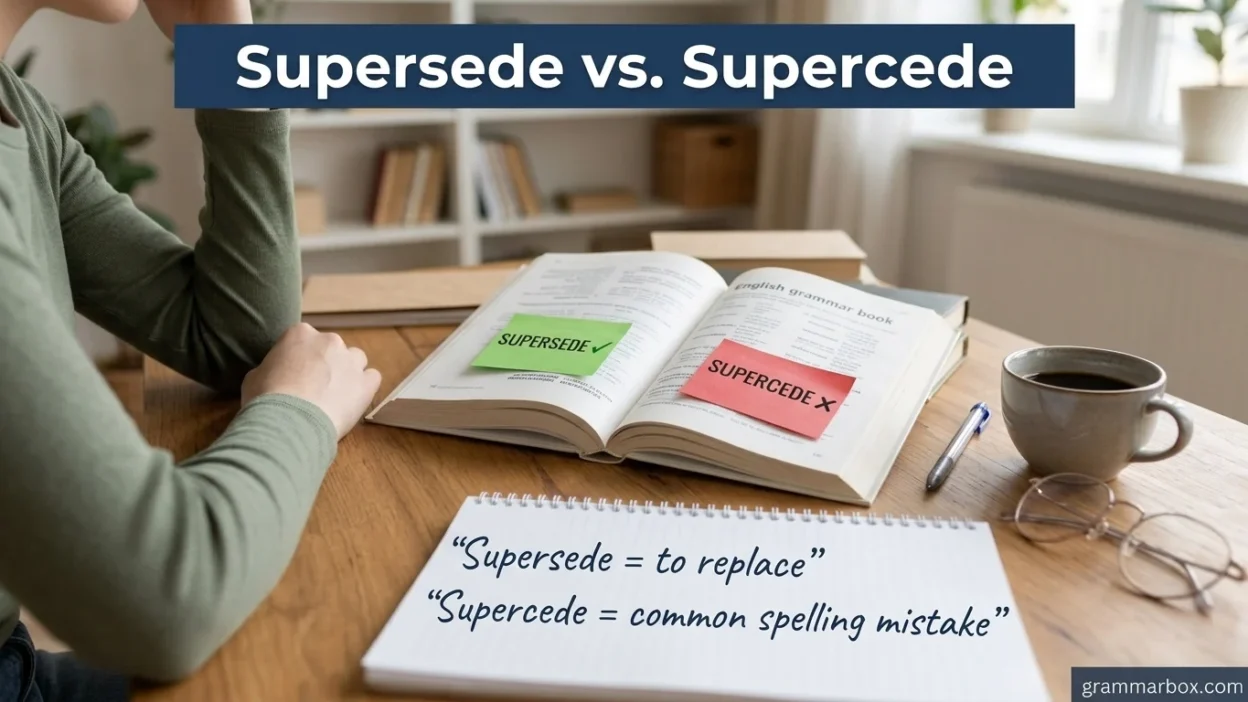
Have you ever wondered if the correct spelling is supersede or supercede? These two words look almost identical, sound similar, and are often confused in everyday writing. However, there is an important difference between them: one is the standard English spelling, while the other is a common misspelling. Understanding this distinction can help you write more accurately and confidently.
The confusion often arises because many English words ending in a similar sound use the letters -cede, -ceed, or -sede. For example, precede and recede end in -cede, while proceed and succeed use -ceed. Since supercede appears to follow a familiar spelling pattern, people may assume it is correct. However, standard modern English uses supersede. In this guide, you will learn the meanings of both spellings, discover how to use supersede correctly, explore practical examples, and find an easy memory trick to remember the right spelling. Whether you are a student, an ESL learner, a professional writer, or a content creator, this explanation will help you avoid a common English spelling mistake.
Quick Answer: Supersede vs Supercede
Supersede is the correct standard spelling and means to replace something older, outdated, or less effective with something newer or better. Supercede is a common misspelling of the same word. Although you may encounter supercede in older or nonstandard writing, use supersede in academic, professional, and everyday English.
Why People Confuse It
People confuse supersede and supercede because both spellings look reasonable and are pronounced similarly. The main difference is the letter in the middle: supersede contains an s, while supercede contains a c.
Several factors contribute to this spelling confusion.
- Similar pronunciation: Both forms are commonly pronounced the same way, so pronunciation does not help writers distinguish them.
- Familiar spelling patterns: English contains words such as precede, recede, and concede, which may lead people to assume that supercede follows the same pattern.
- Spelling mistakes repeated online: When writers use supercede on websites, in emails, or in documents, other people may copy the incorrect spelling.
- Unfamiliar vocabulary: Many people understand the meaning of supersede but rarely use it in conversation, making its spelling harder to remember.
The easiest solution is to remember that supersede is the accepted spelling in standard modern English.
Supersede: Meaning, Definition, and Examples
Supersede is a verb meaning to take the place of something that existed previously. It often describes a newer rule, product, technology, decision, or system replacing an older one.
Definition of Supersede
According to standard English usage, supersede means to replace something or make it no longer necessary, effective, or current.
Part of speech: Verb
Pronunciation: /ˌsuːpərˈsiːd/
Simple meaning: To replace something with something newer or more suitable.
Examples of Supersede in Sentences
- The new company policy will supersede the previous guidelines.
- Modern smartphones have largely superseded traditional mobile phones.
- This agreement will supersede all earlier contracts between the two parties.
- The updated software is designed to supersede the outdated version.
- A more effective treatment may eventually supersede the current method.
- The revised instructions supersede the original directions.
- Digital records have superseded many paper-based filing systems.
- The latest court ruling may supersede the earlier decision.
- New evidence could supersede the assumptions researchers previously accepted.
- The company introduced a new model to supersede its older product.
When to Use Supersede
Use supersede when one thing replaces another, especially when the replacement makes the earlier thing outdated, unnecessary, or no longer applicable.
Common contexts include:
- Business: A new agreement supersedes an earlier contract.
- Technology: New software supersedes an outdated application.
- Law: A new regulation supersedes an earlier rule when it legally replaces it.
- Education: An updated curriculum supersedes the previous version.
- Government: A new policy supersedes an older policy.
- Research: New findings supersede an earlier explanation when they provide a better-supported account.
Remember that supersede does not simply mean that something comes later. It suggests that the newer thing replaces or takes priority over the older one.
Supercede: Meaning and Correct Usage
Supercede is a nonstandard spelling commonly used by mistake when people intend to write supersede.
Although this spelling appears in some published material and may be recorded in historical or variant-spelling discussions, it is not the recommended form in standard modern English.
Is Supercede Ever Correct?
For ordinary modern English writing, you should treat supercede as a misspelling.
For example:
Incorrect: The updated policy will supercede the old rules.
Correct: The updated policy will supersede the old rules.
The meaning remains understandable in the incorrect sentence, but the spelling does not follow the standard form.
Why Does Supercede Look Correct?
The spelling may seem logical because many English verbs use -cede at the end.
Consider these examples:
- Precede: To come before something.
- Recede: To move backward or become less prominent.
- Concede: To admit something or yield.
- Intercede: To intervene on someone’s behalf.
These words help explain why people may mistakenly write supercede. However, English spelling does not always follow a single predictable pattern.
The important point is simple: even though supercede looks plausible, supersede is the spelling you should use.
Supersede vs Supercede: Comparison Table
| Feature | Supersede | Supercede |
|---|---|---|
| Spelling status | Correct standard spelling | Nonstandard spelling |
| Part of speech | Verb | Intended as a verb |
| Meaning | To replace something older or existing | Intended to mean the same as supersede |
| Standard modern English | Recommended | Not recommended |
| Formal writing | Correct choice | Avoid |
| Academic writing | Appropriate | Considered a spelling error |
| Business documents | Recommended | Avoid |
| Example | The new law will supersede the old law. | The new law will supercede the old law. |
| Best usage | Use in all ordinary contexts | Correct to supersede |
Key takeaway: The two spellings are generally intended to express the same meaning, but supersede is the standard form.
When to Use Each
Choosing between supersede and supercede is straightforward because only one is recommended in standard English.
Use Supersede in Formal Writing
Choose supersede when writing essays, reports, emails, business documents, research papers, or website content.
Examples:
- The revised contract supersedes the previous agreement.
- The new textbook will supersede the older edition next semester.
- The updated policy supersedes all conflicting instructions.
In each sentence, something newer replaces an earlier version.
Use Supersede in Everyday English
Although supersede is somewhat formal, it is also appropriate in everyday writing when you need to express the idea of replacement.
Examples:
- The new app has superseded the old one.
- These instructions supersede the ones I sent yesterday.
- A better solution may supersede our original plan.
In casual conversation, you might use replace instead because it is simpler and more familiar.
Avoid Supercede in Standard Writing
Do not use supercede in ordinary modern English documents.
Instead of writing:
- The latest version will supercede the original.
- The new rules supercede the previous guidelines.
- This agreement supercedes the old contract.
Write:
- The latest version will supersede the original.
- The new rules supersede the previous guidelines.
- This agreement supersedes the old contract.
Practical rule: Whenever you want to express the idea of replacing something, write supersede, not supercede.
Examples: Supersede vs Supercede in Sentences
The following examples demonstrate how to use supersede correctly in different situations.
1. Business Examples
Correct: The new employment agreement will supersede the previous contract.
Incorrect: The new employment agreement will supercede the previous contract.
The new agreement replaces the old one.
2. Technology Examples
Correct: Cloud storage has superseded many traditional file-storage methods.
Incorrect: Cloud storage has superceded many traditional file-storage methods.
The first sentence uses the standard spelling.
3. Legal Examples
Correct: The amended regulation supersedes the earlier rule.
Incorrect: The amended regulation supercedes the earlier rule.
The correct sentence indicates that the amended regulation replaces the earlier rule.
4. Education Examples
Correct: The updated syllabus will supersede the previous curriculum.
Incorrect: The updated syllabus will supercede the previous curriculum.
The newer syllabus takes the place of the older one.
5. Software Examples
Correct: The latest software release supersedes the previous version.
Incorrect: The latest software release supercedes the previous version.
The correct spelling ends in -sede.
6. Government Examples
Correct: The new administrative order supersedes the earlier directive.
Incorrect: The new administrative order supercedes the earlier directive.
The new order replaces the earlier directive.
7. Research Examples
Correct: Recent findings have superseded the theory once widely accepted by researchers.
Incorrect: Recent findings have superceded the theory once widely accepted by researchers.
The correct sentence describes newer findings replacing an earlier explanation.
8. Workplace Examples
Correct: The revised employee handbook supersedes the previous edition.
Incorrect: The revised employee handbook supercedes the previous edition.
The updated handbook replaces the older one.
9. Product Examples
Correct: This improved model is expected to supersede the original design.
Incorrect: This improved model is expected to supercede the original design.
The improved model takes the place of the original design.
10. Agreement Examples
Correct: The new agreement supersedes all previous arrangements between the parties.
Incorrect: The new agreement supercedes all previous arrangements between the parties.
The correct spelling is supersedes.
11. Policy Examples
Correct: The revised attendance policy supersedes the old policy starting Monday.
Incorrect: The revised attendance policy supercedes the old policy starting Monday.
The new policy replaces the old one.
12. General Writing Examples
Correct: A stronger argument may supersede the explanation presented earlier.
Incorrect: A stronger argument may supercede the explanation presented earlier.
The first sentence uses the standard spelling.
Common Mistakes
Even experienced writers sometimes make spelling mistakes with words that sound alike. Understanding these common errors can help you write more accurately.
Mistake 1: Assuming Supercede Is Equally Standard
Because supercede looks similar to other English words, writers may assume both spellings are equally acceptable.
Incorrect: The new system will supercede the existing system.
Correct: The new system will supersede the existing system.
Use supersede in standard modern English.
Mistake 2: Choosing Spelling Based on Pronunciation
Both spellings are commonly pronounced alike, so listening to the word will not help you choose the correct form.
Instead, memorize the spelling directly: supersede.
Mistake 3: Using the Wrong Verb Form
The word supersede changes form according to the sentence’s tense and grammatical structure.
Correct forms include:
- Supersede: The new policy will supersede the old one.
- Supersedes: The new policy supersedes the old one.
- Superseded: The new policy superseded the old one.
- Superseding: The new policy is superseding the old one.
Avoid changing the spelling to supercede, supercedes, or superceded in standard writing.
Mistake 4: Thinking Supersede Always Means Improve
Although a replacement may be better, supersede does not necessarily mean that the new option is superior in every respect.
For example:
The new regulation superseded the previous regulation.
This sentence tells us that the new regulation replaced the old one. It does not establish whether the new regulation is better.
Mistake 5: Confusing Supersede With Precede
These verbs have different meanings.
- Supersede: To replace something.
- Precede: To come before something.
Example: The introduction precedes the main discussion, while a revised introduction may supersede the original introduction.
Understanding the meaning helps you choose the right word.
Memory Trick: How to Remember Supersede
The easiest way to remember the correct spelling is to focus on the final part of the word.
Supersede = super + sede
Remember the unusual ending -sede. Although it may look unfamiliar, it is the standard spelling of this word.
Here are three simple memory techniques.
1. Memorize the final four letters
The word ends in sede, not cede.
- Correct: supersede
- Incorrect: supercede
2. Remember one complete sentence
Repeat this sentence whenever you are unsure:
“The new version will supersede the old version.”
Seeing the correct spelling in context makes it easier to remember.
3. Connect the word with replacement
Think of supersede whenever a new policy, product, rule, or system replaces an older one.
For example, a new phone model may supersede the previous model.
Quick Spelling Tip
Several common English verbs end in -cede, including precede, recede, and concede. However, supersede is an important exception to the pattern many writers expect.
If you remember just one thing, remember this: supersede is spelled with an s before ede.
American vs British English
One common question is whether American and British English use different spellings of supersede.
The answer is no. Standard American English and standard British English both use supersede.
Unlike words such as color/colour, organize/organise, and traveling/travelling, this word does not have a standard American-versus-British spelling distinction.
| Usage | American English | British English |
|---|---|---|
| Standard spelling | Supersede | Supersede |
| Meaning | To replace something | To replace something |
| Past tense | Superseded | Superseded |
| Present participle | Superseding | Superseding |
| Nonstandard spelling | Supercede | Supercede |
American English Examples
- The new regulation will supersede the existing rule.
- The latest software update superseded the previous version.
British English Examples
- The revised agreement will supersede the original contract.
- The updated guidance superseded the previous instructions.
Both varieties use the same spelling and grammatical forms.
Remember: If you are writing for an American or British audience, choose supersede. The spelling does not change with the variety of English.
Similar Words
Learning related vocabulary can help you understand supersede more clearly. However, similar words do not always have exactly the same meaning.
1. Replace
Meaning: To put something new in the place of something else.
Example: We need to replace the broken printer.
Replace is the simplest and most common alternative to supersede.
2. Substitute
Meaning: To use one thing or person instead of another.
Example: You can substitute olive oil for butter in some recipes.
Unlike supersede, substitute often describes using an alternative rather than permanently replacing an older system.
3. Supplant
Meaning: To take the place of something or someone, often by becoming more powerful, effective, or successful.
Example: Digital photography gradually supplanted many traditional film-based processes.
Supplant can emphasize displacement or competition.
4. Obsolete
Meaning: No longer used because something newer or more suitable has become available.
Example: The old equipment is now obsolete.
Obsolete describes the condition of something outdated, while supersede describes the act of replacing it.
5. Outdate
Meaning: To make something old-fashioned or no longer current.
Example: New developments quickly outdated the original design.
Outdate emphasizes becoming outdated, whereas supersede emphasizes replacement.
6. Precede
Meaning: To come before something in time, order, or position.
Example: The introduction precedes the conclusion.
This word is especially useful to learn because it shares the -cede ending that may cause spelling confusion.
7. Recede
Meaning: To move backward or become less prominent.
Example: The floodwaters began to recede.
Although recede resembles supersede, it has a different meaning.
8. Succeed
Meaning: To achieve a desired result or come after someone or something.
Example: She worked hard to succeed in her career.
The word succeed also has a similar ending sound, but its spelling and meaning differ.
FAQs:
1. Is Supersede or Supercede Correct?
Supersede is the correct standard spelling in modern English. Supercede is a common nonstandard spelling. Use supersede in essays, professional documents, emails, and online content.
2. What Does Supersede Mean?
Supersede means to replace something older or existing with something new, often making the original unnecessary or no longer applicable.
Example: The revised policy supersedes the previous policy.
3. Why Is Supercede Incorrect?
Supercede is considered a misspelling in standard modern English. Writers may use it because it resembles other verbs ending in -cede, such as precede and recede. However, the accepted spelling is supersede.
4. Is Supersede Used in American and British English?
Yes. Both American English and British English use supersede. There is no standard regional spelling difference between these varieties.
5. What Is the Past Tense of Supersede?
The past tense and past participle are superseded.
Example: The new agreement superseded the earlier contract.
6. Is Supersede a Verb?
Yes. Supersede is a verb that describes replacing something with another thing.
Example: The new software will supersede the old program.
7. What Is a Synonym for Supersede?
Common synonyms include replace, supplant, and, in some contexts, substitute. The best choice depends on the sentence because these words have slightly different meanings and usage patterns.
Conclusion
The difference between supersede and supercede comes down to standard spelling. Although the two forms look similar and are commonly pronounced alike, supersede is the accepted spelling in modern English. The word means to replace something older, outdated, or previously used with something else. It appears frequently in business, technology, law, education, and other formal contexts.
To avoid this spelling mistake, remember the unusual ending -sede in supersede. Do not rely on pronunciation or assume that every English word follows the same spelling pattern. When you need to describe a new policy replacing an old policy or a newer product taking the place of an earlier model, use supersede. With this simple rule in mind, you can write more clearly and confidently.
Remember This
- Supersede: Correct standard spelling.
- Supercede: Common nonstandard spelling.
- Meaning: To replace something older or existing.
- American vs British English: Both use supersede.
- Memory trick: Remember the unusual ending -sede.
The rule is simple: Write supersede, not supercede.