
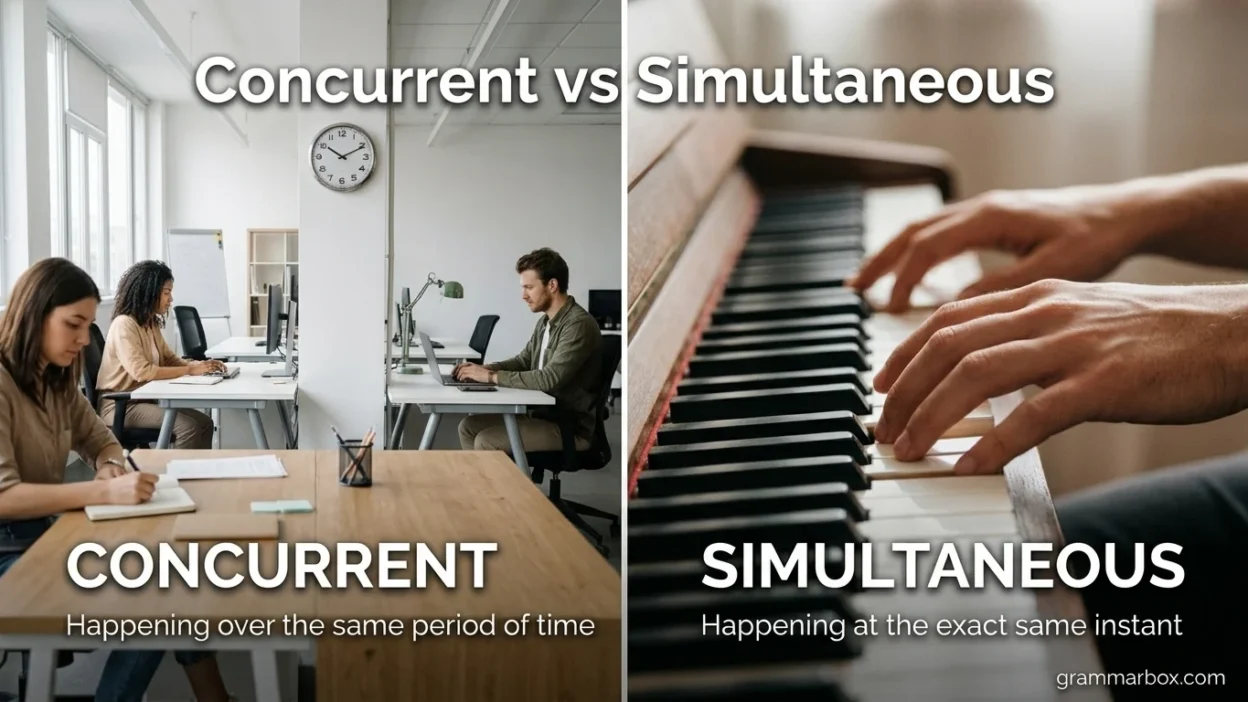
The words concurrent vs simultaneous often confuse English learners because both describe events that happen at the same time or during overlapping periods. In everyday conversations, business communication, technology, and academic writing, these terms may seem interchangeable. However, they have slightly different meanings, and choosing the right word can make your writing more precise. Understanding their differences helps you communicate clearly without making unnecessary grammatical mistakes.
Although both words refer to timing, concurrent usually emphasizes events or activities that occur during overlapping periods, while simultaneous highlights events that happen at the same time, often at precisely the same instant. For example, two projects can be concurrent even if one starts before the other finishes. In contrast, two simultaneous actions occur together at the same moment. This distinction is particularly important when discussing concurrent users, parallel execution, legal sentences, and simultaneous translation. Learning when to use each word will improve your vocabulary and help you write more naturally in professional, academic, and everyday situations.
Quick Answer
Concurrent describes events, activities, or processes that overlap in time, even if they do not begin or end together. Simultaneous describes events that happen at the same time, often at precisely the same moment. Use concurrent for overlapping periods and simultaneous when emphasizing shared timing.
Why People Confuse It
People confuse concurrent and simultaneous because both words describe relationships between events and time. Their meanings overlap, particularly when two activities occur together.
However, the main difference lies in the timing being emphasized:
- Concurrent: Two or more activities take place during overlapping periods.
- Simultaneous: Two or more events happen at the same time.
Consider a workplace example. Two employees might work on concurrent projects throughout the week, even if they start on different days. However, if both employees present their findings at precisely 10 a.m., their presentations are simultaneous.
The distinction becomes especially clear in technology. Concurrent users may access a website during the same general time window without performing every action at precisely the same instant. Simultaneous users, in the stricter sense, would be performing actions at the same moment.
Another reason for confusion is that both words appear in formal writing, technical discussions, and everyday English. Understanding their emphasis makes it easier to select the appropriate term.
Concurrent
Concurrent is an adjective that describes events, activities, conditions, or processes occurring during the same general period, with some overlap in their timing.
The activities do not necessarily need to begin or finish together.
Examples of Concurrent
- The company is managing two concurrent marketing campaigns.
- She enrolled in two concurrent training programs.
- The researchers conducted concurrent studies at different universities.
- Several concurrent projects required the manager’s attention.
- The software supports concurrent user sessions.
- The judge ordered concurrent sentences instead of consecutive ones.
- The server supports thousands of concurrent connections.
- The students pursued concurrent enrollment in high school and college.
- The two projects ran concurrently for six months.
When to Use Concurrent
Use concurrent when discussing:
- Projects that overlap in duration.
- Responsibilities handled during the same period.
- Research studies conducted during overlapping time frames.
- Legal proceedings or investigations that occur during overlapping periods.
- Computer processes that execute with overlapping activity.
- Users, connections, or requests being handled within overlapping time windows.
Example: The university offered two concurrent courses during the summer semester.
This sentence means the courses took place during overlapping periods. They did not necessarily meet at exactly the same time.
Concurrent in Different Writing Contexts
| Context | Example |
|---|---|
| Law | The judge ordered concurrent sentences for both charges. |
| Education | Students can pursue concurrent enrollment in high school and college. |
| Technology | The server supports thousands of concurrent connections. |
| Business | Both teams worked concurrently on separate parts of the launch. |
| Everyday English | Their vacations happened concurrently last July. |
In legal writing, concurrent sentences are served during overlapping periods, whereas consecutive sentences are served one after another. In technology, concurrent processes can make progress during overlapping periods without necessarily executing at the exact same instant.
Simultaneous
Simultaneous is an adjective that describes two or more events happening at the same time. It emphasizes that their timing coincides, often at the same moment.
The word is especially useful when events occur together or when exact timing matters.
Examples of Simultaneous
- The audience gave a simultaneous round of applause.
- Both teams scored simultaneous goals.
- The alarm systems produced simultaneous warnings.
- The machines started their operations simultaneously.
- The interpreter provided simultaneous translation during the conference.
- The two doors locked simultaneously at midnight.
- The fireworks exploded simultaneously over the bay.
- Both swimmers touched the wall simultaneously.
- The countdown and the fireworks began simultaneously.
- They both said the same word simultaneously.
When to Use Simultaneous
Use simultaneous when discussing:
- Actions performed at the same moment.
- Events that occur together.
- Signals or alarms triggered at once.
- Movements made in coordination.
- Communication delivered while someone is speaking.
- Scientific reactions, sporting finishes, and synchronized live events.
Example: The two speakers answered the question simultaneously.
This sentence emphasizes that both speakers answered at the same time, rather than merely answering during the same general period.
Simultaneous in Different Writing Contexts
| Context | Example |
|---|---|
| Science | The reaction produced two gases simultaneously. |
| Sports | Both swimmers touched the wall simultaneously. |
| Live events | The countdown and fireworks began simultaneously. |
| Translation | Interpreters deliver simultaneous translation in real time. |
| Everyday English | They both said the same word simultaneously. |
Simultaneous translation is a specialized example in which an interpreter translates spoken content in real time while the original speaker continues speaking.
Comparison Table
| Feature | Concurrent | Simultaneous |
|---|---|---|
| Main meaning | Events overlap in time | Events happen at the same time |
| Timing emphasis | Shared or overlapping periods | Coinciding timing |
| Precision | A broader time window | Often a specific moment |
| Same starting point required? | No | Usually implied when exact timing is emphasized |
| Same ending point required? | No | Not necessarily |
| Common contexts | Projects, law, education, technology, business | Actions, signals, science, sports, translation |
| Example | Two classes taken over a semester | Two claps at the same moment |
| Adjective form | Concurrent | Simultaneous |
| Adverb form | Concurrently | Simultaneously |
| Noun form | Concurrency | Simultaneity |
The central distinction is that concurrent activities can overlap without happening at precisely the same moment throughout their duration. Simultaneous events share the same timing at the point being described.
In one line: simultaneous means occurring at the same instant, whereas concurrent means occurring during the same general period or overlapping in duration.
When to Use Each
Choosing between concurrent and simultaneous depends on what you want to communicate.
Use Concurrent for Overlapping Activities
Choose concurrent when multiple activities occur during the same period, even if their individual schedules differ.
Examples:
- The department handled three concurrent investigations.
- He completed concurrent assignments for two clients.
- The application processes concurrent requests from multiple users.
- The two projects ran concurrently for six months.
- The system handles high concurrency without lag.
In each example, the activities overlap, but they do not necessarily start or finish together.
Use Simultaneous for Events Happening Together
Choose simultaneous when the main point is that events occur at the same time.
Examples:
- The lights flashed in simultaneous bursts.
- Both candidates gave simultaneous answers.
- The two doors opened simultaneously.
- Both runners crossed the finish line simultaneously.
- The fireworks and the countdown began simultaneously.
These examples emphasize coinciding actions or timing.
Can Concurrent and Simultaneous Be Interchangeable?
Sometimes, yes. If two events happen at precisely the same time, you may be able to describe them as both concurrent and simultaneous.
For example:
- Two concurrent broadcasts aired at noon.
- Two simultaneous broadcasts aired at noon.
Both sentences can be correct, but the emphasis differs. Concurrent highlights the relationship between the broadcasts, while simultaneous stresses their shared timing.
The words are related synonyms, but they are not perfect substitutes in every context. When precise timing matters, simultaneous is often the clearer choice. When the focus is on overlapping schedules or activities, concurrent is generally more appropriate.
Concurrent vs Parallel Execution
Concurrent execution means multiple tasks make progress during overlapping periods. Parallel execution means multiple tasks actually run at the same time, typically on separate processors or processing cores.
For example, a computer may switch between two tasks on a single processor, allowing both to progress concurrently. A multicore processor may execute both tasks in parallel.
Although concurrency and parallelism are related concepts in computing, they do not mean exactly the same thing.
Concurrent Users vs Simultaneous Users
Concurrent users are people using a system during the same general time window, even if their actions do not line up perfectly. Simultaneous users, in the stricter sense, would be people performing actions at precisely the same instant.
For example, a website might have hundreds of concurrent users browsing different pages. That does not mean every user clicks a button at the same moment.
This distinction is useful when discussing website traffic, server capacity, application performance, and software testing.
Examples of Concurrent vs Simultaneous
Here are examples showing how these words work in different contexts.
- Concurrent: The manager supervised two concurrent projects.
Simultaneous: Two presentations began simultaneously. - Concurrent: The students attended concurrent training programs.
Simultaneous: The students submitted their answers simultaneously. - Concurrent: The company conducted concurrent investigations.
Simultaneous: The investigators interviewed both witnesses simultaneously. - Concurrent: The application supports concurrent connections.
Simultaneous: Both notifications appeared simultaneously. - Concurrent: The researchers published concurrent studies.
Simultaneous: The researchers announced their findings simultaneously. - Concurrent: She balanced concurrent responsibilities at work.
Simultaneous: She received simultaneous phone calls. - Concurrent: The court reviewed concurrent legal proceedings.
Simultaneous: The judges announced their decisions simultaneously. - Concurrent: The hospital managed concurrent treatment programs.
Simultaneous: Two alarms sounded simultaneously. - Concurrent: The team worked on concurrent development tasks.
Simultaneous: The developers launched both features simultaneously. - Concurrent: The school scheduled concurrent courses for the semester.
Simultaneous: Two school events started simultaneously. - Concurrent: The organization ran concurrent research projects.
Simultaneous: Both experiments began simultaneously. - Concurrent: The business managed concurrent customer requests.
Simultaneous: Several customers placed their orders simultaneously. - Concurrent: The defendant received concurrent sentences for two offenses.
Simultaneous: The two judges announced their decisions simultaneously. - Concurrent: Thousands of concurrent users accessed the website during the sale.
Simultaneous: Several users clicked the same button simultaneously. - Concurrent: The developers worked concurrently on separate software features.
Simultaneous: The two processors completed their operations simultaneously.
These examples demonstrate that concurrent generally describes overlapping activities, while simultaneous emphasizes events occurring together at the same time.
Common Mistakes
Even proficient English speakers sometimes use these words without considering their specific meanings.
Mistake 1: Treating Both Words as Perfect Synonyms
Incorrect assumption: Concurrent and simultaneous always mean exactly the same thing.
Correction: They overlap in meaning, but concurrent emphasizes overlapping periods, whereas simultaneous emphasizes coinciding timing.
Mistake 2: Using Simultaneous for Activities That Merely Overlap
Example: The two projects were simultaneous throughout the entire month, although one started several days earlier.
Better: The two projects were concurrent throughout the month.
Concurrent is generally more suitable when the activities overlap without sharing the same starting time.
Mistake 3: Assuming Concurrent Means Identical Start Times
Example: The courses were concurrent, but one started in January and the other in February.
This can be perfectly correct if both courses continued during an overlapping period.
Mistake 4: Confusing the Adjective and Adverb Forms
- Concurrent: The company managed concurrent projects.
- Simultaneous: The events had simultaneous starts.
- Concurrently: The employees worked concurrently.
- Simultaneously: Both events started simultaneously.
Use concurrent and simultaneous as adjectives, and concurrently and simultaneously as adverbs.
Mistake 5: Using Simultaneously Without a Clear Timing Relationship
Example: The departments worked simultaneously on separate projects throughout the year.
This may be correct if their activities occurred at the same time, but concurrent may be more precise if the focus is simply on overlapping work schedules.
Mistake 6: Confusing Concurrent with Parallel
Concurrent tasks can overlap in time without executing at the exact same instant. Parallel tasks execute at the same time. In technical writing, choosing the right term helps explain how computer systems handle work.
Memory Trick
Use this simple memory trick to remember the difference:
- Simultaneous = Same second. Both words start with S, and you can associate simultaneous with a specific moment.
- Concurrent = Co-running. The prefix con- can help you remember activities running alongside one another over time.
Imagine two students taking different courses over the same semester. Their courses are concurrent, even if their class schedules differ.
Now imagine both students clapping at exactly 2 p.m. Their actions are simultaneous.
Easy rule: If you mean overlapping activities, choose concurrent. If you mean actions occurring together at the same moment, choose simultaneous.
American vs British English
There is no significant difference between American and British English in the meanings or standard spellings of concurrent and simultaneous.
Both varieties use the words in the same general way.
| Word | American English | British English |
|---|---|---|
| Concurrent | Concurrent | Concurrent |
| Simultaneous | Simultaneous | Simultaneous |
| Concurrently | Concurrently | Concurrently |
| Simultaneously | Simultaneously | Simultaneously |
| Concurrency | Concurrency | Concurrency |
| Simultaneity | Simultaneity | Simultaneity |
Examples in American English:
- The company is managing concurrent projects.
- The two systems started simultaneously.
Examples in British English:
- The company is managing concurrent projects.
- The two systems started simultaneously.
Both forms are standard in the United States and the United Kingdom. The choice depends on meaning and context, not regional spelling preferences.
Similar Words
Several other English words describe events that happen together or during overlapping periods. However, each has its own shade of meaning.
1. Overlapping
Overlapping describes events, periods, or activities that share some time or space.
Example: The two meetings have overlapping schedules.
2. Synchronous
Synchronous describes events or processes that occur in coordination, often according to the same timing or schedule.
Example: The devices use synchronous communication.
3. Coexisting
Coexisting means existing together during the same period or in the same environment.
Example: Different traditions are coexisting within the community.
4. Contemporaneous
Contemporaneous describes things that exist, happen, or originate during the same period.
Example: The historian compared contemporaneous documents.
5. Coordinated
Coordinated describes activities organized to work together effectively.
Example: The teams carried out a coordinated response.
6. Parallel
Parallel describes activities or processes that proceed alongside each other. In computing, parallel execution specifically involves tasks running at the same time.
Example: The teams developed parallel solutions to the same problem.
7. Side-by-Side
Side-by-side can describe activities or processes happening alongside each other, although it can also refer to physical position.
Example: The departments worked side-by-side on the project.
8. At Once
At once is a common expression meaning immediately or at the same time, depending on context.
Example: Both alarms sounded at once.
9. In Unison
In unison means doing or saying something together, often in a coordinated way.
Example: The students answered in unison.
10. Consecutive
Consecutive means following one after another without interruption. It is useful as a contrast to concurrent when events occur in sequence.
Example: She attended three consecutive meetings.
Synonyms and Antonyms
Synonyms for concurrent: overlapping, coexisting, parallel, side-by-side, and simultaneous in some contexts.
Synonyms for simultaneous: synchronized, coincident, at once, and in unison, depending on context.
Antonyms and contrasting terms: sequential, consecutive, successive, and staggered.
The opposite relationship depends on what you want to contrast. Consecutive and successive emphasize sequence, while staggered emphasizes events occurring at different times.
Noun Forms: Concurrency and Simultaneity
The noun form of concurrent is concurrency, while the noun form of simultaneous is simultaneity.
- Concurrency: The system handles high concurrency without lag.
- Simultaneity: The simultaneity of the two signals was essential to the experiment.
These nouns are especially useful in technical, academic, and formal writing.
Remember that related words are not always interchangeable. Choose the word that communicates your intended timing or relationship most accurately.
FAQs:
1. What is the main difference between concurrent and simultaneous?
Concurrent describes activities or events that overlap in time. Simultaneous describes events that happen at the same time, often at precisely the same moment.
2. Are concurrent and simultaneous synonyms?
Yes, they are related synonyms, and their meanings sometimes overlap. However, concurrent emphasizes overlapping periods, while simultaneous emphasizes coinciding timing.
3. Can two events be concurrent but not simultaneous?
Yes. Two projects can be concurrent if they occur during overlapping periods, even when one starts earlier or ends later than the other.
4. Does simultaneous mean exactly at the same time?
Generally, yes. Simultaneous emphasizes that events occur at the same time. In ordinary usage, this often means at the same moment, although exact timing can depend on context.
5. What is the difference between concurrent and synchronous?
Concurrent means activities overlap in time. Synchronous often emphasizes coordinated timing or events occurring according to a shared schedule. In computing, synchronous can also describe operations that follow a particular execution or response sequence.
6. Is concurrently the same as simultaneously?
Not always. Concurrently means during overlapping periods, while simultaneously means at the same time. The words can sometimes be interchangeable when the events genuinely occur together.
7. Which word is better for business writing?
Both words are appropriate. Use concurrent for overlapping projects, responsibilities, or processes. Use simultaneous for events, announcements, or actions occurring at the same time.
8. Are concurrent and simultaneous spelled differently in British English?
No. Both words have the same standard spelling in American and British English.
9. What is the difference between concurrent users and simultaneous users?
Concurrent users access or use a system during the same general time window, while simultaneous users, in the stricter sense, perform actions at the same instant. This distinction can be useful when discussing website traffic and server performance.
10. What are the two types of concurrency?
Two useful categories are task concurrency and data concurrency. Task concurrency involves multiple tasks making progress during overlapping periods. Data concurrency involves multiple operations accessing or working with shared data during overlapping periods. These categories are particularly relevant in computer science.
11. What is another word for concurrent?
Common alternatives include overlapping, coexisting, and parallel. The best choice depends on the context because these words do not have identical meanings in every situation.
12. What is the difference between concurrent and parallel execution?
Concurrent execution means multiple tasks make progress during overlapping periods, even if they take turns using a processor. Parallel execution means tasks run at the same time, typically on separate processing cores or processors.
Final Verdict
The difference between concurrent and simultaneous is subtle but useful. Concurrent is the better choice when two or more activities happen during overlapping periods, even if their starting and ending times differ. Simultaneous is more appropriate when you want to emphasize that events happen at the same time. Although the terms can sometimes be used interchangeably, understanding their emphasis helps you choose more precise vocabulary.
When writing emails, reports, academic papers, or everyday messages, consider if you are describing overlapping activities or events occurring together. Use concurrent for overlapping projects and processes, and simultaneous for coinciding actions or events. In technical contexts, remember that concurrent users do not necessarily perform actions at the same instant, and concurrent execution is not always parallel execution. With practice, the distinction becomes easier to recognize, helping you communicate clearly and confidently.
Remember This
- Concurrent = overlapping in time.
- Simultaneous = happening at the same time.
- Concurrency = the noun form of concurrent.
- Simultaneity = the noun form of simultaneous.
- Parallel execution = tasks running at the same time.
For example, two projects can be concurrent even if they begin on different days, while two people clapping at the same moment are acting simultaneously.