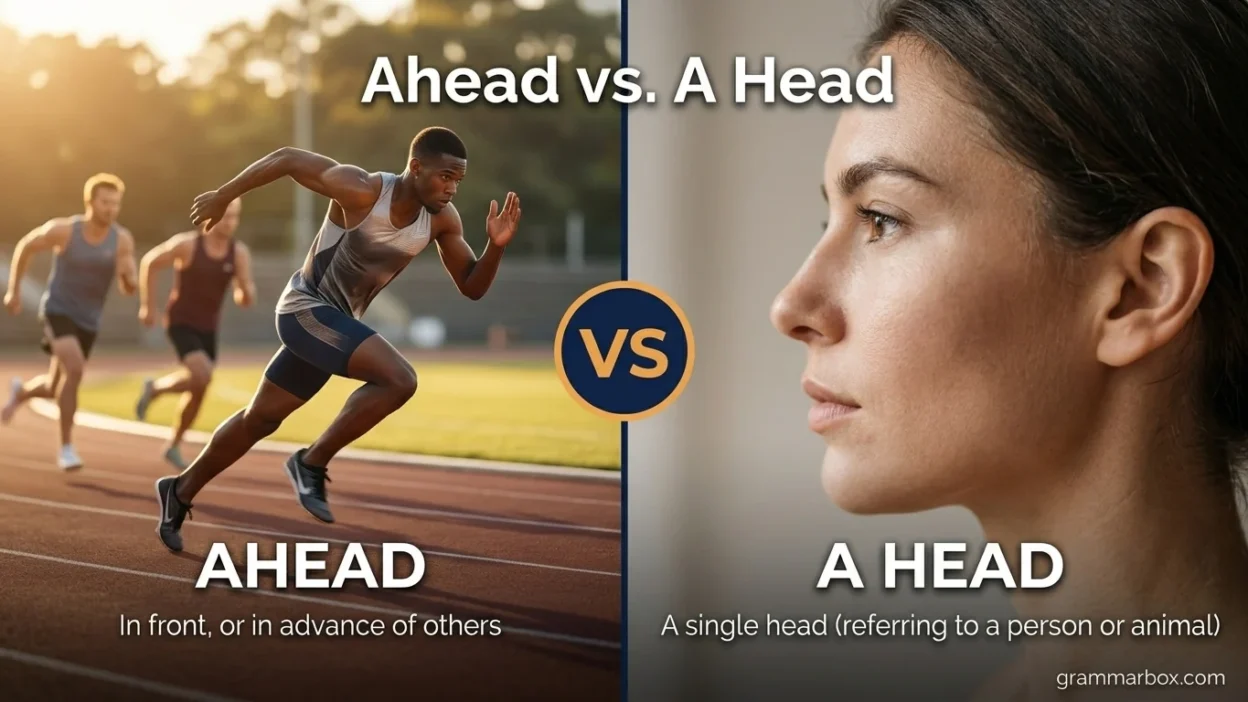
Have you ever wondered whether to write ahead or a head? These expressions sound exactly alike, but they have different meanings and grammatical functions. One word, ahead, usually refers to a position in front, progress, or something that will happen in the future. The two-word phrase a head, on the other hand, refers to one person’s or animal’s head. Understanding the difference between these expressions can help you avoid common spelling mistakes, improve your word choice, and make your English writing clearer.
The confusion between ahead vs. a head is common because both expressions have the same pronunciation. However, their meanings depend on the context of a sentence. For example, you might say, “We have a long journey ahead,” when talking about the future, but “The sculpture has a head made of stone” when describing an object. In this guide, you will learn the meanings, grammar rules, correct usage, and practical examples of both expressions so you can confidently choose the correct form in everyday conversations, academic writing, and professional communication.
Quick Answer: Ahead vs. A Head
Ahead is one word that means forward, in front, or in the future. A head is a two-word phrase consisting of the article “a” and the noun “head,” referring to a person’s or animal’s head. The hyphenated form a-head is not standard in modern English. Choose the expression that matches your intended meaning.
Why People Confuse It
People often confuse ahead and a head because they are homophones. Homophones are words or expressions that sound alike but have different meanings and spellings.
When speaking, there is usually no noticeable difference between these expressions. This makes it easy to mix them up when writing emails, school assignments, social media posts, or other English content. Learners may also assume that ahead should be written as “a-head” because it sounds like two separate parts.
Another reason for this confusion is the relationship between word formation, spelling, and sentence structure. In modern English, ahead is a standard single word, while a head is a separate article and noun. The hyphenated spelling a-head is generally considered a spelling error in ordinary contemporary writing.
Consider these examples:
- “We are moving ahead with the project.” Here, “ahead” means making progress.
- “The doll has a head made of porcelain.” Here, “a head” refers to a physical body part.
- “We have a difficult journey ahead.” Here, “ahead” refers to the future.
The easiest way to avoid these common mistakes is to identify the intended meaning and context before choosing the spelling.
First Word: Ahead
Ahead is an adverb that commonly means in front, forward, further along, or in the future. It can describe physical position, progress, preparation, priority, or something that will happen later.
Meaning of Ahead
The word ahead has several common uses:
- In front: Someone or something is positioned farther forward.
- In the future: Something is expected to happen later.
- Making progress: A person or group is moving forward with a plan.
- In advance: Something is done before a particular time or event.
- Leading: Someone is performing better or occupying a leading position compared with others.
How Ahead Is Used in Real Life
The word ahead appears in everyday communication, directions, planning, competition, and time-related situations.
Examples include:
- The car ahead of us suddenly stopped.
- We have several busy weeks ahead.
- The team moved ahead with its plans.
- Please plan ahead for your final exams.
- She finished the assignment ahead of schedule.
- The road ahead looks narrow.
- Our company is ahead of its competitors.
- Think ahead before making an important decision.
- The train station is just ahead.
- There are difficult challenges ahead, but we are prepared.
Common Expressions with Ahead
The word ahead appears in many familiar English expressions:
- Look ahead: Think about the future.
- Move ahead: Make progress.
- Plan ahead: Prepare for future events.
- Ahead of time: Before the expected time.
- Ahead of schedule: Earlier than the planned time.
- Go ahead: Proceed or give permission.
- Get ahead: Make progress or achieve success.
- Ahead of someone: In front of someone or performing better than them.
Example: “You should prepare ahead of time for your job interview.”
In this sentence, ahead of time means before the interview takes place. It is a correct English phrase used in both formal and informal situations.
Second Word: A Head
A head is a phrase made up of the indefinite article “a” and the noun “head.” It refers to one head belonging to a person, animal, or sometimes an object represented as having a head.
The noun head can refer to the body part containing the brain, eyes, ears, nose, and mouth. It can also refer to a leader, the top part of something, or a unit used when counting certain animals.
Meaning of A Head
The meaning of a head depends on the context:
- A body part: One person’s or animal’s head.
- A sculpture or model: A representation of a head.
- A leader: A person who leads a department or organization, when the context supports that meaning.
- A unit of measurement or counting: One animal counted individually, as in “a head of cattle.”
Examples of A Head in Sentences
- The child drew a head on the paper.
- The statue has a head made of marble.
- A head appeared above the water.
- The toy needs a head before it is complete.
- The artist created a head with remarkable detail.
- The horse lowered its head to drink water.
- The doll has a head that can turn from side to side.
- The costume includes a head covered with feathers.
- A head was missing from the ancient statue.
- The sculpture’s head was carefully restored.
Grammar Rule for A Head
Use a head when you need an article followed by the singular countable noun head.
For example:
- Correct: The robot has a head and two arms.
- Correct: The animal lifted its head.
- Incorrect for the intended physical meaning: The robot has ahead and two arms.
Remember that head can also refer to leadership or the top part of something. The surrounding words determine its precise meaning.
Comparison Table: Ahead vs. A Head
| Feature | Ahead | A Head |
|---|---|---|
| Spelling | One word | Two words |
| Part of speech | Usually an adverb | Article + noun |
| Main meaning | Forward, in front, or in the future | One physical or figurative head |
| Refers to a body part | No | Yes, in the literal sense |
| Refers to progress | Yes | Not usually |
| Refers to future events | Yes | Not by itself |
| Example | We have a long road ahead. | The statue has a head. |
| Common expression | Plan ahead | A head of cattle |
The key distinction is meaning: ahead describes position, progress, or time, while a head refers to a head as a noun. Both are correct forms, but they are not interchangeable.
What About A-Head?
The hyphenated form a-head is generally not accepted as standard modern English spelling. In ordinary writing, use ahead when referring to forward movement, progress, or the future. Use a head when you mean the article “a” followed by the noun “head.”
| Form | Status | Example |
|---|---|---|
| Ahead | Standard modern English | We need to plan ahead. |
| A head | Standard when used as an article + noun | The statue has a head. |
| A-head | Generally nonstandard in modern writing | Avoid this form in ordinary sentences. |
When to Use Each
Choosing between ahead and a head becomes easier when you consider what your sentence is trying to communicate.
When to Use Ahead
Use ahead when describing movement, position, progress, priority, or future events.
Examples:
- Position: The runner ahead of me was moving quickly.
- Future: We have an exciting year ahead.
- Progress: The negotiations are moving ahead.
- Preparation: It is wise to plan ahead.
- Timing: We arrived ahead of schedule.
- Competition: She is ahead of everyone else in the race.
If you can replace ahead with “forward,” “in front,” or “in the future,” you probably need the single-word form.
When to Use A Head
Use a head when you are referring to one head as a noun.
Examples:
- The statue has a head carved from wood.
- The artist created a head out of clay.
- The mannequin has a head but no arms.
- The farmer bought a head of cattle.
Avoid confusing a head with ahead simply because they sound alike. For example, “We have a busy month ahead” is correct because the sentence refers to the future.
Important: Do not automatically use “a head” whenever the subject involves a person or animal. Choose it only when the grammar and intended meaning call for the article “a” plus the noun “head.”
Examples: Ahead vs. A Head in Sentences
The following examples show how these expressions work in different contexts.
Examples Using Ahead
- We need to move ahead before the weather gets worse.
- The finish line is just ahead.
- There is a lot of work ahead of us.
- She stayed ahead of the other students.
- The project is moving ahead as planned.
- Think ahead before spending your savings.
- The company is looking ahead to the next financial year.
- He completed the task three days ahead of schedule.
- The road ahead was blocked by fallen trees.
- You should book your tickets ahead of time.
Examples Using A Head
- The sculpture has a head made of stone.
- The doll’s head fell off during the game.
- The artist designed a head with exaggerated features.
- The animal has a head covered in thick fur.
- The museum displayed a head from an ancient statue.
- The mannequin has a head but no hair.
- The child drew a head with two large eyes.
- The farmer counted the animals by head.
- The robot’s head contains several sensors.
- The craftsman made a head for the wooden puppet.
Examples Showing Both Expressions
- We looked ahead and saw a head above the crowd.
- The artist planned ahead before sculpting a head from clay.
- The road ahead featured a sign decorated with a head carved from wood.
- She moved ahead of the group while carrying a head of lettuce.
- Looking ahead, the sculptor imagined a head with more realistic features.
These examples demonstrate that both expressions can appear in the same sentence while retaining different meanings.
Common Mistakes
Even experienced English writers sometimes confuse ahead and a head. These mistakes often involve spelling, word choice, and sentence structure.
1. Writing A-Head Instead of Ahead
Incorrect: We need to plan a-head for the meeting.
Correct: We need to plan ahead for the meeting.
Why? Ahead is the standard modern spelling for this meaning. The hyphenated form is generally considered a common spelling mistake.
2. Using A Head When You Mean the Future
Incorrect: We have a difficult journey a head.
Correct: We have a difficult journey ahead.
Why? The sentence refers to a future experience, not a physical head.
3. Using Ahead When Referring to a Body Part
Incorrect: The statue has ahead made of bronze.
Correct: The statue has a head made of bronze.
Why? The sentence describes a physical part of a statue.
4. Confusing Ahead of Time with A Head of Time
Incorrect: Please arrive a head of time.
Correct: Please arrive ahead of time.
Why? Ahead of time is an established expression meaning before the expected time.
5. Confusing Ahead with Forward
Although ahead and forward have related meanings, they are not always interchangeable.
- Ahead: She is ahead of her classmates in mathematics.
- Forward: Please move forward to the next room.
Ahead often describes position or progress in relation to someone or something else. Forward more directly describes a direction of movement.
6. Misplacing Ahead in a Sentence
Incorrect: We ahead need to prepare for the exam.
Better: We need to prepare ahead of time for the exam.
Why? The expression should fit naturally into the sentence’s grammar and sentence structure.
Memory Trick: How to Remember Ahead vs. A Head
Use this simple memory trick:
- Ahead = Forward: Think of moving ahead in a race or looking ahead to the future.
- A head = A body part: Imagine a person, animal, statue, or doll with one head.
- A-head = Avoid: Remember that the hyphenated form is generally not standard in modern English.
Try this quick test:
“We have a busy week ____.”
The correct answer is ahead because the sentence refers to the future.
“The doll has ____ made of plastic.”
The correct answer is a head because the sentence describes a physical object.
When in doubt, replace ahead with “forward” or “in the future.” If the meaning fits, the one-word form is likely correct. If you are naming a head as a thing, use a head when the article is grammatically appropriate.
American vs. British English
There is no spelling difference between ahead and a head in American and British English. Both varieties use the same spelling and follow the same basic grammar rules.
| Expression | American English | British English |
|---|---|---|
| Ahead | Correct | Correct |
| A head | Correct | Correct |
| Ahead of schedule | Common | Common |
| Ahead of time | Common | Common |
| A-head | Generally nonstandard | Generally nonstandard |
For example:
- American English: We are moving ahead with the plan.
- British English: We are moving ahead with the plan.
- American English: The statue has a head made of stone.
- British English: The statue has a head made of stone.
Although pronunciation and accent can vary between speakers, these expressions are generally pronounced alike in both varieties. The difference is grammatical and semantic, rather than regional.
Similar Words and Expressions
Several other English words and phrases can create similar spelling or usage confusion. Learning these distinctions can strengthen your vocabulary, improve language awareness, and support more accurate writing.
1. Already vs. All Ready
Already means something has happened before now or earlier than expected. All ready means completely prepared.
- I have already finished my work.
- We are all ready for the trip.
2. Everyday vs. Every Day
Everyday is an adjective meaning ordinary or usual. Every day means each day.
- These are my everyday shoes.
- I exercise every day.
3. Apart vs. A Part
Apart means separated. A part means one piece or portion of something.
- The two houses are far apart.
- She is a part of our team.
4. Awhile vs. A While
Awhile is an adverb meaning for a short time. A while is a noun phrase that often follows a preposition.
- Please wait awhile.
- We stayed there for a while.
5. Into vs. In To
Into often indicates movement toward the inside of something. In to consists of two separate words that belong to different parts of a sentence.
- She walked into the room.
- He handed his assignment in to the teacher.
6. Forward vs. Foreword
Forward relates to direction or progress. A foreword is an introductory section in a book, often written by someone other than the author.
- Take one step forward.
- The book includes a foreword by a famous writer.
These examples show how small differences in spelling, spacing, and word formation can affect meaning and correct usage.
FAQs:
1. Is ahead one word or two words?
Ahead is one word. It usually means forward, in front, or in the future. For example, “We have a busy day ahead.”
2. Is a head grammatically correct?
Yes. A head is grammatically correct when you need the article “a” followed by the singular noun “head.” For example, “The statue has a head made of marble.”
3. What is the difference between ahead and a head?
Ahead describes position, progress, or future time. A head refers to one head as a noun. The expressions sound alike but have different meanings and grammatical functions.
4. Is a-head ever correct in English?
A-head is generally not accepted as a standard spelling in modern English. In ordinary writing, use ahead for progress, position, or future time, and a head when referring to the noun.
5. Is it ahead of time or a head of time?
The correct expression is ahead of time, meaning before the expected or scheduled time. For example, “We arrived ahead of time.”
6. Are ahead and a head homophones?
Yes. In standard English pronunciation, ahead and a head sound alike. They are commonly treated as homophones because their pronunciation is the same while their spelling and meanings differ.
7. Can ahead be used in formal writing?
Yes. Ahead is accepted in both formal and informal English. Depending on the context, alternatives such as in advance, beforehand, or prior to may provide a more precise or formal tone.
8. Do American and British English use different spellings?
No. Both American and British English use ahead and a head with the same spelling. The distinction is based on meaning and grammar, not regional spelling conventions.
Final Verdict
The difference between ahead and a head is straightforward once you understand their meanings. Use ahead when talking about moving forward, being in front, making progress, or referring to future events. Use a head when referring to one head as a noun, such as the head of a statue, doll, or animal. The hyphenated form a-head should generally be avoided in modern writing.
Because ahead and a head sound alike, it is easy to make a spelling mistake when writing quickly. However, remembering that ahead is one word associated with direction or time, while a head is an article followed by a noun, will help you choose correctly. Pay attention to context, review your sentences, and practice using both forms in everyday writing to improve clarity, vocabulary, and grammar control.
Remember This
- Ahead = forward, in front, or in the future.
- A head = the article “a” + the noun “head.”
- A-head = generally nonstandard in modern English.
- Ahead of time = before the scheduled or expected time.
- A head of cattle = one animal counted as a unit in a group.
- Both ahead and a head sound alike, but they are not interchangeable.
The easiest rule: If you mean forward or the future, write ahead. If you mean a physical or figurative head, write a head when the sentence requires the article.