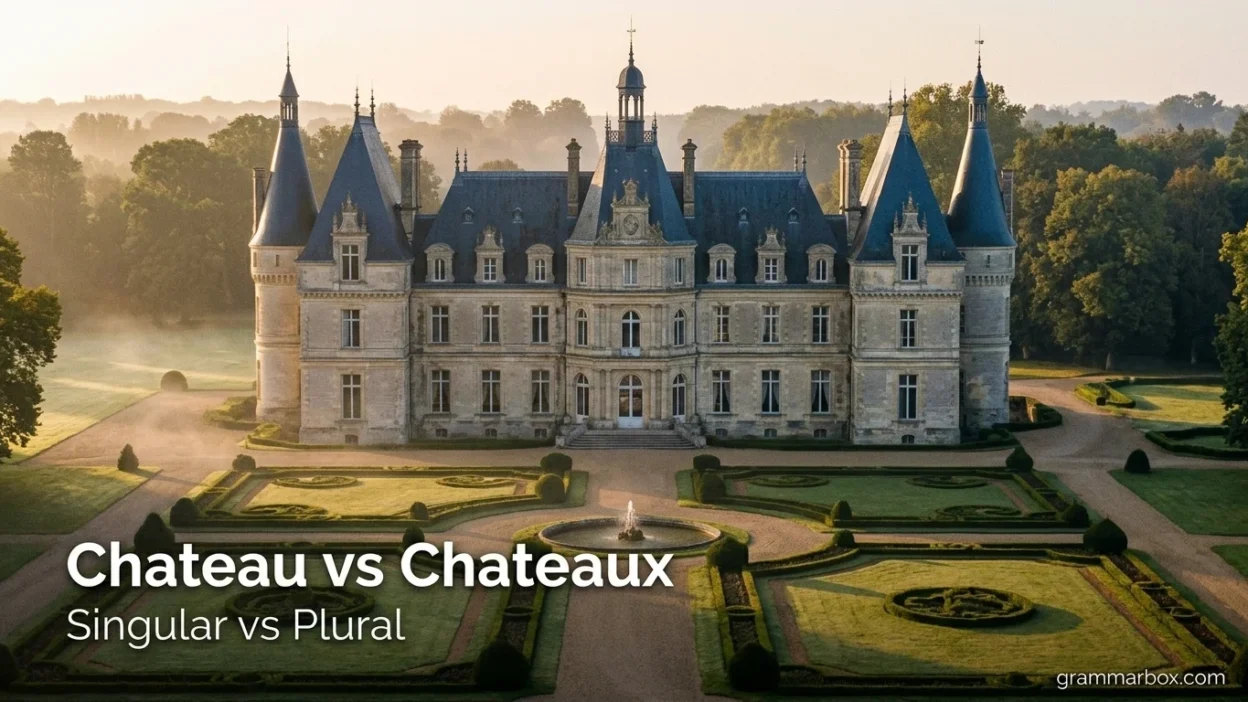
The difference between chateau and chateaux comes down to singular and plural forms. Both words refer to a large French country house, castle, manor, or grand residence, but they are used in different grammatical situations. If you have ever wondered whether to write chateau or chateaux when describing French architecture, historic estates, or luxurious properties, understanding this simple distinction will help you choose the correct word.
These terms come from French, where spelling often changes when a noun becomes plural. English has adopted both forms, particularly in writing about European history, architecture, tourism, and French wine estates. Although the two words share the same basic meaning, they are not interchangeable in every sentence. In this guide, you will learn their meanings, pronunciation, grammatical differences, practical examples, and an easy memory trick to remember which spelling belongs in your sentence.
Quick Answer
Chateau is the singular form, referring to one French castle, manor house, or grand country house. Chateaux is the traditional plural form, referring to two or more such buildings or estates. For example, “a beautiful chateau” describes one property, while “several chateaux” describes multiple properties.
Why People Confuse It
People often confuse chateau vs chateaux because the words have nearly identical meanings and differ mainly in their endings. Both describe grand residences associated with French architecture, history, and culture.
The confusion also comes from English spelling conventions. Many English nouns form their plurals by adding -s or -es, but French loanwords sometimes preserve their original plural forms.
English speakers are familiar with plural patterns such as:
- House → Houses
- Castle → Castles
- Hotel → Hotels
- Chateau → Chateaux
The unusual -eaux ending can look unfamiliar to English learners. The pronunciation can also make the spelling confusing because the final letters are not pronounced as they are in many English words.
Here are the main reasons for the confusion:
- French influence: Both words come from French, where pluralization follows different spelling patterns.
- Unfamiliar spelling: The -eaux ending may look unusual to English speakers.
- Similar pronunciation: The singular and plural forms sound very similar in many English pronunciations.
- Singular and plural mistakes: Writers sometimes use chateaux for one building or chateau for several.
- Alternative plural forms: Some English writers also use chateaus, which can create additional uncertainty.
The key is to focus on the number of properties being described rather than how the words look or sound.
| Word | Number | Meaning |
|---|---|---|
| Chateau | Singular | One chateau |
| Chateaux | Plural | Two or more chateaux |
| Chateaus | Alternative English plural | More than one chateau |
First Word: Chateau
Chateau is a singular noun that refers to one large French residence, castle, manor house, or stately country home.
The word is commonly used when describing historic buildings, elegant estates, architectural landmarks, and properties associated with French wine production.
Meaning of Chateau
A chateau can refer to different types of grand buildings, depending on its historical and cultural context.
For example, it may describe:
- A historic French castle or fortified residence.
- A large country house belonging to a wealthy family.
- An elegant estate surrounded by gardens and landscaped grounds.
- A French wine estate associated with vineyards and winemaking.
- A grand or historic residence that attracts tourists.
The precise meaning depends on the building and the context in which the word appears.
How to Use Chateau in a Sentence
Use chateau when talking about one property.
Examples:
- We stayed in a beautiful chateau during our vacation in France.
- The historic chateau overlooks a peaceful valley.
- She photographed a medieval chateau near the river.
- The family restored its old chateau over several years.
- This chateau is famous for its elegant gardens and architecture.
- The chateau was built several centuries ago.
- We booked a room in a luxurious chateau.
- The old chateau overlooks the countryside.
- The chateau has a large courtyard.
- The owner transformed the chateau into a hotel.
In each sentence, the word refers to one residence or estate.
Chateau as a Wine Estate
In French wine terminology, particularly in Bordeaux, chateau can refer to a wine-producing estate.
For example:
“The wine comes from a famous Bordeaux chateau.”
Here, chateau does not necessarily mean that the wine was produced in an actual castle. It can refer to the entire estate or wine-producing property.
This meaning is particularly useful when writing about French wine regions, vineyards, wineries, and wine production.
Second Word: Chateaux
Chateaux is the traditional plural form of chateau. It refers to two or more French castles, grand residences, country houses, or estates.
The spelling comes from French, where the singular château becomes châteaux in the plural. English commonly uses the same plural spelling, often without the circumflex accent.
Meaning of Chateaux
Chateaux describes multiple properties rather than one individual building. These properties do not necessarily need to be identical in size, design, age, or historical importance.
The word frequently appears in travel writing, historical descriptions, architecture articles, and discussions of French wine regions.
Examples:
- The Loire Valley contains many remarkable chateaux.
- Tourists visit these chateaux to admire their architecture.
- Several chateaux were built during the Renaissance.
- The guide organized a tour of three historic chateaux.
- The region is known for its beautiful chateaux and vineyards.
- We visited several chateaux during our trip to France.
- These chateaux attract thousands of visitors each year.
- Many of the chateaux were built by wealthy families.
- The tour included three magnificent chateaux.
- Some of these chateaux are still privately owned.
Each example refers to more than one property.
Is Chateaux Always French?
The word has French origins, but English speakers also use chateaux in ordinary English writing. It is particularly common when discussing French history, architecture, tourism, and wine estates.
Although chateaux is the traditional French plural, some English contexts use chateaus as an alternative plural form. Both forms can be encountered in English-language writing, but chateaux preserves the traditional French spelling and is widely recognized.
For polished writing about France, architecture, and wine, chateaux is a familiar and appropriate choice.
Comparison Table
| Feature | Chateau | Chateaux |
|---|---|---|
| Grammatical number | Singular | Plural |
| Meaning | One grand residence or estate | Two or more grand residences or estates |
| Origin | French | French |
| Typical context | One castle or country house | Multiple castles or country houses |
| Example | The chateau is beautiful. | The chateaux are beautiful. |
| Verb agreement | Singular verb | Plural verb |
| French spelling | Château | Châteaux |
The simplest distinction is that chateau refers to one property, whereas chateaux refers to multiple properties.
When to Use Each
Choosing between chateau and chateaux becomes easy when you identify whether your sentence describes one building or several.
Use Chateau When Referring to One Property
Choose chateau when the noun is singular.
Correct examples:
- The chateau has a magnificent entrance.
- We visited a famous chateau in France.
- That chateau attracts thousands of visitors annually.
- A historic chateau stands on the hill.
- The chateau is open to visitors.
Notice the singular verbs has, attracts, stands, and is. They agree with the singular noun.
Use Chateaux When Referring to Multiple Properties
Choose chateaux when you mean more than one residence.
Correct examples:
- The chateaux have beautiful gardens.
- We visited several chateaux during our trip.
- These chateaux attract international tourists.
- Many chateaux were restored after the war.
- The chateaux are open to visitors.
Words such as many, several, these, and various often signal that the plural form is needed.
Use the Correct Verb With Each Form
Remember that the noun’s number affects the verb.
- Singular: The chateau is open to visitors.
- Plural: The chateaux are open to visitors.
This agreement is especially important in formal writing, educational content, and SEO articles.
Examples of Chateau vs Chateaux
The following examples show how the two spellings work in everyday English.
Chateau Examples
- The chateau was built several centuries ago.
- We booked a room in a luxurious chateau.
- The old chateau overlooks the countryside.
- A famous architect redesigned the chateau.
- The chateau has a large courtyard.
- Visitors admired the chateau’s stone walls.
- The historic chateau attracts photographers.
- She hopes to visit a French chateau next summer.
- The chateau is surrounded by vineyards.
- The owner transformed the chateau into a hotel.
- A narrow road leads to the chateau.
- The chateau remains an important historical landmark.
Chateaux Examples
- The Loire Valley is famous for its historic chateaux.
- We explored several chateaux during our holiday.
- The chateaux feature impressive architectural details.
- Many chateaux have extensive gardens.
- Tourists photographed the beautiful chateaux.
- These chateaux represent different periods of French history.
- The guide explained how the chateaux were constructed.
- Several chateaux have been converted into hotels.
- The region’s chateaux attract visitors throughout the year.
- We compared the designs of three neighboring chateaux.
- Some chateaux are open to the public.
- The historic chateaux need careful preservation.
Incorrect vs Correct Examples
| Incorrect | Correct | Why |
|---|---|---|
| We visited three chateau. | We visited three chateaux. | Three requires the plural form. |
| The chateaux is beautiful. | The chateau is beautiful. | One property takes the singular form. |
| This chateaux is historic. | This chateau is historic. | This refers to one property. |
| The chateau are impressive. | The chateaux are impressive. | A plural subject takes a plural verb. |
| Many chateau are nearby. | Many chateaux are nearby. | Many indicates multiple properties. |
Common Mistakes
Even experienced writers can make mistakes with French loanwords. These are the most common errors to avoid.
1. Using Chateau After a Plural Number
Incorrect: We toured four chateau.
Correct: We toured four chateaux.
When referring to multiple properties, use the plural form.
2. Using Chateaux for One Building
Incorrect: The chateaux stands beside the lake.
Correct: The chateau stands beside the lake.
The singular subject requires chateau.
3. Adding an Extra S to Chateaux
Avoid writing chateauxs.
Correct: Chateau → Chateaux
The traditional plural form already indicates more than one property. Adding another s is unnecessary.
4. Mixing Singular Nouns With Plural Verbs
Incorrect: The chateau are open today.
Correct: The chateau is open today.
The noun and verb must agree in number.
5. Assuming the Words Have Different Meanings
Chateau and chateaux do not normally describe two different categories of buildings. They express the same basic concept in singular and plural forms.
6. Forgetting the French Accent
In French, the standard spellings are château and châteaux. In English, chateau and chateaux are also widely used without the circumflex accent.
For consistency, follow the spelling conventions used by your publication or style guide.
7. Assuming Every Chateau Is a Castle
A chateau can be a castle-like building, but the word has a broader meaning. It can refer to a large country house, manor, estate, or wine-producing property.
Memory Trick
Here is an easy way to remember the difference between chateau and chateaux:
Chateau = one. Chateaux = more than one.
Think of the final letters -eaux as a clue that the word is plural in this French-derived pair.
Remember these examples:
- One chateau has a garden.
- Two chateaux have gardens.
- Three chateaux attract visitors.
You can also associate the words with numbers:
- 1 = Chateau
- 2 or more = Chateaux
The important thing is to remember the grammatical number, not to rely on the pronunciation. The singular and plural forms are pronounced similarly in many English accents.
American vs British English
There is no major difference between American and British English in the basic distinction between chateau and chateaux. Both varieties use chateau for the singular and chateaux for the plural.
The main spelling variation involves the French accent.
| Variety or context | Singular | Plural |
|---|---|---|
| American English | Chateau | Chateaux |
| British English | Chateau | Chateaux |
| French spelling | Château | Châteaux |
American English Usage
American writers commonly use chateau and chateaux when discussing European architecture, historic residences, tourism, and wine estates.
Example: The couple visited several chateaux in France.
British English Usage
British writers also use the same singular and plural forms.
Example: The historic chateau attracts visitors from across Europe.
Should You Include the Accent?
The circumflex in château and châteaux preserves the traditional French spelling. English-language publications frequently omit it, particularly when using simplified typography or standard English text.
Either approach can be appropriate. The most important consideration is consistency throughout your article.
Similar Words
Understanding related architectural terms can help you describe buildings more precisely.
| Word | Meaning |
|---|---|
| Chateau | French castle, country house, estate, or similar grand residence |
| Castle | Large fortified building, often associated with medieval Europe |
| Manor | Large country house historically associated with a landed estate |
| Palace | Grand residence, especially one associated with royalty |
| Estate | Large property that may include a house, land, and other buildings |
| Mansion | Very large and impressive private house |
These words are related, but they are not exact synonyms.
Castle
A castle is a fortified building historically designed for defense and residence. Some chateaux are castles, but not every chateau is a fortified structure.
Example: The medieval castle protected the surrounding village.
Manor
A manor is a large country house historically associated with an estate or landed property.
Example: The family lived in a manor surrounded by farmland.
Palace
A palace is a grand residence, often associated with royalty, a head of state, or another powerful figure.
Example: The royal palace contains elaborate reception rooms.
Estate
An estate refers to a large property or area of land, often including a main residence and surrounding grounds.
Example: The estate includes vineyards, gardens, and a historic residence.
Château vs Chateau
These spellings have the same singular meaning. Château is the French spelling with a circumflex accent, while chateau is the commonly used unaccented English form.
Château vs Châteaux
The distinction is grammatical rather than semantic: château refers to one property, and châteaux refers to multiple properties.
FAQs:
1. Is chateau singular or plural?
Chateau is singular. It refers to one French castle, manor, grand country house, or estate. For example, “The chateau is beautiful” describes one property.
2. Is chateaux singular or plural?
Chateaux is plural. It refers to two or more chateaus. For example, “The chateaux are beautiful” describes multiple properties.
3. What is the plural of chateau?
The traditional French plural is chateaux.
One chateau → two chateaux
The accented French spellings are château and châteaux.
4. Is chateaus also correct?
Chateaus is an alternative English plural that appears in some dictionaries and usage contexts. However, chateaux is the traditional French plural and a familiar form in English, particularly in writing about France, architecture, history, and wine.
5. How do you pronounce chateau?
In English, chateau is commonly pronounced approximately “shah-TOH.” The exact pronunciation can vary depending on the speaker’s accent.
6. How do you pronounce chateaux?
In English, chateaux is commonly pronounced approximately “shah-TOHZ” by speakers who voice the ending, although many pronounce it much like the singular. The final x is not pronounced like the x in “box.”
7. Does chateau mean castle?
Sometimes. A chateau can refer to a castle-like building, but it can also mean a large country house, manor, estate, or wine-producing property.
8. Is chateau an English word?
Yes. Chateau is a French loanword that is widely used in English, especially in writing about architecture, historic buildings, travel, and wine.
9. Should I write chateau or château?
Both chateau and château are seen in English. The accented form preserves the French spelling, while the unaccented form is also commonly used in English. Choose one style and use it consistently.
10. Can chateau refer to a winery?
Yes. In French wine terminology, especially in Bordeaux, château can refer to a wine-producing estate or property. The plural châteaux can describe several such estates.
Final Verdict
The difference between chateau vs chateaux is simple: chateau refers to one grand residence or estate, while chateaux refers to more than one. Both words share the same basic meaning, and the spelling changes to show whether the noun is singular or plural.
When writing about French architecture, historic castles, country houses, tourism, or wine estates, check the number of properties before choosing your word. Use chateau with singular expressions such as a, this, and one, and use chateaux with plural expressions such as many, several, and these. You may also encounter chateaus as an alternative English plural, but chateaux preserves the traditional French form.
Remember This
- Chateau = one property.
- Chateaux = two or more properties.
- Both forms have the same basic meaning.
- The final x in chateaux is generally silent in English, although pronunciation varies.
- Château and châteaux are the corresponding French spellings with accents.
- Chateaus is an alternative English plural.
Quick memory sentence: One chateau, two chateaux, and no confusion!
Conclusion
The difference between chateau and chateaux is straightforward once you understand the number. Chateau is singular, while chateaux is the traditional plural. Depending on the context, these words can describe French castles, country houses, historic estates, or wine-producing properties.
If you are talking about one property, write chateau. If you are talking about several, write chateaux. Remember the simple pattern one chateau, many chateaux, and you will be able to use both forms correctly and confidently in your writing.