
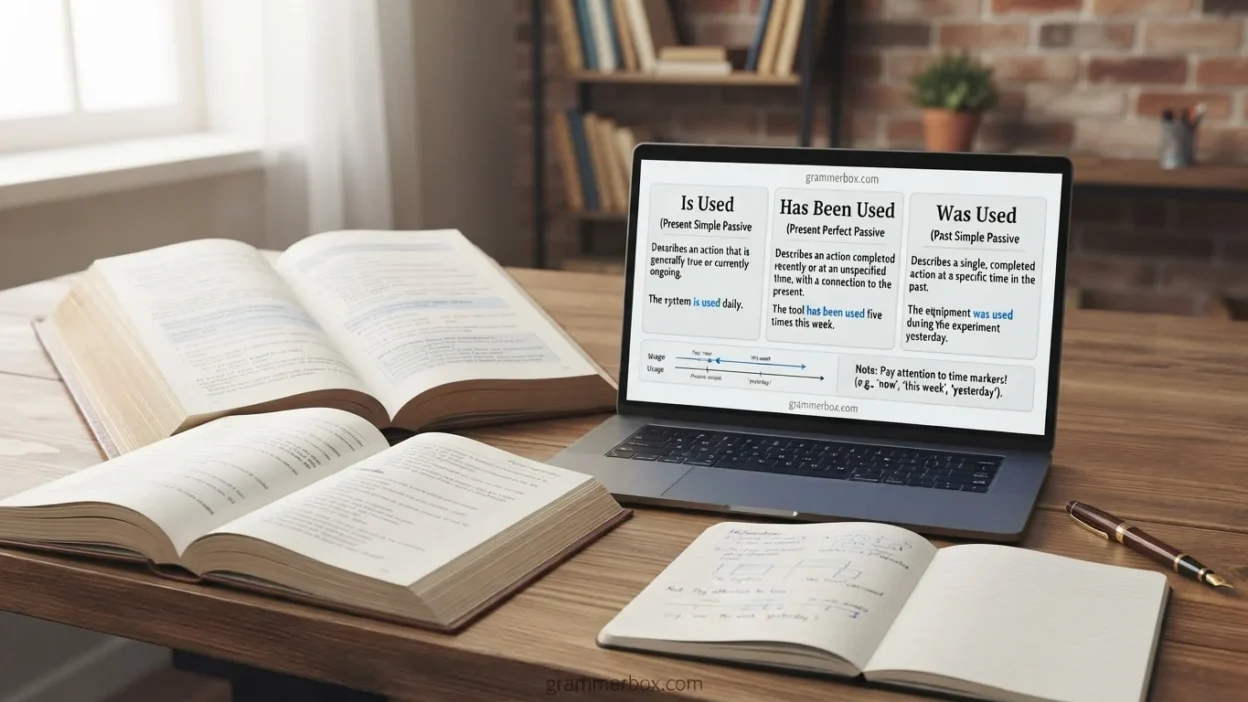
When you see “is used,” “has been used,” and “was used,” the difference can seem small, but each phrase communicates a different time relationship. All three are forms of the passive voice, yet they do not always mean the same thing. Choosing the right one depends on whether you are describing a general practice, a past action with present relevance, or a completed action in the past.
Understanding these forms will help you write clearer English in academic writing, professional communication, reports, and everyday conversation. In this guide, we’ll break down is used vs has been used vs was used with simple explanations, comparison examples, common mistakes, and an easy memory trick. By the end, you’ll know exactly when to use each expression and why.
Quick Answer
“Is used” describes something generally or currently done. “Has been used” describes an action that happened in the past and remains relevant now. “Was used” refers to a completed action at a specific or understood time in the past.
Why People Confuse It
These three expressions are confusing because they all use the passive structure:
be + past participle
The main difference is tense and time:
- Is used → present simple passive
- Has been used → present perfect passive
- Was used → past simple passive
Compare:
- This method is used in schools. → general practice
- This method has been used for many years. → past use continuing or relevant now
- This method was used in the experiment. → completed past use
The object or method may be identical, but the speaker’s focus changes.
Is Used
“Is used” is the present simple passive.
We use it when something is generally, regularly, or currently used.
Structure
Subject + is + past participle
Examples:
- English is used around the world.
- This tool is used to measure temperature.
- The software is used by thousands of students.
- Salt is used to preserve food.
When “Is Used” Is Best
Use is used for:
- General facts
- Regular practices
- Common purposes
- Instructions or explanations
- Things that are currently true
Example:
A thermometer is used to measure temperature.
This does not describe one particular occasion. It explains the general purpose of a thermometer.
Has Been Used
“Has been used” is the present perfect passive.
It describes something that happened in the past but has a connection to the present.
Structure
Subject + has been + past participle
Examples:
- The method has been used successfully.
- This technology has been used for decades.
- The room has been used as an office.
- The system has been used by several companies.
The important idea is that the past action matters now.
For example:
This treatment has been used successfully.
The speaker is interested in its history of successful use and its relevance today.
Important Note
With plural subjects, use have been used:
- The methods have been used for years.
- Several tools have been used in the project.
Was Used
“Was used” is the past simple passive.
Use it when an action happened and was completed in the past.
Structure
Subject + was + past participle
Examples:
- The machine was used yesterday.
- This method was used in the experiment.
- The room was used for the meeting.
- The old system was used until 2020.
A specific past time often appears with was used:
- yesterday
- last week
- in 2019
- during the experiment
- when I was younger
For example:
The old computer was used during the test.
The test is finished, and the sentence focuses on what happened during that past event.
Is Used vs Has Been Used vs Was Used: Comparison Table
| Phrase | Tense | Main Meaning | Typical Time | Example |
|---|---|---|---|---|
| is used | Present simple passive | General/current use | Now or generally | This tool is used in laboratories. |
| has been used | Present perfect passive | Past use connected to now | From the past until now/recently | This tool has been used for years. |
| was used | Past simple passive | Completed past use | Finished past time | This tool was used yesterday. |
The easiest distinction
Think of them this way:
Is used = generally
Has been used = up to now
Was used = then
When to Use Each
Use “Is Used” for General Facts
A dictionary is used to find word meanings.
You are explaining the normal purpose of a dictionary.
Use “Has Been Used” for Past-to-Present Relevance
This dictionary has been used by generations of students.
The use began in the past and is relevant to the present.
Use “Was Used” for a Finished Past Event
This dictionary was used during the examination.
The examination happened in the past and is finished.
A useful comparison
Consider these three sentences:
- The room is used for meetings.
- The room has been used for meetings for ten years.
- The room was used for a meeting yesterday.
The first gives a general fact. The second emphasizes duration and present relevance. The third describes one completed past event.
Is Used vs Has Been Used vs Was Used: Examples
Here are more examples to make the difference clear.
- This software is used by many businesses.
→ General/current fact. - This software has been used by many businesses.
→ Businesses have used it over time, and that experience matters now. - This software was used by our company last year.
→ A completed past situation. - The machine is used to produce plastic parts.
→ General purpose. - The machine has been used for several years.
→ It has a history of use extending to the present. - The machine was used during yesterday’s test.
→ A completed past event. - English is used as a global language.
→ General fact. - English has been used in this region for centuries.
→ Historical use connected to the present. - English was used during the meeting.
→ A completed past occasion. - This method is used to solve the problem.
→ General method or procedure. - This method has been used successfully in previous studies.
→ Previous use is relevant to the current discussion. - This method was used in the 2022 study.
→ Specific completed study.
Common Mistakes
Mistake 1: Using “Was Used” for a General Fact
❌ A hammer was used to drive nails.
If you mean the general purpose of a hammer, use:
✅ A hammer is used to drive nails.
Mistake 2: Using “Has Been Used” With a Finished Past Time
❌ The system has been used yesterday.
“Yesterday” identifies a finished past time, so use:
✅ The system was used yesterday.
Mistake 3: Using “Is Used” for a Past Event
❌ The equipment is used during yesterday’s experiment.
Better:
✅ The equipment was used during yesterday’s experiment.
Mistake 4: Forgetting “Been”
❌ The method has used successfully.
Correct:
✅ The method has been used successfully.
The passive present perfect requires:
has/have + been + past participle
Memory Trick
Use this simple three-word trick:
Is = generally
Has been = up to now
Was = finished then
For example:
- The car is used every day. → general/current routine
- The car has been used for five years. → past until now
- The car was used yesterday. → finished past event
If you see a finished past-time expression such as yesterday, last year, in 2020, or during the meeting, was used is usually the natural choice.
American vs British English
There is generally no major difference between American and British English in how these three passive constructions work.
Both varieties use:
- is used for present/general situations
- has been used for present perfect situations
- was used for completed past situations
The bigger differences between American and British English usually concern vocabulary, spelling, pronunciation, and some preferences for the present perfect versus simple past.
For example, British English may more strongly favor the present perfect in some contexts where American English commonly uses the simple past, particularly with recent events. However, the basic distinction between is used, has been used, and was used remains the same.
Similar Words and Structures
These expressions are related to several other passive constructions.
Is Being Used
This is the present continuous passive.
The computer is being used right now.
It emphasizes an action happening at this moment.
Has Been Used
This is the present perfect passive.
The computer has been used several times today.
It focuses on completed use with present relevance.
Was Being Used
This is the past continuous passive.
The computer was being used when I arrived.
It describes an ongoing action at a particular time in the past.
Had Been Used
This is the past perfect passive.
The computer had been used before I arrived.
It shows that one past action happened before another past event.
FAQs:
Is “is used” present tense?
Yes. “Is used” is the present simple passive. It normally describes a general fact, regular action, or current situation.
Is “has been used” past or present tense?
“Has been used” is the present perfect passive. It describes a past action that has a connection to the present.
Is “was used” past tense?
Yes. “Was used” is the past simple passive and normally describes a completed action in the past.
Can I use “has been used” with “yesterday”?
Generally, no.
❌ It has been used yesterday.
Use:
✅ It was used yesterday.
What is the difference between “is used” and “was used”?
“Is used” describes something generally or currently true, while “was used” describes a completed action in the past.
What is the difference between “has been used” and “was used”?
“Has been used” connects past use to the present, while “was used” places the use in a completed past situation.
Which is correct: “has used” or “has been used”?
It depends on whether the subject performs the action or receives it.
- The company has used the software. → The company performs the action.
- The software has been used by the company. → The software receives the action.
Final Verdict
The difference between is used vs has been used vs was used is mainly about time and perspective.
- Choose is used for general facts, regular practices, and current situations.
- Choose has been used when past use is connected to the present.
- Choose was used for a completed action or event in the past.
The key is not simply whether something happened in the past. Ask yourself what time perspective you want the reader to understand.
Remember This
Once you identify the time relationship, choosing the correct passive form becomes much easier.
Conclusion
Understanding is used, has been used, and was used is essential for accurate English grammar because these phrases can describe similar actions while giving different information about time. Is used presents a general or current fact, has been used connects previous use with the present, and was used describes a completed past event.
When you’re unsure, look for time clues such as every day, generally, for years, recently, yesterday, last year, or in 2020. These clues can quickly show you which tense fits best. With regular practice, the distinction between these passive voice forms will become natural in both speaking and writing.