
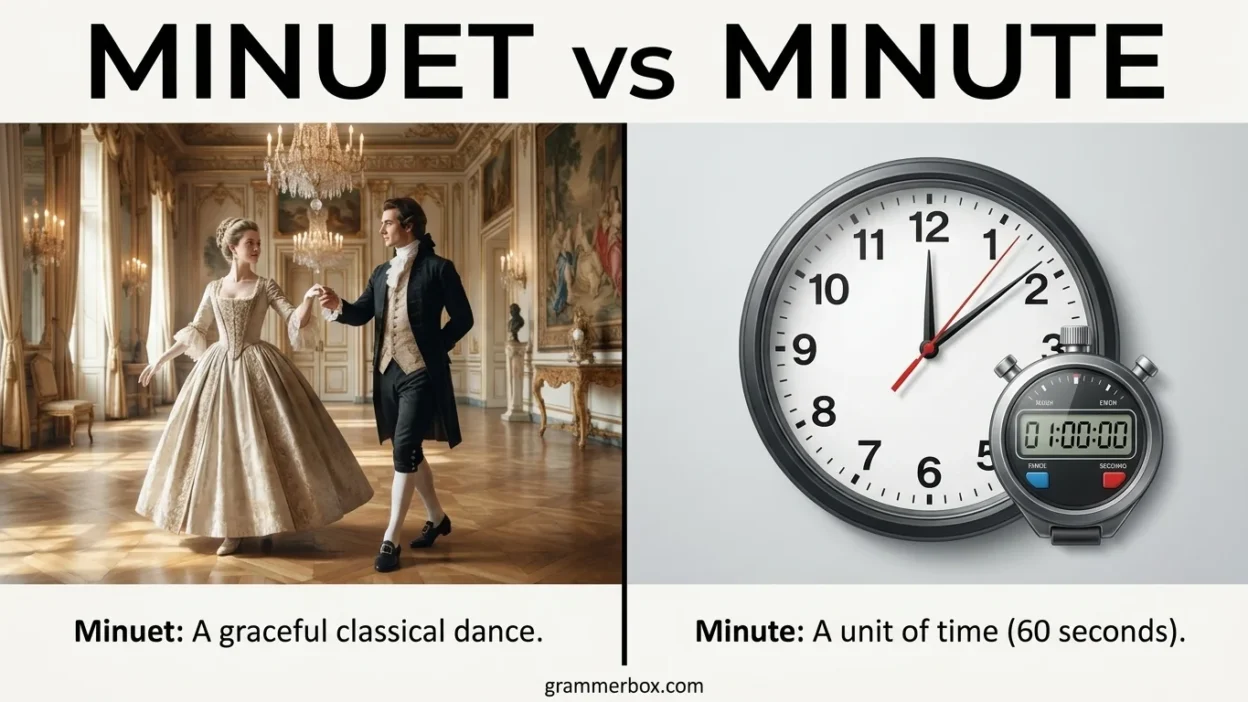
English has many words that look or sound surprisingly similar but have completely different meanings. Minuet vs minute is a great example. Although these two words share several letters, they refer to entirely different things. One is connected to music and dance, while the other commonly refers to time or something extremely small.
Understanding the difference between minuet and minute can help you avoid spelling mistakes and choose the right word in writing. The confusion is especially understandable because “minute” itself has two different pronunciations and meanings. In this guide, you’ll learn what each word means, how to pronounce it, when to use it, and how to remember the difference with simple examples.
Quick Answer
Minuet is a formal, graceful dance and a piece of classical music traditionally associated with it. Minute usually means a unit of time equal to 60 seconds or something extremely small. Despite their similar spelling, they have different meanings and pronunciations.
Why People Confuse Minuet and Minute
The confusion between minuet vs minute mainly comes from their similar spelling.
Both words contain the letters minu, and they can look almost identical when quickly read. However, their meanings are unrelated.
There is another reason for confusion: minute has two common pronunciations:
- MIN-it — a unit of time.
- my-NOOT — extremely small or tiny.
Meanwhile, minuet is generally pronounced min-yoo-ET.
So, remembering the meaning and pronunciation of each word is more useful than relying only on spelling.
First Word: Minuet
Minuet is a noun referring to a slow, graceful dance that became especially popular in European social and courtly settings.
It can also mean a piece of music composed for this type of dance.
The minuet became particularly important in classical music. Composers such as Mozart, Haydn, and Bach used minuet movements in their compositions.
Examples of Minuet
- The dancers performed a graceful minuet at the historical event.
- The composer included a minuet in the symphony.
- We learned the basic steps of the traditional minuet.
- The orchestra played a beautiful minuet.
- The elegant minuet was once popular among European aristocrats.
Pronunciation
Minuet is pronounced approximately:
min-yoo-ET
The final syllable is stressed.
Part of Speech
Minuet is primarily a noun.
Second Word: Minute
Minute has two major meanings and pronunciations.
Minute as a Unit of Time
When pronounced MIN-it, a minute is a unit of time equal to 60 seconds.
Examples:
- I’ll be there in five minutes.
- The meeting lasted thirty minutes.
- Please wait a minute.
- She arrived one minute late.
Minute Meaning Extremely Small
When pronounced my-NOOT, minute is an adjective meaning extremely small, tiny, or insignificant in size.
Examples:
- The scientist observed a minute change in temperature.
- The insect was so minute that we could barely see it.
- There was a minute difference between the two measurements.
The pronunciation changes depending on the meaning, which makes minute an especially interesting English word.
Minuet vs Minute: Comparison Table
| Word | Meaning | Part of Speech | Pronunciation | Example |
|---|---|---|---|---|
| Minuet | A formal dance or music for that dance | Noun | min-yoo-ET | They performed a minuet. |
| Minute | 60 seconds | Noun | MIN-it | Wait one minute. |
| Minute | Extremely small | Adjective | my-NOOT | There was a minute difference. |
The easiest distinction is simple: minuet relates to dance and music, while minute relates to time or tiny size.
When to Use Each
Knowing the definition makes choosing the correct word much easier.
Use “minuet” when talking about:
- A traditional dance
- A formal or graceful dance
- Classical music
- A musical composition associated with the dance
- Historical European court dances
Example:
The musicians played a minuet while the dancers moved across the floor.
Use “minute” when talking about:
- Time
- Sixty seconds
- A short period
- Something extremely small
- Tiny differences or details
Examples:
- Give me a minute to finish.
- The machine detected a minute change.
Minuet vs Minute Examples
Here are more examples to make the distinction clear:
- The musicians performed a beautiful minuet.
- Please wait one minute.
- The dancers practiced the traditional minuet.
- The train will arrive in ten minutes.
- Mozart composed several works containing a minuet.
- We noticed a minute crack in the glass.
- The instructor taught us how to perform a minuet.
- She spent twenty minutes reading the book.
- Even a minute error can affect the final result.
- The ballroom dancers performed an elegant minuet.
- I’ll call you in a few minutes.
- The researcher identified a minute variation in the sample.
Notice how the surrounding context makes the correct word obvious.
Common Mistakes
Mistake 1: Using “minute” for the dance
Incorrect:
The dancers performed a beautiful minute.
Correct:
The dancers performed a beautiful minuet.
Mistake 2: Using “minuet” for time
Incorrect:
Please wait one minuet.
Correct:
Please wait one minute.
Mistake 3: Forgetting the second meaning of “minute”
Minute does not always refer to time.
In a sentence such as:
There was a minute difference between the results.
it means very small, not 60 seconds.
Mistake 4: Assuming similar spelling means similar meaning
English contains many words that look alike but have unrelated meanings. Minuet and minute are one such pair.
Memory Trick: Minuet = Music and Dance
A simple memory trick can help:
Minuet → Music + Dance
Think of the “u” in minuet as reminding you of a musical or graceful performance.
For minute, remember:
Minute → 60 seconds
And when minute means tiny, think:
minute = minuscule
So you can remember:
- Minuet = dance/music
- Minute = time
- Minute = tiny
American vs British English
The meanings of minuet and minute are essentially the same in American and British English.
There is no major difference in meaning between the varieties.
However, pronunciation can vary slightly depending on the speaker’s accent.
For minute meaning 60 seconds, both American and British speakers commonly pronounce it approximately MIN-it.
For minute meaning extremely small, both commonly use the pronunciation approximately my-NOOT.
Minuet also keeps its association with traditional dance and classical music in both varieties of English.
Therefore, whether you are writing for an American or British audience, the important thing is to select the word according to its meaning.
Similar Words
Several words can be useful when discussing these concepts.
Words Related to Minuet
- Dance
- Waltz
- Ballroom
- Music
- Composition
- Movement
- Performance
- Choreography
Words Related to Minute as Time
- Second
- Hour
- Moment
- Period
- Duration
- Time
Words Related to Minute as “Very Small”
- Tiny
- Minuscule
- Microscopic
- Slight
- Tiny-scale
- Infinitesimal
- Negligible
Be careful, though: these words are related in meaning but are not interchangeable in every sentence.
FAQs:
Is “minuet” the same as “minute”?
No. Minuet is a traditional dance or a piece of music associated with that dance. Minute usually means 60 seconds or, when pronounced differently, something extremely small.
How do you pronounce minuet?
Minuet is commonly pronounced approximately min-yoo-ET, with the stress on the final syllable.
How do you pronounce minute?
It depends on the meaning. A unit of time is pronounced MIN-it. When it means extremely small, it is pronounced my-NOOT.
Is minuet a type of dance?
Yes. A minuet is a formal, graceful dance that originated in Europe and became especially associated with courtly and classical traditions.
What does minute mean besides time?
Minute can also be an adjective meaning extremely small or tiny. For example, “a minute detail” means a very small or fine detail.
Why is minute pronounced differently?
English has retained different pronunciations for the two meanings of minute. The time-related noun is pronounced MIN-it, while the adjective meaning extremely small is pronounced my-NOOT.
What is the easiest way to remember minuet vs minute?
Remember minuet = dance/music and minute = time. If minute describes something tiny, remember its synonym minuscule.
Final Verdict
The difference between minuet vs minute becomes easy once you connect each word with its meaning.
Minuet refers to a graceful traditional dance or the music written for it. Minute usually refers to a period of 60 seconds, but it can also mean extremely small.
The spelling may cause confusion, but the context provides a strong clue. If you are discussing dancing or classical music, choose minuet. If you are discussing time or something tiny, choose minute.
Remember This
Minuet = a dance or piece of music.
Minute = 60 seconds.
Minute = extremely small.
A quick memory formula is:
Minuet → Dance
Minute → Time or Tiny
Conclusion
Although minuet and minute look almost identical, they have very different meanings. A minuet belongs to the world of dance and classical music, while a minute can describe either a unit of time or something exceptionally small.
Once you remember these three meanings, the confusion disappears: minuet is a dance, minute is time, and minute can also mean tiny. Paying attention to pronunciation and context will help you use each word accurately in both everyday and formal English.