
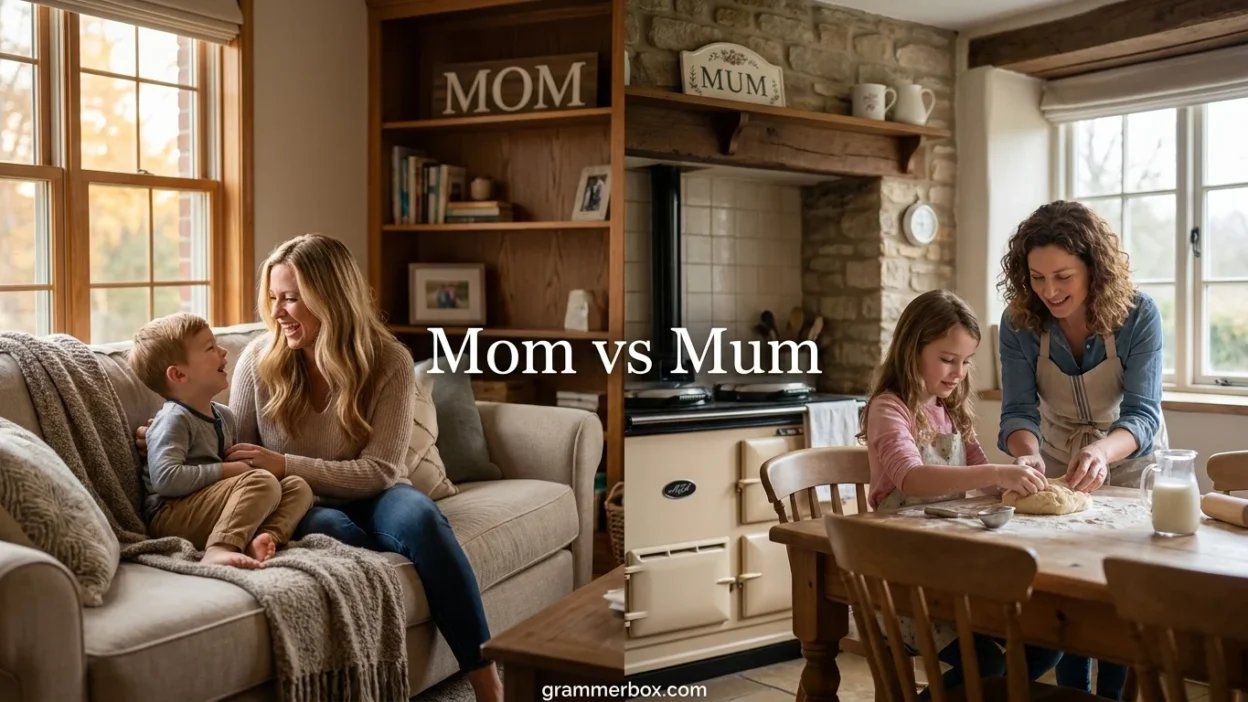
Mom vs mum is a common spelling difference that can confuse English learners because both words have exactly the same basic meaning: a mother. The main difference is not meaning but regional usage. “Mom” is the standard form in American English, while “mum” is more common in British English and is also widely used in other varieties of English influenced by British usage.
Choosing between mom and mum usually depends on your audience, location, and the variety of English you are writing or speaking. If you are writing for an American audience, “mom” will generally sound natural. For British audiences, “mum” is the usual choice. In this guide, we’ll look at the meaning, pronunciation, spelling, examples, common mistakes, and differences between American and British English so you can confidently choose the right word.
Quick Answer
Mom and mum mean the same thing: a mother. Mom is mainly used in American English, while mum is the standard form in British English. Neither spelling is inherently more correct; choose the version that matches your variety of English and your audience.
Why People Confuse It
People often confuse mom vs mum because the two words have the same meaning and are pronounced similarly.
The difference comes from regional English conventions. American English generally uses mom, whereas British English usually uses mum.
For example:
- American English: I called my mom last night.
- British English: I called my mum last night.
Both sentences are grammatically correct.
The important point is that mom and mum are not two different types of mothers. They are regional spelling and usage variants.
Mom
Mom is the common informal word for “mother” in American English.
It is widely used in everyday conversation, text messages, social media, and informal writing in the United States.
Examples of “Mom”
- My mom makes the best pancakes.
- I need to ask my mom first.
- My mom is coming to visit this weekend.
- I called Mom after work.
- Her mom helped her with the project.
When used as a direct name or form of address, Mom is often capitalized.
Example:
“Thanks for helping me, Mom!”
Mum
Mum is the usual informal word for “mother” in British English.
It is particularly common in the United Kingdom and is also used in other English-speaking regions where British English conventions are influential.
Examples of “Mum”
- My mum loves gardening.
- I asked my mum for advice.
- Her mum picked her up from school.
- My mum is making dinner tonight.
- I called Mum before leaving.
Like “Mom,” Mum can be capitalized when it is being used as a name or direct form of address.
Example:
“Love you, Mum!”
Mom vs Mum: Comparison Table
| Feature | Mom | Mum |
|---|---|---|
| Meaning | Mother | Mother |
| Main variety | American English | British English |
| Common in the US | Yes | No |
| Common in the UK | Less common | Yes |
| Part of speech | Noun | Noun |
| Formality | Informal | Informal |
| Example | My mom is here. | My mum is here. |
| Capitalized as direct address | Yes | Yes |
When to Use Each
Use “Mom” When:
Use mom when writing or speaking in American English.
Examples:
- My mom works at a hospital.
- I bought my mom a gift.
- Mom, can you help me?
It is also appropriate when your target audience is primarily American.
Use “Mum” When:
Use mum when following British English conventions.
Examples:
- My mum works at a hospital.
- I bought my mum a gift.
- Mum, can you help me?
If you are writing for readers in the UK, “mum” will generally be the more natural choice.
Mom vs Mum Examples
Here are examples showing how the two words work in everyday sentences:
- My mom is making dinner tonight.
American English. - My mum is making dinner tonight.
British English. - I called my mom after school.
American usage. - I called my mum after school.
British usage. - Mom, where are my keys?
American English direct address. - Mum, where are my keys?
British English direct address. - Her mom bought her a new jacket.
- Her mum bought her a new jacket.
- My mom taught me how to cook.
- My mum taught me how to cook.
- I want to spend Mother’s Day with my mom.
- I want to spend Mother’s Day with my mum.
The meaning remains essentially identical in all these examples. The spelling reflects the variety of English being used.
Common Mistakes
1. Assuming One Spelling Is Incorrect
A common mistake is thinking that either “mom” or “mum” is always wrong.
Both are standard words. Their usage depends largely on regional English.
2. Mixing Regional Conventions
If you are writing an American-English article, consistently using mom is usually appropriate.
For British English content, use mum.
Consistency makes your writing sound more natural.
3. Confusing “Mum” With “Mummy”
“Mum” and “mummy” are related terms, but they are not exactly interchangeable in every context.
“Mummy” is generally more childlike or affectionate, while “mum” is the ordinary informal term in British English.
4. Forgetting Capitalization
When the word is used as a direct form of address, capitalization is commonly used:
- Thanks, Mom!
- Thanks, Mum!
But when referring to someone’s mother generally, lowercase is normally used:
- My mom is a teacher.
- Her mum is a teacher.
Memory Trick
A simple way to remember mom vs mum is:
Mom = American
Mum = British
Think of the “o” in Mom as being associated with the United States.
For British English, remember the “u” in Mum.
US → Mom
UK → Mum
This quick association can help you choose the correct spelling when writing for a particular audience.
American vs British English
The difference between mom and mum is a good example of how English varies around the world.
American English generally prefers:
- mom
- mommy
- momma
British English commonly uses:
- mum
- mummy
- mama
The choice can also vary among individual speakers and families. Regional preferences exist within countries, so real-world usage is not always completely uniform.
If you are writing content for an international audience, you can mention both forms when the distinction is relevant.
Similar Words
Several words can refer to a mother, depending on region, age, relationship, and level of formality.
Mother
Mother is the standard and more formal term.
Example:
“My mother lives in Manchester.”
Mommy
Mommy is commonly used by young children in American English.
Example:
“Mommy, can you read me a story?”
Mummy
Mummy is commonly associated with British English, especially in children’s speech.
Example:
“Mummy, look at this!”
Mama
Mama is an affectionate form used in various English-speaking communities.
Example:
“Her mama always supported her.”
Ma
Ma is an informal form of “mother” used in some dialects and family settings.
Example:
“Ma, I’m home!”
FAQs:
Is “mom” American or British?
Mom is primarily associated with American English. It is the usual informal term for “mother” in the United States.
Is “mum” British or American?
Mum is primarily associated with British English. It is the standard informal term for “mother” in the United Kingdom.
Are mom and mum the same word?
Yes. Mom and mum have the same basic meaning, but they belong to different regional varieties of English.
Is “mum” grammatically correct?
Yes. Mum is a standard English word and is especially common in British English.
Is “mom” grammatically correct?
Yes. Mom is a standard English word, particularly in American English.
Which is more common, mom or mum?
It depends on the region. Mom is more common in American English, while mum is more common in British English.
Should I use “mom” or “mum” in an article?
Use the form that matches your target audience and overall English variety. For American readers, choose mom; for British readers, choose mum.
Conclusion
The difference between mom vs mum is mainly a matter of regional English rather than meaning. Both words are informal ways to refer to a mother, and both are grammatically correct. American English generally favors “mom,” while British English generally favors “mum.”
The easiest rule is to consider your audience before choosing the spelling. If you are writing for Americans, use mom; if you are writing for British readers, use mum. Once you connect each spelling with its regional variety, this commonly confused word pair becomes easy to remember.
Remember This
Mom = American English 🇺🇸
Mum = British English 🇬🇧
Both mean mother, so choose the spelling that matches your audience and style of English.