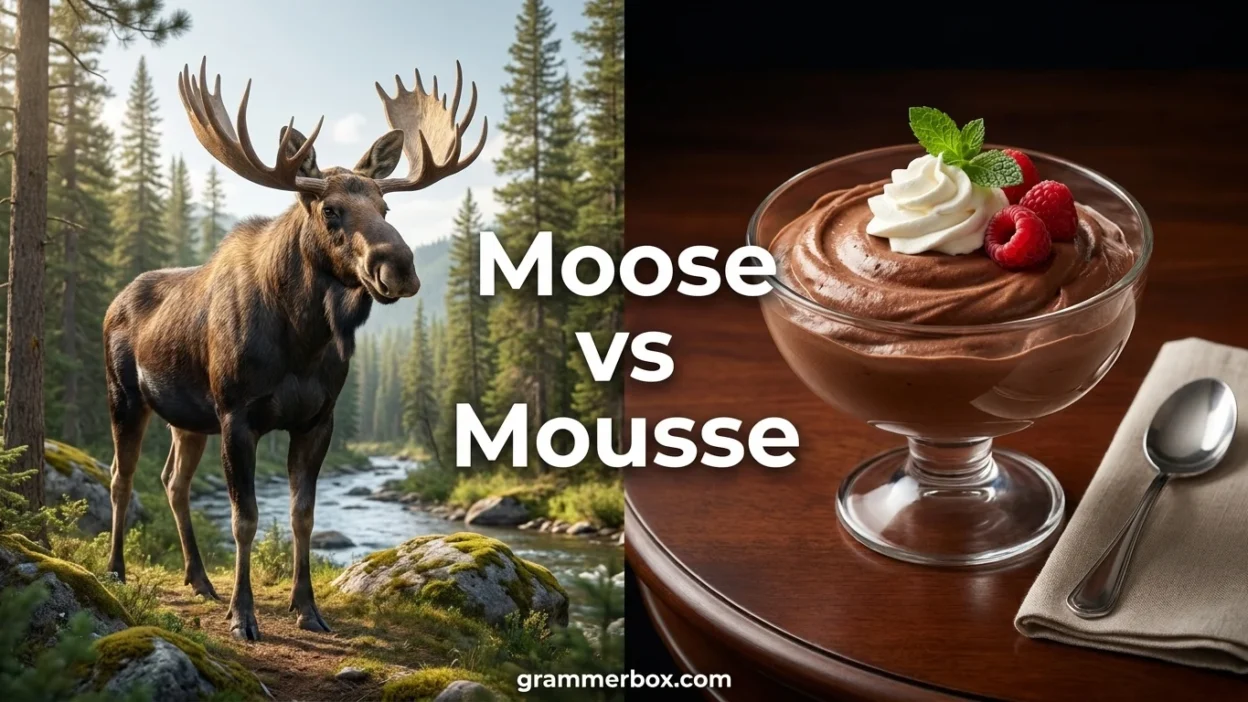
If you have ever seen the words moose and mousse and wondered whether they are related, you are not alone. They look remarkably similar, but they refer to completely different things. Moose is a large North American deer, while mousse is a light, airy food or a styling product for hair. The difference is only one letter, but the meanings could hardly be more different.
Understanding moose vs mousse is useful for writers, English learners, students, and anyone who wants to avoid spelling mistakes. Although both words can sound similar depending on the speaker’s accent, their meanings and origins are distinct. In this guide, we will explain what each word means, show you how to use them correctly, compare their pronunciations, and provide practical examples so you can remember the difference easily.
Quick Answer
Moose is a large deer with broad antlers, especially common in North America. Mousse is a light, fluffy food such as chocolate mousse, or a foamy hair-styling product. They are different words with different meanings and uses.
Why People Confuse It
People often confuse moose and mousse because they look and sound very similar.
The spelling difference is easy to overlook:
- Moose → an animal
- Mousse → a light food or hair product
Both words are pronounced similarly in many varieties of English, which makes the confusion even more understandable.
The context usually makes the intended meaning clear. If someone says, “We saw a moose in the forest,” they are talking about an animal. If they say, “I ordered chocolate mousse,” they are talking about dessert.
Moose
Moose is a noun referring to a very large deer belonging to the deer family. Moose are known for their long legs, large bodies, and, in males, enormous flattened antlers.
For example:
We saw a moose near the lake.
The plural of moose is also moose, not “mooses.”
Moose in a sentence
- The moose walked slowly through the forest.
- We spotted a moose while hiking in Canada.
- A male moose can have enormous antlers.
- The wildlife photographer captured a beautiful picture of a moose.
Key meaning
Moose = a large deer
Mousse
Mousse is a noun with two common meanings.
First, it can refer to a light, airy food, often made by whipping ingredients such as cream, eggs, or chocolate.
She ordered chocolate mousse for dessert.
Second, mousse can refer to a foamy hair-styling product designed to add volume, hold, or texture.
She applied hair mousse before blow-drying her hair.
Mousse in a sentence
- The chocolate mousse was rich and creamy.
- He bought a bottle of hair mousse.
- The chef prepared a strawberry mousse.
- This mousse gives my hair extra volume.
Key meaning
Mousse = a light dessert or foamy hair product
Moose vs Mousse: Comparison Table
| Feature | Moose | Mousse |
|---|---|---|
| Meaning | A large deer | A light, airy food or hair product |
| Part of speech | Noun | Noun |
| Common example | A moose in the forest | Chocolate mousse |
| Another use | Refers to the animal | Hair-styling foam |
| Plural | Moose | Mousses |
| Pronunciation | Usually /muːs/ | Usually /muːs/ |
| Main context | Wildlife and nature | Food, beauty, and hairstyling |
When to Use Each
Choosing between moose and mousse is simple once you identify the context.
Use “moose” when talking about:
- Wildlife
- Deer
- Forest animals
- Antlers
- Nature
- Hunting or wildlife observation
Example:
The tourists were excited to see a moose in the national park.
Use “mousse” when talking about:
- Desserts
- Chocolate
- Fruit-based desserts
- Light and airy foods
- Hair products
- Hair volume and styling
Example:
She used mousse to give her hair more volume.
A quick question can help: Am I talking about an animal? If yes, use moose.
If you are talking about food or hair styling, use mousse.
Moose vs Mousse Examples
Here are practical examples showing the difference:
- We saw a moose near the river.
- The moose had enormous antlers.
- A moose crossed the road in front of us.
- The park is home to many moose.
- The chocolate mousse was delicious.
- She ordered a raspberry mousse after dinner.
- He bought hair mousse for extra volume.
- Apply a small amount of mousse to damp hair.
- The wildlife guide warned us not to approach the moose.
- The restaurant serves a popular chocolate mousse.
- The stylist recommended mousse for her curly hair.
- We photographed a moose from a safe distance.
These examples demonstrate why the surrounding words are important. A moose belongs in a forest, while mousse belongs on a dessert menu or in a bathroom cabinet.
Common Mistakes
Mistake 1: Using “mousse” for the animal
Incorrect:
We saw a mousse in the woods.
Correct:
We saw a moose in the woods.
Mistake 2: Using “moose” for dessert
Incorrect:
I ordered chocolate moose.
Correct:
I ordered chocolate mousse.
Mistake 3: Adding “-s” to the plural of moose
Incorrect:
We saw three mooses.
Correct:
We saw three moose.
The word moose has the same form for singular and plural.
Mistake 4: Confusing mousse with another hair product
Mousse is a foamy styling product, but it is not the same as every type of hair gel, cream, spray, or pomade.
Memory Trick
A simple memory trick can make moose vs mousse easy to remember:
Moose has two O’s for an outdoor animal.
Think:
MOOSE → forest → animal
For mousse, remember the extra S:
MOUSSE → soft, smooth, fluffy
You can also associate mousse with chocolate mousse, one of its most familiar uses.
So remember:
Moose = animal
Mousse = food or hair product
American vs British English
The meanings of moose and mousse do not fundamentally change between American and British English.
Moose refers to the large deer in both varieties of English. However, there is an interesting terminology difference involving the word elk. In North American English, “elk” commonly refers to a particular large deer species, while British English may use “elk” for what North Americans generally call a moose.
Mousse also has the same basic meanings in American and British English. It can describe an airy dessert or a foamy hair-styling product.
Pronunciation can vary slightly by accent, but spelling remains important because the words have different meanings.
Similar Words
If you are learning vocabulary related to moose vs mousse, these words may also be useful.
Words related to moose
- Deer
- Elk
- Antlers
- Wildlife
- Mammal
- Forest
- Animal
- Bull
- Cow
- Calf
Words related to mousse
- Dessert
- Chocolate
- Cream
- Foamy
- Whipped
- Styling
- Hair
- Volume
- Texture
- Product
Be careful with moose and elk, because their naming can vary depending on the English variety and region.
FAQs:
1. Is a moose an animal?
Yes. A moose is a very large member of the deer family, recognized especially by the large antlers of adult males.
2. What is mousse?
Mousse can refer to a light, airy dessert or a foamy hair-styling product.
3. Is mousse pronounced like moose?
In many varieties of English, mousse and moose are pronounced the same or very similarly, which contributes to their confusion.
4. What is the plural of moose?
The plural of moose is moose.
For example:
We saw five moose near the lake.
5. Is chocolate moose correct?
No. The correct expression is chocolate mousse.
Chocolate moose would literally suggest a chocolate-colored or chocolate-related animal rather than the dessert.
6. Is hair mousse the same as hair gel?
No. Hair mousse is typically a lightweight, foamy styling product. Hair gel is generally thicker and is used for different styling effects.
7. How can I remember moose vs mousse?
Remember moose = animal and mousse = dessert or hair product. The extra s in “mousse” can remind you of its soft, foamy texture.
Remember This
Moose = animal 🦌
Mousse = food or hair product 🍫💇
If you are writing about wildlife, use moose. If you are writing about a fluffy dessert or a styling foam, use mousse.
Conclusion
Understanding moose vs mousse is a small but useful part of improving English spelling and vocabulary. These words are easy to confuse because their pronunciation is often identical, but their meanings belong to completely different areas. One describes a large deer, while the other describes something light and foamy.
The easiest way to remember the distinction is to connect each word with a familiar image: picture a moose walking through a forest and mousse sitting on a dessert plate or being applied to someone’s hair. Once that association becomes familiar, choosing the correct spelling becomes much easier.