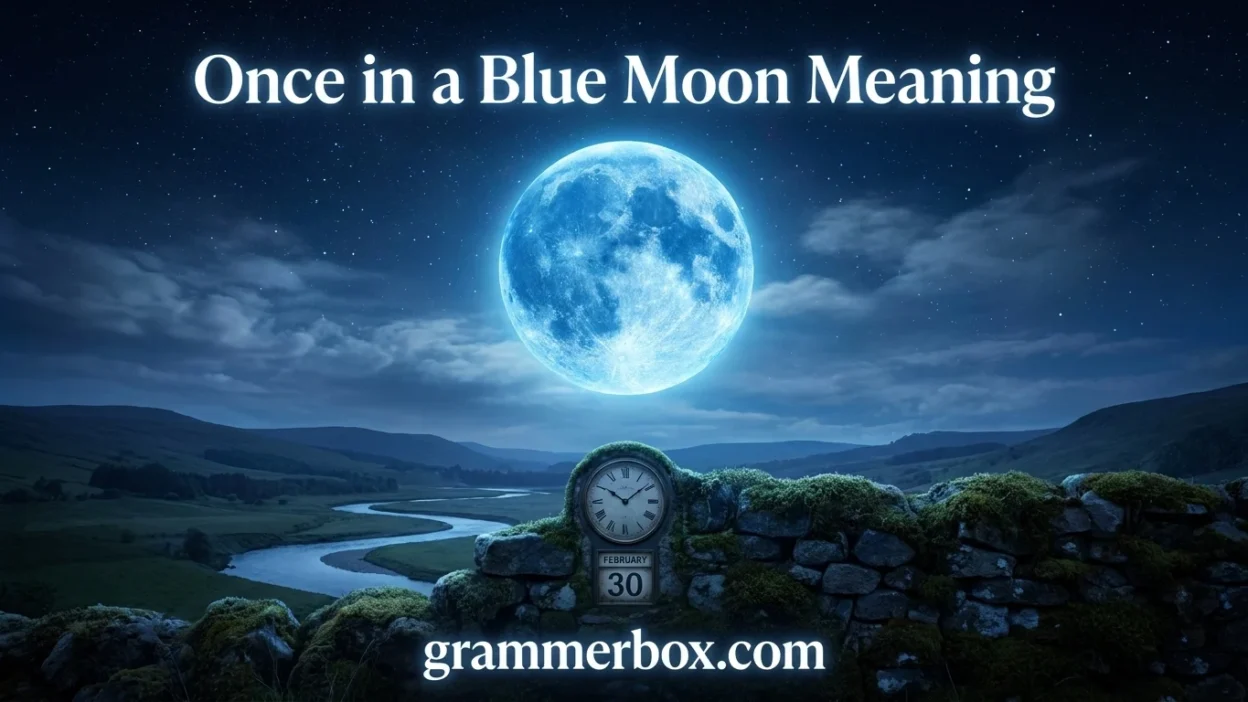
Have you ever heard someone say, “I only eat fast food once in a blue moon” and wondered what they meant? The phrase “once in a blue moon” is a common English idiom used to describe something that happens very rarely. It does not literally mean that an event occurs whenever the moon appears blue. Instead, it emphasizes how unusual or infrequent something is.
This expression is widely used in everyday conversations, writing, movies, and informal speech. You might use it when talking about rare visits, unusual events, occasional habits, or something that almost never happens. Understanding the once in a blue moon meaning can help you sound more natural and confident when speaking or writing English. In this guide, we’ll explain its definition, origin, correct usage, examples, common mistakes, and similar expressions in simple English.
Quick Answer
“Once in a blue moon” means very rarely or almost never. It is an idiom used for something that happens only occasionally. For example, “I go to the cinema once in a blue moon” means that I go to the cinema very rarely.
Why Do People Confuse It?
People sometimes misunderstand once in a blue moon because its literal meaning sounds unusual. A blue moon refers to a rare astronomical occurrence, while the idiom uses that rarity figuratively.
The phrase can therefore be confusing for English learners who interpret every word literally.
The key point is simple:
- Literal idea: A blue moon is an uncommon lunar event.
- Figurative meaning: Something happens very rarely.
- Grammar: It usually describes the frequency of an action or event.
For example:
I eat dessert once in a blue moon.
This means I eat dessert very rarely, not that I wait for the moon to turn blue.
First Word: “Once”
The word once generally means one time or on one occasion.
Examples:
- I visited London once.
- She called me once yesterday.
- I have seen that movie once.
In the idiom once in a blue moon, however, “once” contributes to the idea of an event happening at a very uncommon interval.
The complete phrase has a figurative meaning that is stronger than simply saying “one time.”
Second Word: “Blue Moon”
A blue moon is associated with a rare occurrence involving the full moon. The phrase eventually became connected with the idea of something unusual or infrequent.
In everyday English, you generally should not interpret blue moon literally when it appears in this idiom.
For example:
We go camping once in a blue moon.
The speaker is not talking about the color of the moon. They mean that camping happens very rarely.
Comparison Table
| Expression | Meaning | Frequency | Example |
|---|---|---|---|
| Once in a blue moon | Very rarely | Extremely uncommon | I eat out once in a blue moon. |
| Occasionally | Sometimes | Infrequent | I occasionally eat out. |
| Sometimes | At certain times | Variable | I sometimes eat out. |
| Often | Frequently | Common | I often eat out. |
| Frequently | Happening regularly | High | I frequently eat out. |
| Almost never | Nearly never | Extremely low | I almost never eat out. |
When to Use “Once in a Blue Moon”
Use once in a blue moon when you want to emphasize that something happens very rarely.
It works particularly well in casual conversations and informal writing.
Use it for:
- Rare habits
- Infrequent visits
- Unusual events
- Occasional activities
- Things that almost never happen
Examples:
I visit my old school once in a blue moon.
We order pizza once in a blue moon.
She watches television once in a blue moon.
It is generally more expressive than simply saying rarely.
Examples of “Once in a Blue Moon”
Here are more examples showing how the idiom works naturally in sentences:
- I eat ice cream once in a blue moon.
- We go to the theater once in a blue moon.
- He calls his childhood friends once in a blue moon.
- I drink soda once in a blue moon.
- She visits that restaurant once in a blue moon.
- My brother cooks dinner once in a blue moon.
- They travel abroad once in a blue moon.
- I watch horror movies once in a blue moon.
- We have family reunions once in a blue moon.
- He wears a suit once in a blue moon.
- I play video games once in a blue moon.
- She goes shopping once in a blue moon.
In every example, the expression means that the action happens very rarely.
Common Mistakes
1. Taking the phrase literally
Incorrect interpretation:
“Once in a blue moon” means whenever the moon looks blue.
In normal idiomatic usage, it means very rarely.
2. Using it for frequent activities
You should not use the expression for something that happens every day or every week.
For example:
I brush my teeth once in a blue moon.
This would normally be understood as saying you almost never brush your teeth, so it would be inappropriate if you mean you do it regularly.
3. Changing the phrase unnecessarily
The standard expression is:
once in a blue moon
Avoid unusual variations such as:
- once on a blue moon
- once at a blue moon
- once during blue moon
4. Confusing it with “once”
“Once” by itself means one time, while once in a blue moon means very rarely.
Compare:
I visited Paris once.
This means one time.
I visit Paris once in a blue moon.
This means I visit Paris very rarely.
Memory Trick
Here is an easy way to remember the meaning:
Blue moon = rare → once in a blue moon = very rare.
Think of the phrase as a picture of something unusual happening in the sky. Because a blue moon is associated with rarity, the expression became a memorable way to describe something that does not happen often.
Rare moon = rare event.
That simple connection can help you remember the idiom.
American vs. British English
“Once in a blue moon” is understood in both American and British English.
There is no major difference in its basic meaning or everyday usage between the two varieties.
For example, both American and British speakers can naturally say:
I go there once in a blue moon.
The expression is informal and conversational, although it can also appear in informal writing.
Depending on the context, alternatives such as rarely, hardly ever, or very occasionally may sound more appropriate in formal writing.
Similar Words and Expressions
Several English expressions have a meaning similar to once in a blue moon.
Rarely
Means not often.
I rarely eat sweets.
Hardly ever
Means almost never.
I hardly ever watch television.
Almost never
Indicates that something happens extremely infrequently.
She almost never goes out at night.
Once in a while
Means occasionally, but it can suggest somewhat more frequent activity than “once in a blue moon.”
We meet for coffee once in a while.
Every now and then
Means occasionally or from time to time.
I visit my hometown every now and then.
Once in a great while
Means very occasionally and is similar in meaning to once in a blue moon.
He calls me once in a great while.
FAQs:
1. What does “once in a blue moon” mean?
“Once in a blue moon” means very rarely or almost never. It describes something that happens only occasionally.
2. Is “once in a blue moon” an idiom?
Yes. Once in a blue moon is an English idiom. Its figurative meaning is different from the literal meanings of its individual words.
3. What is an example of “once in a blue moon”?
An example is: “I go to the cinema once in a blue moon.” This means that I go to the cinema very rarely.
4. Is “once in a blue moon” formal or informal?
It is generally considered conversational and informal. In formal writing, rarely, infrequently, or occasionally may be more suitable depending on the intended meaning.
5. Does “once in a blue moon” mean once a month?
No. It does not describe a precise schedule. It simply means that something happens very rarely.
6. Can I use “once in a blue moon” for people?
Yes. You can use it to describe how rarely someone does something or visits somewhere.
My cousin visits us once in a blue moon.
7. What is another word for “once in a blue moon”?
Depending on the context, alternatives include rarely, infrequently, hardly ever, almost never, occasionally, and once in a while. However, these expressions can differ slightly in degree of frequency.
Remember This
Once in a blue moon = very rarely.
If something happens once in a blue moon, it does not happen often. Think “rare event = rare occurrence” and you’ll easily remember the meaning.
Conclusion
Understanding idioms such as once in a blue moon makes everyday English easier to understand and more natural to use. Although the words may sound mysterious when taken literally, the meaning is straightforward: something happens very rarely.
You can use this expression when talking about occasional habits, rare visits, unusual activities, or events that almost never happen. Once you connect blue moon with the idea of rarity, the phrase becomes easy to remember and use correctly.