If you have ever wondered whether “of course” should be written as two words or one, you are not alone. This common English expression appears everywhere in conversations, emails, articles, and everyday writing. Because many English expressions combine words over time, it is easy to assume that “ofcourse” might also be an acceptable spelling.
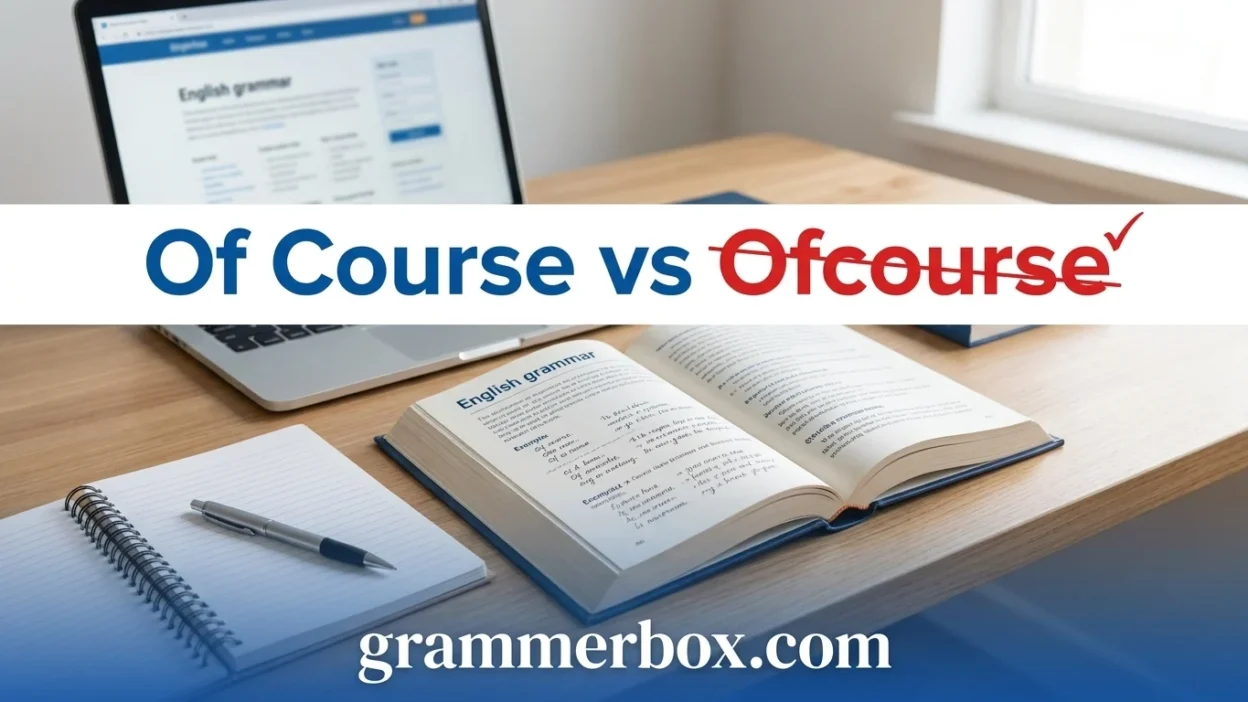
The correct form is “of course”—always written as two separate words in standard English. “Ofcourse” is generally considered a misspelling. The phrase is commonly used to mean “certainly,” “naturally,” or “as expected.” Understanding the correct spelling is especially useful for students, ESL learners, writers, and anyone who wants to communicate clearly and professionally.
Quick Answer
“Of course” is correct, while “ofcourse” is incorrect in standard English. The expression is always written as two words. Use of course when you mean “certainly,” “naturally,” or “yes.” Avoid writing ofcourse in formal or standard English.
Why People Confuse It
People often confuse of course and ofcourse because they are pronounced together as a single phrase in normal speech.
When spoken quickly, the words can sound like one unit. This makes it tempting to write them as one word.
Another reason is that English contains many compound words that have developed from separate words. For example:
- always is one word.
- already is one word.
- of course remains two words.
- ofcourse is not the standard spelling.
Typing habits can also contribute to the mistake, especially when people write quickly in text messages or on social media.
First Word: Of Course
Of course is the correct expression.
It is a common phrase used to express:
- certainty
- agreement
- permission
- something expected or obvious
- polite confirmation
Examples
- Of course, I can help you.
- She will of course attend the meeting.
- Of course, you can borrow my book.
- He was of course surprised by the news.
The phrase can appear at the beginning, middle, or end of a sentence depending on the intended emphasis.
Second Word: Ofcourse
Ofcourse is not the standard English spelling.
Although you may see it in informal online writing, social media posts, comments, or messages, it should generally be treated as a spelling error.
❌ Ofcourse, I will help you.
✅ Of course, I will help you.
If you are writing an essay, email, article, application, report, or professional message, use of course.
Of Course vs Ofcourse: Comparison Table
| Feature | Of Course | Ofcourse |
|---|---|---|
| Correct spelling | ✅ Yes | ❌ No |
| Number of words | Two | One |
| Standard English | ✅ Yes | ❌ No |
| Meaning | Certainly/naturally | Intended to mean “of course” |
| Formal writing | Appropriate | Avoid |
| Informal writing | Appropriate | Still considered incorrect |
| Dictionary-standard usage | Yes | No |
When to Use Each
When to Use “Of Course”
Use of course whenever you want to express certainty, agreement, or something that is naturally expected.
Example:
“Can I ask you a question?”
“Of course!”
It can also be used within longer sentences:
The manager was of course aware of the situation.
When to Use “Ofcourse”
In standard English, there is no normal situation where ofcourse should be used.
If you are tempted to write ofcourse, simply separate the words:
of course
Examples of “Of Course”
Here are more examples showing how the phrase works in everyday English:
- Of course, I remember your name.
- You can of course join us for dinner.
- Of course, she knew the answer.
- “Will you help me?” “Of course!”
- He was of course disappointed by the result.
- Of course, we can change the appointment.
- She is of course welcome to stay.
- “Do you want some coffee?” “Of course.”
- The team will of course need more time.
- Of course, everyone makes mistakes.
- You should of course check your work carefully.
- “Can I come with you?” “Of course you can.”
Notice that the spelling remains of course in every example.
Common Mistakes
1. Writing “Ofcourse”
❌ Ofcourse I understand.
✅ Of course I understand.
The two words should remain separate.
2. Using It as One Word Because It Sounds Connected
English pronunciation does not always tell you where word boundaries belong.
Even though of course may sound like one connected phrase, it is written as two words.
3. Treating It Like a Compound Word
Some expressions eventually become single words, but that does not mean every frequently used phrase follows the same pattern.
Of course has not become ofcourse in standard English.
4. Using Incorrect Spelling in Professional Writing
A spelling error such as ofcourse can make an otherwise polished email or article look less professional.
For formal communication, always choose of course.
Memory Trick
Use this simple trick:
“Of” + “course” = two words, of course!
Think of the phrase as describing something that is naturally or certainly the case.
You can also remember:
Of course = two words, no doubt.
Whenever you type ofcourse, pause and separate it into of course.
American vs British English
There is no meaningful spelling difference between American and British English for this expression.
Both varieties use:
of course
American English:
Of course, I’ll help you.
British English:
Of course, I’ll help you.
The expression has the same basic meaning in both varieties of English.
Similar Words and Expressions
Several expressions can have meanings similar to of course, depending on context.
Certainly
Means something is definite or true.
Certainly, I can help you.
Surely
Often expresses confidence that something is true or will happen.
Surely, you remember him.
Naturally
Suggests that something is expected or unsurprising.
Naturally, she was excited.
Definitely
Expresses strong certainty.
I will definitely attend.
Obviously
Indicates that something seems clear or easily understood.
Obviously, we need more information.
These words are related in meaning, but they are not always interchangeable. The choice depends on tone and context.
FAQs:
Is “ofcourse” one word?
No. Ofcourse is not the standard spelling. The correct form is of course, written as two words.
Is “of course” grammatically correct?
Yes. Of course is a standard English expression commonly used to express certainty, agreement, permission, or something expected.
Should “of course” be hyphenated?
No. In ordinary usage, write of course as two separate words without a hyphen.
Can I use “of course” in formal writing?
Yes. Of course is acceptable in formal writing, although the exact tone depends on the sentence and context.
Why do people write “ofcourse”?
It is usually a spelling mistake caused by the phrase being pronounced closely together or by informal typing habits.
Is “of course” the same in American and British English?
Yes. Both American and British English use of course as two words.
Is “ofcourse” ever correct?
In standard English, ofcourse is generally not considered a correct spelling. Use of course instead.
Remember This
Of course = correct ✅
Ofcourse = incorrect ❌
The phrase contains two words, so keep of and course separate.
Conclusion
Of course is one of the most common expressions in everyday English, but its spelling can easily cause confusion. Although the phrase may sound connected when spoken, standard written English keeps the two words separate. Ofcourse is not the accepted spelling.
If you are writing an email, school assignment, blog post, business document, or social media caption, choose of course. Once you remember that it is a two-word expression, this common spelling mistake becomes easy to avoid.