
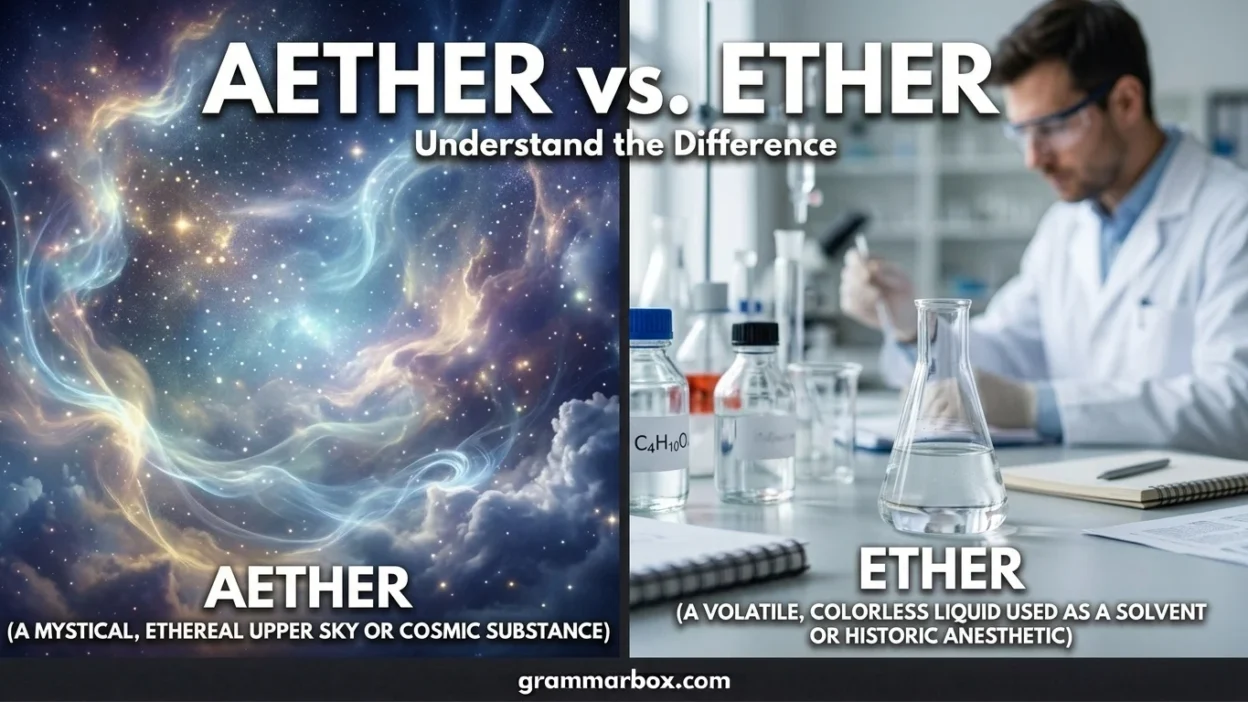
The English language contains many words that look or sound similar but have different meanings, origins, and uses. Aether vs ether is a good example. Both words have connections to ancient ideas about the sky, space, and the invisible substance believed to fill the universe. However, their meanings and contexts are not always interchangeable. Understanding the difference can help you choose the correct spelling when writing about mythology, philosophy, science, or literature.
Although aether and ether are sometimes used as spelling variants, they have distinct associations in modern English. Aether often appears in ancient Greek mythology, fantasy literature, and discussions of the classical concept of a heavenly substance. Ether, on the other hand, is commonly used in chemistry and scientific writing, particularly when referring to a class of organic compounds or diethyl ether. Knowing their historical backgrounds and modern applications makes it easier to recognize which word fits your sentence.
Quick Answer
Aether vs ether: Both words can refer to an imagined substance associated with the heavens or space, but their modern uses differ. Aether is often associated with ancient mythology, classical philosophy, and fantasy. Ether is the more common spelling in chemistry, especially for a class of organic compounds and the chemical substance diethyl ether.
Why People Confuse It
People often confuse aether and ether because the words have closely related histories and overlapping meanings. Both are connected to the ancient Greek word aithēr, which referred to the bright upper air or the pure substance believed to exist above the ordinary atmosphere.
Over time, the spellings developed different associations in English. Writers may encounter aether in mythology books, fantasy novels, or historical discussions of classical philosophy. Meanwhile, students often see ether in chemistry textbooks and scientific explanations.
Three reasons contribute to the confusion:
- Similar meanings: Both words can refer to a supposed substance filling the heavens or space.
- Related origins: Both spellings trace back to the same ancient Greek root.
- Different contexts: Modern scientific writing generally favors ether, while aether often carries a historical, literary, or fantastical tone.
The key is to consider the subject of your sentence rather than choosing a spelling based only on appearance.
Aether: Meaning and Usage
Aether is a noun associated with ancient Greek mythology, classical philosophy, and certain literary traditions. In Greek mythology, Aether personifies the bright upper air breathed by the gods. In classical thought, aether was also described as a special substance beyond the ordinary four elements.
Historically, some philosophers believed that aether filled the celestial region beyond Earth. Later, the luminiferous aether became a proposed medium through which light traveled. Experiments and the development of modern physics eventually undermined this theory.
Today, aether commonly appears in historical, poetic, and fantasy contexts.
Examples of aether in sentences:
- The ancient Greeks imagined aether as the pure air of the heavens.
- The fantasy novel described aether flowing through the magical kingdom.
- The poet used aether to evoke the vastness of the celestial realm.
- The philosopher discussed the role of aether in ancient cosmology.
- In the game, the wizard drew energy from the aether surrounding the stars.
When to use aether:
- When discussing the mythological figure Aether.
- When explaining historical beliefs about the heavenly substance.
- When writing fantasy or speculative fiction.
- When reproducing a historical text that uses this spelling.
Remember that aether is not automatically the correct choice for every reference to space. The intended meaning and the conventions of the subject determine the best spelling.
Ether: Meaning and Usage
Ether is a noun with several meanings, particularly in chemistry, historical science, and older discussions of physics.
In chemistry, an ether is a type of organic compound containing an oxygen atom bonded to two carbon-containing groups. Diethyl ether is a familiar example and has historically been used as an anesthetic. It is also a highly volatile and flammable liquid.
The word ether can also refer to the hypothetical medium once believed to carry light waves. In older scientific writing, this concept is often called the luminiferous ether.
Examples of ether in sentences:
- The chemistry student studied the structure of an ether.
- Diethyl ether was historically used as a general anesthetic.
- The laboratory stored ether away from heat and ignition sources.
- The scientist examined the properties of a particular ether compound.
- Older physics textbooks discussed the hypothetical ether through which light supposedly traveled.
When to use ether:
- When discussing organic chemistry and ether compounds.
- When referring to diethyl ether.
- When describing the historical luminiferous ether theory.
- When using the conventional spelling in scientific or general writing.
In contemporary English, ether is generally the standard spelling for these scientific meanings.
Aether vs Ether: Comparison Table
| Feature | Aether | Ether |
|---|---|---|
| Part of speech | Noun | Noun |
| Historical origin | Ancient Greek aithēr | Ancient Greek aithēr |
| Mythology | Associated with the Greek personification of upper air | May appear in broader historical discussions |
| Classical philosophy | Spelling used for the celestial substance | Also used in discussions of the same concept |
| Chemistry | Uncommon spelling for chemical meanings | Standard spelling for a class of organic compounds |
| Fantasy writing | Often used for magical or celestial substances | Also possible, depending on the fictional world |
| Modern scientific usage | Less common | More common |
| Example | The hero harnessed aether. | The chemist studied ether. |
The main distinction is contextual rather than absolute: aether tends to evoke mythology and literary traditions, while ether is the usual choice in modern chemistry.
When to Use Each
Choosing between aether and ether becomes easier when you identify the subject and purpose of your writing.
Use Aether When:
- You are describing the Greek mythological figure or the heavenly upper air.
- You are discussing historical philosophical ideas and want to preserve a traditional spelling.
- You are writing fantasy fiction involving celestial energy or magical substances.
- You are quoting a source that specifically uses aether.
Example: The sorcerer gathered aether from the shimmering night sky.
Use Ether When:
- You are writing about organic chemistry.
- You are referring to diethyl ether or another ether compound.
- You are explaining the historical theory of luminiferous ether using conventional scientific terminology.
- You need the standard spelling in general modern English.
Example: The researcher examined the molecular structure of the ether.
What If Both Spellings Seem Correct?
In discussions of ancient cosmology, either spelling may be encountered. Follow the terminology used by your source, publisher, or academic discipline. In chemistry, choose ether unless you have a specific reason to reproduce a different spelling.
Examples of Aether vs Ether in Sentences
These examples demonstrate how context helps determine the appropriate word.
- Aether: Ancient philosophers believed that aether filled the celestial regions beyond Earth.
- Ether: The chemist explained how an ether compound differs from an alcohol.
- Aether: The fantasy hero traveled through a sea of glowing aether.
- Ether: Diethyl ether was once widely used to induce surgical anesthesia.
- Aether: The poet described the stars as jewels scattered across the aether.
- Ether: The laboratory followed strict precautions when handling ether.
- Aether: The historian examined ancient descriptions of Aether, the Greek divine personification.
- Ether: The textbook introduced ethers as a class of organic compounds.
- Aether: In the fictional universe, aether powered the floating cities.
- Ether: Early physicists proposed that light traveled through a luminiferous ether.
- Aether: The author used the word aether to create a mysterious, otherworldly atmosphere.
- Ether: The chemistry report identified the compound as an ether.
Notice that the words can overlap when discussing historical beliefs about a heavenly substance. The strongest clue is whether the sentence concerns mythology and literary imagery or conventional chemical terminology.
Common Mistakes
Even experienced writers can mix up aether and ether. Here are some common mistakes to avoid.
1. Using aether as the standard chemical term
Incorrect for conventional modern scientific writing: The student studied the structure of aether compounds.
Preferred: The student studied the structure of ether compounds.
2. Assuming aether is always a different substance
The spellings can refer to the same historical concept. The difference often reflects writing tradition or context rather than two universally distinct substances.
3. Treating the ancient aether as an established scientific substance
Ancient philosophers proposed a celestial substance, and later physicists hypothesized a medium for light. These were historical ideas, not evidence that a luminiferous ether exists.
4. Confusing ether with the entire class of chemical substances
In chemistry, ether can refer to a class of compounds, not just diethyl ether. The specific compound should be identified when precision matters.
5. Choosing a spelling without considering the audience
A fantasy reader may expect aether for a magical force, while a chemistry instructor will normally expect ether for the compound class.
Memory Trick: How to Remember Aether vs Ether
A simple memory trick can help you choose the right word.
- Aether = Ancient and Astral: Think of ancient mythology, heavenly air, celestial realms, and fantasy.
- Ether = Experiments and Elements: Think of chemistry laboratories, molecular structures, and scientific terminology.
The letter A in aether can remind you of ancient, while ether is the spelling to remember for modern chemical compounds.
These associations are helpful guidelines, not strict rules. Historical scientific discussions may use ether, and fictional works can use either spelling.
American vs British English
Unlike many English spelling differences, aether and ether are not primarily an American-versus-British spelling pair.
Both American English and British English commonly use ether for chemical compounds and the historical scientific concept. Both can also use aether in mythology, literature, historical writing, and specialized contexts.
| Context | American English | British English |
|---|---|---|
| Chemical compounds | Ether | Ether |
| Diethyl ether | Ether | Ether |
| Ancient or literary celestial substance | Aether or ether, depending on context | Aether or ether, depending on context |
| Historical light-medium theory | Usually ether | Usually ether |
For ordinary writing, use ether when discussing chemistry, regardless of whether your audience is American or British. For mythology or fiction, select the spelling that best matches your source and intended style.
Similar Words
Several words are related to aether and ether or appear in similar discussions.
- Aethereal: A rare or specialized variant related to ethereal, sometimes used to evoke a heavenly or otherworldly quality.
- Ethereal: Extremely delicate, light, heavenly, or seemingly not of this world. Example: The painting had an ethereal beauty.
- Ethereality: The quality of being ethereal or otherworldly.
- Luminiferous ether: The hypothetical medium once believed to carry light waves through space.
- Aether theory: A broad label that may refer to historical or philosophical concepts of aether, depending on the source.
- Diethyl ether: A specific chemical compound historically used as an anesthetic and also used as a solvent.
- Celestial: Relating to the sky, outer space, or the heavens.
- Quintessence: A term historically associated with the fifth element in some philosophical traditions, sometimes linked to the idea of aether.
Although these terms share related ideas, they are not interchangeable. For example, ethereal describes a quality, while ether is a noun that can identify a chemical compound.
FAQs:
1. Is aether the same as ether?
They can refer to the same historical concept of a heavenly or space-filling substance. However, aether often has mythological or literary associations, whereas ether is the standard spelling for chemical compounds.
2. Which spelling is correct: aether or ether?
Both spellings are correct in appropriate contexts. Use ether for chemistry and most modern scientific references. Use aether when it suits a mythological, historical, or literary context.
3. Is aether an actual scientific substance?
The word has been used for several historical concepts, including the celestial substance of ancient philosophy and the hypothetical medium for light. The proposed luminiferous ether is not part of modern physics.
4. What is ether in chemistry?
An ether is a class of organic compounds in which an oxygen atom is bonded to two carbon-containing groups. Diethyl ether is one well-known example.
5. Why do fantasy writers use the word aether?
Fantasy writers often use aether to suggest celestial energy, magical power, an invisible cosmic force, or a connection to ancient mythology. Its spelling gives the word a traditional or mystical feel.
6. Is aether an American or British spelling?
It is not a standard regional spelling distinction like color and colour. Both American and British English use ether in chemistry and may use aether in literary or historical contexts.
7. What is the difference between ether and ethereal?
Ether is a noun that can refer to a chemical compound or a historical hypothetical substance. Ethereal is an adjective meaning delicate, heavenly, or otherworldly.
Conclusion
Understanding aether vs ether is easier when you remember their shared history and different modern associations. The words are related, but they are not always interchangeable in contemporary writing. Aether often conveys an ancient, celestial, or imaginative meaning, while ether is the familiar spelling in scientific and chemical contexts.
Ultimately, neither spelling is universally correct in every situation. Consider your topic, audience, and the conventions of your field before making a choice. Whether you are writing a fantasy story, exploring ancient Greek mythology, or studying organic chemistry, using the appropriate word will make your writing clearer and more precise.
Remember This
Aether = ancient, celestial, and often literary. Ether = the standard spelling for chemical compounds and most modern scientific usage. Always let context guide your choice.