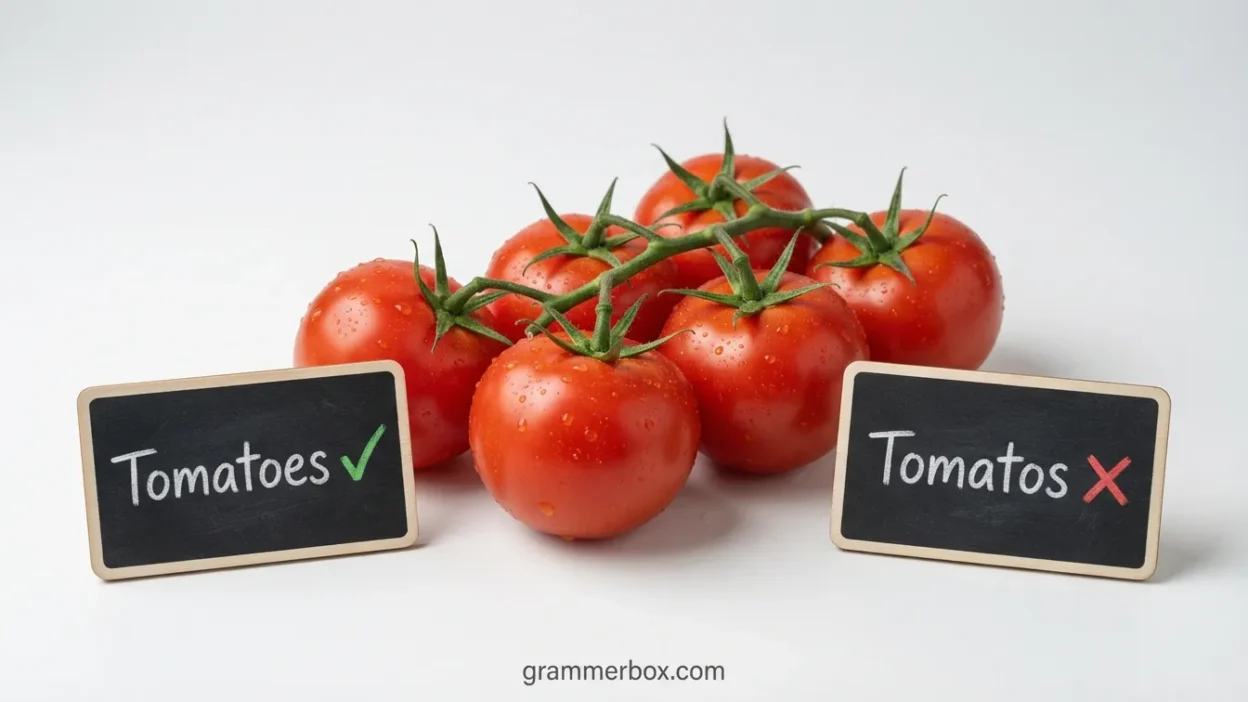
Have you ever paused while writing the word tomatoes and wondered whether it should be spelled tomatos instead? You are not alone. This small spelling difference often confuses English learners, students, and even experienced writers. Both versions look reasonable because many English words form their plurals by simply adding an -s to the singular form. However, the plural of tomato follows a different spelling pattern.
The correct spelling is tomatoes, not tomatos. Although the word ends in the letter o, English spelling conventions generally require -es when forming its plural. Understanding this rule can help you avoid similar mistakes with other words, such as potatoes, heroes, and echoes. If you are writing a school assignment, preparing a recipe, or creating professional content, knowing the correct plural form will make your English clearer and more accurate.
Quick Answer
Tomatoes is the correct plural spelling of tomato. The word tomatos is a common misspelling and should be avoided in standard English. When referring to more than one tomato, always write tomatoes, adding -es rather than just -s.
Why People Confuse It
People often confuse tomatoes and tomatos because English has different rules for forming plural nouns.
Most regular nouns form their plurals by adding -s:
- Book → Books
- Chair → Chairs
- Apple → Apples
- Car → Cars
Since tomato already ends in the letter o, some writers assume that adding an s is enough.
However, many nouns ending in consonant + o form their plurals by adding -es. This is why tomatoes is correct.
Another reason for the confusion is that English has exceptions. For example, photos and pianos take only an -s. These different patterns make it difficult for learners to remember which ending to use.
First Word: Tomatoes
Tomatoes is the correct plural form of the singular noun tomato.
A tomato is a round, usually red fruit commonly used as a vegetable in cooking. It is an important ingredient in salads, sauces, soups, sandwiches, and many other dishes.
When you have more than one tomato, you use tomatoes.
Examples:
- I bought five fresh tomatoes from the market.
- These tomatoes are perfect for making sauce.
- She added chopped tomatoes to the salad.
- The farmer grows organic tomatoes on his land.
- We need three tomatoes for this recipe.
Why is tomatoes correct?
The singular word tomato ends in a consonant followed by o. In its standard plural form, you add -es:
Tomato + es = Tomatoes
This is the accepted spelling in standard American and British English.
Second Word: Tomatos
Tomatos is an incorrect spelling of the plural form of tomato in standard English.
It usually appears when someone applies the basic plural rule of adding -s without considering the spelling convention for certain nouns ending in o.
For example, a writer might think:
Tomato + s = Tomatos
Although this seems logical, it does not produce the accepted spelling.
Incorrect examples:
- I bought some fresh tomatos.
- The garden is full of ripe tomatos.
- She used three tomatos in the recipe.
- These tomatos taste delicious.
Correct versions:
- I bought some fresh tomatoes.
- The garden is full of ripe tomatoes.
- She used three tomatoes in the recipe.
- These tomatoes taste delicious.
Remember that tomatos should not be used in formal writing, academic assignments, professional communication, or standard English.
Tomatoes vs Tomatos: Comparison Table
| Feature | Tomatoes | Tomatos |
|---|---|---|
| Spelling | Correct | Incorrect |
| Singular form | Tomato | Tomato |
| Plural ending | -es | -s |
| Grammar | Standard English | Nonstandard spelling |
| Usage | Formal and informal writing | Avoid |
| Example | Five tomatoes | Five tomatos |
The important difference is that tomatoes is the accepted plural spelling, while tomatos is a spelling mistake.
When to Use Each
Knowing when to use each spelling is simple because only one form is correct in standard English.
Use Tomatoes
Use tomatoes whenever you are talking about two or more tomatoes.
Examples:
- We planted ten tomatoes in the garden.
- Fresh tomatoes make this sandwich delicious.
- The grocery store sells different varieties of tomatoes.
- I prefer tomatoes in my vegetable salad.
Avoid Tomatos
Do not use tomatos as the plural of tomato in standard English.
If you see this spelling in a message, article, recipe, or social media post, it should generally be corrected to tomatoes.
Examples of Tomatoes in Sentences
Here are 15 examples showing how to use tomatoes correctly in everyday English.
- I bought six fresh tomatoes from the grocery store.
- These tomatoes are perfect for making homemade ketchup.
- My mother grows tomatoes in her backyard garden.
- We need two ripe tomatoes for this salad.
- The farmer harvested hundreds of tomatoes this morning.
- She sliced the tomatoes and placed them on the sandwiches.
- Fresh tomatoes contain water and several essential nutrients.
- The children helped pick tomatoes from the garden.
- I added chopped tomatoes to the vegetable soup.
- These tomatoes are sweeter than the ones we bought yesterday.
- The supermarket offers fresh tomatoes throughout the year.
- He prefers eating tomatoes with a little salt.
- The tomato plants produced many beautiful tomatoes this summer.
- Please wash the tomatoes before cutting them.
- We used fresh tomatoes to prepare a delicious pasta sauce.
Notice that tomatoes works naturally whenever you refer to multiple tomatoes.
Common Mistakes
Even though the correct spelling is straightforward, several mistakes can occur when writing the plural of tomato.
Here are some common errors to avoid.
1. Writing Tomatos Instead of Tomatoes
Incorrect: I bought four tomatos.
Correct: I bought four tomatoes.
Always add -es to form the standard plural.
2. Using Tomato for Multiple Items
Incorrect: She bought five tomato.
Correct: She bought five tomatoes.
Use the plural form when referring to more than one.
3. Confusing Tomato and Tomatoes
- Tomato = One
- Tomatoes = More than one
Example: I ate one tomato, but my brother ate three tomatoes.
4. Assuming Every Word Ending in O Takes -S
Not every noun ending in o follows the same plural rule.
For example:
- Potato → Potatoes
- Hero → Heroes
- Photo → Photos
- Piano → Pianos
Learn the accepted plural form of each word instead of applying one rule to every noun.
Memory Trick: How to Remember Tomatoes
A simple memory trick can help you remember the correct spelling.
Think of the word potatoes.
If you already know that the plural of potato is potatoes, you can use the same familiar ending to remember tomatoes.
Tomato → Tomatoes
Remember this simple pattern:
- One tomato
- Two tomatoes
- Three tomatoes
- Many tomatoes
You can also remember the phrase:
Tomatoes need ES to become plural.
This small trick can help you avoid writing tomatos by mistake.
American vs British English
There is no spelling difference between American and British English when it comes to tomatoes.
Both varieties use tomatoes as the correct plural spelling of tomato.
| English Variety | Singular | Plural |
|---|---|---|
| American English | Tomato | Tomatoes |
| British English | Tomato | Tomatoes |
| Canadian English | Tomato | Tomatoes |
| Australian English | Tomato | Tomatoes |
Although American and British English sometimes use different spellings, such as color and colour, the word tomatoes remains the same in both varieties.
Therefore, whether you are writing for an American audience or a British audience, always choose tomatoes.
Similar Words
Several English nouns ending in o also form their plurals with -es. Learning these examples can help you understand the spelling pattern.
| Singular | Correct Plural |
|---|---|
| Potato | Potatoes |
| Hero | Heroes |
| Echo | Echoes |
| Mango | Mangoes |
| Volcano | Volcanoes |
| Torpedo | Torpedoes |
| Mosquito | Mosquitoes |
| Zero | Zeroes |
However, some nouns ending in o simply take -s:
| Singular | Correct Plural |
|---|---|
| Photo | Photos |
| Piano | Pianos |
| Radio | Radios |
| Video | Videos |
| Zoo | Zoos |
| Kilo | Kilos |
These examples show why it is useful to learn individual plural forms rather than assuming every noun follows exactly the same rule.
FAQs:
1. Is it tomatoes or tomatos?
Tomatoes is the correct spelling. Tomatos is a common misspelling and is not accepted as the standard plural form of tomato.
2. What is the plural of tomato?
The plural of tomato is tomatoes. You form it by adding -es to the singular noun.
3. Why does tomato become tomatoes instead of tomatos?
Many nouns ending in consonant + o form their plurals by adding -es. Tomato follows this spelling pattern, giving us tomatoes.
4. Is tomatoes correct in American English?
Yes. Tomatoes is the correct plural spelling in American English. The spelling is also identical in British, Canadian, and Australian English.
5. Is tomatos ever correct?
No. Tomatos is not the standard plural spelling of tomato. In ordinary English writing, you should always use tomatoes.
6. What is the difference between tomato and tomatoes?
Tomato is a singular noun referring to one fruit, while tomatoes is its plural form, referring to two or more.
Example: I bought one tomato yesterday and four tomatoes today.
7. Do all words ending in O take ES in the plural?
No. Some nouns take -es, such as potatoes and heroes, while others take only -s, such as photos and pianos. The correct form depends on the individual word.
Final Verdict: Tomatoes or Tomatos?
The correct spelling is tomatoes, not tomatos. Whenever you want to describe more than one tomato, add -es to the singular form. This is the standard spelling used in American English, British English, and other major varieties of English.
Although tomatos might look reasonable because many English nouns form their plurals by adding only -s, it is not the accepted spelling. Remember the similar word potatoes to make the correct form easier to recall. Whether you are writing a grocery list, preparing a recipe, or completing an academic assignment, always choose tomatoes.
Remember This
- Tomato = Singular (one).
- Tomatoes = Plural (two or more).
- Tomatos = Incorrect spelling.
- Add -es, not just -s, to form the standard plural.
The easiest way to remember is: One tomato, two tomatoes!