
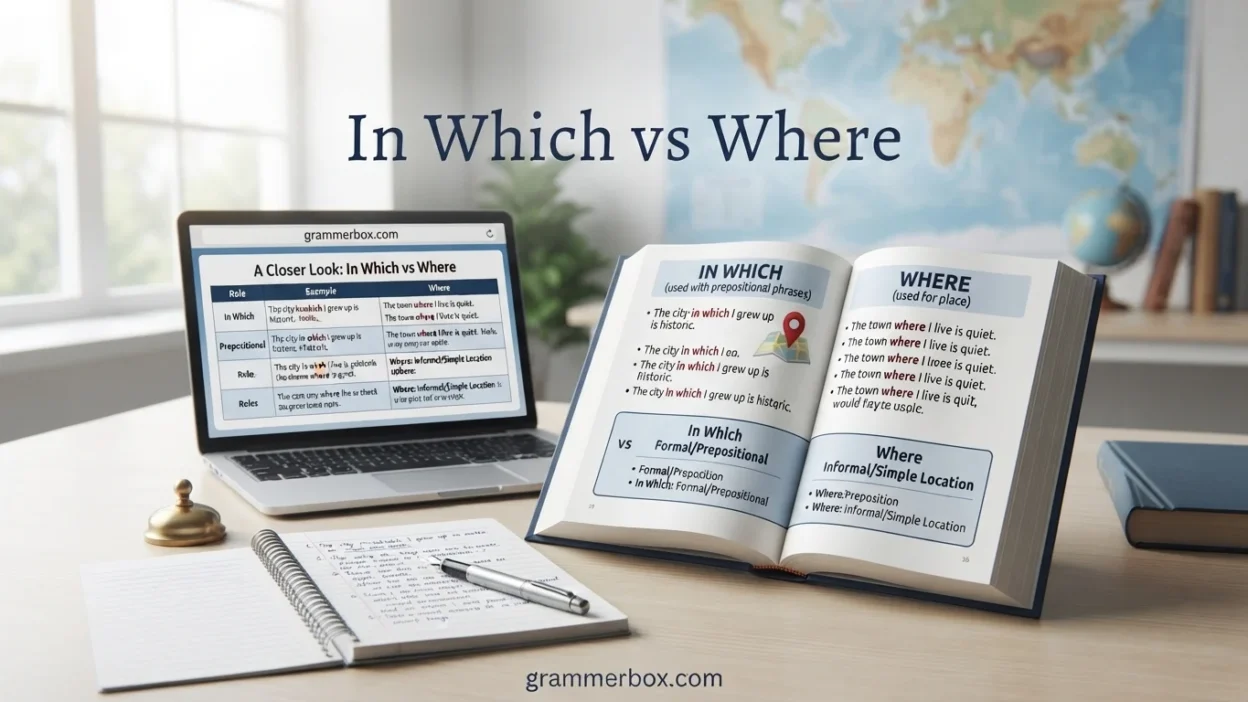
When choosing between in which vs where, many English learners hesitate because both expressions can refer to a place, situation, or context. In some sentences, they can even communicate nearly the same idea. However, they are not always interchangeable. The key difference is usually grammatical: where is an adverb that can refer to a place or situation, while in which is a prepositional phrase followed by a relative pronoun.
Understanding this distinction can make your writing sound clearer and more natural. In which is often preferred in formal or academic writing, while where is generally more concise and conversational. The correct choice depends on what the preceding noun means and how the sentence is structured. In this guide, we’ll explain in which vs where, show clear examples, highlight common mistakes, and give you a simple memory trick so you can confidently choose the right expression.
Quick Answer
In which and where can both introduce relative clauses, especially when referring to places or situations. Where is usually more natural and concise, while in which often sounds more formal. For physical locations, both may work: “the house where I live” and “the house in which I live.”
Why People Confuse It
People often confuse in which and where because they can sometimes appear in almost identical sentences.
For example:
- This is the room where we met.
- This is the room in which we met.
Both sentences are grammatically correct and have essentially the same meaning.
The difference becomes clearer when you consider grammar, formality, and the type of noun being described.
Where is commonly used after words referring to places or situations. In which contains the preposition in and the relative pronoun which, making it a more explicit and often more formal construction.
First Word: In Which
In which is a combination of the preposition in and the relative pronoun which.
It is used to introduce a relative clause and is especially common in formal, academic, professional, and written English.
Examples
- This is the building in which the company operates.
- She described the situation in which she found herself.
- We visited the town in which my grandfather was born.
- The report explains the conditions in which the experiment was conducted.
Because in which sounds more formal, it is particularly useful when writing essays, reports, research papers, and other formal documents.
Meaning of “In Which”
Depending on context, in which can mean:
- in that place
- in that situation
- during that period
- within that condition or circumstance
For example:
The laboratory in which the research was conducted was closed.
Here, in which refers to the laboratory where the research took place.
Second Word: Where
Where is commonly used as a relative adverb to refer to a place, location, or sometimes a situation.
It is generally shorter and more natural in everyday English.
Examples
- This is the house where I grew up.
- Do you remember the restaurant where we had dinner?
- She explained the situation where nobody knew what to do.
For physical locations, where is particularly common.
Instead of saying:
This is the office in which I work.
You can usually say:
This is the office where I work.
The second version is more conversational and concise.
Comparison Table
| Feature | In Which | Where |
|---|---|---|
| Grammar | Preposition + relative pronoun | Relative adverb |
| Main use | Places, situations, conditions | Places and locations |
| Formality | More formal | More natural/conversational |
| Common in academic writing | Yes | Yes, depending on context |
| Common in everyday speech | Less common | Very common |
| Example | The room in which I work | The room where I work |
| Can refer to situations | Yes | Sometimes |
| Usually concise | No | Yes |
When to Use Each
Use “Where” for Places
Use where when referring naturally to a physical location.
- The school where I studied is nearby.
- This is the park where we played.
- I know a café where you can get excellent coffee.
Use “In Which” for Formal Writing
When writing formally, in which can provide a more precise or traditional structure.
- The study describes the environment in which children learn.
- The company created a system in which employees can share ideas.
Use “In Which” for Situations or Conditions
In which is especially useful when the noun refers to a situation, process, system, or condition.
- They faced a situation in which no easy solution existed.
- We developed a system in which every member has a role.
- It was a period in which major changes occurred.
Use “Where” When It Sounds Natural
In less formal contexts, where can often replace in which when the meaning is clear.
- This is the situation where things became complicated.
- That was the moment where everything changed.
However, with abstract nouns such as situation, case, circumstance, or condition, in which is often more precise in formal writing.
Examples of In Which vs Where
1. Physical Place
Natural: This is the house where I grew up.
Formal: This is the house in which I grew up.
2. Workplace
Natural: The office where she works is downtown.
Formal: The office in which she works is downtown.
3. School
Natural: I remember the school where we met.
Formal: I remember the school in which we met.
4. Situation
Formal: They were placed in a situation in which they had to make a quick decision.
5. System
The company introduced a system in which employees could work remotely.
6. Environment
Children learn best in an environment in which they feel comfortable.
7. City
Paris is the city where she was born.
More formally:
Paris is the city in which she was born.
8. Restaurant
That is the restaurant where we celebrated your birthday.
9. Process
The process in which the chemicals react requires careful monitoring.
10. Period
It was a difficult period in which many families struggled.
11. Situation
We encountered a situation in which nobody knew what to do.
12. Building
The building where they hold meetings is across the street.
Common Mistakes
Mistake 1: Using “Where” for Every Situation
Some writers use where whenever they see a noun that describes a context.
For example:
The circumstances where he made the decision were unusual.
In formal writing, this is better expressed as:
The circumstances in which he made the decision were unusual.
Mistake 2: Forgetting the Preposition
If the sentence requires in, you cannot simply remove it from an in which construction without checking the grammar.
Incorrect:
This is the situation which I found myself.
Better:
This is the situation in which I found myself.
Or more naturally:
This is the situation that I found myself in.
Mistake 3: Using “In Where”
Do not combine the two expressions.
❌ The house in where I live is old.
Correct:
✅ The house where I live is old.
Or:
✅ The house in which I live is old.
Mistake 4: Thinking “In Which” Is Always Better
In which is not automatically more correct.
For ordinary conversation:
Where do you live?
is much more natural than trying to use a formal construction.
Memory Trick
Use this simple rule:
Place → Where
Formal place/situation + “in” meaning → In which
Think:
Where = simple and natural
In which = formal and precise
For example:
The room where I work → everyday English.
The environment in which I work → formal English.
If you can naturally replace the expression with “in that place”, in which may be appropriate.
American vs British English
There is no major American-versus-British English difference in the basic grammatical distinction between where and in which.
Both varieties commonly use where for locations:
- The house where I live.
- The restaurant where we ate.
Both also use in which in formal writing:
- The conditions in which the experiment was performed.
- The situation in which the decision was made.
The bigger difference is usually style and formality, not nationality. Everyday speech tends to favor the shorter where, while formal writing may use in which more frequently.
Similar Words
Several other relative words and constructions are related to in which vs where.
Where
Used mainly for places:
This is the city where I was born.
In Which
Often used for formal references to places, situations, systems, and conditions:
This is the city in which I was born.
Which
Can introduce a relative clause but does not always replace in which.
The house which I bought is old.
That
Often works in less formal relative clauses:
The house that I bought is old.
In Which vs Where vs That
Compare:
- The room where we met was small.
- The room in which we met was small.
- The room that we met in was small.
All three can be grammatical, but their structure and style differ.
FAQs:
1. Is “in which” the same as “where”?
Sometimes. When referring to a place, in which and where can have essentially the same meaning.
The house where I live.
The house in which I live.
2. Is “where” more informal than “in which”?
Generally, where sounds more natural and conversational, while in which often has a more formal or written tone.
3. Can I use “in which” for a situation?
Yes. In which is commonly used with abstract nouns such as situation, condition, circumstance, and system.
4. Can “where” refer to a situation?
Yes, especially in conversational English, although in which may be more precise in formal writing.
5. Is “in where” correct?
No. Do not combine in and where in this way.
Use either:
the place where I work
or:
the place in which I work
6. Which is better: “the place where” or “the place in which”?
Both can be correct. The place where is generally more natural in everyday English, while the place in which sounds more formal.
7. Can “where” and “in which” always replace each other?
No. They can overlap when referring to locations or certain situations, but their grammatical structures are different. Always consider the meaning and construction of the sentence.
Remember This
Where = natural way to refer to a place.
In which = more formal construction that can refer to a place, situation, condition, system, or process.
When in doubt, ask yourself: Am I talking about a place, or do I need to emphasize the “in” relationship?
Conclusion
Understanding in which vs where becomes much easier once you focus on both meaning and sentence structure. For ordinary locations, where is usually concise and natural: “the city where I live.” For formal writing or abstract contexts, in which can be more suitable: “the circumstances in which the decision was made.”
Neither expression is automatically better in every situation. The best choice depends on the noun, the intended meaning, and the level of formality. Mastering this small distinction will help you write clearer sentences and avoid common relative-clause mistakes.