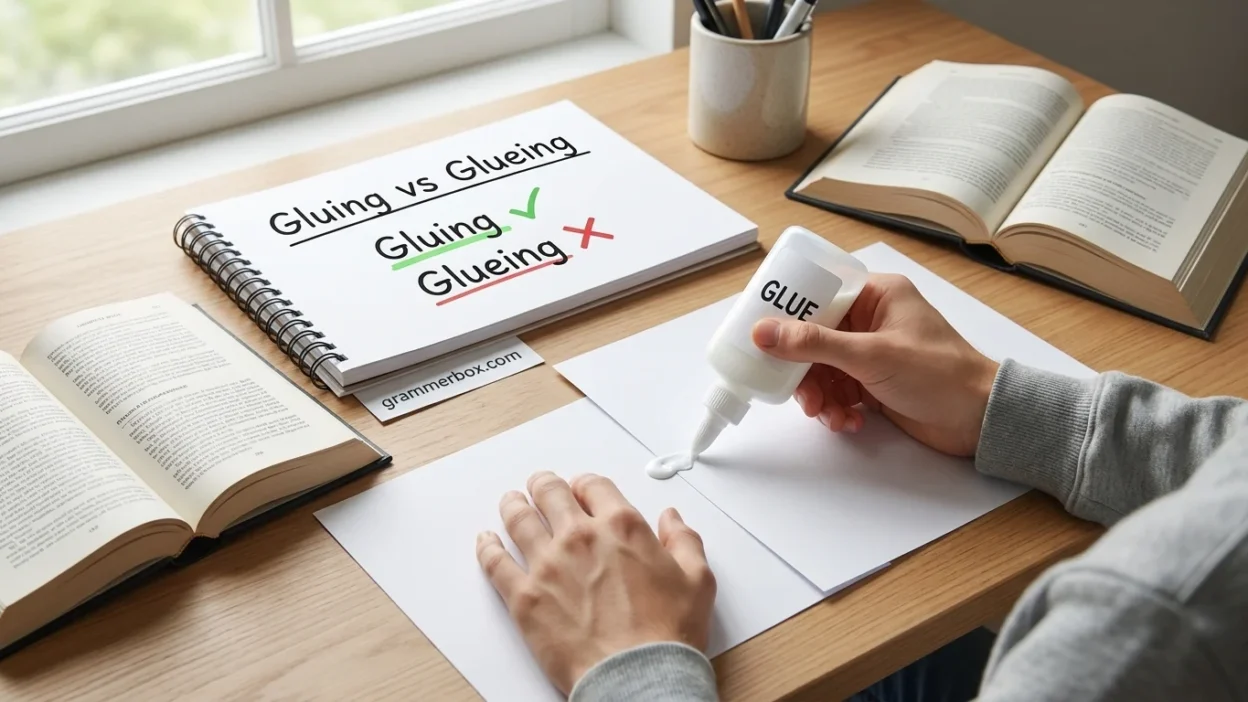
If you have ever hesitated between gluing and glueing, you are not alone. The two spellings look almost identical, but one is much more common in modern English. This confusion usually happens because the verb glue ends in a silent e, and English spelling rules can be inconsistent when adding -ing. If you are writing a school assignment, professional instructions, or a casual message, choosing the right form can make your writing look more polished.
The good news is that gluing is the standard and widely preferred spelling. Glueing is also found, particularly in some British English sources, but it is much less common. Both forms come from the verb glue, meaning to join something using adhesive. In this guide, we will explain the difference between gluing and glueing, show when to use each form, and provide practical examples so you can remember the correct spelling easily.
Quick Answer
Gluing is the standard and most widely accepted spelling of the present participle of glue. Glueing is a less common variant, especially associated with British English. For most writing, gluing is the safest choice. Use it when describing the action of joining things with glue or adhesive.
Why People Confuse It
The confusion comes from the spelling of the base verb glue.
When we add -ing to many verbs ending in a silent e, the final e is removed:
- make → making
- write → writing
- take → taking
- use → using
Following that pattern, you might expect:
- glue → glueing
However, standard modern usage generally favors gluing, with the final e removed and the spelling changed to gluing.
The unusual-looking combination gl + u + i can make gluing feel strange at first. As a result, some writers add the e and write glueing instead.
Gluing
Gluing is the standard spelling used in most modern English writing.
It is the present participle and gerund form of the verb glue. It means joining or attaching something with glue or another adhesive.
Examples
- I am gluing the pieces together.
- She spent the afternoon gluing pictures into her scrapbook.
- We are gluing the broken parts back together.
- He is gluing the label onto the box.
Gluing can also appear after forms of be to describe an action that is happening:
They are gluing the cardboard pieces together.
It can also function as a noun:
Gluing the pieces requires patience.
Because it is the more common spelling, gluing is generally the best choice for essays, websites, educational materials, business writing, and everyday communication.
Glueing
Glueing is a variant spelling of gluing.
It represents the same action: attaching or joining something with glue. You may encounter it in British English dictionaries, older texts, or writing influenced by British spelling conventions.
For example:
She was glueing the photographs into her notebook.
The meaning is exactly the same as:
She was gluing the photographs into her notebook.
The important point is that glueing is not a different verb. It is simply an alternative spelling.
However, because gluing is considerably more common and widely recognized, it is usually the better option when you want the spelling that will look natural to the broadest English-speaking audience.
Gluing vs Glueing: Comparison Table
| Feature | Gluing | Glueing |
|---|---|---|
| Base verb | Glue | Glue |
| Meaning | Joining with glue | Joining with glue |
| Part of speech | Present participle/gerund | Present participle/gerund |
| Standard modern usage | Yes | Less common variant |
| American English | Very common | Rare |
| British English | Common | Also found |
| Best general choice | Yes | Usually no |
| Example | She is gluing the pieces. | She is glueing the pieces. |
When to Use Each
Use “gluing” in most situations
Choose gluing when you want the standard, familiar spelling.
Use it in:
- Academic writing
- Professional documents
- Blog posts
- Instructions
- Schoolwork
- Emails
- General communication
- American English
- Most modern international English
For example:
The students are gluing colored paper onto the poster.
Use “glueing” when following a specific spelling convention
Glueing can appear in British English and other varieties or sources that retain this spelling.
If you are editing or quoting a text that consistently uses glueing, there may be no need to change it. However, if you are simply choosing which spelling to write yourself, gluing is normally the safer choice.
Gluing vs Glueing: 12 Examples
Here are practical examples showing how the word works in everyday sentences.
- I am gluing the broken pieces together.
- She is gluing photographs into her scrapbook.
- The children enjoyed gluing paper shapes onto the poster.
- He spent an hour gluing the model airplane together.
- We are gluing the cardboard to the wooden frame.
- The artist is gluing small pieces of fabric onto the canvas.
- Gluing the pieces requires a steady hand.
- They were gluing decorations onto the birthday cards.
- She finished gluing the pages into the notebook.
- The teacher demonstrated how to safely use glue for gluing crafts.
- He was gluing the loose parts back onto the toy.
- The students are gluing their projects together before presenting them.
You could technically replace gluing with glueing in these sentences, but the shorter form is more familiar to most modern readers.
Common Mistakes
1. Assuming “glueing” must be correct because “glue” keeps its e
English spelling rules are not always perfectly predictable. The fact that glue ends in e does not mean you should automatically preserve that letter before -ing.
Preferred: She is gluing the pieces.
2. Thinking “gluing” is a typo
Some learners see gluing and think it should be glueing. In standard modern usage, however, gluing is a well-established spelling.
3. Treating the two forms as different words
They have the same meaning and grammatical function. The difference is spelling, not definition.
4. Using “glueing” when you want the most widely recognized form
Although glueing exists as a variant, gluing is generally the better choice for broad audiences.
5. Confusing “gluing” with “glue”
Remember that glue is the base verb, while gluing describes the ongoing action.
- I glue the pieces together.
- I am gluing the pieces together.
Memory Trick
Here is a simple way to remember the preferred spelling:
GLUE + ING → GLUING
Think of it as removing the final e before adding -ing:
GLUE → GLU + ING → GLUING
A quick sentence to memorize is:
“I am gluing the pieces together.”
If you remember that sentence, you will have the most common spelling ready whenever you need it.
American vs British English
The spelling difference is not as straightforward as some American-versus-British pairs such as color/colour or center/centre.
In both American and British English, gluing is widely used. However, glueing can also be encountered in British English and is recognized as a variant.
So the safest general rule is:
- American English: Prefer gluing.
- British English: Gluing is also common and generally the safest choice.
- Alternative form: Glueing may appear, especially in British sources.
If you are writing for an international audience, gluing avoids unnecessary spelling confusion.
Similar Words
Understanding related forms can make the spelling easier to remember.
Glue
Glue is the base verb and also a noun.
I need to glue these pieces together.
Glued
Glued is the past tense and past participle.
She glued the broken handle back onto the cup.
Gluing
Gluing is the present participle and gerund.
She is gluing the broken pieces together.
Adhesive
Adhesive is a noun or adjective referring to a substance used to stick things together.
Use a strong adhesive for this material.
Sticking
Sticking can also describe attaching one thing to another, although it is broader than gluing.
The tape is sticking to the surface.
Bonding
Bonding refers more generally to forming a strong connection between materials.
The adhesive is designed for bonding metal and plastic.
Final Verdict
When choosing between gluing and glueing, gluing is the best spelling for most situations. It is the more common modern form and is widely accepted in both American and British English.
Glueing is not a completely meaningless or invented spelling. It exists as a variant and can be found in British English and some other sources. However, it is less common, so using gluing will usually make your writing clearer and more familiar to readers.
Remember This
- Gluing = the standard, preferred spelling.
- Glueing = a less common variant spelling.
- Both refer to the action of joining something with glue.
- Gluing is the safest choice for general and international English.
- Example: “She is gluing the pieces together.”
FAQs:
Is “gluing” the correct spelling?
Yes. Gluing is the standard and most widely used spelling of the present participle and gerund of glue.
Is “glueing” grammatically correct?
Glueing is recognized as a variant spelling, particularly in some British English usage. However, gluing is much more common and is generally preferred.
Is gluing American or British English?
Gluing is used in both American and British English. It is not restricted to one variety of English.
Why is it “gluing” instead of “glueing”?
The preferred spelling drops the final e from glue before adding -ing, producing gluing.
Can I use “glueing” in formal writing?
You may encounter glueing in formal British English sources, but gluing is usually the better choice because it is more widely recognized and commonly used.
What is the past tense of glue?
The past tense is glued.
She glued the pieces together yesterday.
What is the difference between gluing and glueing?
There is no difference in meaning. Both describe the act of joining something with glue. The main difference is that gluing is the more common spelling, while glueing is a less common variant.
Conclusion
The choice between gluing vs glueing can seem confusing because the word glue does not follow the spelling pattern learners may expect. Although both forms can be found in English, gluing is the standard and much more common spelling. It works naturally in American English, British English, academic writing, professional communication, and everyday sentences.
If you are unsure which version to choose, simply remember gluing. It is the safest and most widely recognized form. If you are gluing photographs into a scrapbook, gluing pieces of a model together, or describing a craft project, this spelling will generally be the clearest choice for your readers.