Apostrophes are small punctuation marks, but they play an important role in making English writing clear and grammatically correct. They are commonly used to show possession, form contractions, and indicate when letters or numbers have been omitted. However, many writers struggle to understand where an apostrophe belongs, especially when dealing with plural nouns, possessive nouns, and words that end in -s. Knowing the basic apostrophe rules can help you avoid these common mistakes.
If you are a student, ESL learner, teacher, or professional writer, understanding apostrophe usage will improve your everyday communication. For example, knowing the difference between its and it’s, or students and student’s, can prevent confusion and make your sentences easier to understand. In this guide, we will explain the most important apostrophe rules with simple explanations, practical examples, and useful tips to help you use apostrophes confidently.
Quick Answer
Apostrophes (‘) are used mainly to show possession, create contractions, and indicate omitted letters or numbers. Use ‘s for most singular possessive nouns, an apostrophe after s for regular plural possessives, and apostrophes in contractions such as don’t and it’s.
Why People Confuse Apostrophe Rules
Many people confuse apostrophe rules because the same punctuation mark serves several different purposes. An apostrophe can show ownership in one sentence and replace missing letters in another.
For example:
- The girl’s bag: Shows that the bag belongs to one girl.
- The girls’ bags: Shows that the bags belong to multiple girls.
- She’s happy: Uses an apostrophe to shorten she is.
Another common problem is confusing plural nouns with possessive nouns. A plural noun simply refers to more than one person or thing, while a possessive noun shows ownership or a relationship.
For example:
- Books: More than one book.
- Book’s cover: The cover of one book.
- Books’ covers: The covers of multiple books.
Understanding the purpose of an apostrophe is the easiest way to choose its correct position.
First Word: Apostrophe (‘)
An apostrophe is a punctuation mark used to indicate possession, contractions, and omitted characters. It looks like a small raised comma (‘) placed within or at the end of a word.
1. Apostrophes Show Possession
One of the most common uses of apostrophes is to show that something belongs to someone or something.
Examples:
- Sarah’s notebook is on the desk.
- The dog’s collar is red.
- My father’s car is new.
- The teacher’s explanation was helpful.
- The company’s office is downtown.
In these examples, the apostrophe followed by s indicates ownership or association.
2. Apostrophes Form Contractions
Apostrophes are also used to combine two words by replacing omitted letters.
Examples:
- Do not → Don’t
- Cannot → Can’t
- She is → She’s
- They are → They’re
- We have → We’ve
- I would → I’d
Contractions are especially common in everyday conversations, informal writing, emails, and dialogue.
3. Apostrophes Indicate Missing Letters or Numbers
An apostrophe can show that certain letters or numbers have been left out.
Examples:
- Rock and roll → Rock ‘n’ roll
- 1990s → ’90s
- It is → It’s
- Government → Gov’t (informal abbreviation)
This use is common in informal expressions, shortened forms, and historical references.
Second Word: Apostrophe Rules in Plural and Possessive Forms
Although an apostrophe is a punctuation mark rather than a word, understanding its different grammatical applications is essential.
1. Singular Possessive Nouns
For most singular nouns, add an apostrophe followed by s to show possession.
Examples:
- The boy’s bicycle
- The woman’s handbag
- The teacher’s desk
- The cat’s food
- James’s notebook
Even when a singular name already ends in s, many modern style guides recommend adding ‘s.
2. Regular Plural Possessive Nouns
When a plural noun already ends in s, place the apostrophe after the final s.
Examples:
- The students’ classroom
- The teachers’ meeting
- The players’ uniforms
- The girls’ school
- The parents’ responsibilities
The apostrophe shows that something belongs to more than one person or thing.
3. Irregular Plural Possessive Nouns
Some plural nouns do not end in s. In these cases, add ‘s to show possession.
Examples:
- Children’s toys
- Men’s clothing
- Women’s rights
- People’s opinions
- Mice’s hiding places
Remember that irregular plural nouns follow the singular possessive pattern.
4. Apostrophes in Contractions
Use apostrophes when combining two words into a shorter form.
| Full Form | Contraction |
|---|---|
| Do not | Don’t |
| Is not | Isn’t |
| Cannot | Can’t |
| They are | They’re |
| We are | We’re |
| He has | He’s |
| You have | You’ve |
| It is | It’s |
| I will | I’ll |
| Would not | Wouldn’t |
5. Joint and Separate Possession
When two people share something, the apostrophe usually appears only on the second name.
- Joint possession: Sarah and John’s house.
- Separate possession: Sarah’s and John’s houses.
The first example means they share one house. The second means each person has a separate house.
Comparison Table: Important Apostrophe Rules
The following table summarizes the most important apostrophe rules and their correct applications.
| Rule | Correct Form | Explanation |
|---|---|---|
| Singular possession | Girl’s bag | One girl owns it |
| Regular plural possession | Girls’ bags | Multiple girls own them |
| Irregular plural possession | Children’s books | Children own them |
| Contractions | Don’t | Shortened form of do not |
| Missing numbers | ’90s | The first two digits are omitted |
| Joint possession | Tom and Jack’s room | They share one room |
| Separate possession | Tom’s and Jack’s rooms | They have separate rooms |
| Plural without possession | Girls | No apostrophe needed |
| Possessive pronoun | Its | No apostrophe needed |
| Contraction | It’s | Short for it is or it has |
When to Use Each Apostrophe Rule
Different situations require different apostrophe placements. Here is how to decide which rule applies.
Use Apostrophes for Ownership
Use an apostrophe when you want to show that something belongs to someone or something.
Examples:
- The student’s answer was correct.
- The bird’s nest is in the tree.
- My brother’s phone is expensive.
Use Apostrophes for Contractions
Use an apostrophe when shortening two words into one.
Examples:
- I don’t understand the question.
- She’s going to school.
- They’re watching television.
Use Apostrophes for Omitted Characters
Use an apostrophe when letters or numbers have been deliberately removed.
Examples:
- The class of ’98 organized a reunion.
- Rock ‘n’ roll became popular worldwide.
Avoid Apostrophes in Ordinary Plurals
Do not use apostrophes simply to make regular nouns plural.
Incorrect: I bought three apple’s.
Correct: I bought three apples.
Incorrect: The student’s are studying.
Correct: The students are studying.
Examples of Apostrophe Rules (15+ Practical Examples)
Here are 20 practical examples that demonstrate how apostrophes work in everyday English.
- The girl’s dress is beautiful. (Singular possession)
- The boys’ playground is large. (Plural possession)
- The children’s room is clean. (Irregular plural possession)
- My mother’s cooking is delicious. (Singular possession)
- The teachers’ lounge is upstairs. (Plural possession)
- It’s raining outside. (Contraction of it is)
- I don’t like cold coffee. (Contraction of do not)
- They’re waiting for the bus. (Contraction of they are)
- We’ve finished our homework. (Contraction of we have)
- The dog’s toys are under the table. (Singular possession)
- The students’ projects look impressive. (Plural possession)
- My brother’s friends are visiting today. (Singular possession)
- Women’s clothing is available upstairs. (Irregular plural possession)
- The company’s profits increased this year. (Singular possession)
- Sarah and Michael’s apartment is spacious. (Joint possession)
- Sarah’s and Michael’s apartments are nearby. (Separate possession)
- He can’t attend the meeting tomorrow. (Contraction of cannot)
- The class of ’85 held a reunion. (Omitted numbers)
- The book’s final chapter was interesting. (Singular possession)
- The players’ performances impressed the audience. (Plural possession)
These examples show that apostrophe placement depends on the meaning and grammatical structure of a sentence.
Common Apostrophe Mistakes
Even experienced writers sometimes make apostrophe mistakes. Learning to recognize them will help you improve your punctuation.
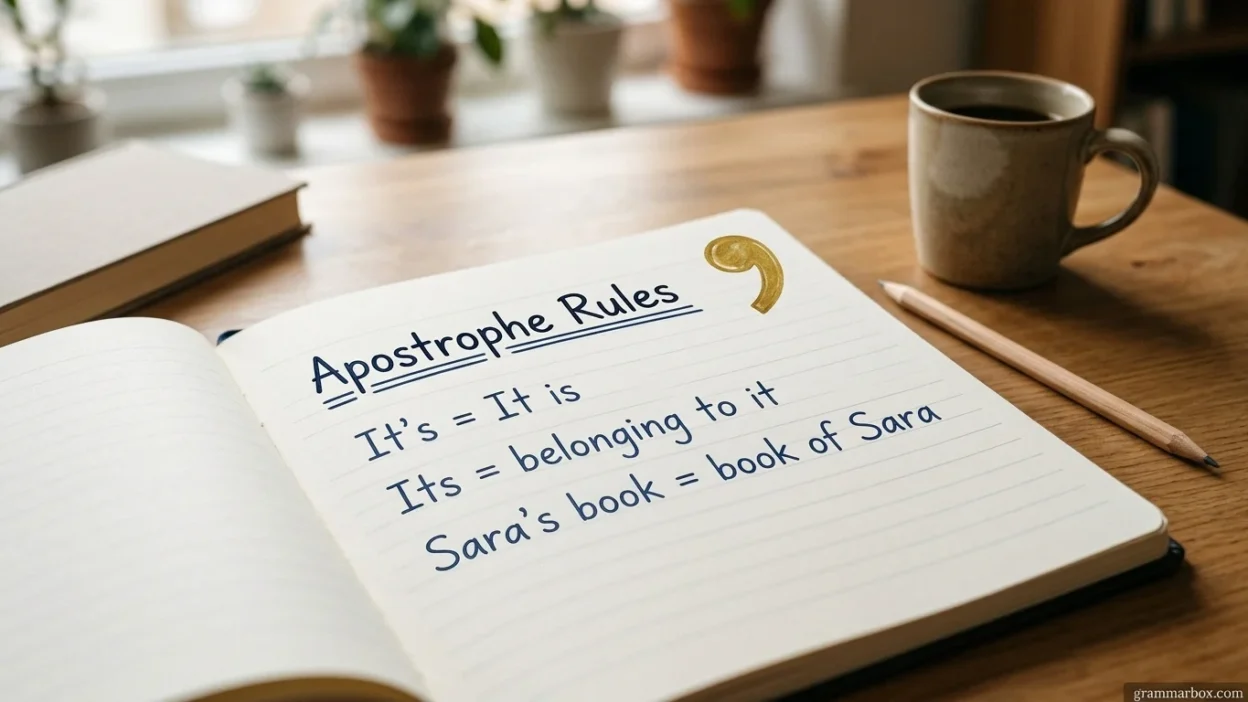
1. Confusing Its and It’s
This is one of the most common apostrophe mistakes.
- Its: Shows possession.
- It’s: Means it is or it has.
Incorrect: The dog wagged it’s tail.
Correct: The dog wagged its tail.
Correct: It’s a beautiful day.
2. Adding Apostrophes to Ordinary Plurals
Regular plural nouns do not need apostrophes.
Incorrect: I have two pen’s.
Correct: I have two pens.
Incorrect: The car’s are expensive.
Correct: The cars are expensive.
3. Confusing Your and You’re
These words have different grammatical functions.
- Your: Shows possession.
- You’re: Means you are.
Incorrect: Your going to enjoy this movie.
Correct: You’re going to enjoy this movie.
Correct: Your jacket is on the chair.
4. Using Apostrophes Incorrectly With Names Ending in S
For most singular names ending in s, adding ‘s is acceptable and widely recommended.
Example: Charles’s house is beautiful.
Some style guides also permit Charles’ house, so follow the required style consistently.
5. Confusing Plural and Possessive Nouns
Remember the difference:
- Students = More than one student.
- Student’s = Something belongs to one student.
- Students’ = Something belongs to multiple students.
This simple distinction prevents many punctuation errors.
Memory Trick: How to Remember Apostrophe Rules
You do not need to memorize every apostrophe rule separately. A few simple tricks can help you remember the correct placement.
Trick 1: Ask Who Owns It?
If a word shows ownership, it probably needs a possessive apostrophe.
- One owner: Add ‘s.
- Multiple owners ending in s: Add ‘ after the s.
- Irregular plural: Add ‘s.
Trick 2: Expand the Contraction
If you can replace the shortened word with two complete words, an apostrophe may be necessary.
- It’s → It is
- They’re → They are
- Don’t → Do not
- She’s → She is or she has
Trick 3: Plurals Usually Do Not Need Apostrophes
If you are simply talking about more than one item, do not add an apostrophe.
- Apples
- Books
- Teachers
- Computers
Easy Reminder: Apostrophes show ownership, missing letters, or shortened words. They do not normally make nouns plural.
American vs British English: Apostrophe Rules
Apostrophe rules are largely the same in American and British English. Both varieties use apostrophes for contractions, possession, and omitted characters.
However, some differences exist in punctuation preferences and style-guide recommendations.
| Usage | American English | British English |
|---|---|---|
| Singular possession | The girl’s book | The girl’s book |
| Plural possession | The girls’ school | The girls’ school |
| Contractions | Don’t, can’t | Don’t, can’t |
| Possessive with a name ending in s | James’s book | James’s book |
| Alternative name style | James’ book (some styles) | James’ book (some styles) |
Key Differences to Remember
- Both varieties use apostrophes in contractions such as isn’t, they’re, and we’ve.
- Both use apostrophes to show singular and plural possession.
- Style preferences for names ending in s can vary between publications.
- Neither American nor British English normally uses apostrophes to form ordinary plurals.
The important point is that apostrophe placement is generally consistent across both varieties of English.
Similar Words and Punctuation Terms
Understanding related punctuation terms can make apostrophe rules easier to learn.
| Term | Meaning | Example |
|---|---|---|
| Apostrophe | Shows possession or omitted letters | Sarah’s bag |
| Quotation mark | Shows direct speech or quotations | “Hello!” |
| Comma | Separates sentence elements | Yes, I agree. |
| Semicolon | Connects closely related independent clauses | I studied; she worked. |
| Colon | Introduces an explanation or list | Bring these items: pens and books. |
| Hyphen | Connects words | Well-known writer |
| Dash | Adds emphasis or extra information | She finally arrived—late. |
| Possessive noun | Shows ownership | The teacher’s desk |
| Contraction | Shortened form of words | Can’t |
These punctuation marks have different functions, so using the correct one helps make your writing more accurate.
FAQs:
1. What are the basic rules for using apostrophes?
The three main uses of apostrophes are showing possession, forming contractions, and indicating omitted letters or numbers. For example, John’s car, don’t, and the ’90s demonstrate these uses.
2. What are the five rules of apostrophes?
Five useful apostrophe rules are:
- Add ‘s to most singular possessive nouns.
- Add an apostrophe after s for regular plural possessives.
- Add ‘s to irregular plural possessives.
- Use apostrophes in contractions.
- Use apostrophes to indicate omitted letters or numbers.
3. When should you not use an apostrophe?
Do not use apostrophes to form ordinary plural nouns or possessive pronouns. For example, write books, students, its, yours, and theirs without apostrophes.
4. Is it James’s or James’?
Both forms are accepted by different style guides. Many modern style guides recommend James’s, while some publications prefer James’. Follow the style guide used in your writing.
5. What is the difference between its and it’s?
Its is a possessive pronoun showing ownership, while it’s is a contraction of it is or it has. For example, The cat licked its paw and It’s getting dark.
6. Do plural words need apostrophes?
No. Ordinary plural nouns do not need apostrophes. Write cars, girls, and books, not car’s, girl’s, or book’s, unless you are showing possession.
7. Where does the apostrophe go in a plural possessive?
For regular plural nouns ending in s, place the apostrophe after the final s. For example, the students’ books means the books belong to multiple students.
8. Can you use an apostrophe with a proper noun?
Yes. Proper nouns can use apostrophes to show possession. Examples include Sarah’s house, London’s streets, and Microsoft’s products.
Final Verdict
Apostrophe rules become much easier when you understand why and where this punctuation mark is used. The most important things to remember are that apostrophes show possession, create contractions, and indicate omitted letters or numbers. Their placement changes depending on whether a noun is singular, plural, or irregular. Learning the difference between forms such as student’s, students’, and students will help you avoid common grammatical mistakes.
If you are writing an academic assignment, professional email, blog post, or everyday message, correct apostrophe usage makes your sentences clearer and more polished. Practice these rules with real examples, pay attention to possessive pronouns, and avoid adding apostrophes to ordinary plurals. With consistent practice, you can use apostrophes naturally and confidently in both American and British English.
Remember This
- Use ‘s for most singular possessive nouns.
- Use s’ for regular plural possessive nouns.
- Use ‘s for irregular plural possessive nouns.
- Use apostrophes to form contractions such as don’t and it’s.
- Never use apostrophes simply to make ordinary nouns plural.
- Remember that its, your, and their are possessive pronouns without apostrophes.
The golden rule: An apostrophe shows ownership or missing letters, not ordinary plurality.