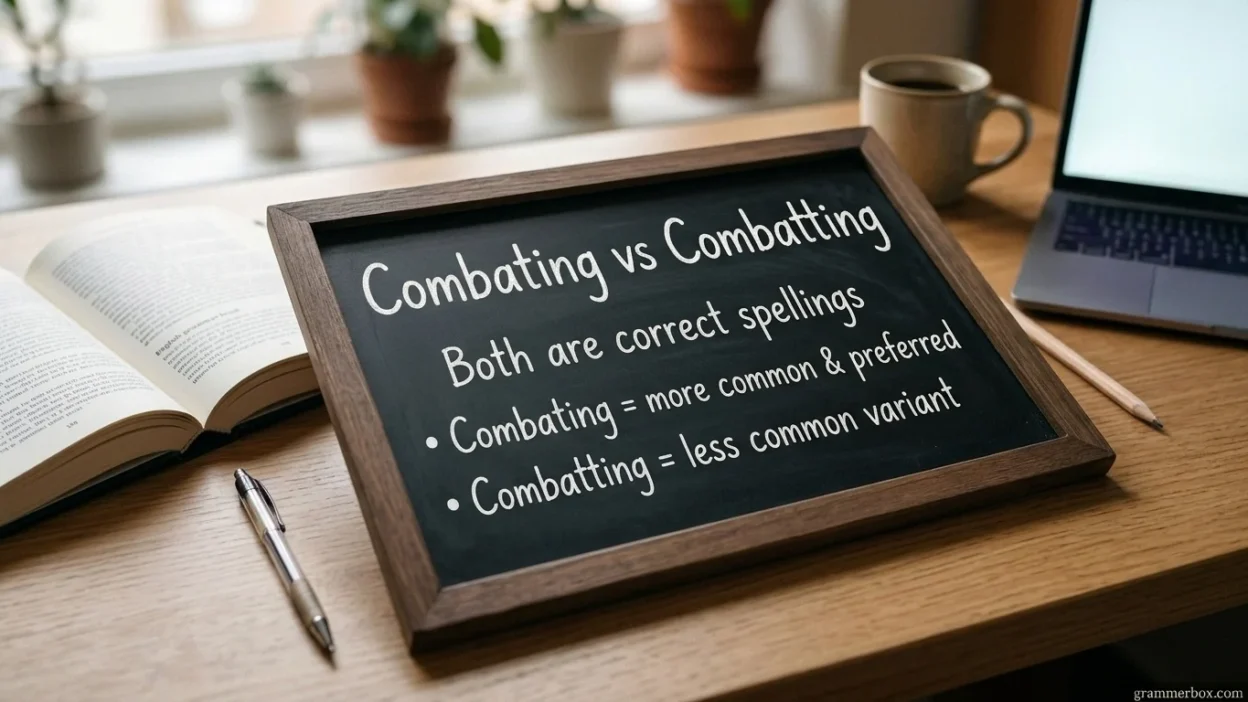
English spelling can sometimes be confusing, especially when a word appears with two different spellings. Combating vs combatting is a good example. Both forms are used in English, and you may encounter them in books, newspapers, academic writing, and everyday conversations. However, their popularity differs depending on the English variety and writing style.
If you have ever wondered whether to write combating crime or combatting crime, you are not alone. The difference comes down to a spelling rule involving the final consonant of a verb. Understanding this rule can help you choose the correct form and avoid unnecessary spelling mistakes. Whether you are writing an academic assignment, a professional report, or an everyday email, knowing when to use each spelling will make your writing clearer and more consistent.
Quick Answer
Both combating and combatting are correct spellings of the present participle of combat. Combating is generally preferred in American English, while combatting is commonly accepted in British English. Both forms mean fighting against, resisting, or taking action to stop something harmful.
Why People Confuse It
People confuse combating and combatting because both spellings follow recognizable English spelling patterns. The confusion mainly comes from whether the final consonant, t, should be doubled when adding the suffix -ing.
In English, some verbs double their final consonant before adding -ing, while others do not. For example:
- Run → Running
- Sit → Sitting
- Open → Opening
- Visit → Visiting
- Combat → Combating or Combatting
Since combat ends in a consonant, writers may assume that the final t must always be doubled. However, English spelling conventions allow both forms.
Another reason for the confusion is regional spelling. American English generally favors combating, whereas British English commonly uses combatting.
First Word: Combating
Combating is the present participle and gerund form of the verb combat. It means actively fighting against, opposing, or trying to prevent something undesirable.
This spelling uses only one final t before the suffix -ing. It is especially common in American English and is widely understood internationally.
Examples of Combating in Sentences:
- The government is combating poverty through new employment programs.
- Doctors are combating the spread of infectious diseases.
- Education plays an important role in combating illiteracy.
- The organization is combating child exploitation.
- Scientists are developing new methods for combating climate change.
- Regular exercise can help in combating stress.
- The police are combating organized crime.
- The campaign focuses on combating online misinformation.
- Communities must work together when combating pollution.
- The school introduced new policies for combating bullying.
When to Use Combating:
Use combating when:
- Writing in American English.
- Following American dictionaries and style guides.
- Preparing academic or professional documents using American spelling conventions.
- You want a widely recognized spelling with a single final t.
Second Word: Combatting
Combatting is another correct present participle and gerund form of combat. It has the same meaning as combating: fighting against something, resisting it, or taking action to prevent it.
The difference is that combatting doubles the final consonant t before adding -ing. This spelling is particularly common in British English, although it is also accepted in other English varieties.
Examples of Combatting in Sentences:
- The government introduced new measures for combatting unemployment.
- Local organizations are combatting homelessness.
- The charity is dedicated to combatting hunger.
- Researchers are combatting antibiotic resistance.
- The school is actively combatting discrimination.
- New regulations are essential for combatting financial fraud.
- The community is combatting the effects of climate change.
- Healthcare workers are combatting the spread of disease.
- The organization is committed to combatting human trafficking.
- Public awareness is important for combatting cybercrime.
When to Use Combatting:
Use combatting when:
- Writing in British English.
- Following a British dictionary or editorial style guide that prefers the doubled consonant.
- Maintaining consistency with British spelling conventions.
- Your intended audience commonly uses British English.
Comparison Table
| Feature | Combating | Combatting |
|---|---|---|
| Spelling | One t | Two t’s |
| Meaning | Fighting against | Fighting against |
| Base verb | Combat | Combat |
| Word form | Present participle/gerund | Present participle/gerund |
| American English | Preferred | Less common |
| British English | Accepted | Commonly preferred |
| Grammar | Correct | Correct |
| Pronunciation | Same | Same |
The main difference is spelling preference, not meaning or grammatical function.
When to Use Each
Choosing between combating and combatting depends primarily on your audience and the spelling convention you follow.
Use Combating When:
- You are writing for an American audience.
- Your document follows American English spelling.
- You are preparing US-based academic or business content.
- You want to follow a style guide that uses the single-t spelling.
For example: The government is combating corruption through stricter regulations.
Use Combatting When:
- You are writing for a British audience.
- Your publication follows British English conventions.
- You are following a dictionary or editorial guide that prefers the doubled-t spelling.
- You want consistency with other British spelling choices.
For example: The organization is combatting poverty in rural communities.
Important: Neither spelling is grammatically incorrect. The most important thing is to choose one spelling convention and use it consistently throughout your writing.
Examples of Combating vs Combatting
Here are additional examples showing how both spellings work in everyday and professional contexts.
| Combating | Combatting |
|---|---|
| We are combating corruption. | We are combatting corruption. |
| The team is combating pollution. | The team is combatting pollution. |
| They are combating poverty. | They are combatting poverty. |
| The campaign is combating racism. | The campaign is combatting racism. |
| Scientists are combating disease. | Scientists are combatting disease. |
| The government is combating crime. | The government is combatting crime. |
| The organization is combating hunger. | The organization is combatting hunger. |
| She is combating stress. | She is combatting stress. |
| The company is combating fraud. | The company is combatting fraud. |
| They are combating misinformation. | They are combatting misinformation. |
Both columns communicate exactly the same ideas. Only the spelling changes.
Common Mistakes
Although both spellings are correct, writers sometimes make mistakes when using them.
1. Assuming One Spelling Is Always Wrong
Some people believe that combatting is incorrect because it contains an extra t. Others assume combating is a spelling mistake because they expect the final consonant to double.
Both forms are accepted.
2. Mixing American and British Spellings
Using combating in one paragraph and combatting in another can make your writing look inconsistent.
Choose the spelling that matches your preferred English variety.
3. Confusing the Verb and Its Other Forms
Remember these related forms:
- Combat: Base verb.
- Combats: Third-person singular.
- Combated: Past tense and past participle.
- Combating: Present participle and gerund.
- Combatting: Alternative present participle and gerund.
4. Treating Them as Different Words
Combating and combatting do not have separate meanings. Both describe the act of fighting against something.
5. Thinking the Pronunciation Changes
The two spellings are pronounced the same way. Doubling the final t does not create a different pronunciation.
Memory Trick
Here is a simple way to remember the difference:
- Combating = American preference: Think of the single t as the simpler American spelling.
- Combatting = British preference: Remember that British English commonly doubles the final t in this word.
You can also remember this simple sentence:
“Americans prefer one T, while British writers commonly use two Ts.”
This trick will help you choose the appropriate spelling without memorizing complicated grammar rules.
American vs British English
The difference between combating and combatting is mainly associated with regional spelling preferences.
American English
American English generally prefers combating. This spelling is widely used in American newspapers, educational materials, business documents, and professional publications.
Example: The government is combating the growing problem of cybercrime.
British English
British English commonly uses combatting. The doubled consonant reflects a spelling convention found in some British English verb forms.
Example: The government is combatting the growing problem of cybercrime.
What About Canadian and Australian English?
Canadian and Australian English can show variation in spelling preferences. Both forms are understood, and individual publications may follow different editorial conventions.
For these varieties, checking the relevant dictionary or style guide is the safest approach.
Similar Words
Here are some other English words that involve spelling variations or similar spelling questions.
| Word Pair | Difference |
|---|---|
| Traveling vs Travelling | American vs British spelling preference |
| Canceling vs Cancelling | Different regional spelling conventions |
| Labeling vs Labelling | Single or doubled final consonant |
| Modeling vs Modelling | American and British spelling |
| Fueling vs Fuelling | Regional spelling preference |
| Worshiping vs Worshipping | Different accepted spelling conventions |
| Quarreling vs Quarrelling | American vs British spelling |
| Signaling vs Signalling | Regional spelling variation |
| Kidnapping vs Kidnaping | Different spelling conventions |
| Focused vs Focussed | Single or doubled consonant |
Learning these spelling differences can help you become more confident when writing in American or British English.
FAQs:
1. Is combating or combatting correct?
Both combating and combatting are correct. They are alternative spellings of the present participle and gerund of combat. The choice generally depends on regional spelling preferences.
2. Is combating American or British English?
Combating is generally preferred in American English. However, it is also accepted and understood in British English.
3. Is combatting British English?
Yes. Combatting is commonly used in British English. It is an accepted spelling that doubles the final consonant before adding -ing.
4. Does combating mean the same as combatting?
Yes. Both words have exactly the same meaning. They describe actively fighting against, resisting, or trying to prevent something.
5. Why does combatting have two Ts?
The spelling combatting doubles the final consonant of the base verb combat before adding the suffix -ing. This follows a recognized English spelling convention.
6. How do you pronounce combating and combatting?
Both words have the same pronunciation. The extra t in combatting does not change how the word is spoken.
7. Which spelling should I use in academic writing?
Use the spelling required by your institution or chosen style guide. If you are following American English, choose combating. If you are following British English, combatting is commonly preferred.
Final Verdict
The choice between combating and combatting is simple once you understand their regional spelling preferences. Both words are correct, have identical meanings, and function as the present participle or gerund of the verb combat. The primary difference is that combating generally follows American English preferences, while combatting is commonly found in British English.
If you are writing for an American audience, choose combating. For British English, combatting is a suitable choice. However, always follow your publication’s preferred dictionary or style guide. Consistency matters more than choosing one spelling over the other.
Remember This
- Combating: Generally preferred in American English.
- Combatting: Commonly preferred in British English.
- Meaning: Both mean fighting against or trying to stop something.
- Grammar: Both are correct present participle and gerund forms.
- Best practice: Follow one spelling convention consistently.
Conclusion
Understanding combating vs combatting does not require memorizing complicated grammar rules. Both spellings are correct, and neither changes the meaning of a sentence. The difference simply reflects variations in English spelling conventions, particularly between American and British English.
For everyday writing, professional communication, and academic work, choose the version that matches your intended audience. Remember that combating is generally the American preference, while combatting is commonly used in British English. Once you understand this distinction, you can use either spelling confidently and avoid unnecessary spelling confusion.