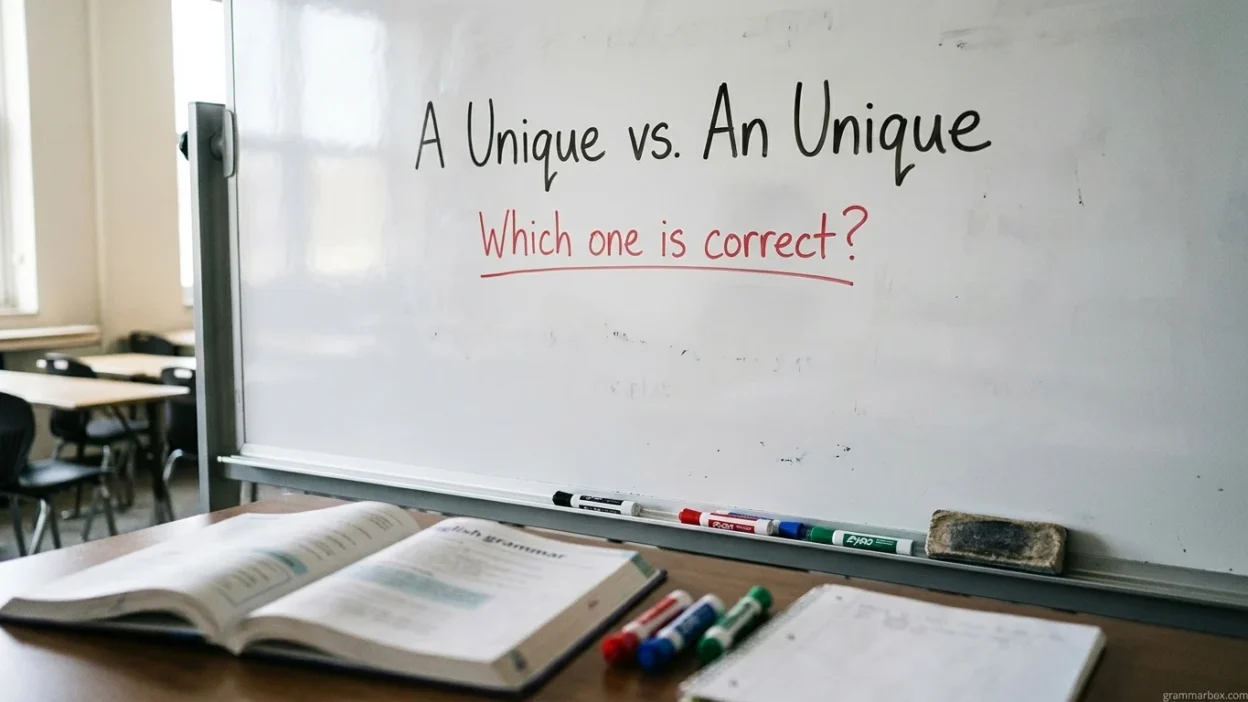
Have you ever wondered if to write “a unique” or “an unique”? You are not alone. Many English learners struggle with this choice because the word unique begins with the vowel letter “u.” According to a common grammar rule, we use “an” before words that begin with vowel sounds. However, English pronunciation does not always follow spelling, which makes this example confusing. Understanding the difference between vowel letters and vowel sounds will help you choose the correct article every time.
The good news is that the rule is simple once you understand how unique is pronounced. In standard English, unique begins with a consonant-like “y” sound, similar to the beginning of you. Therefore, “a unique” is grammatically correct, while “an unique” is generally incorrect in standard modern English. If you are writing an academic essay, a professional email, a blog post, or an everyday message, knowing this distinction will make your English more natural and accurate. Let’s explore the rule, examine practical examples, and learn how to avoid this common article mistake.
Quick Answer
“A unique” is correct, while “an unique” is generally incorrect in standard English. Although unique begins with the vowel letter “u,” it starts with a consonant-like /j/ sound, as in you. English articles depend on pronunciation rather than spelling, so we use “a” before unique.
Why People Confuse It
The confusion between a unique and an unique comes from a common misunderstanding about English articles.
English has two indefinite articles:
- A: Used before words that begin with consonant sounds.
- An: Used before words that begin with vowel sounds.
For example:
- A book
- A university
- An apple
- An umbrella
The word unique creates confusion because its first letter is “u,” a vowel. Many learners assume that every word beginning with a vowel letter must take “an.”
However, English grammar follows the sound at the beginning of a word, not simply its first letter.
The word unique is pronounced approximately as yoo-NEEK. Its opening sound resembles the consonant /j/, as in yes and you.
That is why we say “a unique opportunity,” not “an unique opportunity.”
First Word: A Unique
“A unique” is the correct expression when unique is preceded by the indefinite article a.
The article a is used because unique begins with a consonant-like sound rather than a vowel sound.
Meaning of Unique
The adjective unique means one of a kind, unlike anything else, or particularly distinctive.
It can describe a person, object, experience, idea, characteristic, or situation that stands out from others.
Examples of A Unique
- She has a unique way of explaining difficult concepts.
- We discovered a unique solution to the problem.
- He owns a unique collection of vintage books.
- This painting has a unique style.
- They created a unique opportunity for young artists.
- My teacher shared a unique perspective on the subject.
- The company introduced a unique product to the market.
- Every person has a unique personality.
- We enjoyed a unique experience during our vacation.
- The building features a unique architectural design.
In each example, a is correct because unique begins with the /j/ sound.
When to Use A Unique
Use a unique when you introduce one distinctive person, thing, idea, or experience.
For example:
- A unique idea: An idea that is different from others.
- A unique opportunity: A special or uncommon chance.
- A unique experience: An experience that is distinctive or unlike ordinary experiences.
- A unique personality: A personality with distinctive characteristics.
Remember that the noun following unique does not determine whether you use a or an. The opening sound of the word immediately following the article determines the choice.
Second Word: An Unique
“An unique” is generally incorrect in standard modern English because unique begins with a consonant-like /j/ sound.
The mistake usually occurs when writers choose an article based on the first written letter instead of pronunciation.
Why An Unique Is Incorrect
Consider the pronunciation of these words:
- Unique: /juːˈniːk/
- University: /ˌjuːnɪˈvɜːrsəti/
- Uniform: /ˈjuːnɪfɔːrm/
Although all three words begin with the vowel letter “u,” they start with a /j/ sound, like the beginning of you.
Consequently, standard English uses a before these words.
Correct:
- She has a unique talent.
- He attends a university.
- I bought a uniform.
Incorrect in standard modern English:
- She has an unique talent.
- He attends an university.
- I bought an uniform.
Is An Unique Ever Acceptable?
You may occasionally encounter an unique in older texts, unusual literary constructions, or nonstandard writing. However, it is not the normal choice in contemporary standard English.
For school assignments, professional writing, SEO articles, business communication, and everyday formal English, use “a unique.”
If you are unsure, say the word aloud and listen to its first sound.
Comparison Table
| Expression | Correct or Incorrect? | Explanation | Example |
|---|---|---|---|
| A unique | Correct | Unique begins with a /j/ sound. | She found a unique solution. |
| An unique | Generally incorrect | The word does not begin with a vowel sound. | Avoid this construction in standard English. |
| A university | Correct | University begins with a /j/ sound. | He studies at a university. |
| An umbrella | Correct | Umbrella begins with a vowel sound. | She carried an umbrella. |
| A uniform | Correct | Uniform begins with a /j/ sound. | He wore a uniform. |
| An unusual event | Correct | Unusual begins with a vowel sound. | We witnessed an unusual event. |
| A unique idea | Correct | Unique begins with a /j/ sound. | She suggested a unique idea. |
| An interesting idea | Correct | Interesting begins with a vowel sound. | He proposed an interesting idea. |
The main lesson is that the first sound, not the first letter, determines whether to use “a” or “an.”
When to Use Each
Choosing between a and an becomes easier when you focus on pronunciation.
Use A Before a Consonant Sound
Use a before words that begin with consonant sounds, even when their first written letter is a vowel.
Examples:
- A unique opportunity
- A university student
- A useful tool
- A European country
- A one-time offer
Notice that European begins with a /j/ sound, while one-time begins with a /w/ sound. Both take a.
Use An Before a Vowel Sound
Use an before words that begin with vowel sounds, even when their first written letter is a consonant.
Examples:
- An apple
- An egg
- An hour
- An honest person
- An unusual experience
The words hour and honest begin with a written “h,” but that letter is silent in their usual pronunciation. Their opening sound is a vowel sound, so an is correct.
What About Unique?
Because unique starts with the /j/ sound, use a:
- A unique opportunity
- A unique perspective
- A unique approach
- A unique character
- A unique advantage
Avoid an unique in standard English.
Examples of A Unique in Everyday English
Here are additional examples showing how to use a unique naturally in different situations.
In Daily Conversations
- Your friend has a unique sense of humor.
- We found a unique café in the city.
- That is a unique way to solve the puzzle.
- She gave me a unique gift for my birthday.
- This place offers a unique atmosphere.
In Academic Writing
- The researcher developed a unique method for analyzing the data.
- The study provides a unique perspective on language learning.
- Each culture has a unique set of traditions.
- The student presented a unique argument in the discussion.
- The experiment revealed a unique pattern.
In Business and Professional Writing
- Our company offers a unique service to its customers.
- The campaign presents a unique opportunity to reach new audiences.
- The organization developed a unique strategy for growth.
- This product provides a unique combination of features.
- The candidate brings a unique set of skills to the team.
In Creative Writing
- The traveler discovered a unique village hidden among the mountains.
- She carried a unique necklace that had belonged to her grandmother.
- The character possessed a unique ability to understand animals.
- The artist created a unique world filled with mysterious creatures.
- A unique sound echoed through the empty hallway.
All these examples follow the same grammatical rule: a comes before the consonant-like opening sound of unique.
Common Mistakes
English learners and even experienced writers sometimes misuse articles because they focus too much on spelling.
Here are the most common mistakes to avoid.
Mistake 1: Choosing An Because U Is a Vowel
Incorrect: She has an unique talent.
Correct: She has a unique talent.
Why? The letter “u” is a vowel, but the word unique begins with a /j/ sound.
Mistake 2: Assuming Every U-Word Takes An
Incorrect: He is an university student.
Correct: He is a university student.
The word university begins with the same consonant-like sound as unique.
However, not every word beginning with “u” takes a.
For example:
- An umbrella
- An uncle
- An unusual event
The difference comes from pronunciation.
Mistake 3: Applying the Rule to the Wrong Word
Consider this sentence:
“She described an unusually unique design.”
Here, an is correct because it comes before unusually, which begins with a vowel sound.
The word unique follows the adverb unusually, so it does not determine the article.
Compare:
- A unique design.
- An unusually unique design.
Both are grammatically correct, although unusually unique may sound redundant in some contexts.
Mistake 4: Ignoring Pronunciation
Incorrect: It was an unique experience.
Correct: It was a unique experience.
When writing in English, check how a word is pronounced rather than relying exclusively on its spelling.
Mistake 5: Confusing A and An With The
The words a, an, and the have different uses.
- A unique idea: Introduces one idea that is not already specifically identified.
- The unique idea: Refers to a particular idea that is identifiable from context.
- Unique ideas: Uses no article because the noun is plural and general.
Choosing the correct article depends on both pronunciation and the meaning of the sentence.
Memory Trick
Here is an easy way to remember the difference between a unique and an unique.
Remember: Unique begins like “you.”
Say these words aloud:
- You
- Unique
- University
- Uniform
They all begin with a /j/ sound, similar to the first sound in yes.
Because this sound functions as a consonant sound, use a before these words.
The Simple Rule
Consonant sound = A
Vowel sound = An
Examples:
- A unique idea
- A useful suggestion
- A university
- An apple
- An umbrella
- An honest answer
Do not ask only, “Does this word begin with a vowel letter?”
Instead, ask, “Does this word begin with a vowel sound?”
That small change in your thinking will help you choose the correct article in many English sentences.
American vs British English
The rule for a unique versus an unique is the same in standard American and British English.
Both varieties generally pronounce unique with an initial /j/ sound, so both use a unique.
| Example | American English | British English |
|---|---|---|
| A unique idea | Correct | Correct |
| An unique idea | Generally incorrect | Generally incorrect |
| A university | Correct | Correct |
| An umbrella | Correct | Correct |
| A European city | Correct | Correct |
| An unusual situation | Correct | Correct |
Although American and British English differ in pronunciation, vocabulary, and spelling, this particular article rule does not normally change between them.
For example, Americans and British speakers may pronounce certain words differently, but the standard pronunciation of unique begins with a /j/ sound in both varieties.
Therefore, whether you are writing for an American audience or a British audience, “a unique” is the standard choice.
Similar Words
Several English words create the same confusion because they begin with a vowel letter but have different initial sounds.
Understanding these examples will help you apply the rule beyond unique.
| Word or Phrase | Correct Article | Reason |
|---|---|---|
| Unique | A unique | Begins with a /j/ sound |
| University | A university | Begins with a /j/ sound |
| Uniform | A uniform | Begins with a /j/ sound |
| Useful | A useful | Begins with a /j/ sound |
| European | A European | Begins with a /j/ sound |
| Eulogy | A eulogy | Begins with a /j/ sound |
| Umbrella | An umbrella | Begins with a vowel sound |
| Uncle | An uncle | Begins with a vowel sound |
| Unusual | An unusual | Begins with a vowel sound |
| Unanimous | A unanimous decision | Begins with a /j/ sound |
| Honest | An honest person | The initial h is silent |
| Hour | An hour | The initial h is silent |
| One-time | A one-time offer | Begins with a /w/ sound |
Why These Words Matter
Words such as unique, university, and useful demonstrate that a vowel letter does not always produce a vowel sound.
Similarly, honest and hour show that a written consonant does not always produce a consonant sound.
Learning to recognize these pronunciation patterns makes English articles much easier to use correctly.
FAQs:
1. Is It A Unique or An Unique?
“A unique” is correct in standard modern English. The word unique begins with a /j/ sound, similar to the beginning of you. Because this is a consonant sound, the correct article is a, not an.
2. Why Do We Say A Unique Instead of An Unique?
We say a unique because English indefinite articles depend on pronunciation rather than spelling. Although unique begins with the vowel letter “u,” its initial sound is /j/. Therefore, a unique opportunity is grammatically correct.
3. Is An Unique Grammatically Correct?
In standard contemporary English, an unique is generally considered incorrect. You might encounter it in older writing or nonstandard usage, but it is not recommended for academic assignments, professional documents, or formal communication.
4. Is It A Unique Person or An Unique Person?
The correct expression is “a unique person.” The adjective unique begins with a consonant-like sound, so it takes a. For example: “She is a unique person with an interesting perspective.”
5. Is It A Unique Opportunity or An Unique Opportunity?
The correct expression is “a unique opportunity.” The word opportunity does not determine the article because unique immediately follows it in the phrase as the word after the article. Since unique begins with a /j/ sound, use a.
6. Does American English Use A Unique?
Yes. Standard American English uses a unique, just like standard British English. Both varieties generally pronounce unique with an initial /j/ sound, so the article choice remains the same.
7. Do All Words Beginning With U Use A?
No. The correct article depends on the opening sound, not the written letter. Use a before unique, university, and useful, but use an before umbrella, uncle, and unusual.
8. What Is the Easiest Way to Remember the Rule?
Remember that unique begins like you. Since you starts with a consonant-like /j/ sound, the correct expression is a unique. More generally, use a before consonant sounds and an before vowel sounds.
Final Verdict
The difference between a unique and an unique is based on pronunciation, not spelling. Although unique starts with the vowel letter “u,” it begins with a consonant-like /j/ sound, as in you. Therefore, “a unique” is the correct expression in standard modern English, while “an unique” is generally incorrect.
Whenever you are uncertain about an English article, pronounce the word and listen to its first sound. Use a before consonant sounds and an before vowel sounds. This simple rule also explains why we say a university, a useful tool, and a European country, but an umbrella, an uncle, and an unusual event. Once you understand this distinction, you can use English articles more confidently in conversations, school assignments, professional writing, and everyday communication.
Remember This
- Correct: A unique idea.
- Incorrect in standard English: An unique idea.
- Why? Unique begins with a consonant-like /j/ sound.
- Golden rule: Choose a or an according to the first sound, not the first letter.