
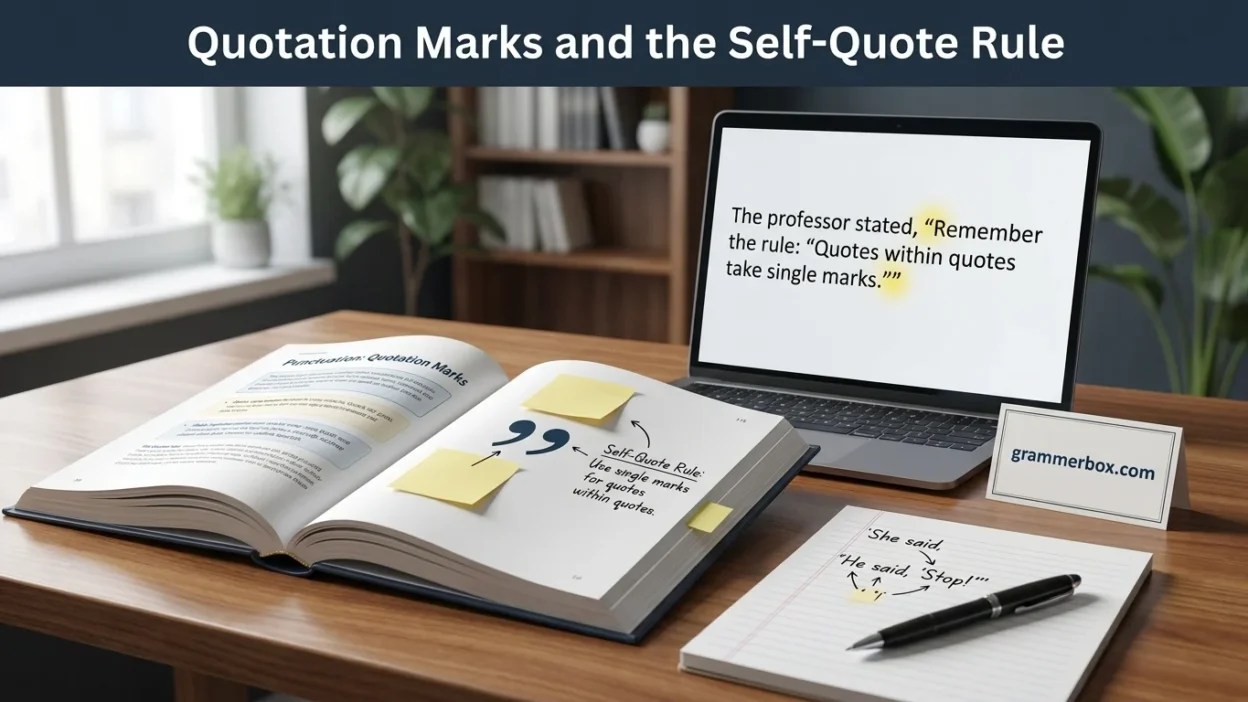
When you write about something you said yourself, quotation marks can become surprisingly confusing. Should you put your own words inside quotation marks? Does it matter whether you are writing an article, a formal essay, a personal story, or a conversation? The quotation marks self quote rule depends largely on whether you are reproducing your exact words or simply describing what you previously said. Understanding this distinction helps you avoid awkward punctuation and makes your writing clearer and more credible.
Quotation marks are normally used to show a speaker’s or writer’s exact words. That rule applies even when the person being quoted is you. However, self-quotation has a few practical considerations, especially when you refer to something you said earlier in the same piece of writing. In this guide, you’ll learn when to use quotation marks around your own words, how punctuation works with self-quotes, and how American and British English handle quotation marks.
Quick Answer
You can use quotation marks when quoting your own exact words. The fact that you are quoting yourself does not change the basic quotation rule. If you are only paraphrasing or summarizing what you said, quotation marks are generally unnecessary.
Why People Confuse It
The confusion comes from the idea that quotation marks are only for quoting other people.
They are not.
Quotation marks indicate that the words inside them are being presented as an exact quotation. Therefore, your own words can be placed in quotation marks when you reproduce them exactly.
Compare:
- I said that the project was difficult.
- I said, “The project is difficult.”
The first sentence paraphrases your statement. The second presents your exact words.
Another common source of confusion is whether you need to quote yourself when referring to something you said previously. The answer is usually no unless you want to reproduce the exact wording.
First Word: Quotation Marks
Quotation marks are punctuation marks used to identify direct quotations.
In American English, double quotation marks are normally used for a direct quote:
I said, “We need more time.”
If you are quoting yourself, the same principle applies:
I told the interviewer, “I learned a lot from the experience.”
The quotation marks do not mean the words came from another person. They simply show that the words are being presented as an exact quotation.
When quoting yourself, quotation marks can:
- Show your exact words
- Distinguish direct speech from surrounding text
- Clarify what you previously said
- Preserve the original wording of a statement
- Make a quotation easier for readers to identify
Second Word: Self-Quote
A self-quote is simply a quotation in which you are the original speaker or writer.
For example:
In my presentation, I said, “This strategy will save time.”
Here, “This strategy will save time” is your own statement being quoted.
You can also quote yourself in an article:
As I wrote earlier, “Clear writing begins with clear thinking.”
However, if you are not reproducing the exact words, you normally do not need quotation marks:
As I explained earlier, clear writing begins with clear thinking.
The second version communicates the idea without claiming to reproduce your precise wording.
Comparison Table
| Situation | Quotation Marks? | Example |
|---|---|---|
| Exact words you previously said | Yes | I said, “I need more time.” |
| Paraphrasing yourself | Usually no | I said that I needed more time. |
| Summarizing your earlier statement | No | I explained the problem earlier. |
| Reproducing a written statement exactly | Yes | I wrote, “The results were unexpected.” |
| Referring generally to your opinion | No | I believe the plan will work. |
| Quoting yourself in an interview | Yes | I told the reporter, “I support the proposal.” |
| Mentioning a word as a word | Often yes | I used the word “effective.” |
When to Use Each
Use quotation marks for exact self-quotes
If you want readers to know that the words are exactly what you said, use quotation marks.
I said, “I will finish the report tonight.”
This tells the reader that the wording is being presented as a direct quotation.
Don’t use quotation marks for paraphrasing
If you change the wording while keeping the meaning, you are paraphrasing.
I said that I would finish the report that night.
Because these are not your exact original words, quotation marks are not normally appropriate.
Use quotation marks when accuracy matters
Self-quotation is particularly useful in:
- Interviews
- Memoirs
- Speeches
- Personal essays
- Articles
- Research writing
- Biographical writing
- Recorded conversations
If the precise wording matters, direct quotation makes that clear.
Examples of the Self-Quote Rule
1. Direct quotation
I said, “I don’t agree with that conclusion.”
Your exact words are presented as a quote.
2. Paraphrase
I said that I disagreed with the conclusion.
No quotation marks are needed because the wording has changed.
3. Referring to an earlier statement
Earlier, I said, “Practice makes progress.”
This is a direct self-quote.
4. Referring to the idea
Earlier, I explained that practice leads to progress.
This is a paraphrase.
5. Quoting yourself in an interview
When asked about the project, I replied, “We are still reviewing the results.”
The quotation marks show your exact response.
6. Quoting something you wrote
In my previous article, I wrote, “Grammar should make communication clearer.”
Because you are reproducing the exact wording, quotation marks are appropriate.
7. Short self-quotation
I described the experience as “extremely rewarding.”
Only the exact quoted words need quotation marks.
8. A longer self-quotation
I explained, “The original plan looked promising, but we discovered several problems during testing.”
The entire reproduced statement is enclosed in quotation marks.
9. Quoting yourself while discussing your own words
The phrase “I need a fresh start” appeared in my original journal entry.
Quotation marks identify the exact words from the entry.
10. Paraphrasing your own statement
In the meeting, I explained that the deadline needed to be extended.
There is no direct quote here, so quotation marks are unnecessary.
11. Quoting a specific phrase
I called the experience “a valuable lesson.”
Only the exact phrase is quoted.
12. Using a self-quote in an article
As I mentioned earlier, “Small changes can produce significant results.”
This works when the quoted wording is genuinely being reproduced.
Common Mistakes
Mistake 1: Assuming you cannot quote yourself
You can.
Quotation marks are not restricted to quotations from other people.
Mistake 2: Using quotation marks around every reference to yourself
Not every reference to something you said requires quotation marks.
Incorrect or unnecessary:
I said, “that I was tired.”
Better:
I said that I was tired.
Or, for the exact words:
I said, “I am tired.”
Mistake 3: Quoting a paraphrase
If you substantially change your original wording, don’t present the new wording as an exact quote.
Mistake 4: Forgetting punctuation
When introducing a direct quotation, punctuation often helps make the sentence structure clear.
I said, “Let’s begin.”
Mistake 5: Changing the quote without indicating the change
If you alter wording inside a quotation for grammatical or contextual reasons, follow the appropriate quotation-editing conventions rather than silently presenting altered wording as completely original.
Memory Trick
Remember:
Exact words = quotation marks.
Same idea = no quotation marks.
Think of quotation marks as a pair of “exact-word signs.”
If you are saying, “These are the words I actually used,” quotation marks can be appropriate.
If you mean, “This is what I meant,” you are usually paraphrasing, so quotation marks are unnecessary.
American vs British English
The basic rule for quoting yourself is the same in both American and British English: quotation marks can identify your exact words.
The main difference is often the style of quotation marks.
American English
American English commonly uses double quotation marks for primary quotations:
I said, “We should leave now.”
A quotation inside another quotation generally uses single quotation marks:
I said, “She told me, ‘Wait here.’”
British English
British publishing styles often use single quotation marks for primary quotations:
I said, ‘We should leave now.’
Double quotation marks may then be used for a quotation within a quotation:
I said, ‘She told me, “Wait here.”’
However, British publishers and style guides vary, so the important thing is to follow the style guide required for your publication.
Similar Words
Understanding related terms can make the quotation rule easier to remember.
Direct quotation
A direct quotation reproduces someone’s exact words.
She said, “I am ready.”
Self-quotation
A self-quotation is a direct quotation of your own words.
I said, “I am ready.”
Paraphrase
A paraphrase expresses the original idea in different words.
I said that I was ready.
Summary
A summary gives the main point without reproducing the original wording.
I discussed my readiness for the project.
Reported speech
Reported speech communicates what someone said without necessarily using their exact words.
I said that I was ready.
FAQs:
Can I put my own words in quotation marks?
Yes. If you are reproducing your own words exactly, you can use quotation marks just as you would for another person’s direct quotation.
Do I need quotation marks when I quote myself?
If you are presenting the exact wording as a direct quotation, yes. If you are merely paraphrasing or summarizing yourself, quotation marks are generally not needed.
Is quoting yourself grammatically correct?
Yes. Self-quotation is grammatically acceptable when you are intentionally reproducing your own exact words.
Should I use single or double quotation marks?
It depends on the style you are following. American English commonly uses double quotation marks for primary quotations, while many British styles commonly use single quotation marks.
Can I quote myself in an essay?
Yes. You can quote yourself when the exact wording is relevant, although academic writing usually benefits from using self-quotation only when there is a clear reason to preserve your original words.
What is the difference between quoting and paraphrasing yourself?
Quoting preserves your original wording, while paraphrasing communicates the same idea using different wording.
Can I quote something I wrote earlier?
Yes. If you reproduce your earlier wording exactly, quotation marks can show that the passage is being quoted rather than newly written.
Remember This
Exact wording → use quotation marks.
Paraphrased meaning → usually no quotation marks.
Whether the original speaker is you or someone else, the basic principle remains the same.
Conclusion
Using quotation marks to quote yourself is perfectly acceptable when you want to reproduce your exact words. The important issue is not who originally said the words but whether you are presenting them as a direct quotation. This makes the self-quote rule much easier to understand.
When writing, always ask yourself one simple question: “Am I giving the exact words, or am I explaining the idea?” Exact words normally belong inside quotation marks; an explanation, paraphrase, or summary normally does not. Following this distinction will help your writing sound natural, precise, and professionally edited.