
When writing about online security, digital identity, or computer systems, you may encounter the words authentication and authentification. They look almost identical, and both are associated with the idea of verifying something. However, one spelling is far more common in modern English, especially in technology, cybersecurity, and everyday communication. Choosing the appropriate term helps make your writing clearer and more professional.
The confusion often arises because English contains many words with similar endings, including identification, verification, and authorization. Writers may assume that adding the suffix -ation or -ification creates interchangeable forms. However, spelling patterns do not always work that way. If you are preparing technical documentation, writing an academic paper, or explaining how a user signs in to an account, understanding the difference between authentication and authentification can help you avoid unnecessary errors. In this guide, you will learn which spelling to prefer, how the terms are used, and how to choose the right word for different contexts.
Quick Answer
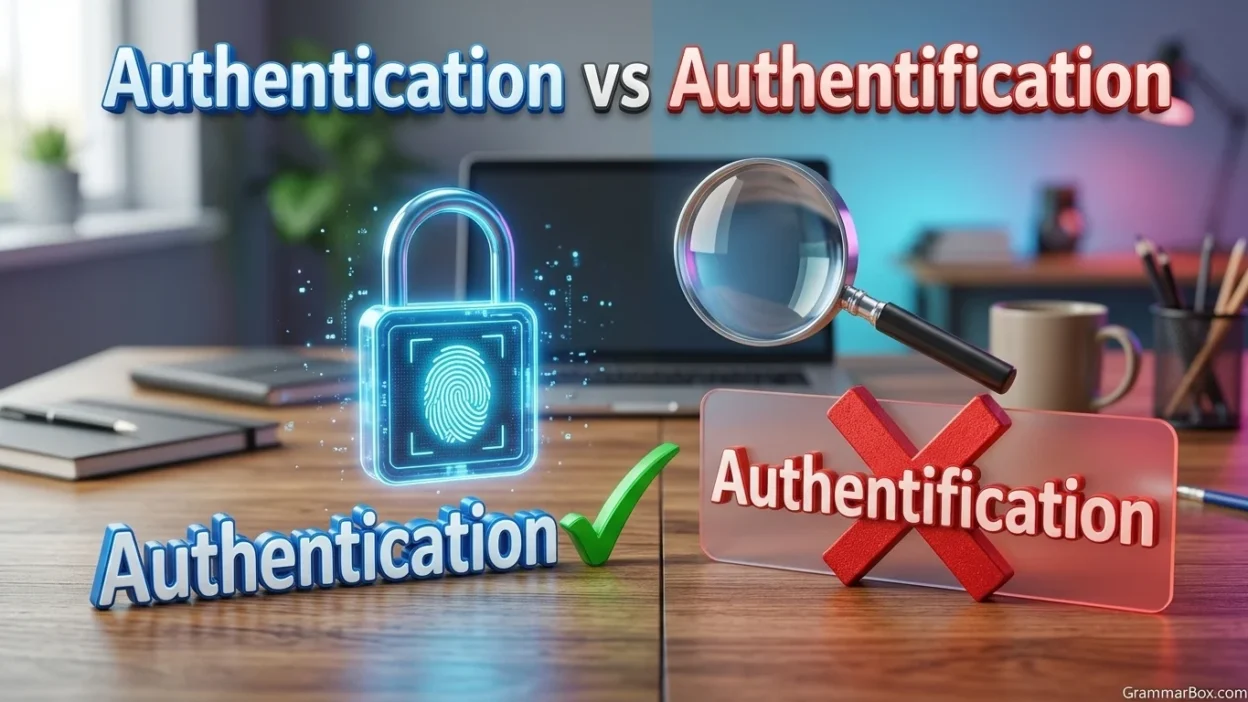
Authentication is the standard, widely accepted spelling in modern English for the process of verifying someone’s identity or confirming that something is genuine. Authentification is a rare variant found in some specialized or historical contexts. In most everyday, professional, academic, and technical writing, use authentication.
Why People Confuse It
People confuse authentication and authentification because the words share the same root and have similar meanings. Both are associated with establishing authenticity, which makes their spelling differences easy to overlook.
Several factors contribute to this confusion:
- Similar appearance: Both words contain the root authent-, making them look like alternative forms of the same word.
- Unfamiliar spelling patterns: English uses different suffixes to form nouns, and these patterns are not always predictable.
- Technical terminology: Readers may encounter unusual variants in older documents, specialized translations, or technical materials.
- Influence of other words: Words such as identification and classification may encourage writers to assume that authentification is the preferred form.
The key distinction is that authentication is the established choice in contemporary English. Unless a particular source, discipline, or historical document requires the alternative spelling, authentication is the safer option.
Authentication
Authentication is a noun that describes the process of verifying identity, confirming the origin of something, or establishing that something is genuine.
The word is especially common in cybersecurity, information technology, banking, and identity management.
Common meanings of authentication
- Identity verification: Confirming that a person is who they claim to be.
- Digital security: Checking a user’s identity before allowing access to a system.
- Document verification: Establishing whether a document is genuine or valid.
- Verification of origin: Confirming the source or authenticity of an item.
Examples of authentication
- The website requires two-factor authentication before granting access.
- Email authentication helps protect a domain against certain types of impersonation.
- The bank introduced biometric authentication for mobile transactions.
- The museum requested authentication of the historical painting.
- Authentication is necessary before employees can access confidential files.
In everyday technical writing, the term most often refers to verifying a user’s identity or confirming that a system, message, or object is genuine.
Related forms
- Authenticate (verb): To verify identity or establish authenticity.
- Authenticated (adjective or past participle): Verified as genuine or as having passed an authentication process.
- Authenticator (noun): A person, device, or application that performs or supports authentication.
- Authentication (noun): The process of verifying identity or authenticity.
For example, an authentication application may generate a code that helps a user prove their identity when signing in.
Authentification
Authentification is a rare spelling variant related to authentication. It may appear in specialized writing, historical sources, or translated technical material, but it is not the normal choice in contemporary English.
Although readers may understand the intended meaning, the word can look unusual in standard professional writing.
When might authentification appear?
You may encounter authentification in the following situations:
- Older or specialized technical documents.
- Text translated from another language.
- Documents that preserve the terminology of a particular institution.
- Historical material in which the original wording needs to be retained.
- Specialized contexts where an author explicitly defines the term.
Its appearance does not automatically mean that a document is incorrect. However, its use should be evaluated in context rather than treated as evidence that it is interchangeable with authentication in every situation.
Examples of the rare variant
The following examples illustrate how the word might appear in a source that uses this spelling:
- The translated manual uses the term authentification for the login verification process.
- The historical document refers to the authentification of official records.
- The author retains authentification because it appears in the original technical specification.
- The glossary includes authentification as a variant of authentication.
- The editor recommends replacing authentification with authentication to follow standard modern English usage.
For ordinary writing, these examples are better expressed with authentication unless there is a specific reason to preserve the alternative form.
Comparison Table
| Feature | Authentication | Authentification |
|---|---|---|
| Status in modern English | Standard and widely accepted | Rare variant |
| General meaning | Verification of identity or authenticity | Associated with verification of identity or authenticity |
| Use in cybersecurity | Common | Uncommon |
| Use in professional writing | Recommended | Usually avoided |
| Use in academic writing | Generally preferred | May appear in specialized sources |
| Use in everyday communication | Appropriate | Unusual |
| Use in software documentation | Standard choice | Use only when context requires it |
| Best general recommendation | Use this spelling | Verify the source before using it |
The main takeaway is straightforward: authentication is the preferred spelling for almost all modern English contexts.
When to Use Each
Choosing between authentication and authentification becomes easier when you consider your audience and the purpose of your writing.
When to use authentication
Use authentication in standard English writing, particularly when discussing identity verification, online accounts, computer security, or the authenticity of documents.
Choose authentication when:
- Writing cybersecurity articles or software documentation.
- Explaining login procedures.
- Describing biometric or multifactor verification.
- Preparing business reports or academic assignments.
- Writing about identity management.
- Explaining how systems verify users or messages.
Example: The company requires multifactor authentication to protect employee accounts.
This sentence uses the established technical term and sounds natural to a contemporary English-speaking audience.
When to use authentification
Use authentification only when a specific context justifies preserving the unusual spelling.
For example:
- You are quoting a historical document.
- You are reproducing terminology from a source without changing its wording.
- A specialized publication explicitly defines the term.
- You are discussing the spelling itself rather than describing a verification process.
Example: The researcher retained the word authentification when transcribing the original document.
Here, the unusual spelling is relevant because the sentence describes the wording of a source.
A simple rule
If you are unsure which spelling to choose, write authentication. It is the clearest and most widely recognized option in modern English.
Examples of Authentication vs Authentification
The following examples show how the standard spelling works in practical situations and how the rare variant might appear in a specialized source.
Examples using authentication
- Online security: Two-factor authentication adds another layer of protection to an online account.
- Banking: The banking application uses biometric authentication to verify customers.
- Workplace systems: Employees must complete authentication before accessing the company network.
- Email security: Email authentication helps receiving servers evaluate whether messages are authorized by a domain.
- Document verification: The lawyer requested authentication of the official document.
- Mobile devices: The phone supports fingerprint authentication for unlocking the screen.
- Cloud computing: Strong authentication helps protect cloud-based services from unauthorized access.
- Education: Students must complete authentication before opening their examination portal.
- Software development: The developer implemented an authentication system for registered users.
- Digital identity: Digital authentication allows a service to verify a user’s identity electronically.
- Cybersecurity policy: The organization requires multifactor authentication for accounts with administrative privileges.
- Technical support: The support team investigated an authentication failure that prevented users from signing in.
Examples using authentification
These examples represent contexts in which the rare spelling might be preserved rather than recommended for general use.
- Translation: The translated document uses authentification where modern English documentation would normally use authentication.
- Historical research: The historian preserved the original spelling of authentification in a quotation.
- Terminology review: The editor questioned whether authentification should be changed to authentication.
- Technical glossary: The glossary records authentification as a rare variant.
- Academic discussion: The researcher examined the use of authentification in a specialized text.
In most of these examples, replacing authentification with authentication would make the wording more familiar to contemporary English readers.
Common Mistakes
Even though the difference between these terms is small, writers can make several mistakes when choosing the correct spelling.
Mistake 1: Treating both spellings as equally common
Incorrect assumption: Authentication and authentification are equally standard in modern English.
Better understanding: Authentication is the established form and should normally be preferred.
Mistake 2: Using authentification in technical documentation
Incorrect or unusual: The application requires authentification before users can continue.
Preferred: The application requires authentication before users can continue.
The second sentence uses the standard term expected in modern software documentation.
Mistake 3: Confusing authentication with authorization
Authentication and authorization are related, but they describe different processes.
- Authentication verifies who a user is.
- Authorization determines what that user is permitted to access or do.
For example, signing in with a password is part of authentication. Being allowed to view a particular file is a matter of authorization.
Mistake 4: Confusing authentication with identification
Identification involves stating or establishing who someone is. Authentication involves verifying a claimed identity or confirming authenticity.
For example, entering a username identifies the account a person wants to access. Providing an appropriate verification factor helps authenticate the user.
Mistake 5: Assuming every rare spelling is automatically wrong
A rare spelling may appear in a historical document, translation, or specialized source. Instead of automatically changing a quotation, check the context.
For new writing, however, authentication remains the best general choice.
Memory Trick
Remember this simple rule:
Authentication is the standard spelling for verifying identity.
Here are three ways to remember it:
- Think of login security: When you sign in to an account, you go through authentication.
- Connect it with authenticator: An authenticator app helps you complete authentication.
- Remember the common form: Authentication is the word used throughout most modern cybersecurity and software documentation.
You can also memorize this sentence:
Authentication verifies identity; authentification is a rare variant.
This memory trick will help you choose the appropriate spelling in emails, reports, assignments, and technical articles.
American vs British English
American and British English differ in many spellings, including color/colour, organize/organise, and center/centre. However, authentication versus authentification is not a comparable regional spelling distinction.
Authentication is the standard choice in both American and British English.
| Context | American English | British English |
|---|---|---|
| Standard spelling | Authentication | Authentication |
| Common cybersecurity term | Authentication | Authentication |
| Login verification | Authentication | Authentication |
| Multifactor security | Multifactor authentication | Multifactor authentication |
| Rare variant | Authentification | Authentification |
The unusual form should not be selected simply because you are writing for a British audience or an American audience.
For example:
- American English: The website requires two-factor authentication.
- British English: The website requires two-factor authentication.
Both sentences use the same standard spelling.
If you are writing for an international audience, authentication is the most reliable option because it is widely recognized across English-speaking regions.
Similar Words
Understanding related vocabulary can help you use authentication more accurately, especially when writing about digital security and identity management.
1. Authentication vs Verification
Authentication often involves confirming a user’s identity or establishing that something is genuine. Verification is a broader term for checking whether information, a claim, or a condition is correct.
Example: The system uses authentication to confirm the user’s identity and verification to check the submitted information.
2. Authentication vs Authorization
Authentication establishes who a user is, while authorization determines which resources that user can access.
Example: Authentication confirms the employee’s identity, and authorization determines whether the employee can open a restricted file.
3. Authentication vs Identification
Identification establishes or states an identity. Authentication checks whether the claimed identity can be trusted.
Example: A username identifies an account, while a password or security key can help authenticate its user.
4. Authentication vs Validation
Authentication concerns identity or authenticity. Validation checks whether information meets specific requirements or rules.
Example: The application authenticates the user and validates the information entered into a registration form.
5. Authentication vs Certification
Authentication can involve establishing that something is genuine. Certification generally involves an authorized person or organization formally confirming that someone or something meets particular standards.
Example: The system uses authentication to verify access, while an independent organization certifies that a product meets specified requirements.
6. Authenticate vs Authenticate
Authenticate is the verb, while authentication is the noun.
Example: The system must authenticate the user before granting access.
The process is called authentication.
7. Authenticity vs Authentication
Authenticity is the quality of being genuine or real. Authentication is the process of checking or establishing identity or authenticity.
Example: The expert examined the painting’s authenticity through a formal authentication process.
These distinctions are useful when writing about cybersecurity, document verification, digital identity, and other technical subjects.
FAQs:
1. Is authentication or authentification correct?
Authentication is the standard spelling in modern English. Authentification is a rare variant that may appear in specialized or historical contexts. For everyday, academic, business, and technical writing, authentication is the recommended choice.
2. Is authentification a real word?
Authentification does appear in some sources, but it is uncommon in contemporary English. Its presence in a document does not automatically make the document incorrect. Nevertheless, authentication is the established form most readers will expect.
3. Why do people write authentification instead of authentication?
People may choose authentification because the words look similar or because they encounter the rare form in translated, historical, or specialized materials. Others may assume that different suffix patterns are interchangeable. For standard modern English, authentication is preferable.
4. What does authentication mean?
Authentication is the process of verifying someone’s identity or establishing that something is genuine. In cybersecurity, it commonly refers to checking a user’s identity before granting access to an account, application, or network.
5. Is authentication the same as authorization?
No. Authentication verifies identity, while authorization determines what an authenticated user is allowed to do. For example, logging in is part of authentication, whereas receiving permission to access a confidential document is a matter of authorization.
6. Is authentication spelled differently in American and British English?
No. Authentication is the standard spelling in both American and British English. Unlike words such as color and colour, it does not have a common American-versus-British spelling distinction.
7. Should I use authentication in an SEO article?
Yes. Authentication is the preferred term for an SEO article about login security, cybersecurity, identity verification, or digital systems. Use it naturally in the title, headings, and body where relevant, without repeating it unnecessarily.
Conclusion
The difference between authentication and authentification is primarily one of standard usage. Although both forms may appear in written material, authentication is the established spelling used to describe identity verification and the confirmation of authenticity. It is the appropriate choice for most modern English communication, particularly when discussing passwords, biometric security, digital accounts, and access control.
Remember that authentication is not the same as authorization, identification, or validation. Each term describes a different concept, and choosing the right one makes technical explanations more precise. When in doubt, use authentication, follow the terminology of reputable sources, and maintain consistent spelling throughout your writing.
Remember This
Use authentication for standard modern English. Reserve authentification for cases where a specific historical, quoted, or specialized context justifies it.