Have you ever wondered if to write putted or put when describing something you placed somewhere in the past? These two forms may look similar, but only one is generally correct in standard English. The confusion often occurs because many English verbs form their past tense by adding -ed, such as walked, played, and wanted. However, English also contains irregular verbs that follow different patterns. The verb put belongs to this group, making its past tense different from what many learners expect.
Understanding the difference between putted and put can help you write more accurately, speak confidently, and avoid common grammar mistakes. If you are learning English, preparing an assignment, or improving your everyday communication, knowing the correct past tense of put is essential. In this guide, you will discover the meanings, grammatical rules, practical examples, and common mistakes associated with these words. You will also learn when putted is acceptable, particularly in golf, so you can choose the right form for your intended meaning.
Quick Answer
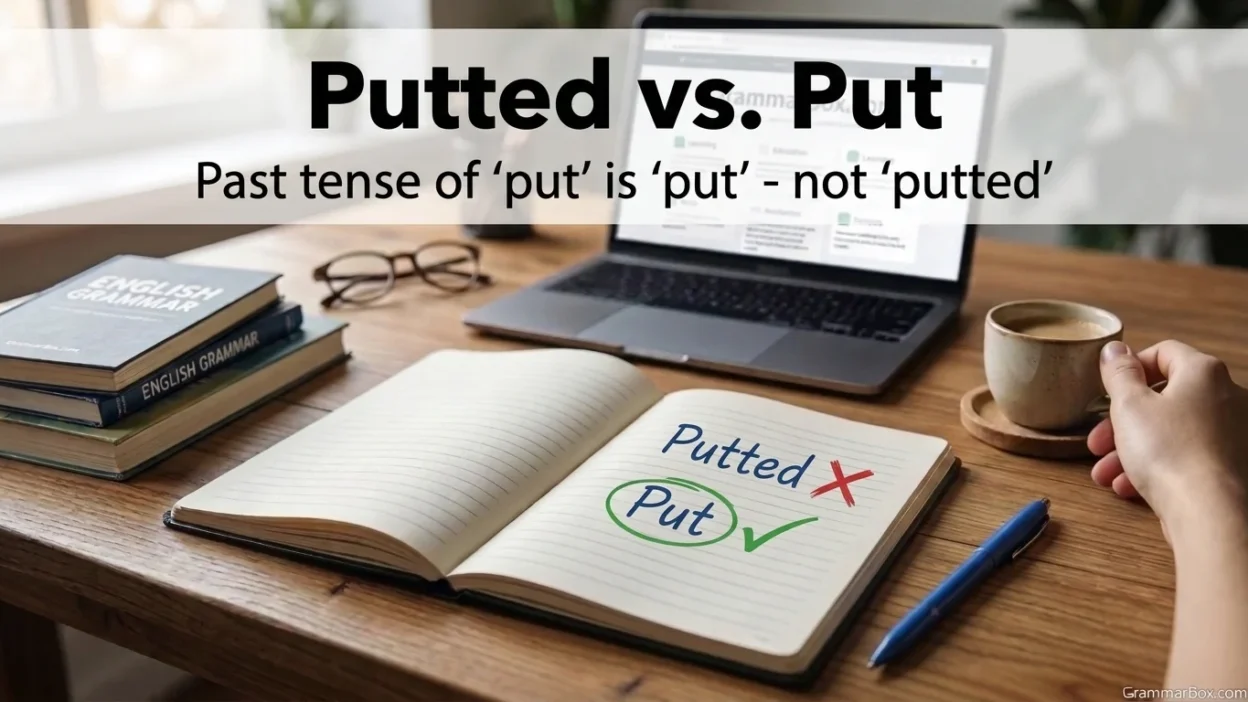
Put is the correct simple past tense and past participle of the verb put. For example, “She put the keys on the table.” The word putted is generally incorrect when describing ordinary placement, but it is a legitimate past-tense form of putt, a verb used in golf.
Why People Confuse It
People often confuse putted and put because regular English verbs usually form their past tense by adding -ed. For example:
- Walk → Walked
- Open → Opened
- Clean → Cleaned
- Play → Played
Following this pattern, English learners may assume that put becomes putted in the past tense. However, put is an irregular verb, so it does not follow the usual rule.
Another reason for the confusion is that putted is a real English word. In golf, putted is the past tense of putt, which means to hit a golf ball gently toward the hole.
The important distinction is the verb being used:
- Put → Put: To place something somewhere.
- Putt → Putted: To hit a golf ball with a putter.
Understanding this difference will help you avoid using putted incorrectly in everyday writing.
First Word: Putted
Putted is the simple past tense and past participle of the verb putt. In golf, putting means making a gentle stroke to roll a ball toward the hole, usually on the putting green.
Meaning of Putted
The word putted describes an action involving a golf putt.
Examples:
- James putted the ball toward the hole.
- She putted confidently during the final round.
- The golfer putted from the edge of the green.
- He putted twice before sinking the ball.
In each sentence, putted describes a specific golfing action rather than the general act of placing something somewhere.
Is Putted Ever Correct?
Yes. Putted is grammatically correct when it is the past-tense form of putt.
For example:
“Michael putted the golf ball into the hole.”
Here, putted correctly describes how Michael hit the ball.
However, the following sentence is incorrect in standard English:
“She putted her phone on the desk.”
The correct version is:
“She put her phone on the desk.”
In this example, the verb means to place an object, so its past-tense form must be put.
Second Word: Put
Put is an irregular English verb that means to place, position, or move something into a particular location or condition.
Unlike regular verbs, put does not change its spelling when used in the simple past tense or as a past participle.
Forms of Put
| Verb Form | Word | Example |
|---|---|---|
| Base form | Put | I put my bag here every morning. |
| Simple past | Put | I put my bag here yesterday. |
| Past participle | Put | I have put my bag here before. |
| Present participle | Putting | I am putting my bag away. |
| Third-person singular | Puts | She puts her bag in the cupboard. |
Notice that the spelling remains the same in the base form, simple past, and past participle.
Examples of Put in Sentences
- I put the book on the shelf yesterday.
- She put her phone inside her handbag.
- They put their shoes near the entrance.
- He has put the documents in the wrong folder.
- We put our trust in the new manager.
In each example, put expresses placement or a related meaning. Its spelling does not change simply because the action happened in the past.
Comparison Table
The following table explains the differences between putted and put.
| Feature | Putted | Put |
|---|---|---|
| Base verb | Putt | Put |
| Main meaning | To hit a golf ball gently | To place or position something |
| Simple past tense | Putted | Put |
| Past participle | Putted | Put |
| Used in everyday placement | No, not in standard English | Yes |
| Used in golf | Yes | Sometimes, depending on the sentence |
| Example | He putted the ball toward the hole. | He put the ball in the box. |
| Common grammar mistake | Using it to mean placed | Assuming it must become putted |
The key rule: Use put for placing or positioning something, and use putted when describing the past action of putting in golf.
When to Use Each
Choosing between putted and put becomes easier when you identify the meaning of the verb.
When to Use Put
Use put when you mean to place, position, or move something into a particular location. It is also used in expressions such as put pressure on, put effort into, and put someone at ease.
Examples:
- She put the groceries in the refrigerator.
- I put my notebook on the desk.
- They put considerable effort into the project.
- He put the children to bed.
- We put the plan into action.
Remember that put remains unchanged when describing a completed action.
Correct: “Yesterday, I put the letter in the mailbox.”
Incorrect: “Yesterday, I putted the letter in the mailbox.”
When to Use Putted
Use putted when talking about the past action of hitting a golf ball with a putter.
Examples:
- The golfer putted the ball toward the cup.
- She putted from a difficult position.
- He putted well throughout the tournament.
- They putted on the practice green before the competition.
In these sentences, putted is the correct past-tense form of putt.
A Simple Way to Decide
Ask yourself what action the sentence describes:
- Placing something? Use put.
- Making a golf putt? Use putted for the past tense.
This simple test works for most everyday situations.
Examples: Putted vs. Put in Sentences
These examples show how to use both words correctly in different contexts.
Examples of Put
- I put my keys on the kitchen counter.
- Sarah put the flowers in a glass vase.
- He put his jacket over the back of the chair.
- We put the boxes in the storage room yesterday.
- The teacher put the homework assignments on the desk.
- They put their money into a savings account.
- She has put a lot of effort into learning English.
- My brother put the milk in the refrigerator.
- The manager put the meeting on the calendar.
- I put my phone on silent during the presentation.
- He put the important papers in a safe place.
- We put the chairs around the table before dinner.
Examples of Putted
- The golfer putted the ball toward the hole.
- She putted from several feet away.
- He putted carefully on the sloping green.
- The professional golfer putted confidently under pressure.
- James putted the ball into the cup on his second attempt.
- She putted well during the final round.
- The player putted from the edge of the green.
- He putted the ball past the hole and had to try again.
- The amateur golfer putted several times during practice.
- Sarah putted successfully on the final green.
Incorrect vs. Correct Examples
| Incorrect Sentence | Correct Sentence | Reason |
|---|---|---|
| She putted her phone on the desk. | She put her phone on the desk. | Put is the past tense of placing something. |
| He putted the groceries away. | He put the groceries away. | The sentence describes placement. |
| I putted the book in my bag. | I put the book in my bag. | Put remains unchanged in the past tense. |
| She putted the golf ball toward the hole. | She putted the golf ball toward the hole. | This sentence is already correct. |
| They have putted the documents in the folder. | They have put the documents in the folder. | The sentence refers to placing documents. |
These examples demonstrate why context matters. A word may be correct in one situation but incorrect in another.
Common Mistakes
English learners and native speakers alike can make mistakes when using irregular verbs. Here are some common errors involving putted and put.
1. Adding -ed to Put
Incorrect: “I putted my shoes near the door.”
Correct: “I put my shoes near the door.”
Why? Put is an irregular verb. Its simple past tense is identical to its base form.
2. Assuming Putted Is Always Wrong
Incorrect rule: “Putted is never a real word.”
Correct rule: “Putted is correct when it is the past tense of putt, particularly in golf.”
For example: “The golfer putted the ball into the hole.”
3. Confusing Put and Putt
The verbs put and putt have different meanings.
- Put: To place something somewhere.
- Putt: To hit a golf ball gently toward the hole.
Compare these sentences:
“She put the golf ball in her bag.”
“She putted the golf ball toward the hole.”
The first sentence describes placement, while the second describes a golfing action.
4. Using Putted After Have or Has Incorrectly
Incorrect: “I have putted the books on the shelf.”
Correct: “I have put the books on the shelf.”
When the verb means to place something, its past participle is put, even when used with have, has, or had.
However, “I have putted three times today” is grammatically correct if the speaker is describing golf.
5. Changing Put in Every Past-Tense Sentence
Some learners believe that every past-tense verb needs a different spelling. That is not true.
Examples:
- Present: I put the cup on the table.
- Past: I put the cup on the table yesterday.
- Present perfect: I have put the cup on the table.
The verb remains put in all three sentences.
Memory Trick
Remember this simple rule to distinguish putted from put:
Put = Place. Putted = Golf.
Think of put as the verb you use when placing an object somewhere. Think of putted as the word you use when describing a golfer’s completed stroke.
Here is another helpful memory trick:
Put stays put!
Whether you are talking about yesterday, today, or something you have already done, the past-tense form of put remains put.
Examples:
- Today: I put the bag on the chair.
- Yesterday: I put the bag on the chair.
- Before now: I have put the bag on the chair.
For golf, remember that the base verb is putt, so its past-tense form is putted.
American vs. British English
There is no significant difference between American and British English regarding the standard past-tense forms of put and putt.
Both varieties use put as the simple past tense and past participle of the verb meaning to place something somewhere. Both also recognize putted as the past tense of the golfing verb putt.
| Usage | American English | British English |
|---|---|---|
| Past tense of placing something | Put | Put |
| Past participle of placing something | Put | Put |
| Past tense of the golf verb putt | Putted | Putted |
| Example of placement | She put the book on the desk. | She put the book on the desk. |
| Example of golf | He putted the ball into the hole. | He putted the ball into the hole. |
Although spelling differences exist between American and British English, such as color and colour, the distinction between put and putted does not depend on regional spelling conventions.
For standard English writing, use put whenever you mean to place or position something, regardless of whether you follow American or British English.
Similar Words
Understanding other irregular verbs can help you recognize why put does not follow the regular -ed pattern.
Here are several verbs with similar characteristics.
| Base Verb | Simple Past | Past Participle | Example |
|---|---|---|---|
| Put | Put | Put | She put the bag down. |
| Cut | Cut | Cut | He cut the paper yesterday. |
| Hit | Hit | Hit | She hit the ball. |
| Set | Set | Set | They set the table. |
| Shut | Shut | Shut | He shut the door. |
| Let | Let | Let | She let me leave early. |
| Cost | Cost | Cost | The ticket cost ten dollars. |
| Hurt | Hurt | Hurt | I hurt my knee yesterday. |
These verbs demonstrate that English does not always form the past tense by adding -ed.
Put vs. Set
Both put and set can describe placing something somewhere, but their usage differs depending on context.
- Put: “She put the book on the desk.”
- Set: “She set the book on the desk.”
Both sentences are grammatically correct, although set can emphasize positioning something deliberately.
Put vs. Place
Put and place can have similar meanings, but place often sounds more formal or deliberate.
- Put: “Please put your bag here.”
- Place: “Please place your bag on the counter.”
Both verbs can use regular past-tense forms differently: put remains put, while place becomes placed.
Putt vs. Put
These verbs are easy to confuse because their spellings are similar.
- Put: To position something.
- Putt: To strike a golf ball gently toward the hole.
Examples:
“She put the ball in the basket.”
“He putted the ball across the green.”
Recognizing the difference between these verbs will help you use put, putt, and putted correctly.
FAQs:
1. Is putted a real word?
Yes. Putted is a real English word and the simple past tense and past participle of putt, a verb associated with golf. However, it is not the standard past-tense form of put when that verb means to place something somewhere.
2. Is putted grammatically correct?
Yes, when used as the past tense of putt. For example, “She putted the ball toward the hole” is correct. If you mean that someone placed an object somewhere, use put instead.
3. What is the past tense of put?
The simple past tense of put is put. For example, “I put the book on the shelf yesterday.” The spelling does not change when referring to a completed action.
4. Is it put or putted in the past tense?
Use put when describing the past action of placing something somewhere. Use putted when describing the past action of making a golf putt. The correct choice depends on the meaning of the verb.
5. Is the past participle of put put or putted?
The past participle of put is put. For example, “She has put the documents in the folder.” Putted is the past participle of the separate verb putt.
6. Why doesn’t put become putted?
Put is an irregular verb. Unlike regular verbs that form their past tense by adding -ed, irregular verbs follow their own patterns. In this case, the base form, simple past tense, and past participle are all spelled put.
7. What is the difference between put and putt?
Put generally means to place or position something. Putt refers to hitting a golf ball gently toward the hole. Their past-tense forms are different: put becomes put in the past, while putt becomes putted.
Final Verdict
The difference between putted and put comes down to meaning and verb usage. Put is the correct simple past tense and past participle of the verb put, which means to place or position something. You can use it when describing an action that happened yesterday, last week, or at any point in the past. For example, “She put the keys on the counter” is grammatically correct.
On the other hand, putted is correct when used as the past tense of putt, particularly in golf. For example, “He putted the ball toward the hole” correctly describes a golfing action. Once you understand that put and putt are different verbs, choosing the right form becomes much easier. Keep the meaning of your sentence in mind, and you will avoid this common English grammar mistake.
Remember This
- Put means to place or position something.
- Put is the simple past tense of put.
- Put is also the past participle of put.
- Putted is the past tense and past participle of putt, particularly in golf.
- American and British English follow the same rule.
Easy rule to remember: If you mean placing something, use put. If you mean making a golf putt in the past, use putted.