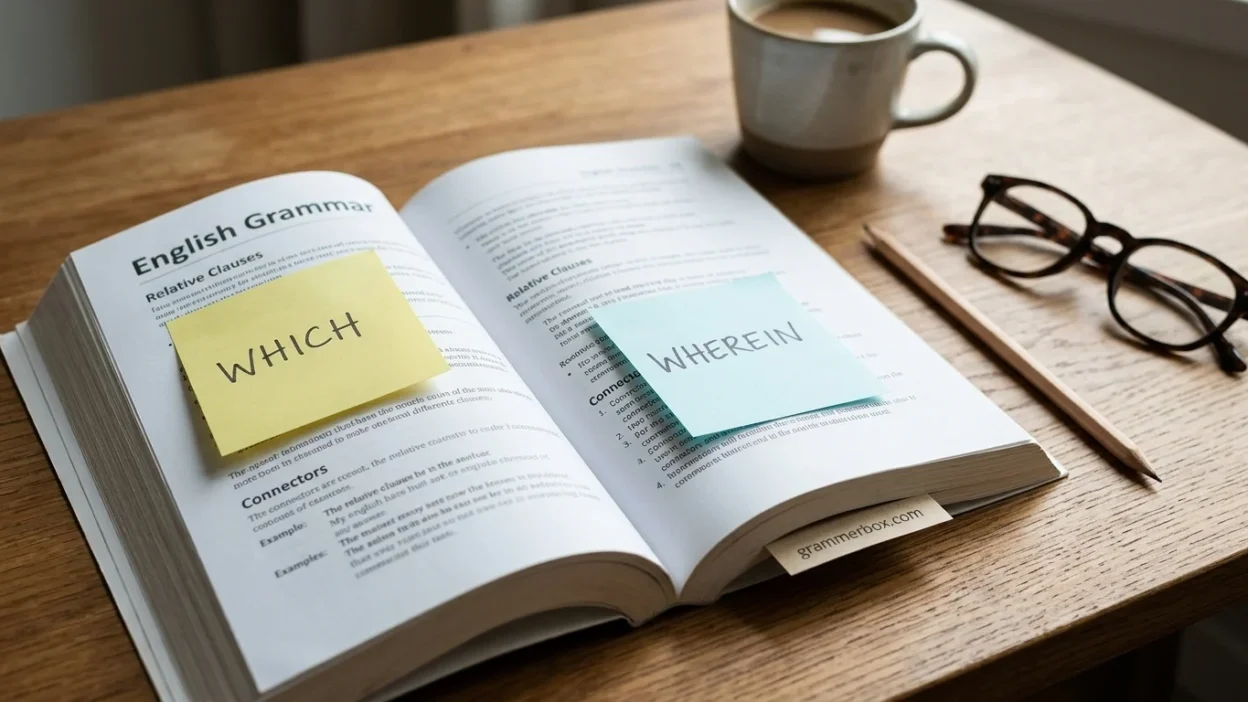
Choosing between which vs. wherein can be confusing, especially when writing formal sentences, academic papers, or professional documents. Although both words can introduce additional information, they serve different grammatical purposes. Understanding their meanings and sentence structures will help you communicate more clearly and avoid common English grammar mistakes.
The word which is widely used to introduce relative clauses, ask questions, and identify or describe things. In contrast, wherein is a more formal term that generally means in which or within which. It often appears in legal documents, academic writing, technical explanations, and formal descriptions of situations or systems. For example, you might write, “The book, which I purchased yesterday, is interesting,” but “The agreement describes a process wherein both parties share responsibility.” Both sentences are grammatically correct, but the words perform different functions. In this guide, you will learn the definitions, grammatical rules, differences, and practical examples of which and wherein so you can confidently choose the right word for every context.
Quick Answer
Which is used to identify or describe something, introduce relative clauses, or ask questions. Wherein means “in which” or “within which” and refers to a situation, process, document, or context. Use which in everyday English and wherein when its specific meaning fits a more formal sentence.
Why People Confuse It
People often confuse which and wherein because both can connect ideas within a sentence. However, their meanings and grammatical functions are not interchangeable.
The confusion usually comes from three reasons:
- Both introduce additional information: Each word can help connect one part of a sentence to another.
- Both appear in formal writing: Academic papers, reports, and technical documents may contain either word.
- Their meanings can overlap in certain contexts: In some sentences, wherein can be replaced with in which, while which can introduce a clause describing the same subject.
Consider these examples:
- Which: The report, which explains the new policy, was published yesterday.
- Wherein: The report describes a system wherein employees receive performance-based rewards.
The first sentence uses which to provide additional information about the report. The second uses wherein to describe a system in which something happens.
The key difference is that which generally refers to a thing or introduces a clause about it, whereas wherein emphasizes the context or situation within which something occurs.
First Word: Which
Meaning of Which
Which is a pronoun or determiner used to refer to things, identify choices, or introduce information about a noun. It is one of the most common words in English and appears in both formal and informal communication.
Depending on the sentence, which can refer to an object, idea, event, situation, or previously mentioned statement.
Examples:
- Which book would you like to read?
- The car, which belongs to my brother, is parked outside.
- She missed the bus, which made her late for work.
- The company introduced a new policy, which improved communication.
In the first example, which asks a question. In the remaining examples, it introduces information about a noun or a preceding statement.
How to Use Which Correctly
Use which in the following situations.
1. To ask questions
Use which when asking someone to choose between options or identify a particular item.
Examples:
- Which subject do you enjoy the most?
- Which road leads to the airport?
- Which of these answers is correct?
2. To introduce a nonrestrictive relative clause
A nonrestrictive relative clause adds extra information that is not essential to identifying the noun. It is usually separated by commas.
Examples:
- My laptop, which I bought last year, still works perfectly.
- The museum, which opened in 1995, attracts thousands of visitors.
3. To introduce a restrictive relative clause
In American English, which can also introduce a restrictive clause that identifies a particular thing, although that is often preferred in this context.
Example:
- The book which contains the answers is on the table.
Here, the clause identifies the specific book being discussed. In American English, many writers would use that instead.
4. To refer to an entire preceding idea
Which can refer to the meaning of an entire preceding clause.
Example:
- He forgot to submit the application, which disappointed his manager.
The word which refers to the fact that he forgot to submit the application.
Is Which Formal or Informal?
Which works naturally in everyday conversations, emails, business writing, academic papers, and professional reports.
It does not sound unnecessarily complicated or overly formal, making it a versatile choice in almost every type of writing.
Second Word: Wherein
Meaning of Wherein
Wherein is an adverb that means “in which,” “within which,” or “in what respect,” depending on the context.
It is generally used to describe a situation, arrangement, process, document, or system in which something happens or exists.
Unlike which, wherein is relatively uncommon in everyday conversation. It appears more frequently in legal documents, academic writing, technical descriptions, and formal explanations.
Examples:
- The contract outlines the conditions wherein either party may terminate the agreement.
- The researcher developed a model wherein students learn through practical activities.
- They discussed a situation wherein everyone had equal responsibilities.
- The document describes a system wherein users can manage their accounts independently.
In each example, wherein introduces the context in which an action, condition, or arrangement exists.
How to Use Wherein Correctly
Use wherein when you want to express the idea of something occurring within a particular situation, arrangement, or framework.
1. In formal or academic writing
Example:
- The study examines an environment wherein students can learn independently.
This means the study examines an environment in which students can learn independently.
2. In legal documents
Example:
- The agreement establishes circumstances wherein either party may request a review.
The sentence describes the circumstances in which a review may be requested.
3. When describing systems or processes
Example:
- The organization introduced a procedure wherein employees submit reports electronically.
Here, wherein explains the process within which employees submit their reports.
4. When explaining a particular situation
Example:
- We encountered a scenario wherein the available evidence was insufficient.
The word refers to the situation in which the evidence was insufficient.
Is Wherein Outdated?
Wherein is not incorrect or obsolete. However, it can sound formal, technical, or old-fashioned when used unnecessarily.
For everyday communication, expressions such as in which or where may sound more natural.
For example:
- Formal: The document describes a process wherein applicants provide their personal details.
- Simpler: The document describes a process in which applicants provide their personal details.
Both sentences are grammatical, but the second is more straightforward.
Comparison Table: Which vs. Wherein
| Feature | Which | Wherein |
|---|---|---|
| Basic meaning | Identifies, describes, or asks about something | In which or within which |
| Grammatical role | Pronoun or determiner | Adverb |
| Main purpose | Refers to things or introduces descriptive information | Describes the context in which something occurs |
| Common usage | Everyday and formal English | Mainly formal, technical, or legal English |
| Questions | Commonly used in questions | Rarely used in ordinary questions |
| Relative clauses | Introduces clauses referring to things or ideas | Introduces clauses describing a situation or framework |
| Formality | Neutral and versatile | More formal |
| Common alternative | That, depending on context | In which, within which |
| Example | The machine, which is new, works well. | The machine operates in a system wherein safety is essential. |
Main takeaway: Use which to refer to or describe something. Use wherein when you specifically mean in which or within which.
When to Use Each
Choosing between which and wherein becomes easier when you consider what your sentence needs to express.
Use Which When Referring to a Thing
Choose which when you want to identify an object, describe a noun, or add information about something already mentioned.
Examples:
- The phone, which has a large screen, is expensive.
- She selected the option which suited her needs.
- The meeting was postponed, which surprised everyone.
In these examples, which refers to a phone, an option, or the result of an event.
Use Wherein When Describing a Context
Choose wherein when you mean in which or within which and want to explain a process, situation, arrangement, or framework.
Examples:
- They created a program wherein students practice speaking English.
- The contract specifies conditions wherein additional fees may apply.
- We discussed a scenario wherein both teams could benefit.
In each sentence, wherein identifies the circumstances in which something happens.
Use In Which Instead of Wherein When Clarity Matters
Although wherein is grammatically correct in suitable contexts, in which often sounds more natural.
Compare:
- Formal: The study presents a model wherein learners receive immediate feedback.
- Clearer: The study presents a model in which learners receive immediate feedback.
Both versions express the same basic idea. The second is often easier for general readers to understand.
A Simple Decision Rule
Before choosing a word, ask yourself these questions:
- Am I asking about a choice or referring to a thing? Use which.
- Am I adding descriptive information about a noun? Use which when appropriate.
- Do I mean “in which” or “within which”? Consider wherein.
- Would in which make the sentence clearer? If so, use that expression instead.
Examples of Which vs. Wherein
The following examples show how each word works in different contexts.
Examples Using Which
- Which color do you prefer for your bedroom?
- The house, which stands near the river, belongs to my uncle.
- She bought a new phone, which has an excellent camera.
- The teacher explained the lesson, which helped everyone understand the topic.
- Which of these restaurants serves vegetarian food?
- The movie, which received several awards, was released last year.
- He forgot his password, which prevented him from logging in.
- The road which leads to the village is narrow.
- We visited a park which contains several historical monuments.
- She completed the assignment early, which impressed her professor.
In these examples, which asks a question, describes a noun, or refers to a previously mentioned idea.
Examples Using Wherein
- The contract describes a situation wherein either party may withdraw.
- The researchers developed a model wherein participants learn through experience.
- The book presents a world wherein technology controls everyday life.
- The policy establishes circumstances wherein employees may work remotely.
- They designed a system wherein users can exchange information securely.
- The agreement outlines conditions wherein refunds are permitted.
- The course provides an environment wherein students can practice independently.
- The report discusses a process wherein raw materials become finished products.
- The team explored a scenario wherein resources were limited.
- The document explains a framework wherein responsibilities are shared equally.
These sentences use wherein to describe the circumstances, framework, or process within which something occurs.
Examples Showing the Difference
Compare the following pairs to understand the distinction more clearly.
Example 1
- Which: The policy, which explains the rules, was updated.
- Wherein: The policy describes a system wherein employees receive annual bonuses.
The first sentence adds information about the policy. The second describes a system established by the policy.
Example 2
- Which: The course, which lasts six weeks, begins tomorrow.
- Wherein: The course includes a practical exercise wherein students apply their knowledge.
The first sentence describes the course. The second explains the context of the exercise.
Example 3
- Which: The agreement, which both parties signed, is legally binding.
- Wherein: The agreement establishes conditions wherein either party may request changes.
The first sentence describes the agreement. The second explains the circumstances covered by it.
Example 4
- Which: The software, which was released recently, includes new features.
- Wherein: The software uses an environment wherein users can test new features safely.
The first sentence provides information about software. The second describes the environment in which users test features.
Common Mistakes
Even experienced English writers sometimes misuse which and wherein. Understanding the following mistakes can help you write more naturally.
Mistake 1: Using Wherein When Which Is Needed
Incorrect: The laptop, wherein is on the desk, belongs to me.
Correct: The laptop, which is on the desk, belongs to me.
Why? The sentence describes the laptop’s location. It does not mean that something happens within a particular system or situation.
Mistake 2: Using Which When Wherein Is Intended
Awkward: The agreement describes a process which employees submit their reports electronically.
Better: The agreement describes a process wherein employees submit their reports electronically.
Also correct and often clearer: The agreement describes a process in which employees submit their reports electronically.
Why? The sentence needs an expression describing the process within which the action occurs.
Mistake 3: Assuming Wherein Always Means Where
Incorrect assumption: Wherein and where are interchangeable in every sentence.
Example:
- The document describes a situation wherein both parties share responsibility.
- The document describes a situation in which both parties share responsibility.
These versions are equivalent in meaning.
However, where can also refer to a physical location, while wherein generally emphasizes a situation, framework, or context. Replacing one with the other does not always preserve the intended meaning or style.
Mistake 4: Using Wherein to Sound More Professional
Awkward: I have attached the report wherein you can find the requested figures.
More natural: I have attached the report, in which you can find the requested figures.
Also natural: I have attached the report containing the requested figures.
Why? Formal vocabulary does not automatically improve writing. Choose the expression that communicates your meaning clearly.
Mistake 5: Forgetting Commas Around Nonessential Which Clauses
Incorrect in standard American punctuation: My car which I bought last year, needs repairs.
Correct: My car, which I bought last year, needs repairs.
Why? The clause adds nonessential information, so it should be enclosed in commas.
Remember that essential clauses generally do not take commas, and American English often favors that over which for essential clauses.
Memory Trick
A simple memory trick can help you distinguish which from wherein without memorizing complicated grammatical definitions.
Remember: Which = What thing? Wherein = In what situation?
Use this shortcut:
- Which: Think of choosing or describing a thing.
- Wherein: Think of something happening within a situation, system, or process.
For example:
- Which: Which book belongs to you?
- Wherein: The book describes a world wherein people communicate without speaking.
The first sentence asks you to identify a book. The second describes the circumstances of a fictional world.
Another useful trick is to replace wherein with in which.
If the sentence still makes sense, wherein may be appropriate.
Example:
- The agreement establishes a process wherein both parties participate.
- The agreement establishes a process in which both parties participate.
The two sentences communicate essentially the same meaning.
American vs. British English
The difference between which and wherein is primarily grammatical and stylistic, rather than a difference between American and British spelling.
Both American and British English use which and wherein. The words have essentially the same meanings in both varieties.
However, their use can vary depending on writing style and context.
Which in American English
American English commonly uses that in restrictive relative clauses, especially when the information identifies the particular thing being discussed.
Example:
- The book that I ordered arrived yesterday.
American writers may also use which in restrictive clauses, but many style guides recommend that for clarity.
For nonrestrictive clauses, which is common:
- My book, which arrived yesterday, is on the desk.
Which in British English
British English commonly uses which in both restrictive and nonrestrictive relative clauses.
Examples:
- The book which I ordered arrived yesterday.
- My book, which arrived yesterday, is on the desk.
In both varieties, punctuation and sentence meaning help determine the correct usage.
Wherein in American and British English
Wherein has the same basic meaning in both varieties: in which or within which.
Examples:
- American English: The report describes a system wherein employees receive additional training.
- British English: The report describes a system wherein employees receive additional training.
Neither sentence is exclusive to one variety of English.
Practical advice: Whether you write American or British English, use which for ordinary descriptions and wherein when its specific meaning is appropriate. For maximum readability, consider in which as an alternative to wherein.
Similar Words
Several English words and expressions are related to which and wherein. Learning their differences will help you choose more precise language.
| Word or Phrase | Meaning | Example |
|---|---|---|
| Which | Refers to a thing or introduces a clause | The book, which is new, belongs to me. |
| That | Identifies or specifies something | The book that I bought is expensive. |
| Where | Refers to a place or, informally, a situation | This is the house where I grew up. |
| In which | Means within a particular situation or context | This is the system in which we work. |
| Within which | Emphasizes boundaries or limits | The period within which payment is required is specified. |
| Whereby | By which or through which a method works | They created a system whereby customers earn points. |
| Whereupon | Immediately after which | He signed the document, whereupon the meeting ended. |
| Whence | From which place or source | They returned to the town whence they had departed. |
Which vs. That
Both words can introduce relative clauses, but their use depends on the meaning and style of the sentence.
- Which: The phone, which I bought yesterday, is already damaged.
- That: The phone that I bought yesterday is already damaged.
In the first sentence, the clause adds information. In the second, it identifies the particular phone.
Wherein vs. Whereby
These two formal words are especially easy to confuse.
- Wherein means in which: The document describes a system wherein employees share information.
- Whereby means by which or through which: The company introduced a system whereby employees can share information securely.
The distinction is simple: wherein describes the context, while whereby often describes the method or means.
Wherein vs. In Which
These expressions frequently have the same meaning.
- The report describes a situation wherein employees work remotely.
- The report describes a situation in which employees work remotely.
Both are grammatical. However, in which is often easier to understand and more suitable for general audiences.
FAQs:
1. What is the main difference between which and wherein?
Which refers to or describes something, while wherein means in which or within which. Use which for identifying or describing things and wherein for explaining a context, process, or situation.
2. Is wherein grammatically correct?
Yes. Wherein is a grammatically correct English word. It is commonly used in formal, legal, academic, and technical writing to describe the context within which something happens.
3. Can I use wherein instead of which?
Not in every sentence. Wherein can replace in which in suitable contexts, but it cannot generally replace which when referring to or describing an ordinary object.
For example, “The car, which is red, belongs to me” cannot naturally become “The car, wherein is red, belongs to me.”
4. Does wherein mean where?
Not exactly. Where commonly refers to a physical place, while wherein generally means in which or within which. Depending on the context, both may refer to a situation, but they are not universally interchangeable.
5. Is wherein too formal for everyday English?
It can sound overly formal in casual conversation. Although it is correct, expressions such as in which or where may communicate the same idea more naturally.
6. Should I use which or wherein in academic writing?
Use which when referring to or describing a thing, idea, or preceding statement. Use wherein when explaining a particular situation, process, or framework. In many academic contexts, in which is a clear alternative to wherein.
7. What is the difference between wherein and whereby?
Wherein means in which, emphasizing the context or situation. Whereby means by which or through which, often emphasizing a method or mechanism.
For example, “a system wherein employees collaborate” describes the system’s context, while “a system whereby employees collaborate” emphasizes the means through which collaboration occurs.
Conclusion
Understanding which vs. wherein helps you write sentences that are grammatically accurate, clear, and appropriate for your audience. Although both words connect ideas, which generally refers to or describes something, while wherein explains the context in which an action or condition exists. Recognizing this difference will help you avoid awkward sentence structures and improve your English grammar.
The easiest way to remember the distinction is to ask what your sentence needs to express. If you are identifying a thing, asking a question, or adding information about a noun, consider which. If you mean in which or within which, consider wherein. By choosing words according to their actual meanings rather than their level of formality, you can make your writing more natural, precise, and professional.
Remember This
Which = identifies or describes a thing.
Wherein = in which or within which.
When in doubt, replace wherein with in which. If the sentence retains its intended meaning and sounds natural, wherein may be appropriate. Otherwise, choose the word or phrase that expresses your meaning most clearly.