
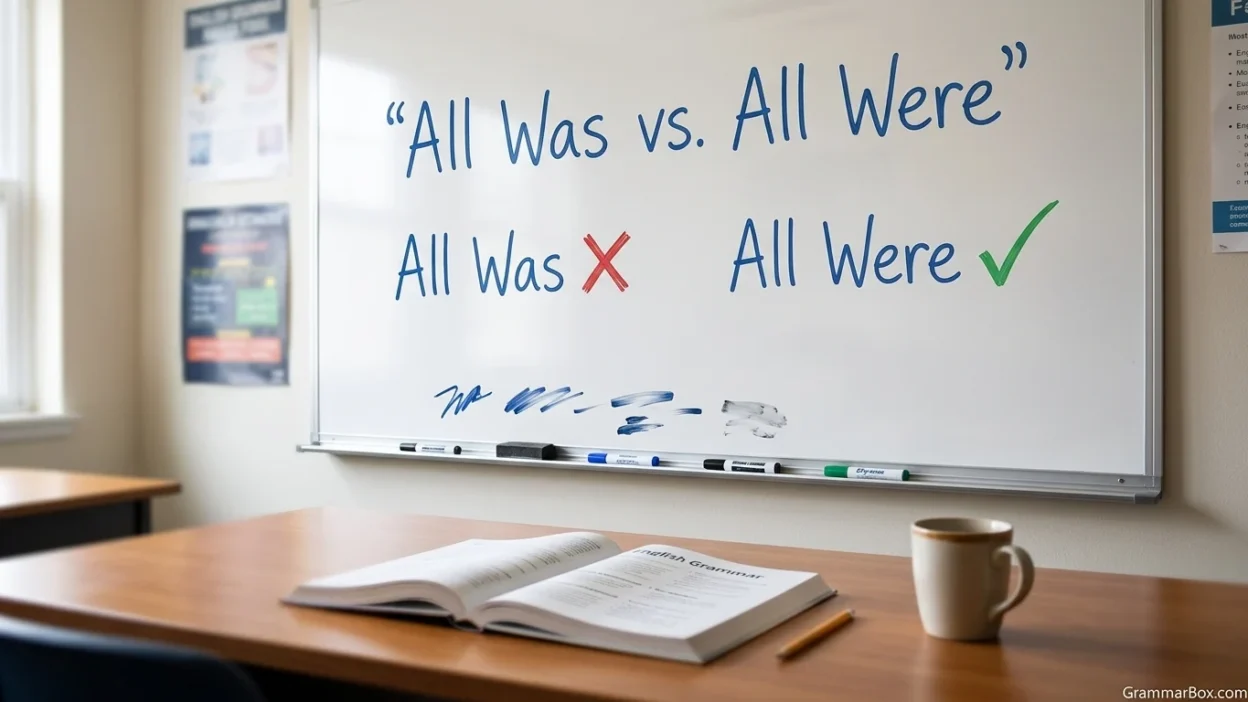
Choosing between all was vs. all were can be confusing because the correct verb depends on what the word all refers to. Sometimes, all was is correct, while in other situations, all were is the grammatically appropriate choice. Understanding this difference will help you write clearer sentences and avoid common subject-verb agreement mistakes.
The confusion usually arises because all can refer to a single thing, a group of people, several objects, or an entire situation. English grammar treats these meanings differently. For example, you might say, “All was quiet in the village,” but you would normally say, “All were present at the meeting” when referring to multiple people. Both expressions can be correct, depending on the context.
In this guide, you will learn the meanings of all was and all were, discover when to use each expression, and explore practical examples that make the grammar rules easier to remember.
Quick Answer: All Was vs. All Were
All was is generally used when all refers to an entire situation, everything collectively, or an uncountable concept. All were is used when all refers to multiple people or countable things. The correct choice depends on the meaning of all and whether the intended subject is singular or plural.
Why People Confuse It
The expressions all was and all were are confusing because the word all does not always behave like a singular or plural noun.
Unlike words such as everyone or everything, which have more predictable grammatical patterns, all can refer to different kinds of subjects.
Consider these examples:
- All was lost. Here, all means everything that mattered or everything someone possessed.
- All were lost. Here, all refers to multiple people or things that became lost.
Both sentences are grammatically possible, but they communicate different meanings.
Three factors help determine which expression is correct:
- Meaning: Does all refer to everything collectively or to several individual items?
- Subject-verb agreement: Is the subject understood as singular or plural?
- Context: What does all refer to in the surrounding sentence?
Understanding these factors makes it much easier to choose the correct past-tense verb.
All Was: Meaning and Usage
All was is generally correct when all refers to everything collectively, an entire situation, or a singular or uncountable concept.
In these cases, all is understood as a singular subject, so it takes the singular past-tense verb was.
When to Use All Was
Use all was when referring to an overall condition, situation, or collective idea.
Examples:
- All was quiet after the storm.
- All was well until the power went out.
- All was lost when the company closed.
- All was ready for the celebration.
- All was peaceful in the countryside.
- All was forgiven after their conversation.
In these examples, all refers to an overall state or situation rather than several separately identified people or objects.
All Was in Everyday English
The expression also appears in storytelling, descriptive writing, and formal or literary contexts.
For example:
“After the guests left, all was silent in the house.”
Here, all describes the general atmosphere of the house. The sentence treats the situation as a whole, making was appropriate.
Another example is:
“Despite the difficulties, all was not lost.”
This sentence means that there was still some hope or that the entire situation had not become hopeless.
Is All Was Always Correct?
No. Although all was is correct in many contexts, it is not appropriate when all clearly refers to multiple people or plural countable things.
Incorrect for a plural subject:
“All was waiting outside the classroom.”
If all refers to several students, the correct sentence is:
“All were waiting outside the classroom.”
Always identify what all represents before choosing the verb.
All Were: Meaning and Usage
All were is used when all refers to multiple people, animals, or countable things.
The verb were is the plural past-tense form of be. It agrees with plural subjects, making it appropriate when all represents several individual members of a group.
When to Use All Were
Use all were when describing multiple people or things in the past.
Examples:
- All were present at the meeting.
- All were invited to the wedding.
- All were happy with the results.
- All were ready to leave.
- All were waiting for the bus.
- All were accounted for after the evacuation.
In each sentence, all refers to multiple individuals or objects.
All Were in Everyday English
This expression is especially common when discussing groups, teams, families, students, employees, and collections of countable objects.
For example:
“All were excited about the school trip.”
Here, all refers to several people who shared the same feeling.
Another example is:
“The documents were checked, and all were approved.”
In this sentence, all refers to multiple documents, so were is the correct choice.
Can All Were Refer to People?
Yes. When all refers to several people, were is generally the appropriate verb.
For example:
- All were welcome at the event.
- All were informed about the changes.
- All were treated fairly.
However, when all refers to an entire situation or an uncountable concept, was may be more appropriate.
Compare:
- All was forgiven. The situation or wrongdoing was collectively forgiven.
- All were forgiven. Multiple people were forgiven.
The context determines which meaning is intended.
Comparison Table: All Was vs. All Were
| Feature | All Was | All Were |
|---|---|---|
| Basic usage | Refers to everything collectively or a singular situation | Refers to multiple people or things |
| Verb form | Singular past tense | Plural past tense |
| Grammar principle | Singular subject-verb agreement | Plural subject-verb agreement |
| Common context | Conditions, situations, and collective ideas | Groups, individuals, and countable objects |
| Example | All was quiet. | All were quiet. |
| Meaning of the example | The overall environment was quiet. | Several people or things were quiet. |
| Another example | All was lost. | All were lost. |
| Meaning of the example | Everything was lost. | Multiple people or items were lost. |
The main rule: Use all was for a singular or collective meaning and all were for a plural meaning. Always consider the intended meaning and the noun or idea that all represents.
When to Use Each
Choosing between all was and all were becomes easier when you identify the subject’s meaning.
Use All Was for an Entire Situation
When all means everything collectively, was is often appropriate.
Examples:
- All was peaceful in the village.
- All was arranged before the guests arrived.
- All was forgotten after many years.
These sentences describe situations or experiences as a whole.
Use All Were for Multiple People
When all refers to several individuals, use were.
Examples:
- All were invited to the ceremony.
- All were satisfied with the service.
- All were prepared for the examination.
The subject represents multiple people, so the plural verb is appropriate.
Use All Were for Countable Plural Things
When all refers to several identifiable objects, were is generally correct.
Examples:
- All were packed before noon.
- All were delivered on Monday.
- All were damaged during transportation.
Here, all refers to multiple countable objects, such as boxes, packages, or products.
Pay Attention to Uncountable Nouns
When all refers to an uncountable noun, the verb is usually singular.
Examples:
- All the water was gone.
- All the information was useful.
- All the furniture was delivered.
Notice that the verb agrees with the uncountable noun: water, information, and furniture.
However, when all refers to plural countable nouns, use were.
Examples:
- All the bottles were empty.
- All the reports were complete.
- All the chairs were occupied.
This distinction is one of the most reliable ways to determine the correct verb.
Examples of All Was vs. All Were
The following examples demonstrate how context changes the correct choice.
Examples Using All Was
- All was quiet after the children went to bed.
- All was well until the weather suddenly changed.
- All was lost when the ship sank.
- All was ready for the opening ceremony.
- All was forgiven after they apologized.
- All was peaceful during the early morning hours.
- All was arranged before the guests arrived.
- All was forgotten as they celebrated their success.
- All was not lost despite the unexpected setback.
- All was silent when the principal entered the room.
In these sentences, all refers to a general condition, an overall situation, or something understood collectively.
Examples Using All Were
- All were present at the annual meeting.
- All were excited about the upcoming holiday.
- All were invited to the graduation ceremony.
- All were ready to begin the competition.
- All were waiting outside the building.
- All were satisfied with the final results.
- All were accounted for after the emergency.
- All were selected for the training program.
- All were happy to see their old teacher.
- All were informed about the schedule change.
In these examples, all refers to several people or things.
Examples That Show How Meaning Changes
Sometimes, both expressions are correct, but their meanings differ.
Example 1: Lost
- All was lost during the fire.
- All were lost during the fire.
The first sentence treats everything that was lost as a collective whole. The second refers to multiple people or things that became lost.
Example 2: Quiet
- All was quiet in the room.
- All were quiet during the presentation.
The first describes the overall atmosphere. The second describes several people or things that remained quiet.
Example 3: Ready
- All was ready for the event.
- All were ready for the event.
The first treats preparations or the overall situation as a whole. The second refers to several people or items that were prepared.
Example 4: Well
- All was well after the operation.
- All were well after the operation.
The first describes the overall situation. The second refers to several people who were doing well.
Remember that the surrounding context must make the intended meaning clear.
Common Mistakes
Even fluent English speakers can become confused about subject-verb agreement when using all. Here are some common mistakes to avoid.
Mistake 1: Using Was for a Clearly Plural Subject
Incorrect: All was present at the meeting.
Correct: All were present at the meeting.
Why? The sentence refers to multiple people, so the plural verb were is appropriate.
Mistake 2: Using Were for a Singular Uncountable Noun
Incorrect: All the information were useful.
Correct: All the information was useful.
Why? Information is an uncountable noun in standard English, so it takes a singular verb.
Mistake 3: Assuming All Is Always Singular
Incorrect: All were quiet in the house, even though the sentence is intended to describe the overall atmosphere.
Better: All was quiet in the house.
Why? When all describes the general condition of a place, was is often the natural choice.
The original sentence is not inherently ungrammatical, however. It could be correct if all referred to several people or things that were quiet.
Mistake 4: Ignoring the Noun After All
Incorrect: All the students was ready.
Correct: All the students were ready.
Why? Students is a plural countable noun, so the verb must be plural.
Mistake 5: Confusing Collective Meaning With Plural Meaning
Incorrect: All the money were spent.
Correct: All the money was spent.
Why? Money is uncountable in this context, so it takes was.
To avoid these mistakes, identify the noun or idea represented by all before selecting the verb.
Memory Trick: How to Remember All Was vs. All Were
A simple memory trick can help you choose the right expression quickly.
Think of it this way:
- All = everything as one whole → was
- All = several people or things → were
For example:
- All was peaceful. The situation was peaceful.
- All were peaceful. Several people or things were peaceful.
You can also replace all with a more specific expression to check your sentence.
Try replacing all with everything:
- Everything was ready.
- Everything was lost.
Now try replacing all with all the students:
- All the students were ready.
- All the students were present.
This substitution method helps you identify whether the intended subject is singular or plural.
Quick tip: If you can replace all with everything without changing the intended meaning, was is often the right choice. If all refers to several people or countable objects, were is usually correct.
American vs. British English
The basic grammar rules for all was and all were are the same in American and British English.
Both varieties generally use was when all refers to an entire situation or an uncountable concept, and were when it refers to multiple people or plural countable things.
Examples in American English:
- All was quiet after the game.
- All were present at the meeting.
- All the equipment was delivered.
Examples in British English:
- All was quiet after the match.
- All were present at the meeting.
- All the equipment was delivered.
The vocabulary may differ slightly between the varieties, but the subject-verb agreement rules remain essentially the same.
Is There a Regional Preference?
There is no general American-versus-British rule that makes all was correct in one variety and all were correct in the other.
The choice depends primarily on meaning and grammatical context, not nationality.
Writers in both varieties should pay attention to whether all refers to a singular or uncountable concept or to a plural group.
Similar Words and Expressions
Understanding related expressions can strengthen your knowledge of English subject-verb agreement.
All Is vs. All Are
These expressions use the present tense rather than the past tense.
- All is well. Describes an overall situation as satisfactory.
- All are welcome. Refers to multiple people who are welcome.
Everything Was vs. Everyone Was
These expressions may look similar, but they refer to different kinds of subjects.
- Everything was ready. Everything refers to things or circumstances.
- Everyone was ready. Everyone refers to people and takes a singular verb in standard English.
All Has vs. All Have
The same subject-agreement principle applies to has and have.
- All the information has been collected.
- All the students have arrived.
The first sentence uses an uncountable noun, while the second uses a plural countable noun.
There Was vs. There Were
These expressions are also governed by subject-verb agreement.
- There was a problem with the computer.
- There were several problems with the computer.
Use was for a singular noun and were for a plural noun in these examples.
All of It Was vs. All of Them Were
These expressions make the distinction especially clear.
- All of it was damaged.
- All of them were damaged.
It is singular, while them refers to multiple people or things.
FAQs:
1. Is All Was Grammatically Correct?
Yes, all was is grammatically correct when all refers to an entire situation, everything collectively, or an uncountable concept.
For example: “All was quiet after the storm.”
However, when all refers to multiple people or plural countable things, all were is generally correct.
2. Is All Were Grammatically Correct?
Yes, all were is correct when all refers to multiple people or countable things.
For example: “All were invited to the celebration.”
The plural verb were agrees with the plural meaning of the subject.
3. Should I Say All Was Well or All Were Well?
All was well is the conventional expression when you mean that everything in a situation was satisfactory.
For example: “After the inspection, all was well.”
Use all were well when referring to multiple people or things that were doing well. For example: “After the examination, all were well.”
4. Is All Was Lost Correct?
Yes. All was lost is a common and grammatically correct expression when all means everything that could be lost.
Example: “After the company closed, all was lost.”
If you are referring to multiple people or objects that became lost, all were lost may be appropriate.
5. Do Americans Say All Was or All Were?
Americans use both expressions. The choice depends on the intended meaning and the subject’s grammatical number.
For example, “All was quiet” describes an overall situation, while “All were present” refers to multiple people.
6. Can All Be Singular or Plural?
Yes. The word all can take a singular or plural verb depending on what it refers to.
When it refers to an uncountable noun or an entire situation, a singular verb is generally appropriate. When it refers to plural countable nouns, a plural verb is generally appropriate.
7. What Is the Easiest Way to Choose Between All Was and All Were?
First, determine what all means in your sentence.
If it means everything collectively or refers to an uncountable noun, use was in the past tense. If it refers to multiple people or plural countable objects, use were.
For example, say “All the food was eaten” but “All the guests were seated.”
Remember This
- All was: Use it for an entire situation, a collective idea, or an uncountable noun.
- All were: Use it for multiple people or plural countable things.
- Check the context: The word all can have singular or plural meaning.
- Follow subject-verb agreement: Make sure the verb matches what all refers to.
The key takeaway: Don’t memorize all was or all were as a fixed expression. Understand the meaning of the subject, and the correct verb will usually become clear.
Conclusion
The difference between all was and all were comes down to meaning and subject-verb agreement. Although both expressions describe past situations, all was generally refers to everything collectively or an uncountable concept, while all were refers to multiple people or countable objects. Recognizing this distinction will help you avoid common grammar mistakes and write more naturally.
Whenever you are unsure which expression to use, look at the subject and ask what all represents. If it refers to an overall situation, as in “All was peaceful,” use was. If it refers to a group of people, as in “All were present,” use were. With practice, choosing between these two expressions will become a simple and natural part of your English writing.