
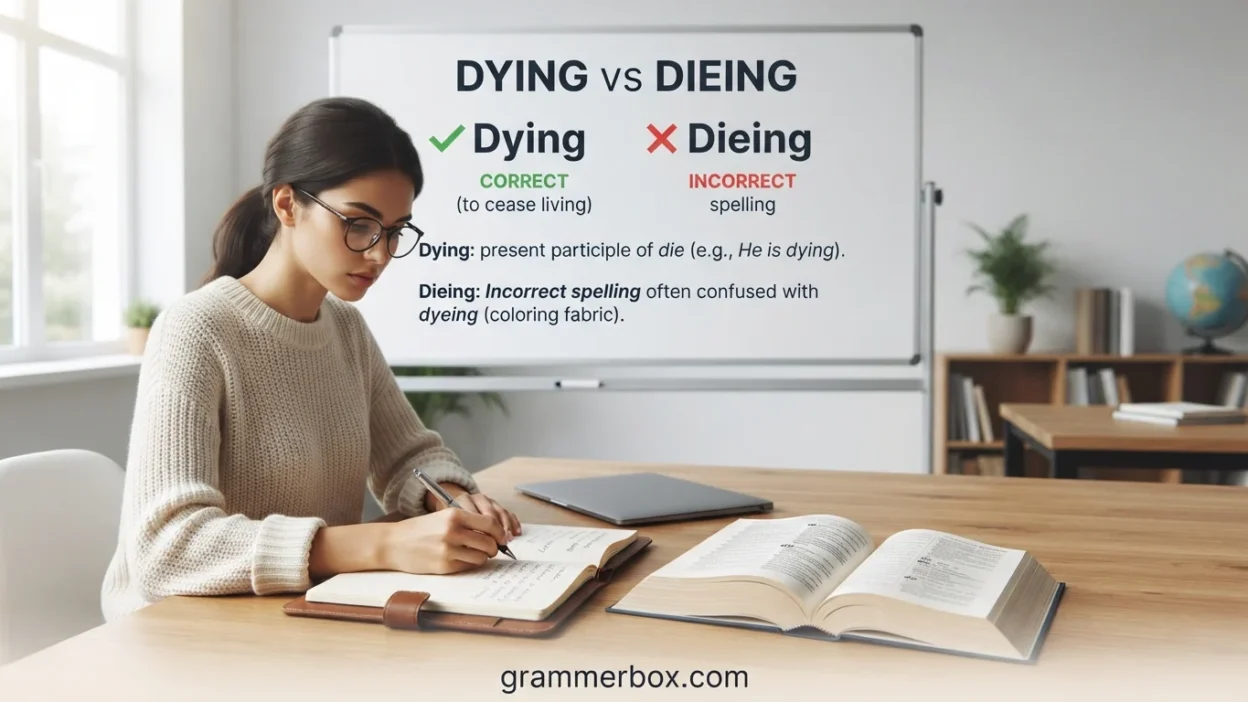
If you have ever wondered whether the correct spelling is dying or dieing, you are not alone. These two forms look almost identical, but only one is normally correct when you want to write the present participle of the verb die. The confusion happens because English spelling rules often change when a verb ending in -ie takes the -ing suffix.
The correct form is dying. It can describe someone or something that is approaching death, but it is also used figuratively in expressions such as “dying of laughter” or “dying to know.” Dieing is generally considered a misspelling when it is intended as the -ing form of die. Understanding this small spelling rule can help you avoid a common mistake in emails, essays, social media posts, and everyday writing.
Quick Answer
Dying is the correct spelling of the -ing form of die. When die becomes a present participle, the final -ie changes to y before -ing: die → dying. Dieing is generally incorrect in standard English.
Why People Confuse It
The confusion comes from the way English forms present participles.
For many verbs, we simply add -ing:
- walk → walking
- read → reading
- jump → jumping
Because die ends in -ie, it may seem logical to write dieing. However, English uses a special spelling pattern here.
When a verb ends in -ie, the -ie changes to y before -ing:
- die → dying
- lie → lying
- tie → tying
So, dying is the standard spelling.
First Word: Dying
Dying is the correct present participle and gerund form of die.
It can refer to the process of approaching death:
The old tree is dying.
It can also have several figurative meanings. For example, someone can be dying of laughter, dying for attention, or dying to see something.
Examples of “Dying”
- The flowers are dying without enough water.
- The patient is dying from a serious illness.
- I was dying of laughter at his joke.
- She is dying to know what happened.
- The fire is slowly dying out.
Second Word: Dieing
Dieing is generally considered an incorrect spelling when you mean the present participle of die.
The standard form is:
die → dying
not:
die → dieing
For example:
❌ The plant is dieing.
✅ The plant is dying.
There can be rare technical or specialized contexts in which dieing appears as a form of another word, particularly die as a noun or verb referring to a tool used for cutting, shaping, or stamping. However, this is not the ordinary spelling of the -ing form of die meaning “to stop living.”
Comparison Table
| Word | Correct? | Meaning | Example |
| Dying | ✅ Yes | Present participle of die | The flowers are dying. |
| Dieing | ❌ Usually no | Incorrect spelling when referring to death | The flowers are dieing. |
| Die | ✅ Yes | To stop living | Plants die without water. |
| Died | ✅ Yes | Past tense of die | The plant died yesterday. |
When to Use Each
Use “Dying”
Use dying whenever you need the -ing form of the verb die.
Common uses include:
- Dying from a disease or condition
- Dying of an illness or emotion
- Dying out when something gradually disappears
- Dying down when something becomes weaker
- Dying to express a strong desire
Examples:
- The tradition is dying out.
- The noise is dying down.
- I am dying to hear your story.
- He was dying of laughter.
Avoid “Dieing”
Do not use dieing when you mean that someone or something is approaching death.
Instead, write dying.
Examples of Dying vs Dieing
Here are some examples that make the difference clear:
- ✅ The leaves are dying because of the heat.
- ❌ The leaves are dieing because of the heat.
- ✅ The flowers are dying without sunlight.
- ❌ The flowers are dieing without sunlight.
- ✅ The animal was dying from its injuries.
- ❌ The animal was dieing from its injuries.
- ✅ The fire is dying down.
- ❌ The fire is dieing down.
- ✅ I am dying to know the answer.
- ❌ I am dieing to know the answer.
- ✅ The old custom is dying out.
- ❌ The old custom is dieing out.
Common Mistakes
1. Adding -ing directly
A common mistake is treating die like a regular verb:
die + ing = dieing
But English changes -ie to y:
die → dying
2. Confusing “dying” with “died”
Dying describes an ongoing process.
The plant is dying.
Died describes a completed event.
The plant died yesterday.
3. Writing “dieing” in formal work
Because dieing is generally incorrect for this meaning, it should be avoided in essays, professional writing, academic work, and other formal contexts.
Memory Trick
Remember this simple rule:
IE changes to Y before ING.
So:
DIE → DYING
You can also remember the pattern:
- lie → lying
- tie → tying
- die → dying
Think: “IE says goodbye to ING and becomes Y.”
American vs British English
There is no meaningful American-versus-British spelling difference for this word.
Both American and British English use:
dying
So whether you are writing for an American or British audience, the standard form is the same.
Similar Words
Several words are related to dying and can sometimes cause additional confusion:
- Die — to stop living
- Died — past tense of die
- Dying — present participle of die
- Death — the end of life
- Dead — no longer alive
- Dying out — gradually disappearing
- Dying down — gradually becoming weaker
- Dying to — strongly wanting something
Understanding these forms makes it easier to choose the right word depending on the sentence.
FAQs:
Is “dying” or “dieing” correct?
Dying is correct when you mean the -ing form of die. Dieing is generally a misspelling in this context.
Why is “dying” spelled with a y?
English changes the final -ie of a verb to y before adding -ing. Therefore, die becomes dying.
Is “dieing” ever a word?
In rare specialized contexts, dieing may occur as a form related to the noun or verb die meaning a tool used for shaping or stamping. But it is not the normal spelling of die + ing meaning approaching death.
Is “dying” a verb?
Yes. Dying is the present participle and gerund form of the verb die.
What is the past tense of die?
The past tense is died.
The plant died last week.
What is the difference between dying and died?
Dying describes an ongoing process, while died refers to an event that has already happened.
Is “dying” the same in British and American English?
Yes. Dying is the standard spelling in both British and American English.
Remember This
Die + ing = Dying, not Dieing.
Dying is the standard form in sentences such as “The plant is dying” and “I am dying to know.”
Conclusion
The dying vs dieing confusion is easy to solve once you remember the -ie y spelling rule. Whenever die takes -ing, the ie changes to y, producing dying.
Whether you are writing an academic assignment, professional email, article, or everyday message, choose dying when you mean the ongoing form of die. The word dieing should generally be avoided for this meaning.