
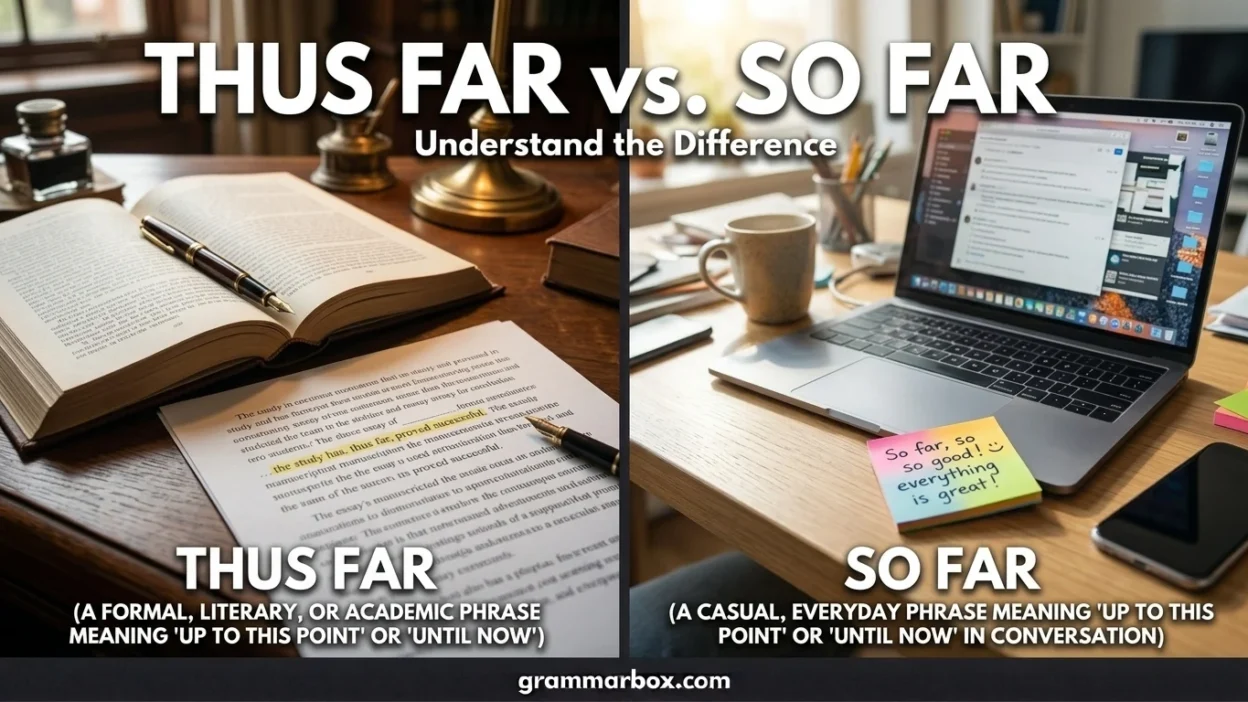
When writing or speaking in English, small phrases can make a sentence sound more natural and precise. Two expressions that often confuse learners are thus far and so far. Both refer to something that has happened or been true up to a particular point in time. However, they can differ in tone, formality, and the situations in which they sound most appropriate. Understanding these differences will help you choose the right expression in everyday conversations, academic writing, and professional communication.
Although thus far vs. so far may seem like a simple vocabulary comparison, knowing how each phrase works can improve your English fluency. For example, you might use “so far” when discussing your progress in a course, while “thus far” may fit better in a formal report about research findings. Both expressions are grammatically correct in many of the same contexts, but they do not always sound equally natural. This guide explains their meanings, usage rules, differences, and practical examples so you can confidently use either expression.
Quick Answer
Thus far and so far both mean “until now” or “up to this point.” The main difference is tone: “so far” is more common in everyday English, while “thus far” sounds more formal and is often used in academic, professional, or analytical writing. Both can describe progress, events, and results up to the present.
Why People Confuse It
People confuse “thus far” and “so far” because both expressions communicate the same basic idea: something has continued or developed up to the present moment.
For example:
- “The project has been successful so far.”
- “The project has been successful thus far.”
Both sentences are grammatically correct and express the same general meaning.
The confusion arises because English has several expressions with overlapping meanings, but their tone and frequency differ.
Here are the main reasons these phrases are often confused:
- Similar meanings: Both mean “until now” or “up to this point.”
- Similar grammatical roles: Both can modify verbs and describe ongoing situations or results.
- Different levels of formality: “So far” is conversational, while “thus far” is more formal.
- Overlapping contexts: Both can appear in reports, discussions, presentations, and descriptions of progress.
The easiest way to distinguish them is to consider your audience and the tone you want to create.
First Word: Thus Far
Thus far is an adverbial expression meaning “until now,” “up to this point,” or “up to the present stage.”
It is commonly used in formal writing, academic discussions, business reports, and analytical explanations. The word “thus” gives the expression a more formal tone than the everyday alternative “so far.”
Examples of Thus Far
- The research has produced promising results thus far.
- Thus far, the team has completed three major stages.
- No significant problems have been identified thus far.
- The evidence gathered thus far supports the original hypothesis.
- The company has met its targets thus far.
- Thus far, the investigation has revealed no clear explanation.
When to Use Thus Far
Use “thus far” when you want your writing to sound measured, formal, or analytical.
It is particularly useful in:
- Academic writing: “The findings thus far suggest a possible connection.”
- Business reports: “The strategy has delivered positive results thus far.”
- Research summaries: “No reliable conclusion can be drawn from the evidence collected thus far.”
- Formal presentations: “Thus far, we have achieved all three objectives.”
Remember that “thus far” is not limited to formal contexts. You can use it in ordinary conversation, but it may sound more deliberate or formal than necessary.
Second Word: So Far
So far is an adverbial expression meaning “until now” or “up to this point.” It is one of the most common ways to describe progress, experiences, events, and results that have occurred before the present moment.
It is natural in casual conversations, emails, classroom discussions, and many forms of professional writing.
Examples of So Far
- I have enjoyed the course so far.
- So far, everything is going according to plan.
- We have received ten applications so far.
- The weather has been pleasant so far.
- She has answered five questions so far.
- So far, nobody has reported a problem.
When to Use So Far
Use “so far” when you want your English to sound natural, direct, and conversational.
It works well in:
- Daily conversations: “How is your new job going so far?”
- Education: “I have learned several useful grammar rules so far.”
- Workplace communication: “We have completed most of the tasks so far.”
- Personal updates: “Everything has been fine so far.”
- Informal writing: “This is my favorite book so far.”
Although “so far” is especially common in conversation, it is also perfectly acceptable in professional and academic writing when a straightforward tone is appropriate.
Comparison Table
| Feature | Thus Far | So Far |
|---|---|---|
| Meaning | Until now; up to this point | Until now; up to this point |
| Tone | More formal | Neutral and conversational |
| Common use | Reports, research, formal writing | Conversation, emails, general writing |
| Grammar | Adverbial expression | Adverbial expression |
| Everyday frequency | Less common | More common |
| Academic writing | Appropriate | Also appropriate |
| Professional writing | Appropriate | Also appropriate |
| Example | The results are encouraging thus far. | The results are encouraging so far. |
The essential difference is style, not basic meaning. In many sentences, you can replace one phrase with the other without changing the intended message.
When to Use Each
Choosing between “thus far” and “so far” becomes easier when you think about the context, audience, and level of formality.
Use Thus Far for Formal or Analytical Writing
Choose “thus far” when discussing evidence, research, progress reports, or developments in a formal setting.
Examples:
- The committee has reviewed all submitted proposals thus far.
- The available evidence thus far does not establish a definitive cause.
- Our analysis has identified two significant trends thus far.
These sentences sound appropriate in formal reports because the phrase fits an analytical tone.
Use So Far for Everyday Communication
Choose “so far” when speaking naturally or giving a straightforward update.
Examples:
- I like my new school so far.
- We have saved enough money so far.
- How is your vacation going so far?
These examples sound natural in everyday English.
Can You Use Both in the Same Situation?
Yes. Both expressions can describe the same situation.
For example:
- “The project has progressed smoothly so far.”
- “The project has progressed smoothly thus far.”
Neither sentence is inherently incorrect. The first sounds more natural in everyday communication, while the second sounds more formal.
Practical rule: When unsure, use “so far.” It is widely accepted, easy to understand, and suitable for most situations.
Examples: Thus Far vs. So Far in Sentences
The following examples demonstrate how both expressions work in different contexts.
Examples Using Thus Far
- The investigation has uncovered no new evidence thus far.
- Thus far, the students have completed all their assignments.
- The company has maintained steady growth thus far.
- No major disagreements have emerged thus far.
- The experiment has produced consistent results thus far.
- The information collected thus far remains incomplete.
- Thus far, the negotiations have been productive.
- The new policy has received positive feedback thus far.
- Researchers have identified several possible explanations thus far.
- The candidate has demonstrated strong leadership skills thus far.
Examples Using So Far
- I have read three chapters so far.
- So far, the movie has been entertaining.
- We have not received a response so far.
- She has completed half of her homework so far.
- The weather has stayed warm so far.
- How is your English course going so far?
- So far, I have had a great experience at this company.
- They have sold twenty tickets so far.
- Nothing unusual has happened so far.
- This is the most useful lesson I have taken so far.
Examples Where Both Expressions Work
Consider these pairs:
- Thus far: The plan has worked well thus far.
- So far: The plan has worked well so far.
- Thus far: No errors have been found thus far.
- So far: No errors have been found so far.
- Thus far: We have completed four stages thus far.
- So far: We have completed four stages so far.
In each pair, the main difference is the level of formality rather than the meaning.
Common Mistakes
Although both phrases are straightforward, English learners sometimes use them awkwardly or misunderstand their meaning.
1. Assuming Thus Far Is Always More Correct
Incorrect assumption: “Thus far” is grammatically superior to “so far.”
Correction: Both expressions are correct. Your choice depends on context and style.
2. Using Thus Far in Every Conversation
Example: “Thus far, I am enjoying my lunch.”
This sentence is grammatically possible, but it may sound unnecessarily formal in casual conversation.
More natural: “I’m enjoying my lunch so far.”
3. Thinking So Far Is Too Informal for Professional Writing
“So far” is acceptable in many business documents, progress updates, and academic discussions. You do not need to replace it with “thus far” simply to sound professional.
4. Confusing the Expressions With a Completed Time Period
Both expressions usually describe a period extending from an earlier point up to now.
For example:
- Natural: “I have learned a lot so far.”
- Natural: “I have learned a lot thus far.”
If you are describing a completely finished period in the past, a different time expression may be more appropriate.
5. Repeating the Same Expression Unnecessarily
Avoid awkward repetition such as:
“So far, the project has been successful so far.”
Better: “So far, the project has been successful.”
Use the expression once unless repetition is genuinely needed for emphasis.
Memory Trick
A simple memory trick can help you remember the difference between “thus far” and “so far.”
- So far = simple and social. Think of everyday conversations, personal updates, and casual messages.
- Thus far = formal and focused. Think of reports, research, analysis, and professional summaries.
For example, when talking to a friend, you might say, “I like the new restaurant so far.”
When writing a research report, you might say, “The evidence thus far supports the proposed explanation.”
This is a useful guideline rather than a strict grammar rule. Either expression can work in many contexts.
American vs. British English
There is no major difference in meaning between “thus far” and “so far” in American and British English. Both expressions are understood in both varieties.
However, their everyday use and tone remain important.
American English
In American English, “so far” is common in casual conversations, workplace updates, and general writing.
Examples:
- Everything is going well so far.
- We have received several responses so far.
“Thus far” is also used, particularly in formal reports and analytical writing.
British English
British English also uses “so far” frequently in conversation and general writing.
Examples:
- The project has gone well so far.
- I have enjoyed the course so far.
“Thus far” is understood and can appear in formal or academic contexts.
Is One Expression American or British?
No. These are not American-versus-British spelling variants. The difference is mainly one of tone and usage, not regional spelling.
Similar Words and Expressions
Several English expressions have meanings similar to “thus far” and “so far.” However, their precise usage can vary.
| Expression | Meaning | Example |
|---|---|---|
| Until now | Up to the present | Until now, we have had no problems. |
| Up to now | From an earlier point to the present | Up to now, the plan has worked. |
| To date | Up to the present date | To date, the company has hired twelve people. |
| As of now | At the present time | As of now, the schedule remains unchanged. |
| Hitherto | Until this time; formerly | Hitherto, the method had not been tested. |
| At this point | At the current stage | At this point, we need more information. |
| As yet | Until now, often in negative statements | No decision has been made as yet. |
Which Alternative Should You Choose?
- Use until now for a clear, direct statement about the present.
- Use up to now when emphasizing progress over time.
- Use to date in reports and discussions of measurable achievements.
- Use as of now when emphasizing the current situation or status.
- Use hitherto for a more formal or literary tone.
- Use at this point when referring to a current stage in a process.
- Use as yet when emphasizing that something has not happened or been completed.
These alternatives can enrich your vocabulary, but they are not always interchangeable in every sentence.
FAQs:
1. What is the difference between thus far and so far?
Both mean “until now” or “up to this point.” “Thus far” is generally more formal, while “so far” is more common in everyday English. In many contexts, they can be used interchangeably.
2. Is thus far grammatically correct?
Yes. “Thus far” is a grammatically correct expression used to describe progress, events, or results up to the present. It is especially common in formal, academic, and professional writing.
3. Is so far formal or informal?
“So far” is neutral and works in both informal and formal contexts. It is particularly common in conversation, but it is also appropriate for many professional emails, reports, and academic texts.
4. Can I use thus far in an academic essay?
Yes. “Thus far” can be useful in academic essays, research papers, and analytical writing when discussing findings or developments up to the present. However, “so far” is also acceptable when a simpler tone suits the writing.
5. Can thus far and so far be used interchangeably?
Often, yes. Both expressions communicate the idea of something continuing up to now. The main difference is tone, although the best choice can depend on the sentence and its context.
6. Is thus far old-fashioned?
“Thus far” can sound formal or slightly literary compared with “so far,” but it is not incorrect or obsolete. It remains useful in formal writing, reports, and careful explanations.
7. Which expression should English learners use?
English learners can generally choose “so far” because it is common, natural, and appropriate in many situations. Learning “thus far” is also helpful for understanding formal writing and expanding vocabulary.
Remember This
Thus far = more formal. So far = more conversational.
Both mean “until now” or “up to this point.” When in doubt, choose “so far” because it sounds natural in most everyday situations and remains acceptable in many professional contexts.
Conclusion
Understanding “thus far vs. so far” is a simple way to improve your English vocabulary and writing style. Both phrases describe what has happened or remained true up to the present, so the key distinction is not their basic meaning but how they sound in context. “So far” is widely used in daily conversations, informal writing, and general communication, while “thus far” often fits formal reports, academic writing, and analytical discussions.
As you practice English, pay attention to the tone of your sentences and the people who will read or hear them. Choose the expression that communicates your message naturally without making your writing unnecessarily complicated. With regular practice, you will learn when to use “thus far,” when “so far” is the better choice, and how to express ongoing progress with greater confidence.