
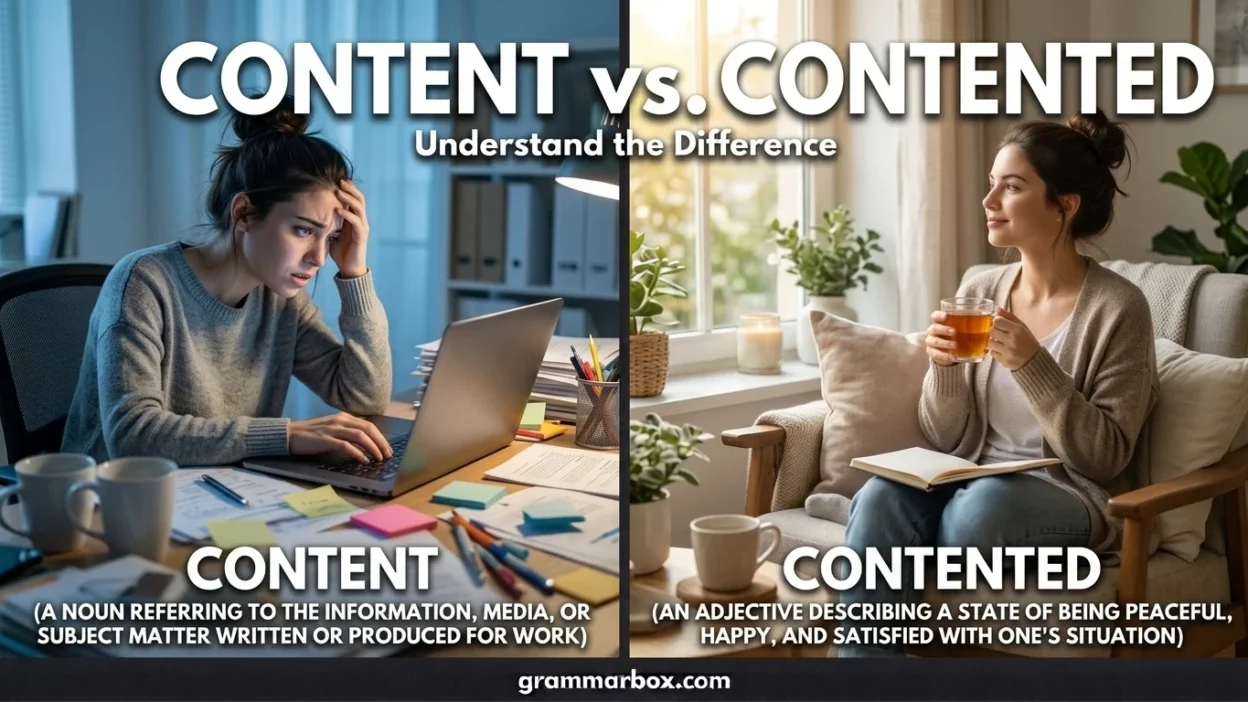
The words content vs. contented can confuse English learners because both relate to satisfaction and happiness. However, they are not always interchangeable, and understanding their grammatical roles helps you use them correctly. If you are writing an email, preparing an essay, improving your vocabulary, or learning English as a second language, knowing the difference between these words can make your sentences clearer and more natural.
Both words can describe a feeling of satisfaction, but they work differently in sentences. Content can function as an adjective meaning satisfied, a noun referring to material or information, or a verb meaning to satisfy. Contented, on the other hand, is an adjective that describes someone who feels satisfied, peaceful, or happy with their situation. Their pronunciation and context can also help distinguish them. In this guide, you will learn their meanings, grammatical differences, common mistakes, and practical examples so you can confidently choose the right word in everyday and academic writing.
Quick Answer
Content can mean satisfied or refer to information, material, or something contained within an item. Contented is an adjective describing someone who feels satisfied, peaceful, or happy. For example, “She is content with her life” and “She is contented with her life” are both grammatically correct.
Why People Confuse It
People often confuse content and contented because both words can describe a state of satisfaction. In sentences about happiness or personal fulfillment, their meanings overlap.
For example:
- She feels content with her life.
- She feels contented with her life.
Both sentences express satisfaction. However, contented emphasizes the feeling of being satisfied, while content is a more versatile word with several meanings.
The confusion becomes greater because content can also refer to written material, videos, website information, or the contents of a container. Its meaning depends on the sentence and pronunciation.
Content: Meaning and Usage
Content has several meanings depending on how it is used in a sentence.
1. Content as an Adjective
As an adjective, content means satisfied with a situation or happy with what you have.
Examples:
- I am content with my current job.
- She seems content living in a small town.
- They were content with the final results.
- He felt content after spending time with his family.
This use often emphasizes accepting or appreciating your current circumstances without needing anything more.
2. Content as a Noun
As a noun, content can refer to information, material, or the ideas included in something.
Examples:
- The website publishes educational content.
- The content of the book is easy to understand.
- Video content attracts many online viewers.
- The teacher reviewed the content of the lesson.
In this meaning, content is especially common in education, publishing, marketing, and digital communication.
3. Content as a Verb
As a verb, content means to satisfy someone or provide enough to meet their needs.
Examples:
- A simple explanation may content the students.
- The small gift did not content her.
- He tried to content himself with the available options.
This verb usage is less common in everyday conversation than the adjective and noun forms.
Contented: Meaning and Usage
Contented is an adjective that describes someone who feels satisfied, comfortable, or peaceful with their circumstances.
It often conveys a sense of calm happiness rather than excitement or intense joy.
Examples:
- The contented child smiled at her mother.
- He looked contented after a relaxing afternoon.
- They lived a simple but contented life.
- She felt contented with her decision.
- The old man appeared contented in his garden.
The word frequently describes a person’s emotional state, expression, lifestyle, or general feeling of satisfaction.
When Is Contented the Better Choice?
Use contented when you want to emphasize a person’s satisfied or peaceful state.
For example:
- The cat looked contented beside the warm fireplace.
- After years of hard work, she felt contented with her life.
In these sentences, contented helps highlight the feeling of calm satisfaction.
Content vs. Contented: Comparison Table
| Feature | Content | Contented |
|---|---|---|
| Part of speech | Noun, adjective, or verb | Adjective |
| Meaning as an adjective | Satisfied or at ease | Feeling satisfied or peaceful |
| Other meanings | Information, material, or to satisfy | No comparable common noun or verb meaning |
| Common contexts | Happiness, websites, books, education | Happiness, emotions, lifestyle |
| Example | I am content with my life. | I feel contented with my life. |
| Everyday usage | Very common in several meanings | Common when describing satisfaction |
| Grammatical flexibility | High | More limited |
The key distinction is that content has several grammatical functions, while contented specifically describes a satisfied state.
When to Use Each
Choosing between these words is easier when you consider the meaning of your sentence.
Use Content When:
- You want to describe someone who is satisfied.
- You are discussing information on a website or in a book.
- You need the verb meaning to satisfy someone.
- You want a concise description of someone’s emotional state.
Examples:
- I am content with my progress.
- The article contains useful content.
- She is content to stay at home tonight.
Use Contented When:
- You want to describe a person’s peaceful satisfaction.
- You are describing someone’s expression or emotional state.
- You want to emphasize a sense of calm happiness.
Examples:
- The contented baby fell asleep.
- He looked contented after dinner.
- They were contented with their quiet lifestyle.
Practical tip: If you are describing a person who feels satisfied, both words may work. If you mean information or material, use content, not contented.
Examples of Content vs. Contented
Here are 14 examples showing how these words work in everyday English.
Examples Using Content
- I am content with the progress I have made.
- She is content to spend the weekend reading.
- The students were content with their examination results.
- He felt content after helping his neighbors.
- The website offers useful content for English learners.
- Please check the content of the document before submitting it.
- A warm meal was enough to content the tired traveler.
- They seemed content with their simple lifestyle.
Examples Using Contented
- The contented baby slept peacefully in the crib.
- She looked contented while sitting in the garden.
- He led a quiet and contented life in the countryside.
- The contented dog rested beside its owner.
- After finishing her work, Maria felt contented.
- They appeared contented with the choices they had made.
Examples in Similar Contexts
Compare these pairs to understand how the adjective forms overlap:
- Content: The farmer was content with his life.
- Contented: The farmer lived a contented life.
- Content: She felt content after completing the project.
- Contented: She wore a contented smile after completing the project.
Both words can be correct in similar situations, but the surrounding sentence determines which sounds more natural.
Common Mistakes
English learners sometimes use content and contented interchangeably without considering their grammatical roles.
Mistake 1: Using Contented to Mean Information
Incorrect: The website has educational contented.
Correct: The website has educational content.
Content is the noun referring to information or material. Contented does not have this meaning.
Mistake 2: Assuming Contented Is Always More Correct
Incorrect assumption: “I am content with my life” is grammatically wrong.
Correct: “I am content with my life” is perfectly natural English.
The adjective content is widely used to describe satisfaction.
Mistake 3: Treating Contented as a Noun
Incorrect: Her contented was obvious.
Correct: Her contentment was obvious.
Use contentment as the noun for the state of being satisfied.
Mistake 4: Confusing Content With Contented in Writing
Incorrect: The contented of the article is helpful.
Correct: The content of the article is helpful.
When referring to the information in an article, content is the appropriate noun.
Mistake 5: Forgetting the Difference Between Contentment and Happiness
Although both words relate to positive feelings, contentment usually suggests satisfaction with one’s circumstances rather than excitement or intense happiness.
For example, someone may be content with a quiet evening without feeling especially excited.
Memory Trick
Use these simple tricks to remember the difference:
- Content = many meanings. It can describe satisfaction, information, or the act of satisfying someone.
- Contented = a satisfied feeling. Think of a peaceful person who feels comfortable with life.
- Contentment = the feeling itself. Use this noun when talking about the state of being satisfied.
Remember these examples:
- I am content with my job.
- I feel contented after a peaceful day.
- My contentment comes from appreciating simple things.
If the sentence is about website articles, books, videos, or information, choose content.
American vs. British English
There is no major American-versus-British spelling difference between content and contented. Both forms are standard in American English and British English.
| Usage | American English | British English |
|---|---|---|
| Satisfied | I am content with my life. | I am content with my life. |
| Describing satisfaction | She looked contented. | She looked contented. |
| Information or material | Online content | Online content |
| Noun for satisfaction | Contentment | Contentment |
The main distinction is grammatical and contextual, not regional. Both varieties use content and contented in broadly the same ways.
One pronunciation detail is worth remembering: when content means information or material, it is commonly pronounced CON-tent. When it means satisfied, it is commonly pronounced con-TENT. The pronunciation of contented follows the satisfied meaning.
Similar Words
Several English words are related to content and contented, but each has its own nuance.
| Word | Meaning | Example |
|---|---|---|
| Contentment | The state of being satisfied | She found contentment in her work. |
| Satisfied | Having one’s needs or expectations met | He was satisfied with the answer. |
| Happy | Feeling pleasure or joy | They were happy together. |
| Pleased | Feeling approval or enjoyment | I was pleased with the results. |
| Fulfilled | Feeling that life or an activity is meaningful | She felt fulfilled by teaching. |
| Comfortable | Feeling at ease | He was comfortable with the decision. |
| Gratified | Feeling pleasure because something desirable happened | She was gratified by their support. |
| Serene | Calm and peaceful | The lake looked serene. |
Content vs. contentment: Content can be an adjective meaning satisfied, while contentment is the noun describing that state.
Contented vs. satisfied: These words often overlap, but contented tends to suggest peaceful, ongoing satisfaction, while satisfied can refer to a specific need, request, or expectation being met.
FAQs:
1. What is the main difference between content and contented?
Content can be a noun, adjective, or verb. Contented is an adjective describing someone who feels satisfied or peaceful. Both can describe satisfaction, but only content commonly refers to information or material.
2. Is contented a real English word?
Yes. Contented is a standard English adjective. It describes someone who feels satisfied, comfortable, or peaceful with their circumstances.
3. Can I say “I am contented”?
Yes. “I am contented” is grammatically correct. You can also say “I am content.” Both express satisfaction, although content is often the more concise choice.
4. Is contented the past tense of content?
No. Contented can be the past-tense form of the verb content, meaning to satisfy someone. It is also an adjective describing a satisfied state. In everyday English, the adjective use is particularly common.
5. What is the noun form of contented?
The related noun is contentment, which means the state of being satisfied or at peace with one’s circumstances.
Example: “She found contentment in her simple lifestyle.”
6. Is contented more positive than content?
Not necessarily. Both words express satisfaction. However, contented can emphasize a peaceful or settled feeling, while content is more versatile and may sound more neutral or concise.
7. Do American and British speakers use content and contented differently?
Their basic meanings and grammatical uses are the same in American and British English. Differences in context and personal style may influence which word a speaker prefers, but neither word belongs exclusively to one variety.
Remember This
- Content: Satisfied, information, material, or to satisfy.
- Contented: Feeling satisfied, comfortable, or peaceful.
- Contentment: The state of being satisfied.
- American vs. British English: Both varieties use these words in the same basic ways.
The easiest rule is to look at the context. If you mean information, choose content. If you are describing a satisfied person, content and contented may both be correct.
Conclusion
Learning the difference between content and contented helps you communicate more clearly and avoid common English grammar mistakes. Although the two words overlap when describing satisfaction, they are not interchangeable in every situation. Their grammatical roles and meanings determine which form works best.
For everyday writing, remember that content is the more versatile word, while contented specifically describes a feeling of satisfaction or peace. With practice and attention to context, you can use both words naturally in conversations, academic assignments, and professional writing.