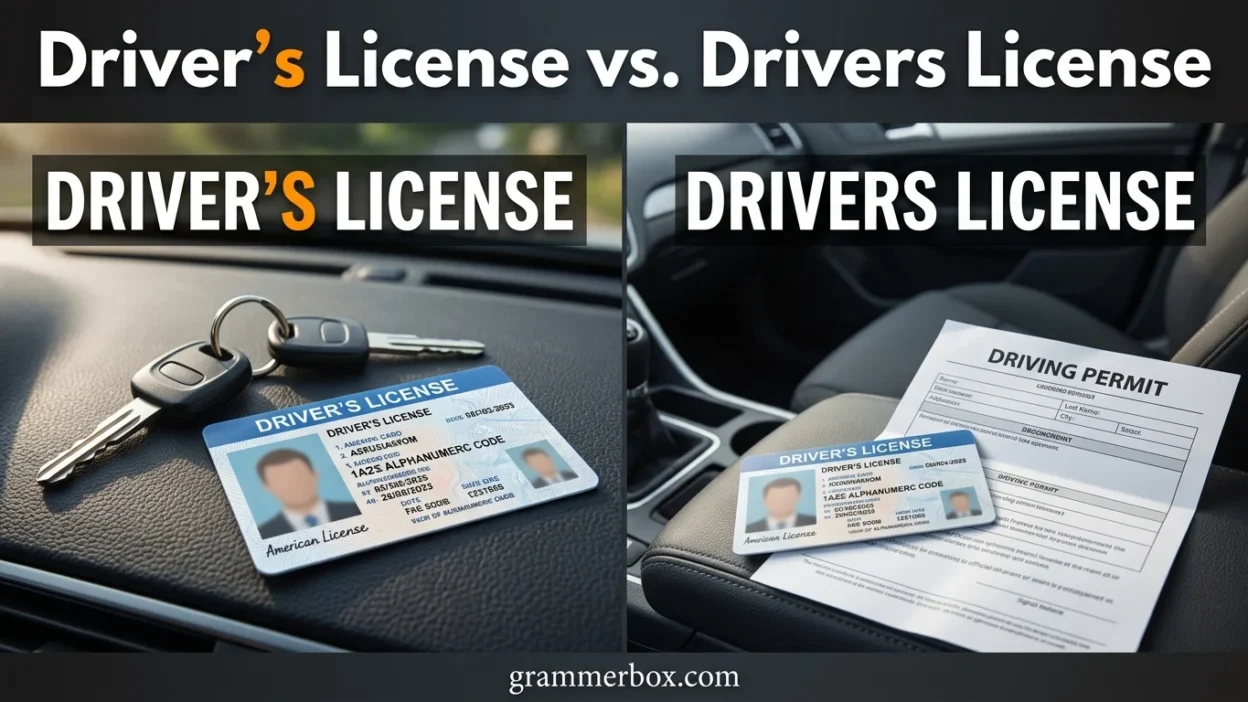
When writing about driving permits, one small punctuation mark can make a difference. Many people search for driver’s license vs. drivers license because they are unsure whether the word driver needs an apostrophe. Both forms appear online, in informal writing, and in discussions about driving laws, but one is the standard choice in American English.
Understanding the difference helps you write more accurately in school assignments, professional documents, online articles, and everyday conversations. If you are applying for a driving permit, checking identification requirements, or preparing content about road safety, choosing the correct spelling makes your writing clearer and more professional.
The confusion comes from the way English uses apostrophes to show possession and how plural nouns are formed. Since driver’s and drivers look and sound almost identical, it is easy to overlook the grammatical distinction. Fortunately, the rule is straightforward once you understand how the expression works.
Quick Answer
Driver’s license is the standard American English spelling. The apostrophe indicates a possessive relationship: a license associated with a driver. Drivers license is generally considered incorrect in standard American English because it omits the apostrophe. In British English, driving licence is the usual expression.
Why People Confuse It
The phrases driver’s license and drivers license differ by just one punctuation mark. Because the apostrophe does not change the pronunciation, writers may not notice when it is missing.
Three common reasons explain the confusion:
- Similar pronunciation: Both expressions sound the same when spoken.
- Possessive grammar: Writers sometimes forget that driver’s is a possessive form.
- Informal usage: Search queries, social media posts, and casual messages sometimes omit apostrophes.
Another source of confusion is the difference between singular and plural possessives. English uses driver’s for one driver and drivers’ for multiple drivers. These forms have different grammatical meanings, even though they are closely related.
First Word: Driver’s License
Driver’s license is the standard spelling in American English. The apostrophe before the s indicates possession or association with a driver.
Meaning of Driver’s License
A driver’s license is an official document or credential that authorizes a person to operate certain types of motor vehicles, subject to applicable laws and restrictions.
For example:
- She renewed her driver’s license last week.
- I need my driver’s license to rent a car.
- His driver’s license expires in December.
- Please show your driver’s license at the checkpoint.
In each sentence, driver’s license refers to the credential associated with an individual driver.
Why Is the Apostrophe Necessary?
The word driver’s is the singular possessive form of driver.
Consider these examples:
- Driver: A person who operates a vehicle.
- Driver’s: Belonging or relating to one driver.
- Drivers: More than one driver.
- Drivers’: Belonging or relating to multiple drivers.
The phrase driver’s license follows the familiar English possessive pattern used in expressions such as teacher’s desk, student’s book, and customer’s receipt.
Second Word: Drivers License
Drivers license is a common nonstandard spelling of the American expression driver’s license. It leaves out the apostrophe that normally marks the possessive form.
What Does Drivers License Mean?
In everyday writing, readers will usually understand drivers license to mean the document that permits someone to drive. However, being understandable does not necessarily make a spelling grammatically standard.
For example:
- Nonstandard: I forgot my drivers license at home.
- Standard: I forgot my driver’s license at home.
- Nonstandard: You must renew your drivers license soon.
- Standard: You must renew your driver’s license soon.
- Nonstandard: Her drivers license was checked by the officer.
- Standard: Her driver’s license was checked by the officer.
Is Drivers License Ever Correct?
The exact phrase drivers license is generally incorrect when referring to an individual’s driving credential in standard American English.
However, the plural possessive form drivers’ licenses is correct when discussing licenses belonging to multiple drivers.
For example:
– The drivers’ licenses were checked during the inspection.
Here, the apostrophe comes after the s because the licenses are associated with multiple drivers.
Comparison Table
| Expression | Grammatical status | Meaning or use |
|---|---|---|
| Driver’s license | Correct | License associated with one driver |
| Drivers license | Nonstandard | Common punctuation error |
| Drivers’ licenses | Correct | Licenses associated with multiple drivers |
| Driver licenses | Correct in some contexts | Compound noun used in certain official or technical terminology |
| Driving licence | Correct | Standard British English expression |
The important distinction is that driver’s license is the usual American English expression, while driving licence is the usual British English expression.
When to Use Each
Knowing when to use each form will help you avoid punctuation mistakes in formal and informal writing.
Use Driver’s License for One Person
Choose driver’s license when referring to an individual’s driving credential in American English.
Examples:
- I submitted a copy of my driver’s license.
- Your driver’s license must be valid.
- He passed the test and received his driver’s license.
This form works in emails, articles, schoolwork, government-related writing, and everyday communication.
Use Drivers’ Licenses for Multiple Drivers
Use drivers’ licenses when the licenses belong to or are associated with multiple drivers.
Examples:
- The company verified all employees’ drivers’ licenses.
- The officers inspected the drivers’ licenses.
- The database stores information about registered drivers’ licenses.
The apostrophe follows the plural s because drivers is plural.
Use Driving Licence in British English
In British English, driving licence is the conventional term.
Examples:
- She applied for a driving licence.
- Please bring your driving licence to the appointment.
- He renewed his driving licence online.
Remember that license is the American spelling of the noun, while licence is the standard British noun spelling. In British English, license is commonly used as a verb.
Examples of Driver’s License vs. Drivers License
Here are 12 examples to help you recognize the correct expression in different contexts.
- Correct: I need to renew my driver’s license this month.
- Incorrect: I need to renew my drivers license this month.
- Correct: She showed her driver’s license to the police officer.
- Incorrect: She showed her drivers license to the police officer.
- Correct: My driver’s license is in my wallet.
- Incorrect: My drivers license is in my wallet.
- Correct: He forgot to bring his driver’s license to the appointment.
- Incorrect: He forgot to bring his drivers license to the appointment.
- Correct: The company checked the drivers’ licenses of its delivery staff.
- Correct: Every applicant must present a valid driver’s license.
- Correct: The driving instructor asked to see the student’s driver’s license.
- Correct: In the UK, you would usually refer to this document as a driving licence.
Examples 1–8 demonstrate the standard singular American expression and its nonstandard alternative. Example 9 uses the plural possessive correctly because the licenses are associated with multiple drivers.
Common Mistakes
Even experienced writers sometimes confuse possessive apostrophes. Watch out for these frequent errors.
1. Leaving Out the Apostrophe
Incorrect: Please bring your drivers license.
Correct: Please bring your driver’s license.
The apostrophe is needed in the standard American expression.
2. Putting the Apostrophe in the Wrong Place
Incorrect: I checked the driver’s licenses of all the applicants.
This sentence may be correct if referring to one driver’s multiple licenses, but it is usually not the intended meaning when discussing several applicants.
Better: I checked the applicants’ driver’s licenses.
The plural possessive applicants’ indicates that the licenses belong to multiple applicants.
3. Confusing Drivers With Driver’s
Drivers is a plural noun, while driver’s is singular possessive.
- The drivers arrived early. (More than one driver.)
- The driver’s car is outside. (A car associated with one driver.)
- The driver’s license is valid. (A license associated with one driver.)
4. Mixing American and British Spelling
Avoid switching randomly between driver’s license and driving licence in the same piece of writing. Follow the spelling convention appropriate to your audience.
Memory Trick
Use this simple trick to remember the correct form:
One driver = driver’s license.
Multiple drivers = drivers’ licenses.
Think of the apostrophe as a marker that shows association or possession.
- One driver: the apostrophe goes before the s.
- Multiple drivers: the apostrophe goes after the s.
If you are writing for an American audience and referring to one person’s driving credential, choose driver’s license. This quick rule will help you avoid one of the most common apostrophe mistakes.
American vs. British English
American and British English use different conventional expressions for the document that authorizes someone to drive.
| Feature | American English | British English |
|---|---|---|
| Common expression | Driver’s license | Driving licence |
| Noun spelling | License | Licence |
| Verb spelling | License | License |
| Example | I renewed my driver’s license. | I renewed my driving licence. |
In the United States, driver’s license is the standard everyday expression. In the United Kingdom, driving licence is the conventional term.
Other English-speaking countries may use different official names, and the wording on government documents can vary by jurisdiction. When writing about a particular country’s licensing system, check its official terminology.
Similar Words
Understanding related expressions can help you use apostrophes and licensing terminology correctly.
- Driver’s permit: A permit that allows someone to drive under specified conditions.
- Learner’s permit: A provisional authorization for someone learning to drive.
- Driving licence: The standard British English term for a driving credential.
- Driver license: A compound expression used in some official terminology, including certain U.S. state agency names.
- Drivers’ licenses: The plural possessive form referring to licenses associated with multiple drivers.
- Vehicle registration: Documentation showing that a vehicle is registered with the relevant authority; it is not the same as a driver’s license.
- Identification card: A document used to verify identity that does not necessarily authorize driving.
These terms are related, but they are not interchangeable in every context.
FAQs:
1. Is it driver’s license or drivers license?
Driver’s license is the standard American English spelling. The apostrophe marks the possessive form of driver. The spelling drivers license is generally considered nonstandard when referring to one person’s driving credential.
2. Why does driver’s license have an apostrophe?
The apostrophe marks a possessive relationship between driver and license. It indicates a license associated with a driver, following a common English grammatical pattern.
3. Is drivers’ licenses correct?
Yes. Drivers’ licenses is correct when referring to licenses associated with multiple drivers. The apostrophe comes after the plural s to form the plural possessive.
4. Is driver license also correct?
Yes, driver license appears in some official and technical terminology, including the names of certain government agencies. However, driver’s license remains the usual expression in everyday American English.
5. Do British people say driver’s license?
The conventional British English expression is driving licence. British English generally uses licence as the noun spelling and license as the verb spelling.
6. Is driver’s license one word or two?
Driver’s license consists of two words. The apostrophe is part of the first word, driver’s, and license is the second word.
7. Should I write driver’s license in formal writing?
Yes. Use driver’s license in formal American English writing when referring to an individual’s driving credential. In official documents, follow the exact terminology used by the relevant licensing authority.
Final Verdict
The correct choice for standard American English is driver’s license, not drivers license. The apostrophe before the s identifies driver’s as a singular possessive form. Although readers can usually understand the version without an apostrophe, it is best avoided in polished writing.
Use drivers’ licenses when referring to licenses associated with multiple drivers, and use driving licence when following conventional British English usage. Paying attention to this small punctuation detail can improve your grammar, make your writing more professional, and help you communicate clearly.
Remember This
- Driver’s license: Standard American English for one person’s driving credential.
- Drivers license: Generally nonstandard because the apostrophe is missing.
- Drivers’ licenses: Correct plural possessive for licenses associated with multiple drivers.
- Driving licence: Conventional British English expression.
The easiest rule to remember is simple: one driver, driver’s license; multiple drivers, drivers’ licenses.