When describing quality, behavior, results, or someone’s performance, fair and good can sometimes seem interchangeable. Both words can be used to express a positive or acceptable opinion, but they do not usually communicate the same level of approval. Understanding the difference can help you choose the right word in everyday conversations, academic writing, reviews, and professional communication.
The main distinction is that good generally indicates a positive or satisfactory level of quality, while fair often means reasonable, acceptable, or average. However, fair can have several other meanings, including treating people equally, having light skin or hair, or describing something that is just and impartial. Because of these different meanings, context matters when deciding between fair vs good. This guide explains their meanings, differences, examples, common mistakes, and practical usage so you can use both words confidently.
Quick Answer
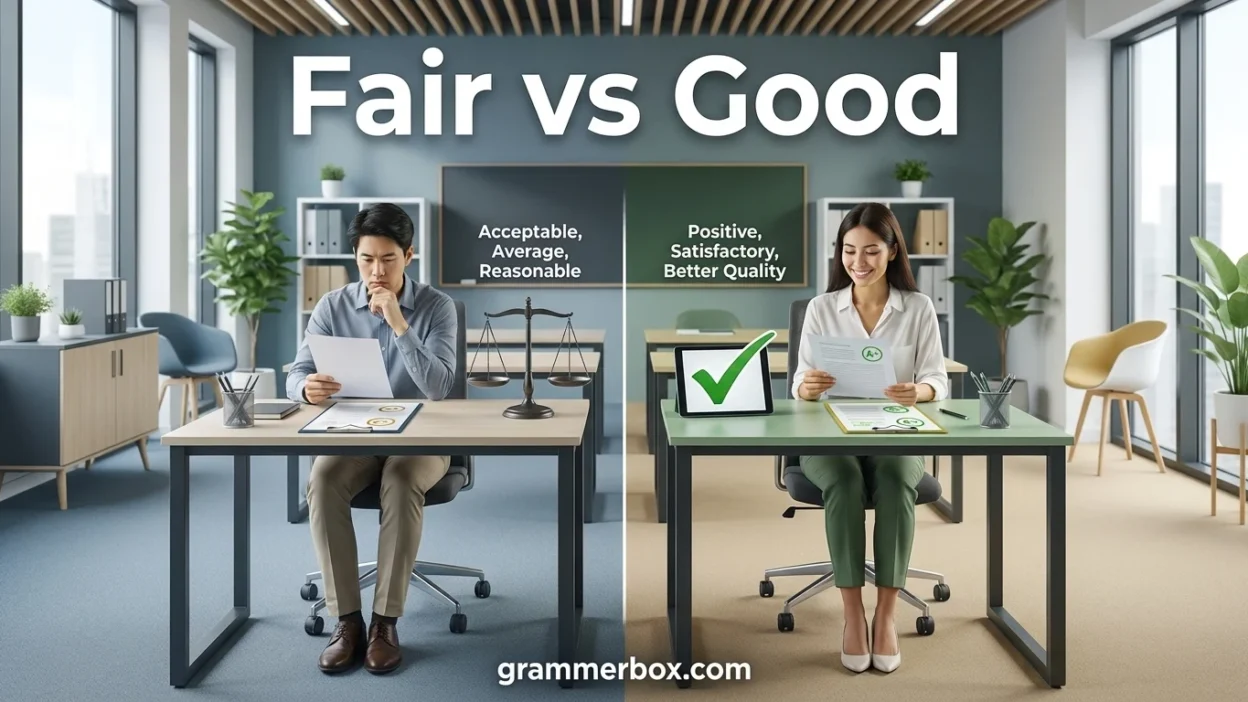
Good usually means satisfactory, positive, or above average. Fair often means acceptable but not particularly impressive, or reasonable and just. For example, “She did a good job” expresses stronger praise than “She did a fair job.” However, fair has additional meanings related to justice, equality, appearance, and weather.
Why People Confuse Fair and Good
People confuse fair and good because both can describe something positively.
For example:
- “The movie was fair.”
- “The movie was good.”
Both sentences suggest the movie was not necessarily bad, but the level of approval is different.
Good generally gives a stronger positive impression. Fair often suggests something is merely acceptable or average.
There is another source of confusion: fair has meanings unrelated to quality.
For example:
- The teacher was fair to every student.
- She has fair hair.
- We had fair weather yesterday.
So, the correct choice depends heavily on context.
First Word: Fair
Fair is an adjective with several meanings.
When talking about quality, fair can mean acceptable, reasonable, or average, but it often suggests that something is not especially impressive.
Examples
- The restaurant received a fair review.
- His performance was fair, but it could have been better.
- We made a fair amount of progress.
- The hotel was fair for the price.
Fair Can Also Mean Just or Equal
One of the most common meanings of fair is just, impartial, or reasonable.
- The judge made a fair decision.
- Everyone deserves a fair opportunity.
- Our teacher is fair to all students.
In these examples, replacing fair with good would change the meaning.
Fair Can Describe Appearance
Fair can also describe someone with light-colored skin, hair, or complexion.
- She has fair skin.
- He has fair hair.
Fair as a Noun
Fair can also refer to an event where people gather for entertainment, food, games, or exhibitions.
- We went to the county fair.
- The school is hosting a science fair.
Second Word: Good
Good is one of the most common adjectives in English. It generally describes something that is positive, satisfactory, useful, enjoyable, or of high quality.
Examples
- She did a good job.
- This is a good book.
- He is a good student.
- We had a good conversation.
Depending on context, good can describe quality, ability, behavior, character, experiences, or results.
Good Often Suggests Positive Quality
Compare:
The food was fair.
This suggests the food was acceptable or average.
The food was good.
This indicates that the speaker liked the food and considered its quality satisfactory or positive.
Good Can Describe Character
Good can also describe someone’s moral character.
- She is a good person.
- He is a good friend.
- They are good neighbors.
In these cases, fair would not normally mean the same thing.
Fair vs Good: Comparison Table
| Feature | Fair | Good |
|---|---|---|
| Basic meaning | Acceptable, reasonable, or average | Positive or satisfactory |
| Quality rating | Often average or moderate | Generally positive |
| Strength of praise | Weaker | Stronger |
| Justice | Can mean just or impartial | Usually does not mean this |
| Appearance | Can mean light-colored | Does not normally mean this |
| Weather | Can mean pleasant/clear | Can mean pleasant, but less specific |
| Example | The result was fair. | The result was good. |
When to Use Each
Use “Fair” When Something Is Acceptable
Use fair when something meets a reasonable standard but is not necessarily excellent.
- The service was fair.
- His exam result was fair.
- The quality was fair for the price.
Use “Fair” for Justice or Equality
Use fair when talking about equal or impartial treatment.
- That is a fair decision.
- We need a fair system.
- The rules should be fair to everyone.
Use “Good” for Positive Quality
Use good when something is satisfactory, useful, enjoyable, or positive.
- This is a good idea.
- She gave a good presentation.
- The food tastes good.
Use “Good” for Positive Character
Use good when describing someone’s character or behavior.
- He is a good friend.
- She is a good person.
- They are good parents.
Fair vs Good Examples
Here are some practical examples that show the difference:
- The movie was fair, but not memorable.
- The movie was good, and I enjoyed it.
- She gave a fair answer to the question.
- She gave a good answer that explained everything clearly.
- His performance was fair.
- His performance was good and impressed the audience.
- The teacher gave us a fair opportunity.
- He is a good teacher.
- The hotel was fair for the price.
- The hotel was good and comfortable.
- The judge made a fair decision.
- She did a good job on the project.
- We had fair weather during our trip.
- We had a good time during our trip.
Notice that fair does not always mean “slightly less good.” In sentences about justice or equality, it has a completely different meaning.
Common Mistakes
Mistake 1: Treating Fair and Good as Exact Synonyms
They can overlap when describing quality, but they do not always mean the same thing.
Better:
- “The service was fair.” → acceptable or average
- “The service was good.” → positive or satisfactory
Mistake 2: Using Good When You Mean Just
Incorrect or unnatural:
The judge made a good decision.
This may mean the decision was sensible, but if your intended meaning is impartial or equitable, fair is more precise.
The judge made a fair decision.
Mistake 3: Assuming Fair Always Means Average
Fair has several meanings.
It can mean:
- reasonable
- impartial
- acceptable
- light-colored
- pleasant or clear
- a public event
Context determines the meaning.
Mistake 4: Thinking Fair Always Means Bad
In quality-related contexts, fair is generally more positive than poor, although it may indicate only moderate quality.
A simple scale might be:
Excellent → Good → Fair → Poor
This is a useful general guide, although exact meanings vary by context.
Memory Trick
Remember:
Good = positive quality.
Fair = acceptable or just.
A simple trick is:
Fair is about what is reasonable; good is about what is positive.
If you are talking about equal treatment, justice, or impartiality, think fair.
If you are praising quality, performance, behavior, or an experience, good will often be the better choice.
American vs British English
The words fair and good are used in both American and British English, and their core meanings are essentially the same.
In both varieties, fair can mean reasonable or impartial:
- That was a fair decision.
- Everyone deserves a fair chance.
Both also use good for positive quality:
- That was a good movie.
- She did a good job.
However, expressions and the strength of particular words can vary depending on region and context. The basic distinction between fair and good remains consistent in standard American and British English.
Similar Words
Several words are related to fair and good, but each has its own nuance.
Words Similar to Fair
- Reasonable
- Just
- Impartial
- Equitable
- Moderate
- Acceptable
- Average
Words Similar to Good
- Positive
- Fine
- Great
- Excellent
- Pleasant
- Satisfactory
- Beneficial
Be careful with fine because it can sometimes mean “good” and sometimes merely “acceptable,” much like fair in certain contexts.
FAQs:
Is fair better than good?
When describing quality, good generally expresses stronger positive approval than fair. Fair often means acceptable or average.
Does fair mean good?
Sometimes fair can mean acceptable or reasonably good, but it is not an exact synonym for good. Its meaning depends on context.
What is the difference between fair and good performance?
A fair performance is generally acceptable but may have room for improvement. A good performance indicates a stronger level of achievement.
Is “fair” a positive or negative word?
Fair can be positive or neutral depending on context. In “a fair decision,” it is clearly positive. In “a fair performance,” it may suggest only moderate quality.
Can fair and good be used interchangeably?
Not always. They may overlap when discussing quality, but fair can also mean just, impartial, or reasonable, while good has many different uses.
What is the opposite of fair?
The opposite depends on the meaning. For justice, possible opposites include unfair or unjust. For quality, poor may be an opposite of fair in some rating systems.
What is the opposite of good?
Common opposites include bad, poor, or inferior, depending on the context.
Remember This
Fair usually means acceptable, reasonable, or just, while good usually means positive, satisfactory, or of good quality.
Think:
Fair = reasonable or acceptable
Good = positive or satisfactory
Conclusion
Choosing between fair vs good becomes easier when you focus on the intended meaning. If you are describing something as positive or satisfactory, good is usually the natural choice. If you mean acceptable, moderate, reasonable, or impartial, fair may be more appropriate.
Most importantly, remember that fair has several meanings. A fair decision concerns justice, fair hair concerns appearance, and fair weather concerns conditions. Good is broader for expressing positive quality and character. Understanding these differences will make your English more precise and natural.