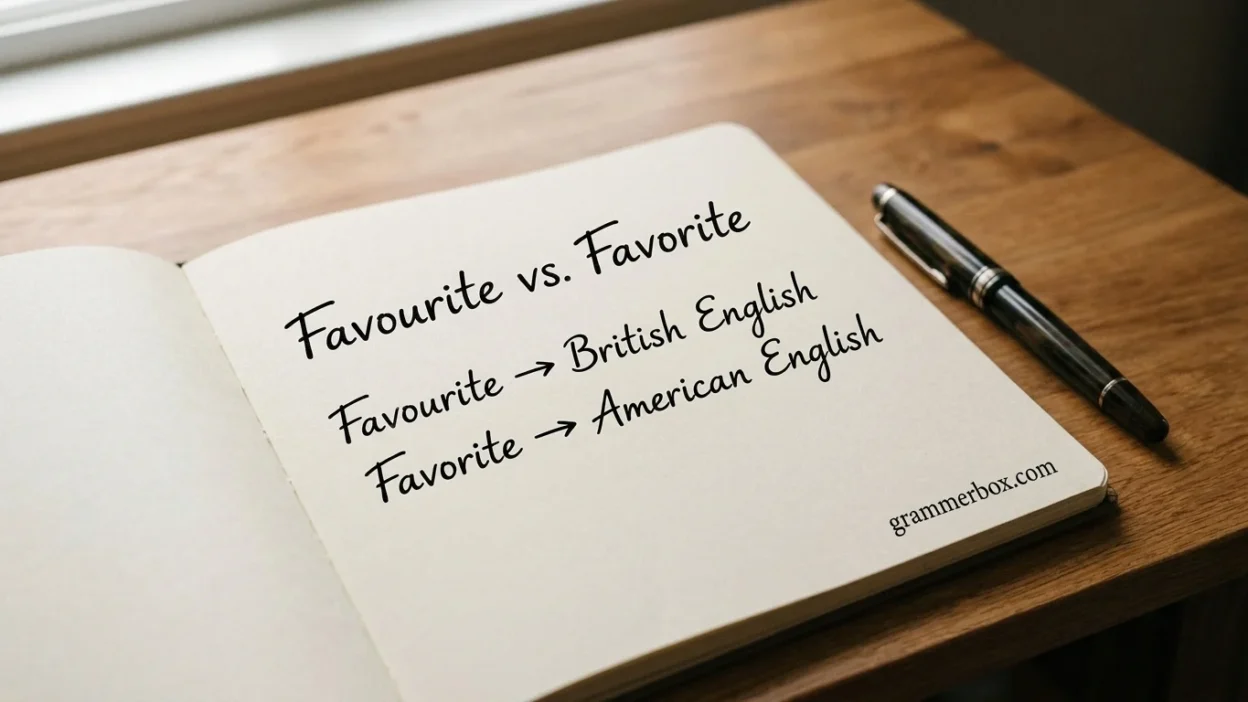
Have you ever wondered if to write favourite or favorite? Both spellings are correct, but choosing the right one depends on the type of English you are using. This small spelling difference often confuses students, ESL learners, writers, and even native English speakers. Although the words look slightly different, they share exactly the same meaning and pronunciation.
The main difference between favourite vs. favorite is regional spelling. British English, Australian English, and Canadian English generally prefer favourite, while American English uses favorite. Both words describe a person, thing, activity, or choice that someone likes more than others. Understanding this distinction can help you write more consistently, especially in academic assignments, professional documents, blog posts, and everyday communication. Let’s explore their meanings, spelling rules, examples, and regional differences so you can confidently choose the correct version.
Quick Answer
Favourite is the British English spelling, while favorite is the American English spelling. Both words mean something or someone that you like more than others. They have the same pronunciation and grammatical uses. Choose the spelling that matches your intended English variety.
Why People Confuse It
People often confuse favourite and favorite because they have identical meanings and pronunciation. The only noticeable difference is the letter u in the British spelling.
English has several regional spelling differences, particularly between American and British English. Words such as colour/color, honour/honor, and flavour/flavor follow a similar pattern.
Here are the main reasons for the confusion:
- Different regional standards: British and American English follow different spelling conventions.
- Similar pronunciation: Both versions sound exactly alike.
- Online content: Readers frequently encounter both spellings on websites and social media.
- Educational differences: Students may learn one spelling system but encounter another in books or online resources.
The important thing to remember is that neither spelling is incorrect. Your choice simply depends on your audience and writing style.
First Word: Favourite
Favourite is the standard British English spelling. It is commonly used in the United Kingdom and other English-speaking regions that follow British spelling conventions.
It can function as both a noun and an adjective.
As a noun:
When used as a noun, favourite refers to a person or thing that someone likes more than others.
Examples:
- Chocolate cake is my favourite.
- She has always been my favourite.
- This song is an old favourite of mine.
- Which is your favourite?
As an adjective:
When used as an adjective, favourite describes something that a person likes best.
Examples:
- Blue is my favourite colour.
- This is my favourite restaurant.
- Reading is her favourite hobby.
- He wore his favourite jacket.
British English spelling tip: Remember the letter u in favourite. The same spelling pattern appears in words such as colour, honour, and neighbour.
Second Word: Favorite
Favorite is the standard American English spelling. It is widely used throughout the United States and in American publications, websites, newspapers, and educational materials.
Like favourite, it can function as both a noun and an adjective.
As a noun:
It describes a person or thing that someone likes best.
Examples:
- Pizza is my favorite.
- She is my favorite in the competition.
- That movie is an old favorite.
- What is your favorite?
As an adjective:
It describes something that someone prefers over other choices.
Examples:
- Red is my favorite color.
- This is my favorite book.
- Basketball is his favorite sport.
- She ordered her favorite dessert.
American English spelling tip: American English generally drops the letter u in words such as favorite, color, honor, and neighbor.
Favourite vs. Favorite: Comparison Table
| Feature | Favourite | Favorite |
|---|---|---|
| English variety | British English | American English |
| Meaning | Liked the most | Liked the most |
| Pronunciation | Same | Same |
| Spelling | With u | Without u |
| Part of speech | Noun and adjective | Noun and adjective |
| Common usage | UK, Australia | United States |
| Correct spelling | Yes | Yes |
The two spellings communicate exactly the same idea. The difference is entirely regional, not grammatical or semantic.
When to Use Each
Choosing between favourite and favorite is simple once you know your target audience.
When to Use Favourite
Use favourite when writing in British English or following a spelling style that retains the letter u.
Common situations include:
- Writing for readers in the United Kingdom.
- Preparing British English school assignments.
- Creating content for British publications.
- Writing for audiences in Australia that follow British spelling.
- Following a British English style guide.
Examples:
- Football is my favourite sport.
- This is my favourite place to relax.
- She is my favourite teacher.
When to Use Favorite
Use favorite when writing in American English.
Common situations include:
- Writing for an American audience.
- Preparing assignments using American English.
- Creating content for US-based websites.
- Writing American business documents.
- Following an American English style guide.
Examples:
- Football is my favorite sport.
- This is my favorite place to relax.
- She is my favorite teacher.
Important: Avoid mixing both spelling systems in the same piece of writing. Consistency makes your content look more professional.
Examples of Favourite vs. Favorite in Sentences
Here are 12 examples showing how both spellings work in everyday English.
- British: My favourite subject is English.
American: My favorite subject is English. - British: Chocolate is her favourite dessert.
American: Chocolate is her favorite dessert. - British: What is your favourite movie?
American: What is your favorite movie? - British: He always wears his favourite shoes.
American: He always wears his favorite shoes. - British: This is my favourite restaurant in London.
American: This is my favorite restaurant in London. - British: Reading books is my favourite activity.
American: Reading books is my favorite activity. - British: She bought her favourite dress yesterday.
American: She bought her favorite dress yesterday. - British: Summer is my favourite season.
American: Summer is my favorite season. - British: This song has become my new favourite.
American: This song has become my new favorite. - British: My favourite actor is very talented.
American: My favorite actor is very talented. - British: Which is your favourite colour?
American: Which is your favorite color? - British: This little café is one of my favourites.
American: This little café is one of my favorites.
Notice that the meaning and sentence structure remain unchanged. Only the regional spelling differs.
Common Mistakes
Although favourite and favorite are both correct, writers sometimes make mistakes when choosing between them.
Here are some common errors to avoid:
1. Thinking one spelling is incorrect
Incorrect understanding: Favourite is wrong in American English, or favorite is wrong in British English.
Correction: Both are recognized English spellings. They simply belong to different regional conventions.
2. Mixing spelling systems
Example:
- My favourite color is blue.
This sentence mixes British favourite with American color.
Better options:
- British: My favourite colour is blue.
- American: My favorite color is blue.
3. Changing the meaning
Some learners assume that the two words have slightly different meanings.
Correction: They mean exactly the same thing.
4. Using unnecessary alternative spellings
Do not create spellings such as favorit or favourit. The standard forms are favorite and favourite.
5. Forgetting consistency in longer articles
If you begin an article using British English, continue using British spelling throughout. The same rule applies to American English.
Memory Trick: How to Remember Favourite vs. Favorite
A simple memory trick can help you remember which spelling belongs to each variety of English.
- Favourite = British: Remember the extra U in the British spelling.
- Favorite = American: American English usually removes the U in this spelling pattern.
You can also remember these matching pairs:
| British English | American English |
|---|---|
| Favourite | Favorite |
| Colour | Color |
| Honour | Honor |
| Flavour | Flavor |
| Neighbour | Neighbor |
Easy trick: If you are writing for the UK, remember the U. If you are writing for the US, leave it out.
American vs. British English
American and British English share the same language, but they have several spelling differences. The favourite/favorite distinction is one of the most familiar examples.
British English generally preserves the letter u in certain words ending in -our. American English often removes it.
Consider these examples:
| British English | American English |
|---|---|
| Favourite | Favorite |
| Colour | Color |
| Humour | Humor |
| Labour | Labor |
| Neighbour | Neighbor |
| Behaviour | Behavior |
| Rumour | Rumor |
| Flavour | Flavor |
These differences do not change the meaning or pronunciation of the words.
However, regional spelling preferences are not always identical across every English-speaking country. Canadian and Australian English often follow British conventions for these words, although Canadian English also has some American spelling influences.
If you are writing for an international audience, choose one recognized spelling system and use it consistently.
Similar Words and Related Spelling Differences
If you understand favourite vs. favorite, you can also learn other commonly confused British and American spelling pairs.
Here are some useful examples:
1. Colour vs. Color
Both words refer to the visual appearance of something. Colour is British English, while color is American English.
2. Honour vs. Honor
Both describe respect, recognition, or a strong sense of moral principles.
3. Flavour vs. Flavor
Both refer to the distinctive taste of food or drinks.
4. Neighbour vs. Neighbor
Both describe someone who lives nearby.
5. Behaviour vs. Behavior
Both refer to the way a person or animal acts.
6. Humour vs. Humor
Both describe the quality of being funny or entertaining.
7. Labour vs. Labor
Both refer to work, effort, or physical and mental activity.
These examples demonstrate a common spelling pattern: British English often retains the letter u, while American English usually removes it in these particular words.
FAQs:
1. Is favourite or favorite correct?
Both are correct. Favourite is the British English spelling, whereas favorite is the American English spelling. Both have the same meaning and pronunciation.
2. Is favourite British or American English?
Favourite is the British English spelling. It is also commonly used in other English-speaking countries, including Australia.
3. Is favorite American or British English?
Favorite is the standard American English spelling. It is commonly used in the United States in everyday writing, education, and professional communication.
4. Do favourite and favorite mean the same thing?
Yes. Both words describe a person or thing that someone likes more than others. There is no difference in their meanings.
5. How do you pronounce favourite and favorite?
Both words are pronounced the same way. The extra letter u in favourite does not create a different pronunciation.
6. Is favourite used in Canada?
Yes. Favourite is widely accepted in Canadian English and is the traditional Canadian spelling. However, Canadian English includes some American spelling influences as well.
7. Should I use favourite or favorite in SEO content?
Choose the spelling that matches your target audience. Use favourite for British-focused content and favorite for American-focused content. Consistency is more important than choosing one spelling universally.
Final Verdict
The difference between favourite and favorite comes down to regional spelling preferences. Both words are grammatically correct, have identical meanings, and are pronounced the same way. The British English version includes the letter u, while the American English version leaves it out.
If your readers are primarily in the United Kingdom, Australia, or other regions that follow British spelling, choose favourite. If you are writing for American readers, use favorite. The most important rule is to maintain consistency throughout your writing.
Remember This
- Favourite = British English spelling.
- Favorite = American English spelling.
- Both words have the same meaning.
- Both words have the same pronunciation.
- Neither spelling is incorrect.
- Always follow your target audience’s spelling conventions.
Conclusion
Understanding favourite vs. favorite is easy once you recognize the difference between British and American English. The two words describe something or someone you like best, and neither spelling is better or more correct than the other. The only difference is the regional spelling convention.
If you choose favourite or favorite, make sure your spelling matches your audience and remains consistent throughout your writing. Learning small differences like this can improve your English spelling, strengthen your writing skills, and help you communicate more confidently.