The English words sow vs sew can confuse learners because they have different spellings and meanings but similar pronunciations. Both words are commonly used in everyday English, yet they describe completely different actions. If you are writing about gardening, planting seeds, sewing clothes, or repairing fabric, choosing the correct word is essential for clear communication.
Understanding the difference between sow and sew is easier than it seems. Sow generally means to plant seeds in the ground, while sew means to join pieces of fabric using a needle and thread. Although their meanings are unrelated, their pronunciation can make them difficult to distinguish in conversation. Learning their definitions, grammatical forms, and practical examples will help you use both words correctly. Whether you are a student, an English learner, a writer, or someone improving everyday grammar, this guide will help you remember when to use sow and when to use sew.
Quick Answer
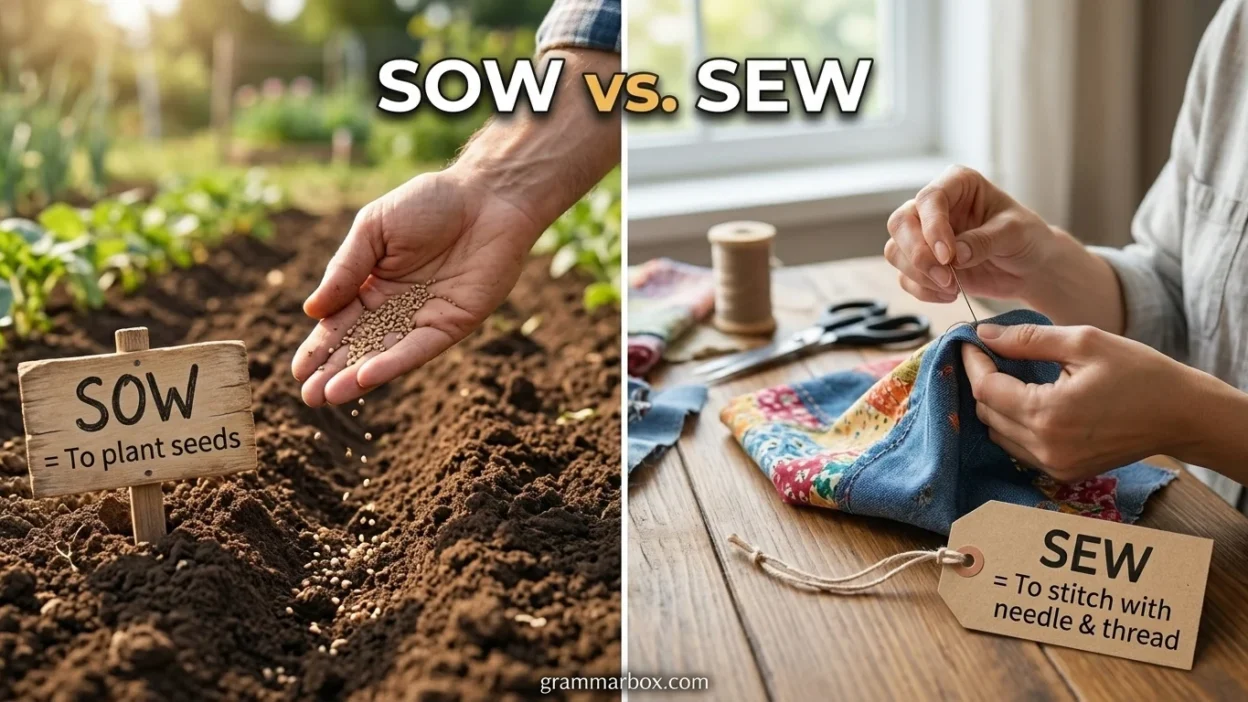
Sow means to plant or scatter seeds so that plants can grow. Sew means to join, repair, or decorate fabric using a needle and thread. Although these words sound similar, they have different meanings and uses. Remember: you sow seeds in a garden and sew clothes with thread.
Why People Confuse It
People often confuse sow and sew because they are pronounced similarly in many English accents. Their spellings differ by only one letter, but their meanings belong to entirely different contexts.
Here are the main reasons for the confusion:
- Similar pronunciation: Both words can sound alike in ordinary conversation.
- Different spellings: Their similar sounds make it easy to choose the wrong spelling when writing.
- Unfamiliar vocabulary: English learners may know one word but not the other.
- Limited context: Without a complete sentence, it may be difficult to determine which word is intended.
The easiest solution is to connect each word with a specific activity. Think of seeds and gardening when you see sow. Think of needles, thread, and clothing when you see sew.
First Word: Sow
Sow is a verb that means to plant seeds in the ground or scatter seeds over an area so that plants can grow.
Gardeners and farmers commonly use this word when discussing planting vegetables, flowers, crops, or grass.
Meaning of Sow
The word sow can describe several related actions:
- Planting seeds: Putting seeds into soil so they can grow.
- Scattering seeds: Spreading seeds across a prepared area.
- Creating something that develops: Introducing an idea, feeling, or condition that may grow over time.
The third meaning is often figurative. For example, someone can sow doubt by making another person uncertain.
Examples of Sow in Sentences
- We will sow tomato seeds in the garden this weekend.
- The farmer plans to sow wheat before the rainy season.
- She decided to sow flower seeds along the fence.
- You should sow the seeds in moist soil.
- The gardener will sow grass seed in the empty field.
- His careless remarks began to sow doubt among the team.
- They sowed corn across several acres last spring.
- If you sow good habits, you may develop a healthier lifestyle.
Grammatical Forms of Sow
The verb sow has several forms:
| Verb Form | Word | Example |
|---|---|---|
| Base form | Sow | We sow seeds in spring. |
| Third-person singular | Sows | She sows herbs in pots. |
| Past tense | Sowed | They sowed the field yesterday. |
| Past participle | Sown or sowed | The seeds have been sown. |
| Present participle | Sowing | He is sowing vegetable seeds. |
Important: Both sowed and sown are accepted forms, although sown is especially common as a past participle in sentences such as “The seeds have been sown.”
Second Word: Sew
Sew is a verb that means to join, repair, or decorate fabric using a needle and thread. It is commonly associated with making clothes, fixing torn garments, and creating fabric items.
People who sew may work by hand or use a sewing machine.
Meaning of Sew
The word sew can describe different activities involving fabric:
- Making clothes: Joining pieces of fabric to create a garment.
- Repairing fabric: Fixing a hole or tear in clothing.
- Decorating material: Adding stitching, patterns, or embellishments.
- Creating fabric items: Making bags, curtains, cushions, and other products.
Examples of Sew in Sentences
- My grandmother taught me how to sew a button onto a shirt.
- She wants to sew a dress for the wedding.
- I need to sew the torn pocket before wearing these trousers.
- He learned to sew using a small sewing machine.
- They sew handmade bags to sell at the local market.
- My sister sews beautiful designs onto jackets.
- She sewed a patch onto his backpack yesterday.
- The costume has been sewn by an experienced tailor.
Grammatical Forms of Sew
The verb sew also has several forms:
| Verb Form | Word | Example |
|---|---|---|
| Base form | Sew | I sew my own clothes. |
| Third-person singular | Sews | She sews every weekend. |
| Past tense | Sewed | He sewed the button back on. |
| Past participle | Sewn or sewed | The dress has been sewn. |
| Present participle | Sewing | They are sewing a new costume. |
Important: Sewed is the simple past tense. Both sewn and sewed can be used as past participles, depending on the sentence.
Sow vs Sew: Comparison Table
The following table highlights the main differences between sow and sew.
| Feature | Sow | Sew |
|---|---|---|
| Part of speech | Verb | Verb |
| Main meaning | To plant or scatter seeds | To join fabric with a needle and thread |
| Common context | Gardening and farming | Clothing, textiles, and repairs |
| Past tense | Sowed | Sewed |
| Past participle | Sown or sowed | Sewn or sewed |
| Present participle | Sowing | Sewing |
| Example | We sow seeds in the garden. | I sew buttons onto shirts. |
| Figurative use | To sow doubt or confusion | To sew something together, literally or figuratively |
The key difference is straightforward: sow is associated with seeds, while sew is associated with stitching.
When to Use Each
Choosing between sow and sew becomes simple when you consider the action described in your sentence.
When to Use Sow
Use sow when you are talking about planting seeds or introducing something that may develop over time.
Common situations include:
- Planting vegetable or flower seeds.
- Growing crops on a farm.
- Spreading grass seed across a lawn.
- Introducing doubt, fear, or disagreement.
- Using expressions such as “sow the seeds of success.”
Examples:
- We need to sow the seeds before the weather gets colder.
- His comments may sow distrust among his colleagues.
- The farmer sows rice during the appropriate planting season.
When to Use Sew
Use sew when you are talking about stitching fabric or making something with a needle and thread.
Common situations include:
- Making dresses, shirts, or trousers.
- Repairing torn clothes.
- Attaching buttons or patches.
- Creating curtains, bags, or cushions.
- Using a sewing machine for fabric projects.
Examples:
- I will sew the loose button onto my coat.
- She wants to sew a cushion cover.
- My aunt taught me to sew by hand.
A Simple Way to Decide
Ask yourself what the sentence describes:
- Are you planting seeds? Use sow.
- Are you stitching fabric? Use sew.
- Are you describing the beginning of a feeling or situation? You may need the figurative verb sow.
This quick check will help you select the correct spelling in most situations.
Examples: Sow vs Sew in Everyday English
These examples demonstrate how the two words work in different contexts.
- Sow: The gardener will sow carrot seeds tomorrow.
- Sew: My mother will sew a new dress for the party.
- Sow: Farmers sow their crops when the soil is ready.
- Sew: I need to sew a small hole in my shirt.
- Sow: She hopes to sow wildflower seeds along the path.
- Sew: He learned to sew while studying fashion design.
- Sow: The politician’s remarks seemed to sow fear among residents.
- Sew: The tailor will sew the sleeves onto the jacket.
- Sow: We sowed the seeds early in the spring.
- Sew: She sewed a colorful patch onto her backpack.
- Sow: The organization wants to sow the seeds of positive change.
- Sew: They are sewing costumes for the school play.
- Sow: You should sow the seeds at the recommended depth.
- Sew: I sewed the torn seam before leaving home.
- Sow: The seeds have been sown in prepared soil.
- Sew: The curtains have been sewn to the correct length.
Examples Showing the Difference
Compare these sentences to see how changing one letter changes the meaning.
- I will sow the seeds. This means I will plant seeds.
- I will sew the seams. This means I will stitch parts of fabric together.
Another comparison:
- They sowed the field. They planted seeds in the field.
- They sewed the fabric. They stitched the material.
The surrounding words provide helpful clues about which verb belongs in a sentence.
Common Mistakes
Even experienced English users can occasionally confuse sow and sew, especially when writing quickly. Understanding these common mistakes can help you avoid them.
Mistake 1: Using Sew When Talking About Seeds
Incorrect: We will sew sunflower seeds in the garden.
Correct: We will sow sunflower seeds in the garden.
Why? Seeds are planted or scattered, so sow is the appropriate verb.
Mistake 2: Using Sow When Talking About Clothes
Incorrect: She will sow a button onto her shirt.
Correct: She will sew a button onto her shirt.
Why? Attaching a button with thread requires sewing.
Mistake 3: Confusing Their Past-Tense Forms
Incorrect: He sewed wheat in the field.
Correct: He sowed wheat in the field.
Why? The past tense of sow is sowed, while the past tense of sew is sewed.
Mistake 4: Choosing the Wrong Past Participle
Incorrect: The dress has been sown.
Correct: The dress has been sewn.
Why? The sentence describes fabric that has been stitched. Sown is associated with planting seeds.
Mistake 5: Forgetting Figurative Uses
The verb sow is not limited to agriculture.
For example:
- Correct: His actions sowed confusion.
- Incorrect: His actions sewed confusion.
The figurative expression sow confusion means to create or spread confusion.
Memory Trick: How to Remember Sow vs Sew
The easiest way to remember these words is to connect each one with a familiar object.
Sow = Seeds
Both sow and seeds begin with the letter S.
Think of a gardener scattering seeds across the soil.
Memory sentence: “I sow seeds so that flowers can grow.”
Sew = Stitching
Think of a sewing machine, a needle, and a spool of thread.
When you sew, you join fabric or repair clothing.
Memory sentence: “I sew shirts using a needle and thread.”
One-Line Memory Trick
Sow seeds; sew shirts.
This short phrase connects each spelling with its correct meaning. Remembering these two actions makes it easier to choose the right word when writing sentences.
American vs British English
The difference between sow and sew is not a matter of American versus British English. Both words are used in American English and British English with the same basic meanings.
| Word | American English | British English |
|---|---|---|
| Sow | Plant or scatter seeds | Plant or scatter seeds |
| Sew | Stitch fabric with a needle and thread | Stitch fabric with a needle and thread |
| Sowed | Past tense of sow | Past tense of sow |
| Sewed | Past tense of sew | Past tense of sew |
| Sown | Past participle of sow | Past participle of sow |
| Sewn | Past participle of sew | Past participle of sew |
There can be minor differences in pronunciation across regional accents, but the spellings and basic meanings remain the same.
For example:
- American English: We will sow the seeds in April.
- British English: We will sow the seeds in April.
- American English: She will sew a dress for the event.
- British English: She will sew a dress for the event.
In both varieties, the correct choice depends on whether you are planting seeds or stitching fabric.
Similar Words
Several English words are related to sow and sew or are sometimes confused with them. Learning their meanings can improve your vocabulary.
1. Seed
A seed is the part of a plant that can grow into a new plant.
Example: She planted a tomato seed in a small pot.
2. Sewing
Sewing is the activity of joining or decorating fabric with stitches.
Example: Sewing is one of her favorite hobbies.
3. Stitch
To stitch means to join or repair material using stitches.
Example: The tailor stitched the torn sleeve.
4. Plant
To plant means to put a seed or plant into the ground so it can grow.
Example: We plant vegetables in our backyard.
5. Harvest
To harvest means to collect crops when they are ready.
Example: Farmers harvest wheat in the summer.
6. Sow the Seeds
Sow the seeds can refer to planting actual seeds or beginning something that may develop in the future.
Example: The teacher hopes to sow the seeds of curiosity in her students.
7. Seam
A seam is the line where two pieces of fabric have been joined by stitching.
Example: The seam on my jacket needs repairing.
8. Sower
A sower is someone who plants or scatters seeds.
Example: The sower prepared the field before planting.
These words are useful for discussing gardening, agriculture, clothing, and sewing projects.
FAQs:
1. What is the difference between sow and sew?
Sow means to plant or scatter seeds, while sew means to join or repair fabric with a needle and thread. Their meanings are different even though their pronunciations are similar.
2. Is it sow or sew seeds?
The correct word is sow.
Example: We will sow vegetable seeds in the garden.
You sow seeds because you plant them in the ground to grow.
3. Is it sow or sew clothes?
The correct word is sew.
Example: She knows how to sew her own clothes.
You sew clothes by joining pieces of fabric with stitches.
4. What is the past tense of sow?
The simple past tense of sow is sowed.
Example: The farmer sowed wheat last autumn.
Its past participle can be sown or sowed, depending on the construction.
5. What is the past tense of sew?
The simple past tense of sew is sewed.
Example: She sewed a button onto her jacket.
The past participle can be sewn or sewed.
6. Do sow and sew sound the same?
They are pronounced alike in many English accents, although pronunciation can vary regionally. Because they often sound similar, understanding their meanings is especially helpful when writing.
7. Can sow be used figuratively?
Yes. Sow can describe introducing something that develops over time, such as doubt, fear, or disagreement.
Example: His words sowed doubt among the audience.
8. How can I remember sow vs sew?
Remember this phrase: “Sow seeds; sew shirts.” Use sow for planting and sew for stitching. Associating each word with a familiar activity helps you remember the correct spelling.
Remember This
- Sow = Plant seeds. Example: I sow flower seeds in the garden.
- Sew = Stitch fabric. Example: I sew a button onto my shirt.
- Sowed = Past tense of sow. Example: The farmer sowed wheat.
- Sewed = Past tense of sew. Example: She sewed a dress.
- Sown and sewn = Common past participles. Use sown for planting and sewn for stitching.
Quick reminder: Sow seeds, sew clothes. If you remember these four words, you will rarely confuse sow and sew again.
Conclusion
Learning the difference between sow and sew is a simple but useful step toward better English spelling and grammar. Although the two words sound similar, sow relates to planting seeds, while sew describes stitching fabric. Understanding their meanings, grammatical forms, and common uses will help you avoid mistakes in schoolwork, professional writing, and everyday communication.
The next time you encounter these words, look at the context before choosing your spelling. Think about whether the sentence describes gardening or sewing, and use the appropriate verb. With regular practice, these commonly confused words will become much easier to recognize and use correctly.