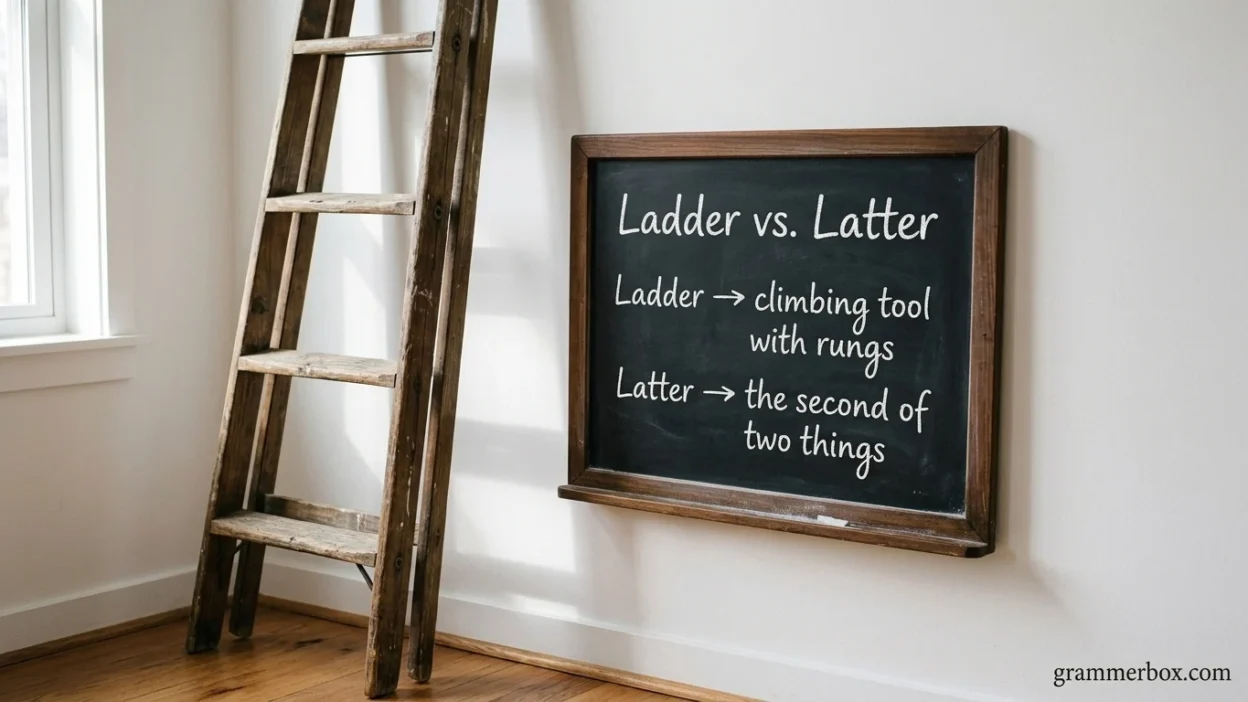
Have you ever confused ladder and latter while writing or reading English? These two words look and sound similar, but they have completely different meanings. One refers to a familiar object used for climbing, while the other helps identify the second option in a pair. Understanding the difference between ladder and latter can make your writing clearer and prevent common spelling mistakes.
The confusion often happens because both words contain similar letters and have nearly identical pronunciations in many English accents. However, using the wrong word can change the meaning of your sentence entirely. If you are a student, an ESL learner, a writer, or someone improving everyday English, learning when to use ladder or latter is important. In this guide, you will discover their definitions, grammatical roles, examples, common mistakes, and easy memory tricks to remember the difference.
Quick Answer: Ladder or Latter?
Ladder is a structure with steps or rungs used for climbing up or down. Latter refers to the second of two people, things, or choices previously mentioned. For example, you climb a ladder to reach a roof, but you choose the latter when selecting the second option.
Why People Confuse Ladder and Latter
People often confuse ladder and latter because they have similar spellings and pronunciations. Both words begin with the letter combination “la” and contain closely related sounds.
However, their meanings and grammatical functions are completely different.
Here are the main reasons for the confusion:
- Similar pronunciation: In many English accents, both words sound almost identical.
- Closely related spelling: They differ by only a few letters, making typing mistakes easy.
- Different meanings: One describes a physical object, while the other identifies the second item in a pair.
- Limited familiarity: English learners may understand one word but not recognize the other.
The easiest way to avoid confusion is to remember that ladder is something you climb, whereas latter refers to the second option mentioned.
First Word: Ladder
Ladder is a noun that refers to a piece of equipment with two long vertical sides connected by horizontal steps or rungs. People use it to climb to higher or lower places.
Ladders are commonly found in homes, workplaces, construction sites, and gardens.
Meaning of Ladder
According to its standard English meaning, a ladder is a climbing device that helps someone reach places that would otherwise be difficult to access.
Examples:
- He used a ladder to clean the windows.
- The firefighter climbed the ladder to rescue the child.
- Please put the ladder back in the garage.
- She carefully climbed the wooden ladder.
- The worker placed a ladder against the wall.
- We need a taller ladder to reach the roof.
- My father bought a new aluminum ladder.
- Be careful when standing on the ladder.
- The painter carried his ladder to the backyard.
- Someone left a ladder beside the building.
Types of Ladders
Different ladders are designed for different purposes.
- Step ladder: A self-supporting ladder with steps, commonly used at home.
- Extension ladder: A ladder that can be extended to reach greater heights.
- Straight ladder: A simple ladder that leans against a supporting surface.
- Folding ladder: A ladder designed to fold for convenient storage.
- Rope ladder: A flexible ladder made with ropes and steps.
Figurative Use of Ladder
The word ladder can also describe a series of stages or levels through which someone progresses.
For example:
- She is climbing the corporate ladder.
- Education can help people move up the social ladder.
- He worked hard to reach the top of the career ladder.
In these expressions, ladder does not refer to an actual climbing device. It represents progress, achievement, or advancement.
Second Word: Latter
Latter is an adjective or pronoun used to refer to the second of two people, things, choices, or situations mentioned previously.
It helps readers understand which of two previously mentioned options someone is discussing.
Meaning of Latter
Latter means the second or last-mentioned of two things.
It is particularly useful in formal writing when discussing two alternatives without repeating their names.
Examples:
- I like tea and coffee, but I prefer the latter.
- John and David attended the meeting; the latter arrived late.
- We can travel by bus or train. I prefer the latter.
- She studied history and geography, but the latter interested her more.
- Both options are good, but the latter is cheaper.
- He considered buying a laptop or a tablet and selected the latter.
- My favorite subjects are English and science, with the latter being more challenging.
- The first proposal was expensive, while the latter was affordable.
- We discussed two solutions, but the latter seemed more practical.
- Sarah and Emily applied for the position; the latter received the offer.
Grammatical Use of Latter
Latter usually functions as an adjective or pronoun.
As an adjective:
- The latter option is more affordable.
- I prefer the latter approach.
As a pronoun:
- We discussed two books, and I chose the latter.
- Both suggestions were interesting, but the latter was better.
Remember that latter normally refers to the second of two previously mentioned items. It should not be used when the reader cannot identify the two options.
Ladder vs. Latter: Comparison Table
The following table highlights the important differences between ladder and latter.
| Feature | Ladder | Latter |
|---|---|---|
| Meaning | A climbing structure | The second of two things |
| Part of speech | Noun | Adjective or pronoun |
| Main purpose | Climbing or reaching heights | Identifying the second option |
| Physical object | Yes | No |
| Example | Climb the ladder. | I prefer the latter. |
| Related expression | Career ladder | The former and the latter |
| Common context | Construction and household tasks | Comparisons and formal writing |
| Pronunciation | LAD-er | LAT-er |
Key difference: Ladder is a physical or figurative structure for climbing, while latter identifies the second item in a previously mentioned pair.
When to Use Each
Choosing between ladder and latter becomes easier when you understand the context of your sentence.
When to Use Ladder
Use ladder when you are talking about equipment used for climbing or reaching higher places.
You can also use it when describing progress through different levels.
Use ladder when:
- Someone needs to climb onto a roof.
- A worker is painting a wall.
- You are discussing construction equipment.
- Someone is progressing in their career.
- You are describing social or professional advancement.
Examples:
- The gardener used a ladder to trim the tree.
- She hopes to climb the corporate ladder.
- Keep the ladder away from the doorway.
When to Use Latter
Use latter when you have already mentioned two people, objects, choices, or situations and want to refer to the second one.
Use latter when:
- Comparing two alternatives.
- Discussing two previously mentioned people.
- Referring to the second of two subjects.
- Writing formal essays or reports.
- Avoiding unnecessary repetition.
Examples:
- I can study English or mathematics, but I prefer the latter.
- We considered two hotels, and the latter was more comfortable.
- Both brothers are talented, but the latter is more creative.
Important: Always make sure your reader knows which two things you are comparing before using latter.
Ladder vs. Latter: 15 Examples in Sentences
Here are additional examples showing how ladder and latter work in everyday English.
Examples With Ladder
- The ladder was too short to reach the ceiling.
- He placed the ladder near the window.
- The construction worker climbed the ladder carefully.
- My brother repaired the broken ladder.
- She borrowed a ladder from her neighbor.
- The cat climbed up the ladder.
- Always check a ladder before using it.
- He wants to move up the corporate ladder.
Examples With Latter
- I enjoy reading novels and biographies, but I prefer the latter.
- We can meet on Monday or Tuesday; the latter works better.
- She studied biology and chemistry, choosing the latter as her major.
- Both dresses are beautiful, but the latter is less expensive.
- He offered two explanations, and the latter made more sense.
- They discussed two plans, but the latter was easier to implement.
- My favorite activities are swimming and cycling, although I prefer the latter.
Common Mistakes With Ladder and Latter
Even experienced English writers sometimes confuse these words. Understanding the following mistakes can help you avoid incorrect word choices.
1. Using Ladder When You Mean Latter
Incorrect: I like tea and coffee, but I prefer the ladder.
Correct: I like tea and coffee, but I prefer the latter.
Why? The sentence refers to the second drink, not a climbing structure.
2. Using Latter When You Mean Ladder
Incorrect: He climbed the latter to reach the roof.
Correct: He climbed the ladder to reach the roof.
Why? The sentence describes a physical object used for climbing.
3. Using Latter Without Mentioning Two Options
Incorrect: I prefer the latter.
Correct: I prefer the latter of the two available options.
Why? The reader needs enough context to identify the second option.
4. Using Latter for More Than Two Options
Incorrect: We considered three options, and the latter was the cheapest.
Better: We considered three options, and the last one was the cheapest.
Why? Latter traditionally identifies the second of two previously mentioned items. Use last or final when discussing three or more.
5. Confusing Latter With Later
Incorrect: I will call you latter.
Correct: I will call you later.
Why? Later refers to a future time, while latter refers to the second of two things mentioned.
Memory Trick: How to Remember Ladder vs. Latter
You do not need to memorize complicated grammar rules to distinguish these words. A simple memory trick can help.
Remember Ladder: You Climb It
Think of a ladder as equipment with steps that help you climb.
Ladder = Climbing
Example: The boy climbed the ladder.
Remember Latter: The Second Choice
Think of latter as the second item in a pair.
Latter = Second
Example: I like apples and oranges, but I prefer the latter.
Quick Memory Tip
- LADDER: Think of steps, climbing, and heights.
- LATTER: Think of the second choice in a comparison.
You can also remember this sentence:
“I climb a ladder, but I choose the latter.”
This short sentence demonstrates both meanings and makes the distinction easier to remember.
American vs. British English: Ladder vs. Latter
There is no meaningful difference between the definitions or standard spellings of ladder and latter in American and British English.
Both varieties use:
- Ladder for a climbing structure.
- Latter for the second of two previously mentioned things.
However, pronunciation can vary between regional accents.
In many American accents, the letter combination “tt” in latter and the “dd” in ladder may sound like a soft flap, making the words nearly identical.
In many British accents, the pronunciation may also be similar, although regional differences can affect how clearly the consonants are distinguished.
The important point is that neither spelling is exclusively American or British.
Both ladder and latter are correct in American and British English.
Similar Words to Ladder and Latter
Understanding related words can improve your vocabulary and help you avoid confusing similar-looking English words.
Words Related to Ladder
- Staircase: A structure containing steps that connects different floors.
- Stairs: A series of steps used to move between levels.
- Step ladder: A self-supporting climbing device.
- Rung: One of the horizontal bars on a ladder.
- Scaffold: A temporary structure used by workers at heights.
Words Related to Latter
- Former: The first of two people or things mentioned.
- Second: Coming after the first in a sequence.
- Last: Coming at the end of a series.
- Previous: Happening or existing before something else.
- Final: The last part or stage of something.
Former vs. Latter
Former and latter are especially important because they are often used together.
- Former: Refers to the first of two things mentioned.
- Latter: Refers to the second of two things mentioned.
Example:
“I like coffee and tea, but the former keeps me more alert, while the latter is more relaxing.”
Here, coffee is the former, and tea is the latter.
FAQs:
1. What is the difference between ladder and latter?
Ladder refers to a physical structure used for climbing, while latter refers to the second of two people or things previously mentioned. They have similar pronunciations but completely different meanings.
2. Is it a ladder or a latter?
Both are correct English words, but their usage depends on the meaning. Use ladder for climbing equipment and latter when referring to the second of two previously mentioned choices.
3. Does latter mean later?
No. Latter and later have different meanings. Latter identifies the second of two things, while later refers to a future time or something happening afterward.
4. Can latter refer to three things?
Traditionally, latter refers to the second of two previously mentioned items. When discussing three or more items, use last or final to identify the final one.
5. Is latter a noun or an adjective?
Latter is commonly used as an adjective or pronoun. For example, “the latter option” uses it as an adjective, while “I prefer the latter” uses it as a pronoun.
6. What is the opposite of latter?
Former is the opposite of latter when discussing two things. Former refers to the first item, while latter refers to the second.
7. Are ladder and latter pronounced the same?
They are pronounced almost identically in many English accents. However, pronunciation can vary depending on regional speech patterns.
8. Is ladder or latter used in formal writing?
Both words are appropriate in formal writing. Ladder describes climbing equipment or advancement, while latter helps identify the second of two previously mentioned items.
Final Verdict
The difference between ladder and latter is simple once you understand their meanings. Ladder is a noun that describes equipment used for climbing, while latter refers to the second of two previously mentioned people, things, or choices. Although their spellings and pronunciations are similar, they cannot be used interchangeably.
Whenever you are unsure which word to choose, look at the meaning of your sentence. If someone is climbing, reaching a height, or progressing through different levels, use ladder. If you are comparing two options and referring to the second one, use latter. Remembering this simple distinction will help you write more accurately and communicate your ideas with confidence.
Remember This
- Ladder = A climbing structure with steps or rungs.
- Latter = The second of two previously mentioned things.
- Former = The first of two previously mentioned things.
- Later = At a future time.
Easy sentence to remember: “I climbed the ladder and chose the latter option.”