Have you ever wondered if to say “reply me” or “reply to me” when asking someone to respond to a message? These expressions may look similar, but only one is generally correct in standard English. Many English learners confuse them because verbs such as tell, answer, and respond follow different grammatical patterns. Understanding these differences can help you write clearer emails, send natural text messages, and communicate more confidently in everyday conversations.
The confusion often comes from the way English verbs work with objects and prepositions. For example, we say “tell me” and “answer me,” but we usually say “reply to me.” Although these expressions communicate a similar idea, their grammatical structures are different. Learning when to use each construction will help you avoid common grammar mistakes in professional writing, academic assignments, and casual conversations. In this guide, you will discover the difference between “reply me” and “reply to me,” explore practical examples, and learn an easy trick to remember the correct expression.
Quick Answer
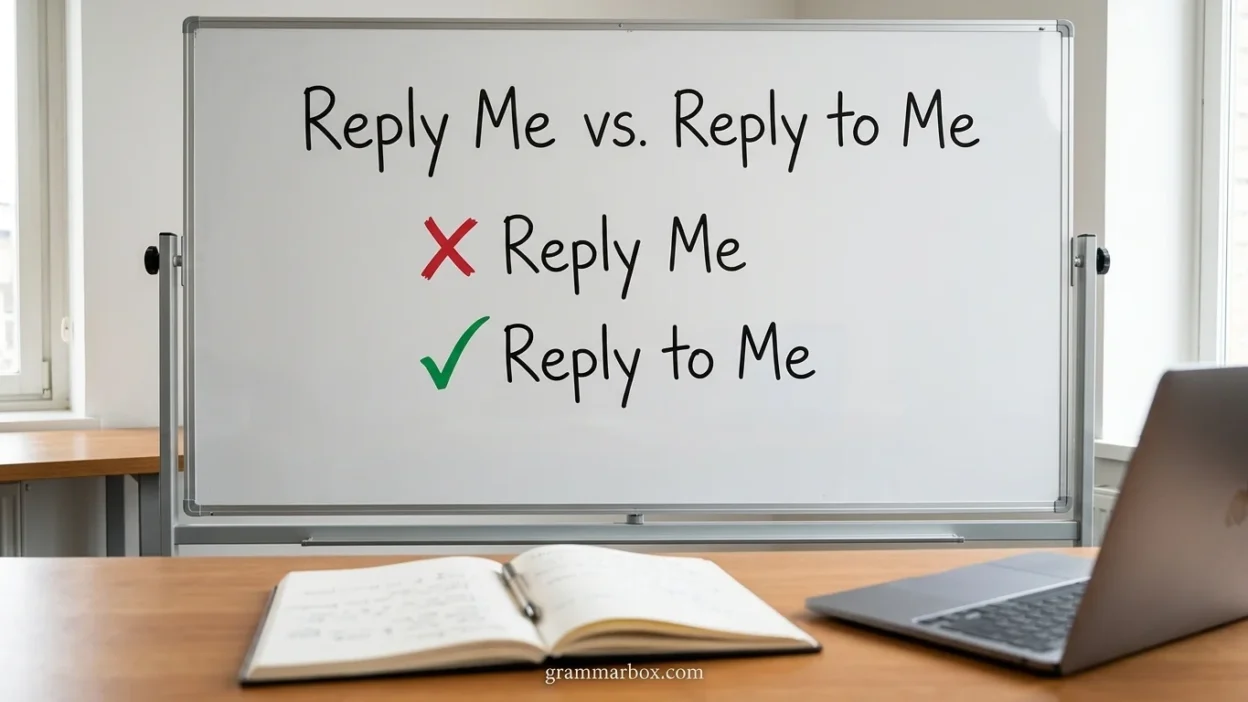
“Reply to me” is the grammatically correct expression in standard English. The verb reply generally takes the preposition to before the person receiving the response. For example, say “Please reply to me” rather than “Please reply me.” You can also say “Please respond to me” or “Please answer me.”
Why People Confuse It
People confuse “reply me” and “reply to me” because both expressions communicate the idea of responding to someone. However, English verbs do not all follow the same grammatical rules.
Consider these examples:
- Tell me: Correct. The verb tell can take a person as its direct object.
- Answer me: Correct. The verb answer can take a person as its direct object.
- Reply to me: Correct. The verb reply normally uses the preposition to before the person receiving the response.
- Reply me: Generally incorrect in standard English when you mean “respond to me.”
The key is understanding that verbs have different patterns. You cannot always remove a preposition simply because another verb does not need one.
For English learners, remembering these patterns is more useful than translating expressions word for word from another language.
First Word: Reply Me
“Reply me” is generally incorrect in standard English when you want someone to respond to you.
The problem is grammatical structure. In this context, reply is normally used with the preposition to when identifying the person receiving the response.
For example:
Incorrect: Please reply me as soon as possible.
Correct: Please reply to me as soon as possible.
The second sentence follows standard English grammar.
Why Is “Reply Me” Incorrect?
The verb reply typically does not take the recipient as a direct object in this construction. Instead, the preposition to connects the verb with the person receiving the reply.
Compare these sentences:
- Incorrect: She replied me yesterday.
- Correct: She replied to me yesterday.
- Incorrect: Can you reply me later?
- Correct: Can you reply to me later?
In each correct sentence, to introduces the person receiving the response.
Can “Reply Me” Ever Be Correct?
In ordinary standard English, use “reply to me” when asking someone to respond directly to you.
However, the word reply can be used in other grammatical structures without to when no recipient is expressed.
Examples:
- She replied immediately.
- He replied politely.
- They replied yesterday.
These sentences are correct because they do not identify the recipient with a direct object.
Remember: You can use reply without to when the sentence does not specify a recipient, but you generally need to before the person receiving the response.
Second Word: Reply to Me
“Reply to me” is the correct and natural expression in standard English when asking someone to respond to you.
The preposition to connects the verb reply with the person who receives the response. This construction works in casual conversations, text messages, professional emails, and academic writing.
Examples:
- Please reply to me when you have time.
- She replied to me this morning.
- Could you reply to me before Friday?
- I hope you will reply to me soon.
Each sentence follows the standard grammatical pattern.
How to Use “Reply to Me” Naturally
You can use this expression in several situations.
1. In everyday conversations
“Please reply to me when you get home.”
2. In professional emails
“Could you please reply to me regarding the meeting schedule?”
3. In text messages
“Reply to me when you are free.”
4. In academic communication
“Please reply to me if you have any questions about the assignment.”
5. When requesting information
“Would you reply to me with the details?”
The expression is grammatically correct in all these examples. Depending on the context, however, a shorter alternative such as “Please reply” may sound more natural.
Comparison Table
The following table summarizes the differences between “reply me” and “reply to me.”
| Feature | Reply Me | Reply to Me |
|---|---|---|
| Grammatical correctness | Generally incorrect in standard English | Correct |
| Verb pattern | Uses me as a direct object | Uses to before the recipient |
| Appropriate for formal writing | No | Yes |
| Appropriate for text messages | Avoid it | Yes |
| Natural in standard English | No | Yes |
| Example | Reply me tomorrow. | Reply to me tomorrow. |
| Recommended usage | Avoid when addressing the recipient | Use when asking someone to respond to you |
The main difference is the preposition to. When the person receiving the reply is identified, standard English generally requires this preposition.
When to Use Each
Choosing between these expressions is straightforward once you understand how the verb reply works.
When to Use “Reply to Me”
Use “reply to me” when you want to identify yourself as the person receiving the response.
Examples:
- Please reply to me today.
- He promised to reply to me.
- You can reply to me by email.
- She has not replied to me yet.
This construction is suitable for formal and informal situations.
When to Use “Reply” Without “To Me”
You do not always need to mention the recipient. If the context already makes it clear who should respond, simply use reply.
Examples:
- Please reply soon.
- She replied yesterday.
- He will reply later.
- They replied immediately.
You can also use reply to with other recipients:
- Please reply to the manager.
- I replied to her message.
- He replied to the email.
- She replied to my question.
When to Use “Respond to Me” or “Answer Me”
Sometimes, a different verb may be more appropriate.
- Respond to me: A clear, slightly formal alternative.
- Answer me: Often direct and suitable when asking for an answer.
- Get back to me: A natural expression when asking someone to contact you again.
- Reply to me: A standard expression for responding to a message or communication.
Choose the expression that best matches your intended meaning and tone.
Examples of Reply Me vs. Reply to Me
Here are 15 examples to help you understand the correct usage.
Incorrect and Correct Examples
1. Asking someone to respond
Incorrect: Please reply me soon.
Correct: Please reply to me soon.
2. Sending a text message
Incorrect: Can you reply me when you are free?
Correct: Can you reply to me when you are free?
3. Professional communication
Incorrect: Please reply me regarding the meeting.
Correct: Please reply to me regarding the meeting.
4. Asking for an update
Incorrect: Reply me with the latest information.
Correct: Reply to me with the latest information.
5. Talking about the past
Incorrect: She replied me yesterday.
Correct: She replied to me yesterday.
6. Making a polite request
Incorrect: Could you reply me at your earliest convenience?
Correct: Could you reply to me at your earliest convenience?
7. Discussing an unanswered message
Incorrect: He did not reply me.
Correct: He did not reply to me.
8. Asking a friend to respond
Incorrect: Reply me when you reach home.
Correct: Reply to me when you reach home.
9. Requesting confirmation
Incorrect: Please reply me to confirm your attendance.
Correct: Please reply to me to confirm your attendance.
10. Following up on an email
Incorrect: I am waiting for you to reply me.
Correct: I am waiting for you to reply to me.
More Examples With “Reply”
The following sentences demonstrate how reply works in different contexts.
11. Without mentioning the recipient
She replied immediately after reading the message.
12. With a person as the recipient
My colleague replied to me within an hour.
13. With an email as the recipient
Please reply to the email before Monday.
14. With a question as the subject
He replied to my question politely.
15. With a professional request
I would appreciate it if you could reply to me at your earliest convenience.
These examples show that reply can stand alone or take a prepositional phrase beginning with to. The correct structure depends on what information you include in the sentence.
Common Mistakes
English learners sometimes make mistakes when using reply because they apply the grammatical rules of other verbs to it.
Here are some common errors and their corrections.
1. Using “Reply Me”
Incorrect: Please reply me tomorrow.
Correct: Please reply to me tomorrow.
Why? The preposition to is normally required before the recipient.
2. Confusing “Reply” With “Answer”
Incorrect: I will reply your question.
Better: I will reply to your question.
Also correct: I will answer your question.
Why? Answer can take a direct object, whereas reply generally uses to before the question or message being addressed.
3. Forgetting “To” in the Past Tense
Incorrect: She replied me last night.
Correct: She replied to me last night.
Why? Changing reply to replied does not change its usual grammatical pattern.
4. Adding an Unnecessary Preposition After “Answer”
Incorrect: Please answer to me.
Correct: Please answer me.
Also correct: Please respond to me.
Why? In the sense of giving someone an answer, answer can take a direct object. Respond, by contrast, normally uses to before the person receiving the response.
5. Using “Reply Back” Unnecessarily
Example: Please reply back to me.
This expression is common in everyday conversation, but back is often unnecessary because reply already means to respond.
A simpler alternative is:
“Please reply to me.”
6. Assuming All Similar Verbs Follow the Same Rule
Compare these examples:
- Tell me.
- Answer me.
- Respond to me.
- Reply to me.
The grammatical patterns differ, so learn each verb together with its usual construction.
Memory Trick
Here is a simple trick to remember the difference between “reply me” and “reply to me.”
Remember this pattern: Reply TO someone, but answer someone.
Think of to as the bridge connecting the reply to the person receiving it.
For example:
- Reply to me.
- Reply to her.
- Reply to your teacher.
- Reply to the email.
Now compare:
- Answer me.
- Answer her.
- Answer your teacher.
- Answer the question.
The second group does not normally need to when answer takes a direct object.
An Easy Sentence to Remember
Memorize this sentence:
“Please reply to me, but answer my question.”
It demonstrates both grammatical patterns in one short example.
If you remember this rule, you will be less likely to confuse reply with answer in everyday English.
American vs. British English
The difference between “reply me” and “reply to me” is not generally a matter of American versus British English.
Both American and British English normally use “reply to me” when identifying the person receiving a reply.
Here are examples that work in both varieties.
| American English | British English |
|---|---|
| Please reply to me soon. | Please reply to me soon. |
| She replied to me yesterday. | She replied to me yesterday. |
| He hasn’t replied to me yet. | He hasn’t replied to me yet. |
| Please reply to my email. | Please reply to my email. |
There may be differences in vocabulary, spelling, and everyday communication styles between American and British English, but this particular grammatical pattern is broadly shared.
For example, an American speaker might say, “Get back to me when you can,” while a British speaker might use the same expression or simply say, “Please get back to me.”
Both are natural ways to request a response.
The important point: Use “reply to me” regardless of whether you are writing in American or British English.
Similar Words and Expressions
Several English expressions have meanings similar to “reply to me.” However, their grammatical structures and tones can differ.
1. Respond to Me
This is a direct alternative to “reply to me.”
Example: Please respond to me when you receive the document.
It is appropriate for professional and everyday communication.
2. Answer Me
This expression is grammatically correct and often sounds more direct.
Example: Please answer me honestly.
It is particularly suitable when someone expects an answer to a question.
3. Get Back to Me
This is a common conversational expression meaning to respond or contact someone again.
Example: Please get back to me when you have the information.
It is widely used in workplace communication and informal conversations.
4. Write Back to Me
This expression is useful when asking someone to respond in writing.
Example: Please write back to me when you receive the letter.
It is especially suitable for letters, emails, and written messages.
5. Text Me Back
This informal expression is commonly used for text messages.
Example: Text me back when you are available.
In casual conversations, this often sounds more natural than “reply to me.”
6. Respond to My Message
This expression identifies the message rather than the person receiving the response.
Example: Please respond to my message by tomorrow.
It works well in professional emails and other formal communication.
Which Expression Should You Choose?
- Use reply to me for a general request for a response.
- Use respond to me for a slightly more formal tone.
- Use answer me when requesting an answer.
- Use get back to me when asking someone to follow up.
- Use text me back when talking about text messages.
- Use respond to my message when you want to emphasize a particular message.
Selecting the right expression will make your English clearer and more natural.
FAQs:
1. Is “reply me” grammatically correct?
“Reply me” is generally incorrect in standard English when you mean “respond to me.” The correct expression is “reply to me.” For example, say, “Please reply to me when you are free.”
2. Should I say “reply me” or “reply to me”?
You should generally say “reply to me.” The verb reply normally requires the preposition to before the person receiving the response. For example, “She replied to me yesterday” is correct.
3. Is “please reply me” correct?
No. In standard English, the natural expression is “Please reply to me.” You can also simply say “Please reply” if the recipient is already clear from the context.
4. Is “reply to me” formal or informal?
“Reply to me” is appropriate in both formal and informal communication. You can use it in professional emails, academic correspondence, text messages, and everyday conversations. The surrounding wording determines how formal the request sounds.
5. Can I say “reply back to me”?
Yes, people commonly use “reply back to me” in conversation. However, back is often unnecessary because reply already means to respond. “Please reply to me” is a simpler alternative.
6. Is “answer me” correct?
Yes. “Answer me” is grammatically correct because answer can take a person as its direct object. For example, “Please answer me honestly” is correct. Compare it with “Please reply to me honestly.”
7. Is “reply to me” correct in American and British English?
Yes. “Reply to me” is standard in both American and British English. Neither variety generally uses “reply me” when the intended meaning is “respond to me.”
8. Can I use “reply” without “to”?
Yes. You can use reply without to when you do not mention the recipient. For example, “She replied immediately” and “He replied yesterday” are both grammatically correct.
Final Verdict
The difference between “reply me” and “reply to me” comes down to standard English grammar. When you want to identify the person receiving a response, use “reply to me.” The expression “reply me” is generally considered incorrect in this context. Remember that verbs such as reply, respond, and answer follow different grammatical patterns, even when they communicate similar meanings.
If you are writing an email, sending a text message, or speaking with someone in English, choose the expression that sounds natural and follows the correct verb pattern. You can say “Please reply to me,” “Please respond to me,” or “Please answer me,” depending on your intended meaning. Learning these small grammatical differences will help you communicate more clearly and confidently.
Remember This
The simple rule is:
- ❌ Reply me.
- ✅ Reply to me.
- ✅ Respond to me.
- ✅ Answer me.
- ✅ Please reply.
Quick memory tip: Reply to someone, but answer someone.