Have you ever wondered if to use plane or plain in a sentence? These two English words sound exactly alike, but they have different meanings and uses. This makes them a common source of confusion for students, English learners, writers, and even native speakers. Understanding the difference between plane and plain can help you improve your spelling, grammar, and everyday communication.
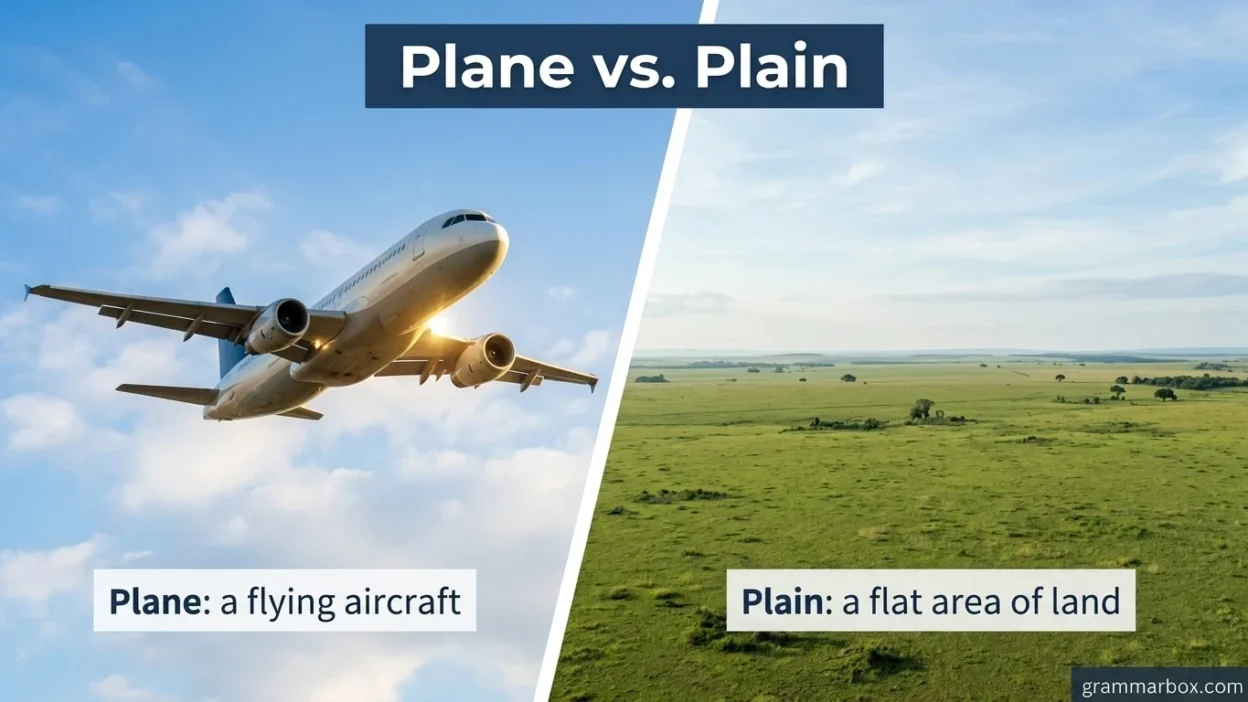
The word plane usually refers to an aircraft, a flat surface, or a level in mathematics and geometry. In contrast, plain commonly means simple, clear, or without decoration. It can also refer to a large area of flat land. Although both words share the same pronunciation, you cannot always use one in place of the other. Learning their meanings, grammatical roles, and correct usage will help you avoid common spelling mistakes. In this guide, you will discover the difference between plane and plain, explore practical examples, and learn an easy memory trick to remember which word to use.
Quick Answer: Plane vs. Plain
Plane usually means an aircraft, a flat surface, or a mathematical surface. Plain means simple, ordinary, or without decoration, and it can also describe flat land. Both words sound alike, but their meanings differ. Choose the correct spelling according to the meaning you want to express.
Why People Confuse Plane and Plain
People often confuse plane and plain because they are homophones. Homophones are words that sound the same but have different meanings and spellings.
Both words are pronounced approximately as /pleɪn/, which sounds like the word play followed by an n. Since their pronunciation is identical, listeners cannot distinguish them by sound alone.
The confusion becomes easier to understand when you consider that both words can describe something flat.
- Plane: A flat surface in geometry or a tool used to smooth wood.
- Plain: A large, relatively flat area of land.
However, their meanings are different in other contexts.
For example:
- The plane landed safely at the airport.
- She wore a plain white shirt.
The first sentence refers to an aircraft, while the second describes a shirt without decoration.
Understanding the context is the easiest way to choose the correct word.
First Word: What Does Plane Mean?
Plane is a noun and, in some contexts, a verb. It has several meanings depending on how it is used.
1. Plane as an Aircraft
The most familiar meaning of plane is an aircraft that flies through the air.
Examples:
- Our plane arrived thirty minutes early.
- I watched the plane disappear behind the clouds.
- They booked a plane to travel across the country.
In everyday English, plane is a common shortened form of airplane or aeroplane.
2. Plane as a Flat Surface
In mathematics and geometry, a plane is a flat, two-dimensional surface that extends infinitely in every direction.
Examples:
- The points lie on the same plane.
- We studied geometric planes in mathematics class.
- The diagram shows two lines intersecting on a plane.
This meaning frequently appears in geometry, engineering, and other technical subjects.
3. Plane as a Tool
A plane can also be a tool used by carpenters to make wooden surfaces smooth and even.
Examples:
- The carpenter used a plane to smooth the wooden door.
- He bought a new hand plane for his workshop.
- She carefully planed the rough edge of the board.
Here, plane can function as both a noun and a verb. The verb to plane means to smooth or level a surface using a plane.
4. Plane as a Level or Dimension
The word can also describe a particular level of existence, activity, or thought.
Examples:
- The discussion moved to a different plane of understanding.
- The artist explored emotions on a deeper plane.
- Their ideas operate on a similar plane.
In these examples, plane refers to a level or dimension rather than a physical aircraft.
Second Word: What Does Plain Mean?
Plain is an adjective, noun, and, less commonly, an adverb in certain expressions. Its meaning depends on the context.
1. Plain as Simple or Unadorned
The most common meaning of plain is simple, ordinary, or without decoration.
Examples:
- He wore a plain black T-shirt.
- I prefer plain curtains without patterns.
- She chose a plain notebook for school.
In these sentences, plain describes something without extra decoration or elaborate features.
2. Plain as Clear or Obvious
Plain can also mean clear, understandable, or easy to recognize.
Examples:
- It was plain that he was disappointed.
- The teacher explained the rule in plain English.
- Her intentions were plain to everyone.
The expression plain English means language that is clear and easy to understand.
3. Plain as Flat Land
As a noun, a plain is a large area of relatively flat land with few major changes in elevation.
Examples:
- The horses ran across the wide plain.
- Farmers grow wheat on the fertile plains.
- The river flows through an open plain.
Geographical plains are important for agriculture, wildlife, and human settlements.
4. Plain as Ordinary or Unremarkable
Plain can describe someone or something that is not especially attractive, elaborate, or unusual.
Examples:
- The room looked plain without furniture.
- The design was plain but practical.
- She preferred a plain style over an elaborate one.
When describing a person, plain can sometimes sound critical or unkind, especially when referring to physical appearance. Use it thoughtfully.
Plane vs. Plain: Comparison Table
The following table summarizes the main differences between plane and plain.
| Feature | Plane | Plain |
|---|---|---|
| Pronunciation | /pleɪn/ | /pleɪn/ |
| Main meaning | An aircraft | Simple or unadorned |
| Other meanings | A flat mathematical surface, a woodworking tool, a level | Flat land, clear, obvious, ordinary |
| Part of speech | Noun and verb | Adjective and noun; also used adverbially in certain expressions |
| Common phrases | Airplane, plane ticket, geometric plane | Plain clothes, plain English, open plain |
| Example | The plane took off at noon. | He wore a plain shirt. |
| Memory clue | Think of flying or geometry. | Think of simplicity or flat land. |
The key difference: Plane often relates to aircraft, geometry, or smoothing surfaces, while plain usually describes simplicity or refers to flat land.
When to Use Plane vs. Plain
Choosing between plane and plain becomes easier when you identify the meaning of your sentence.
When to Use Plane
Use plane when you mean:
- An aircraft: The plane landed safely.
- A mathematical surface: The points lie on the same plane.
- A woodworking tool: The carpenter picked up his plane.
- A level or dimension: They discussed the issue on a different plane.
Quick test: If your sentence refers to an aircraft, geometry, a woodworking tool, or a level, plane is probably the correct choice.
When to Use Plain
Use plain when you mean:
- Simple or undecorated: She wore a plain dress.
- Clear or obvious: It became plain that the plan had failed.
- Easy-to-understand language: Please explain it in plain English.
- Flat land: The cattle grazed across the plain.
Quick test: If you mean simple, clear, ordinary, or a large area of flat land, use plain.
Compare These Sentences
Consider the following examples:
- Correct: I bought a plane ticket for tomorrow.
- Correct: I bought a plain ticket for tomorrow.
The first sentence refers to a ticket for air travel. The second sentence could describe a ticket that is simple or unadorned, although it is unusual without additional context.
Similarly:
- Correct: The plane flew over the mountains.
- Correct: The plain stretched across the valley.
The context determines which spelling communicates your intended meaning.
Plane vs. Plain: 15 Examples in Sentences
Here are 15 practical examples to help you understand the difference between plane and plain.
Examples of Plane
- The plane departed from the airport at seven in the morning.
- We watched the plane fly above the clouds.
- My family booked a plane ticket to London.
- The geometry teacher drew a triangle on a plane.
- The carpenter used a plane to smooth the wooden surface.
- The discussion moved to a higher plane of understanding.
- Our plane was delayed because of bad weather.
- The engineer studied the angle between two lines on a plane.
Examples of Plain
- She wore a plain white shirt to the interview.
- Please explain the instructions in plain English.
- The farmer owns a house on the plain.
- It was plain that the students needed more practice.
- He prefers plain rice instead of heavily seasoned rice.
- The village lies across a broad, grassy plain.
- The room looked plain without pictures or decorations.
Examples Using Both Words
These sentences demonstrate how the two words can appear in the same context.
- The plane flew over a vast, open plain.
- The pilot wore a plain uniform before boarding the plane.
- From the plane, we could see the green plain below.
These examples show that the words can sound identical while expressing completely different ideas.
Common Mistakes When Using Plane and Plain
Even experienced English users sometimes misspell these words. Here are the mistakes worth avoiding.
Mistake 1: Using Plain for an Aircraft
Incorrect: The plain landed at the airport.
Correct: The plane landed at the airport.
Why? An aircraft is called a plane, not a plain.
Mistake 2: Using Plane to Describe Something Simple
Incorrect: She wore a plane black dress.
Correct: She wore a plain black dress.
Why? Plain describes something simple or without decoration.
Mistake 3: Confusing a Plane with a Plain
Incorrect: The cattle grazed across the plane.
Correct: The cattle grazed across the plain.
Why? A large area of flat land is a plain. A plane has different meanings, including an aircraft and a mathematical surface.
Mistake 4: Assuming Both Words Are Interchangeable
Incorrect: Please explain the instructions in plane English.
Correct: Please explain the instructions in plain English.
Why? The established expression plain English refers to clear, accessible language.
Mistake 5: Relying Only on Pronunciation
Because both words sound the same, listening alone will not help you select the correct spelling.
Instead, ask yourself what you are describing:
- Something that flies? Use plane.
- Something simple? Use plain.
- A large area of flat land? Use plain.
- A mathematical surface? Use plane.
Checking the meaning before writing will help you avoid these common homophone errors.
Memory Trick: How to Remember Plane vs. Plain
The easiest way to remember the difference is to connect each spelling with a familiar word or idea.
Remember Plane with A for Aircraft
Think of plane = airplane.
Both words contain the letter sequence plane, making this a simple association.
Examples:
- The plane is ready for takeoff.
- I booked a plane ticket.
- The plane flew above the city.
You can also associate plane with geometry if you are studying mathematics.
Remember Plain with Simple
Think of plain = simple.
Both words can describe something without unnecessary decoration or complexity.
Examples:
- A plain shirt has no elaborate design.
- Plain English is easy to understand.
- A plain landscape may have few noticeable changes in elevation.
One-Line Memory Rule
A plane flies, while plain means simple or flat land.
This quick reminder works for many everyday situations. When you encounter either word, focus on its meaning rather than its pronunciation.
American vs. British English: Plane vs. Plain
There is no significant spelling difference between American and British English for these two words.
Both varieties use plane for an aircraft, a mathematical surface, or a woodworking tool. Both also use plain to describe something simple, clear, or a large area of flat land.
The main difference concerns the longer word used for an aircraft:
| American English | British English |
|---|---|
| Airplane | Aeroplane |
| Plane | Plane |
| Plain shirt | Plain shirt |
| Plain English | Plain English |
| Flat plain | Flat plain |
Examples:
- American English: We took an airplane to Chicago.
- British English: We took an aeroplane to London.
- Both varieties: The plane arrived on time.
- Both varieties: He wore a plain white shirt.
Although airplane is more common in American English and aeroplane is traditionally associated with British English, plane is widely understood and used in both.
Remember: The choice between plane and plain depends on meaning, not on whether you are writing American or British English.
Similar Words: Homophones Like Plane and Plain
Plane and plain belong to a larger group of English homophones. Learning these word pairs can improve your spelling, vocabulary, and writing accuracy.
1. Pair vs. Pear
- Pair: Two things that belong together.
- Pear: A type of fruit.
Example: I bought a pair of shoes and a ripe pear.
2. Right vs. Write
- Right: Correct or the opposite of left.
- Write: To form words using letters.
Example: Please write the right answer.
3. Sea vs. See
- Sea: A large body of salt water.
- See: To notice or look at something.
Example: We could see the sea from our hotel.
4. Flour vs. Flower
- Flour: A powder used in baking.
- Flower: The part of a plant that often produces seeds.
Example: She used flour to bake a cake and placed a flower on the table.
5. Brake vs. Break
- Brake: A device used to slow or stop a vehicle.
- Break: To separate into pieces or take a rest.
Example: Press the brake before taking a break from driving.
6. Here vs. Hear
- Here: In this place.
- Hear: To perceive sound.
Example: Come here so you can hear the announcement.
Understanding homophones helps you recognize why correct spelling matters even when two words sound identical.
FAQs:
1. What is the main difference between plane and plain?
Plane commonly means an aircraft, a mathematical surface, or a woodworking tool. Plain means simple, clear, or without decoration. It can also refer to a large area of relatively flat land.
2. Are plane and plain pronounced the same?
Yes. Plane and plain are homophones because they have the same pronunciation but different spellings and meanings.
3. Is it a plane or a plain in the sky?
Use plane when referring to an aircraft in the sky.
Example: The plane flew above the clouds.
4. Is it plain English or plane English?
The correct expression is plain English. It means language that is clear, direct, and easy to understand.
Example: The lawyer explained the agreement in plain English.
5. Can plain refer to land?
Yes. A plain is a broad area of relatively flat land. Plains are often used for farming and grazing.
Example: The river runs through a fertile plain.
6. Is a plane a geometric shape?
A plane is a flat, two-dimensional surface that extends infinitely in every direction. It is a fundamental concept in geometry, but it is not the same as a bounded shape such as a triangle or circle.
7. Does American English use plane and plain differently from British English?
No. Both American and British English use the same spelling and meanings for plane and plain. The main regional difference is that airplane is more common in American English, while aeroplane is traditionally associated with British English.
8. What is an easy way to remember plane vs. plain?
Remember plane = airplane and plain = simple. If you are talking about something that flies, choose plane. If you mean something simple, clear, or a large area of flat land, choose plain.
Final Verdict: Plane vs. Plain
The difference between plane and plain becomes simple when you focus on meaning. Plane refers to an aircraft, a flat mathematical surface, a woodworking tool, or a particular level. Plain describes something simple or unadorned, means clear or obvious, or refers to a large area of relatively flat land. Although the two words sound alike, their meanings and uses are distinct.
To avoid mistakes, remember that a plane flies, while a plain can be a simple shirt or a wide stretch of land. Read your sentence carefully and identify what you want to describe before choosing the spelling. With regular practice and the examples in this guide, you can use plane and plain confidently in everyday writing, school assignments, professional communication, and English grammar exercises.
Remember This
- Plane = an aircraft, a mathematical surface, a woodworking tool, or a level.
- Plain = simple, clear, unadorned, or a large area of flat land.
- Both words sound the same, but their meanings and spellings are different.
- Memory trick: A plane flies; plain means simple.