Have you ever wondered if to say “curious about” or “curious of”? These expressions may look similar, but they are not equally common in everyday English. Choosing the right preposition can help you sound more natural, communicate your ideas clearly, and avoid common grammar mistakes. Whether you are writing an email, speaking with friends, or preparing an English assignment, understanding the difference between these phrases is useful.
The main challenge is knowing which preposition naturally follows the adjective curious. In standard modern English, “curious about” is the usual and widely accepted expression when you want to learn more about a person, subject, event, or situation. The phrase “curious of” is much less common and may sound unnatural in ordinary conversation. However, understanding how prepositions work can help you recognize different expressions and choose the best wording for your sentence. In this guide, you will learn the meanings, grammatical patterns, practical examples, and common mistakes associated with curious about and curious of.
Quick Answer
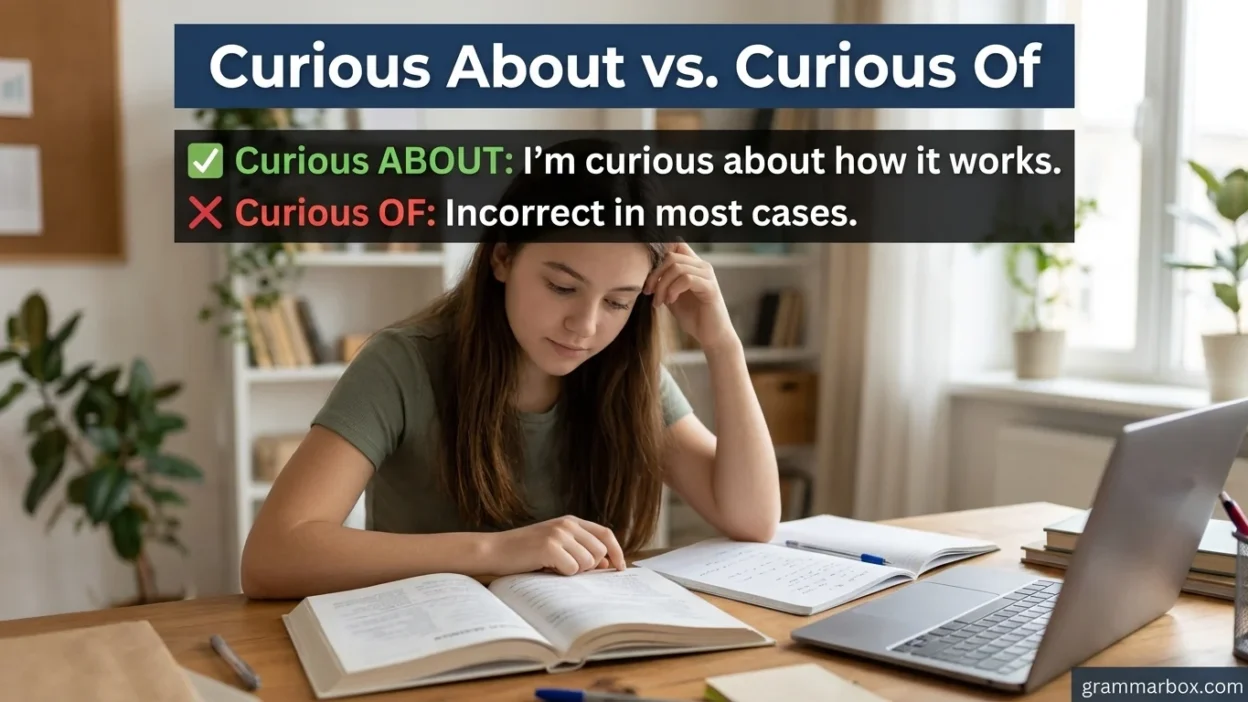
“Curious about” is the standard, natural choice when you want to know more about something or someone. For example, “I am curious about your experience.” “Curious of” is uncommon in modern English and generally should not replace “curious about.” In most situations, use curious about for clear, natural communication.
Why People Confuse It
People often confuse curious about and curious of because English adjectives can take different prepositions. For example, we say “interested in,” “afraid of,” and “curious about.” These combinations do not always follow a predictable rule.
Another reason for the confusion is that “of” is a common preposition in English. Learners may assume it can follow any adjective describing a feeling or mental state. However, English usage depends on established word combinations, known as collocations.
Consider these examples:
- Correct and natural: I am curious about her new project.
- Unnatural in ordinary modern English: I am curious of her new project.
- Correct and natural: He is curious about the results.
- Unnatural in ordinary modern English: He is curious of the results.
The key is to learn the adjective and its usual preposition together. When you want to express a desire to discover, understand, or learn something, curious about is generally the best choice.
First Word: Curious About
Curious about means wanting to know, understand, or discover more about a particular person, subject, event, or situation.
It is the standard expression in contemporary English and appears frequently in everyday conversations, academic writing, professional communication, and online content.
Meaning of Curious About
The adjective curious describes a person who wants to learn something or understand something better. The preposition about introduces the topic that interests that person.
For example:
- I am curious about your opinion.
- She is curious about how the machine works.
- They are curious about the new student.
- We were curious about the final decision.
In each sentence, the speaker wants to learn more about a particular topic or person.
When to Use Curious About
Use curious about when expressing interest in:
- People: I am curious about our new neighbor.
- Events: Everyone was curious about the announcement.
- Knowledge: She is curious about ancient history.
- Experiences: He is curious about life in another country.
- Questions: I am curious about why you changed your mind.
- Future possibilities: We are curious about what will happen next.
This expression works with nouns, pronouns, and question clauses.
Examples:
- I am curious about your travel experiences.
- She is curious about the answer.
- Are you curious about the new policy?
- My children are curious about space.
- He was curious about how the experiment worked.
Is Curious About Formal or Informal?
The expression is appropriate in both formal and informal English.
In casual conversation, you might say:
“I am curious about that movie.”
In a professional setting, you might write:
“We are curious about the factors that influenced the final outcome.”
Both sentences are grammatically natural. The level of formality depends on the surrounding language rather than the phrase itself.
Second Word: Curious Of
Curious of is an uncommon expression in modern English. Although learners sometimes use it as an alternative to curious about, it generally sounds unnatural when expressing ordinary interest in a subject or person.
For most contemporary writing and conversation, choose curious about instead.
Meaning and Usage of Curious Of
The adjective curious has historically appeared with different prepositions in some contexts, and unusual or older constructions may occur in literature or specialized writing. However, this does not mean that curious of is a standard substitute for curious about.
For example:
- Less natural: I am curious of your plans.
- More natural: I am curious about your plans.
- Less natural: She is curious of the answer.
- More natural: She is curious about the answer.
The second sentence in each pair is the preferred choice in contemporary standard English.
Is Curious Of Grammatically Correct?
Whether an expression is grammatically possible in a particular historical or literary context is different from whether it is idiomatic in modern English.
Curious of is not the normal collocation for expressing interest in something. In everyday writing, school assignments, business communication, and English-learning materials, it is best to use curious about.
If you encounter curious of in an older text or unusual construction, consider the context rather than assuming it has the same meaning and usage as curious about.
Better Alternatives to Curious Of
Instead of using curious of, consider these natural expressions:
- Curious about the answer
- Interested in the answer
- Eager to learn the answer
- Wondering about the answer
- Keen to discover the answer
For example:
Less natural: I am curious of your decision.
Better: I am curious about your decision.
Alternative: I would like to understand your decision.
These alternatives make your meaning clearer and help your English sound more natural.
Comparison Table: Curious About vs Curious Of
| Feature | Curious About | Curious Of |
|---|---|---|
| Main usage | Standard modern English | Uncommon in modern English |
| Meaning | Wanting to learn or understand more | Not a usual way to express interest |
| Naturalness | Natural and widely accepted | Generally sounds unnatural |
| Everyday conversation | Recommended | Usually avoid |
| Formal writing | Appropriate | Generally avoid |
| Academic writing | Appropriate | Usually replace with curious about |
| Example | I am curious about the results. | I am curious of the results. |
| Best choice | Yes | No, in ordinary modern usage |
Remember: When expressing interest in a subject, person, question, or situation, curious about is the preferred expression.
When to Use Each
Understanding the difference becomes easier when you focus on the message you want to communicate.
1. Use Curious About to Express Interest
Choose curious about when you want to learn more about something.
Examples:
- I am curious about your new business.
- The students are curious about the experiment.
- She is curious about his decision.
The phrase identifies the subject that interests someone.
2. Use Curious About to Ask Questions Indirectly
You can use curious about when introducing an indirect question.
Examples:
- I am curious about why she left early.
- We are curious about how the system works.
- He is curious about whether the meeting will continue.
These sentences are natural because about introduces the question or issue the speaker wants to understand.
3. Avoid Curious Of in Ordinary Sentences
If you want to express interest, replace curious of with curious about.
For example:
Incorrect or unnatural: She is curious of the results.
Natural: She is curious about the results.
Incorrect or unnatural: I am curious of what happened.
Natural: I am curious about what happened.
This simple change improves clarity and follows standard contemporary usage.
4. Use Interested In for a Similar Meaning
Sometimes interested in is an excellent alternative.
Examples:
- I am curious about photography.
- I am interested in photography.
- She is curious about the new course.
- She is interested in the new course.
Both expressions can communicate interest, although curious about often emphasizes wanting to know or discover something, while interested in can describe a broader or more lasting interest.
Examples: Curious About vs Curious Of
Here are 15 examples to help you understand how these expressions work in context.
Correct Examples with Curious About
- I am curious about your plans for the weekend.
The speaker wants to know what the other person plans to do. - She is curious about how plants grow.
She wants to understand the process of plant growth. - We were curious about the sudden change in weather.
The group wanted to understand why the weather changed. - Are you curious about the results of the experiment?
The question asks whether someone wants to know the outcome. - My brother is curious about different cultures.
He wants to learn about the customs and traditions of other people. - The teacher was curious about why the student arrived late.
The teacher wanted an explanation. - I am curious about your experience working abroad.
The speaker wants to learn about that experience. - They are curious about the company’s new product.
They want to discover more information about the product. - She became curious about the noise coming from upstairs.
The unusual noise made her want to investigate. - He is curious about whether the plan will succeed.
He wants to know if the plan will work. - We are curious about the history of this building.
The group wants to learn about the building’s past. - The children were curious about the stars in the night sky.
They wanted to understand or discover more about the stars.
Examples Showing Why Curious Of Is Usually Avoided
- Less natural: I am curious of your opinion.
Better: I am curious about your opinion. - Less natural: She is curious of the answer.
Better: She is curious about the answer. - Less natural: They were curious of what happened.
Better: They were curious about what happened.
These examples show why choosing the conventional preposition matters. Although the intended meaning may be understandable, curious about is the idiomatic choice in these sentences.
Common Mistakes
English learners sometimes make predictable mistakes when choosing between curious about and curious of. Learning to recognize them can improve your grammar and writing.
Mistake 1: Using Of Instead of About
Incorrect or unnatural: I am curious of your new job.
Correct: I am curious about your new job.
Why? The standard collocation is curious about when referring to something you want to learn more about.
Mistake 2: Assuming All Adjectives Use the Same Preposition
Incorrect: She is interested about science.
Correct: She is interested in science.
Why? Different adjectives take different prepositions. Learn common combinations such as curious about, interested in, afraid of, and proud of.
Mistake 3: Using Curious About Without a Clear Topic
Unclear: I am curious about.
Better: I am curious about the results.
Why? The phrase usually needs a topic, noun phrase, or appropriate clause to complete its meaning.
Mistake 4: Confusing Curiosity with Suspicion
Example: I am curious about his sudden departure.
This sentence normally means that you want to understand why he left. It does not necessarily mean that you suspect him of doing something wrong.
Tip: Use curious about for a desire to know more. Use more specific language when you want to express suspicion or doubt.
Mistake 5: Thinking Curious About Is Too Informal
Some learners believe that curious about belongs only in conversation.
That is not true. It works in formal writing, academic discussions, reports, and professional emails.
For example:
“The researchers were curious about the relationship between the two variables.”
This is a natural sentence in an academic context.
Memory Trick
Curious ABOUT = wanting to know ABOUT something.
The word about connects your curiosity to the topic you want to explore.
For example:
- Curious about science
- Curious about the answer
- Curious about the future
- Curious about someone’s opinion
You can also remember the phrase through a question:
“What am I curious about?”
The answer supplies the topic of your curiosity.
For example:
“What are you curious about?”
“I am curious about the new project.”
This memory trick works because it reinforces the natural word combination rather than asking you to memorize complicated grammar rules.
American vs British English
There is no important difference between American and British English in the standard use of curious about.
Both varieties commonly use this expression to describe a desire to learn or understand something.
| Situation | American English | British English |
|---|---|---|
| Asking about a person | I’m curious about him. | I’m curious about him. |
| Asking about a topic | She’s curious about science. | She’s curious about science. |
| Asking about a decision | We’re curious about the decision. | We’re curious about the decision. |
| Formal writing | Curious about is standard. | Curious about is standard. |
| Curious of | Generally uncommon | Generally uncommon |
American English Examples
- I am curious about your new apartment.
- She is curious about the election results.
- We are curious about the next step.
British English Examples
- I am curious about your new flat.
- She is curious about the election results.
- We are curious about the next step.
Notice that the phrase curious about remains the same. Differences such as apartment and flat reflect vocabulary preferences, not a difference in the grammar of this expression.
The takeaway: Whether you are writing for an American or British audience, choose curious about when expressing interest or a desire to know more.
Similar Words and Expressions
Several English expressions can communicate a meaning similar to curious about. However, each has its own nuance and preferred grammatical pattern.
| Expression | Meaning | Example |
|---|---|---|
| Interested in | Having an interest in something | She is interested in art. |
| Wondering about | Thinking about or questioning something | I am wondering about the results. |
| Eager to know | Strongly wanting information | He is eager to know the answer. |
| Keen to learn | Enthusiastic about learning | They are keen to learn new skills. |
| Fascinated by | Extremely interested in something | She is fascinated by astronomy. |
| Intrigued by | Interested because something is unusual or mysterious | I am intrigued by the story. |
| Curious about | Wanting to discover or understand something | We are curious about the outcome. |
Curious About vs Interested In
Both expressions communicate interest, but their emphasis can differ.
- Curious about: I am curious about how the engine works.
- Interested in: I am interested in mechanical engineering.
The first sentence emphasizes wanting to understand something. The second describes an interest in a broader subject.
Curious About vs Wondering About
These phrases are closely related.
- Curious about: She is curious about the new employee.
- Wondering about: She is wondering about the new employee.
The first describes her curiosity. The second emphasizes the thought or question currently on her mind.
Curious About vs Intrigued By
Intrigued by often suggests that something is unusual, interesting, or mysterious.
- I am curious about the old photograph.
- I am intrigued by the old photograph.
Both sentences are correct. The second may suggest that the photograph has something mysterious or especially interesting about it.
Curious About vs Curious To Know
You can also use curious to know when emphasizing a desire to discover an answer.
Examples:
- I am curious about the outcome.
- I am curious to know the outcome.
Both sentences are natural. The first focuses on the subject, while the second emphasizes the desire to find out.
FAQs:
1. Is Curious About Grammatically Correct?
Yes. Curious about is grammatically correct and widely used in modern English. It describes a desire to learn, discover, or understand something.
Example: I am curious about your opinion.
2. Is Curious Of Correct English?
Curious of is uncommon in contemporary English and is generally not the natural choice when expressing interest in something. In most everyday and formal contexts, use curious about instead.
Example: I am curious about the answer.
3. Should I Say Curious About You or Curious Of You?
In ordinary modern English, curious about you is the preferred expression.
Example: I am curious about you because you have an interesting background.
Depending on the context, this may express interest in someone’s personality, experiences, or life.
4. Can I Use Curious About in Formal Writing?
Yes. Curious about is suitable for formal emails, academic essays, professional reports, and research writing.
Example: The researchers were curious about the possible causes of the change.
5. What Is Another Way to Say Curious About?
You can use interested in, wondering about, eager to know, intrigued by, or keen to learn, depending on the meaning you want to express.
Example: I am interested in the results.
6. Is Curious About Used in Both American and British English?
Yes. Both American and British English commonly use curious about. There is no significant regional difference in the standard grammatical pattern.
7. What Preposition Follows Curious?
The usual preposition is about when you want to identify the topic of someone’s curiosity.
Example: She is curious about the new opportunity.
Another natural construction is curious to know, as in “I am curious to know what happened.”
Conclusion
Choosing the right preposition can make your English sound clearer and more natural. When you want to express interest in a person, topic, event, or situation, curious about is the safest and most widely accepted choice. It works in everyday conversations, academic assignments, professional emails, and formal writing. Learning this common adjective-preposition combination will also help you recognize similar patterns in English.
Remember that English prepositions are not always predictable. Rather than translating directly from your first language, learn common expressions as complete phrases. Practice using curious about in your own sentences, and pay attention to how fluent English speakers use it. With regular practice, choosing the correct expression will become easier, helping you communicate confidently and accurately.
Remember This
- Curious about: The standard expression for wanting to know or understand something.
- Curious of: Uncommon and generally unnatural when used to express ordinary interest.
- American vs British English: Both varieties commonly use curious about.
- Useful alternatives: Interested in, wondering about, intrigued by, and curious to know.
The easiest rule to remember is this: When you want to know more about something, say “curious about.”