
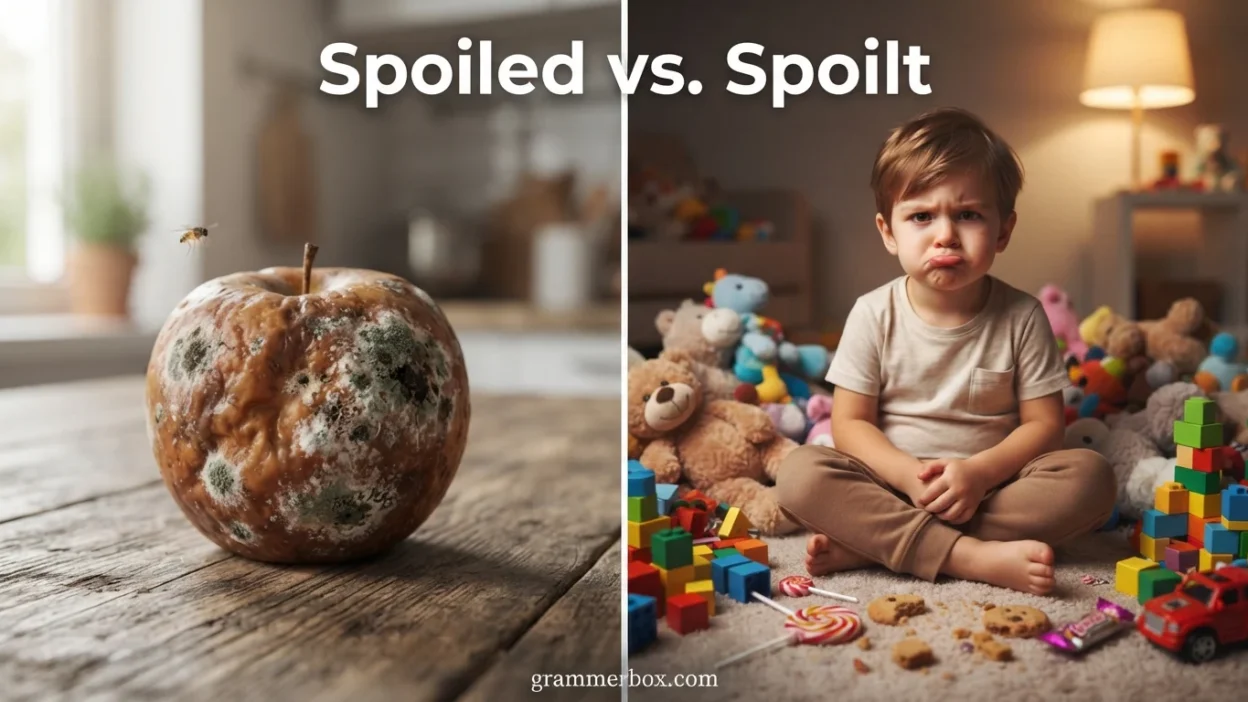
Have you ever wondered whether to write spoiled or spoilt? Both spellings are correct, and both are commonly used as the past tense and past participle of the verb spoil. The confusion arises because English has different spelling conventions, particularly in American and British English. Although these words look slightly different, they generally communicate the same meaning.
Understanding the difference between spoiled and spoilt can help you write more confidently, whether you are preparing an email, completing a school assignment, or creating professional content. Both forms can describe food that has gone bad, a child who receives too much attention or too many privileges, or an experience that has been ruined. However, one spelling is more common in certain English-speaking countries. In this guide, you will learn how each word works, when to use it, and how to avoid common spelling mistakes. With practical examples and a simple memory trick, choosing between spoiled and spoilt becomes much easier.
Quick Answer
Spoiled and spoilt are both correct spellings of the past tense and past participle of spoil. Spoiled is more common in American English, while spoilt is frequently used in British English. Both mean damaged, ruined, gone bad, or treated with excessive indulgence, depending on the context.
Why People Confuse It
People often confuse spoiled and spoilt because they are different spellings of the same verb form. Unlike words with completely different meanings, these two forms usually have no meaningful difference in definition.
The confusion mainly comes from regional spelling preferences. American English generally favors spoiled, while British English often accepts both forms and frequently uses spoilt in everyday writing.
Another reason for the confusion is that English verbs do not all follow the same pattern. Some verbs have one standard past-tense form, while others allow alternative spellings.
For example:
- Spoiled: The milk spoiled in the refrigerator.
- Spoilt: The milk spoilt in the refrigerator.
Both sentences are grammatically correct and express the same idea.
First Word: Spoiled
Spoiled is the past tense and past participle of the verb spoil. It is the preferred spelling in American English and is also widely understood and used in other varieties of English.
The word can describe something that has become unusable, an event that has been ruined, or a person who has been given excessive attention or privileges.
Meaning of Spoiled
Depending on the sentence, spoiled can mean:
- Gone bad: Food that is no longer fresh or safe to eat.
- Ruined: Something that has been damaged or made less enjoyable.
- Overindulged: A person who has received too much special treatment.
- Damaged: Something affected by an undesirable change.
Examples of Spoiled
- The spoiled fruit had an unpleasant smell.
- Heavy rain spoiled our outdoor picnic.
- The child became spoiled after receiving everything he wanted.
- Someone spoiled the ending of my favorite movie.
- The hot weather spoiled the food left outside.
When to Use Spoiled
Choose spoiled when writing in American English or when following a style guide that prefers this spelling. It is also a practical choice for international content aimed at readers familiar with American spelling conventions.
Second Word: Spoilt
Spoilt is another correct past-tense and past-participle form of the verb spoil. It is particularly common in British English and is also used in other varieties of English around the world.
Like spoiled, it can describe rotten food, a ruined occasion, or someone who has become accustomed to excessive attention and privileges.
Meaning of Spoilt
The meaning of spoilt depends on context:
- Rotten: Food that is no longer fresh.
- Ruined: An event or experience that has been negatively affected.
- Overindulged: Someone who expects special treatment.
- Made less enjoyable: Something that has lost its original appeal.
Examples of Spoilt
- The spoilt milk had to be thrown away.
- Our trip was spoilt by the unexpected storm.
- The spoilt child refused to share his toys.
- The surprise was spoilt when she revealed the secret.
- The beautiful view was spoilt by the construction work.
When to Use Spoilt
Use spoilt when writing in British English if it matches your preferred style, audience, or publication guidelines. It is especially familiar in British and some Commonwealth English contexts.
Remember that spoilt is not an incorrect or informal version of spoiled. It is a recognized alternative spelling.
Comparison Table
| Feature | Spoiled | Spoilt |
|---|---|---|
| Correct spelling | Yes | Yes |
| Part of speech | Past tense and past participle | Past tense and past participle |
| American English | More common | Less common |
| British English | Common and accepted | Frequently used |
| Meaning | Ruined, rotten, overindulged | Ruined, rotten, overindulged |
| Example | The food spoiled. | The food spoilt. |
| Best choice for US audiences | Usually preferred | Less typical |
| Best choice for UK audiences | Acceptable | Often preferred |
The main difference is spelling preference, not meaning. Both words can be used correctly in the appropriate context.
When to Use Each
Choosing between spoiled and spoilt becomes easier when you consider your audience and the type of English you are using.
Use Spoiled When:
- Writing for an American audience.
- Following American English spelling conventions.
- Preparing content for a publication that prefers regular -ed forms.
- Writing sentences such as “The food spoiled overnight.”
Use Spoilt When:
- Writing for a British audience that prefers this form.
- Following a British English style guide that uses spoilt.
- Writing sentences such as “The picnic was spoilt by the rain.”
- Maintaining consistency with other British English spellings in your document.
Can You Use Both in the Same Article?
It is best to choose one spelling and use it consistently throughout a piece of writing. Although both are correct, switching between them without a reason can make your writing look inconsistent.
For example, if your article uses American English, write “The milk spoiled” and “The surprise was spoiled.” If you prefer British English with spoilt, use that spelling consistently where appropriate.
Examples: Spoiled vs. Spoilt in Sentences
Here are 15 practical examples showing how both spellings work in everyday English.
- Food: The spoiled milk smelled terrible.
- Food: The spoilt milk smelled terrible.
- Weather: The storm spoiled our weekend plans.
- Weather: The storm spoilt our weekend plans.
- Children: His parents worried that he was becoming spoiled.
- Children: His parents worried that he was becoming spoilt.
- Movies: Please do not spoil the ending of the film.
- Movies: The ending was spoiled by an online comment.
- Surprises: She spoiled the surprise by telling everyone.
- Surprises: She spoilt the surprise by telling everyone.
- Vacation: The delayed flight spoiled our holiday.
- Vacation: The delayed flight spoilt our holiday.
- Appearance: The original design was spoiled by poor repairs.
- Appearance: The original design was spoilt by poor repairs.
- General use: The heat had spoiled the food before lunchtime.
These examples show that the spelling can change while the basic meaning remains the same. Notice that spoil is also used in the present tense, as in “Please do not spoil the surprise.”
Common Mistakes
Even though spoiled and spoilt are both correct, writers sometimes misuse them or confuse them with related forms.
Mistake 1: Assuming Spoilt Is Incorrect
Incorrect assumption: “Spoilt is always a spelling mistake.”
Correction: Spoilt is a legitimate English spelling, particularly common in British English.
Mistake 2: Thinking the Words Have Different Meanings
Some writers believe spoiled means rotten while spoilt refers only to a badly behaved child.
In reality, both forms can describe spoiled food, ruined plans, and overindulged children. Context determines the meaning.
Mistake 3: Mixing Regional Spellings Inconsistently
Using spoiled in one paragraph and spoilt in the next can create inconsistency when there is no stylistic reason for the change.
Better approach: Follow one spelling convention throughout your article.
Mistake 4: Confusing Spoiled With Spoiling
These forms serve different grammatical purposes.
- Spoiled: The food spoiled yesterday.
- Spoiling: The food is spoiling quickly.
- Spoil: Do not spoil the surprise.
Choose the form that fits the tense and structure of your sentence.
Mistake 5: Using Spoiled Only for Food
Both forms have several meanings. They can describe ruined plans, damaged experiences, or people who receive excessive indulgence.
For example, “The broken equipment spoiled the presentation” is also correct.
Memory Trick
Here is an easy way to remember the difference between spoiled and spoilt.
Remember the American “-ed” preference: American English generally favors spoiled, while British English often uses spoilt.
Try this simple association:
- Spoiled = American preference
- Spoilt = common British alternative
Think of the extra letters in spoiled as following the familiar pattern of many regular English past-tense verbs, such as played and cleaned. The shorter spoilt is an alternative form often encountered in British writing.
This trick is a guide to regional preference, not a strict rule. Both spellings are correct, and British writers can also use spoiled.
American vs. British English
American and British English sometimes differ in spelling, and spoiled versus spoilt is one example of this variation.
American English
In American English, spoiled is generally the standard and more frequent choice.
Examples:
- The food spoiled in the heat.
- The child was spoiled by his grandparents.
- The unexpected news spoiled her mood.
American dictionaries and writing conventions commonly favor the -ed form.
British English
In British English, both forms are accepted, but spoilt is a familiar and often preferred alternative, particularly in everyday expressions.
Examples:
- The food spoilt during the journey.
- The child was spoilt by his grandparents.
- The rain spoilt our afternoon.
British writers also use spoiled, so it would be inaccurate to say that the -ed form is wrong in the United Kingdom.
Which Spelling Should You Choose?
Your audience should guide your decision. For a US-focused website, use spoiled. For a UK-focused publication, spoilt may be a natural choice if it matches the publication’s style.
For international SEO content, either spelling can work. Make the intended meaning clear, provide useful examples, and avoid unnecessary repetition of both forms.
Similar Words
Understanding related words can help you expand your vocabulary and use spoil more accurately.
| Word | Meaning | Example |
|---|---|---|
| Spoil | To damage or ruin something | Do not spoil the surprise. |
| Spoiling | Causing something to deteriorate or become ruined | The heat is spoiling the food. |
| Spoilage | The process of food or another material becoming damaged | Refrigeration helps prevent food spoilage. |
| Rotten | Decayed or decomposed | The rotten apple was discarded. |
| Ruined | Damaged beyond usefulness or enjoyment | The rain ruined our picnic. |
| Overindulged | Given excessive attention or privileges | The overindulged child expected constant praise. |
| Stale | No longer fresh | The bread became stale overnight. |
| Decayed | Broken down through natural deterioration | The decayed wood needed replacing. |
These words are related to the meanings of spoiled and spoilt, but they are not always interchangeable. For example, stale usually describes food that has lost freshness, while spoiled can also refer to an experience that has been ruined.
FAQs:
1. Is spoiled or spoilt correct?
Both spellings are correct. Spoiled is more common in American English, while spoilt is frequently used in British English. Both can function as the past tense and past participle of spoil.
2. Is spoilt British or American English?
Spoilt is particularly associated with British English and is also used in some other English-speaking regions. American English generally favors spoiled.
3. Does spoiled mean the same as spoilt?
Yes. In most contexts, they have the same meaning. Both can describe food that has gone bad, plans that have been ruined, or a person who has received excessive indulgence.
4. Is spoilt grammatically correct?
Yes. Spoilt is a recognized English word, not a grammatical error. It is a correct past-tense and past-participle form of the verb spoil.
5. Should I write spoiled milk or spoilt milk?
Both expressions are correct. Spoiled milk is the more common choice in American English, while spoilt milk is a familiar alternative in British English.
6. What is the past tense of spoil?
The past tense can be spoiled or spoilt. For example, “The heat spoiled the food” and “The heat spoilt the food” are both correct.
7. Can I use spoiled and spoilt interchangeably?
Yes, their meanings generally overlap, so they can often be used interchangeably. However, follow your target audience’s spelling conventions and maintain consistency within the same document.
Remember This
- Spoiled: The preferred form in American English.
- Spoilt: A common alternative, especially in British English.
- Meaning: Both words generally mean the same thing.
- Grammar: Both can be used as the past tense and past participle of spoil.
- Writing tip: Follow your audience’s spelling conventions and remain consistent.
Conclusion
Learning the difference between spoiled and spoilt is simple once you understand that both spellings are correct. The words share the same basic meaning, and the main distinction is their regional usage. Whether you are describing spoiled food, a ruined holiday, or a child who receives too many privileges, either spelling can communicate your message clearly.
For confident English writing, consider who will read your work before choosing a spelling. Use spoiled when following American English conventions and consider spoilt when following a British English style that prefers it. By applying this simple guideline and checking your writing for consistency, you can avoid common spelling mistakes and make your sentences more natural.