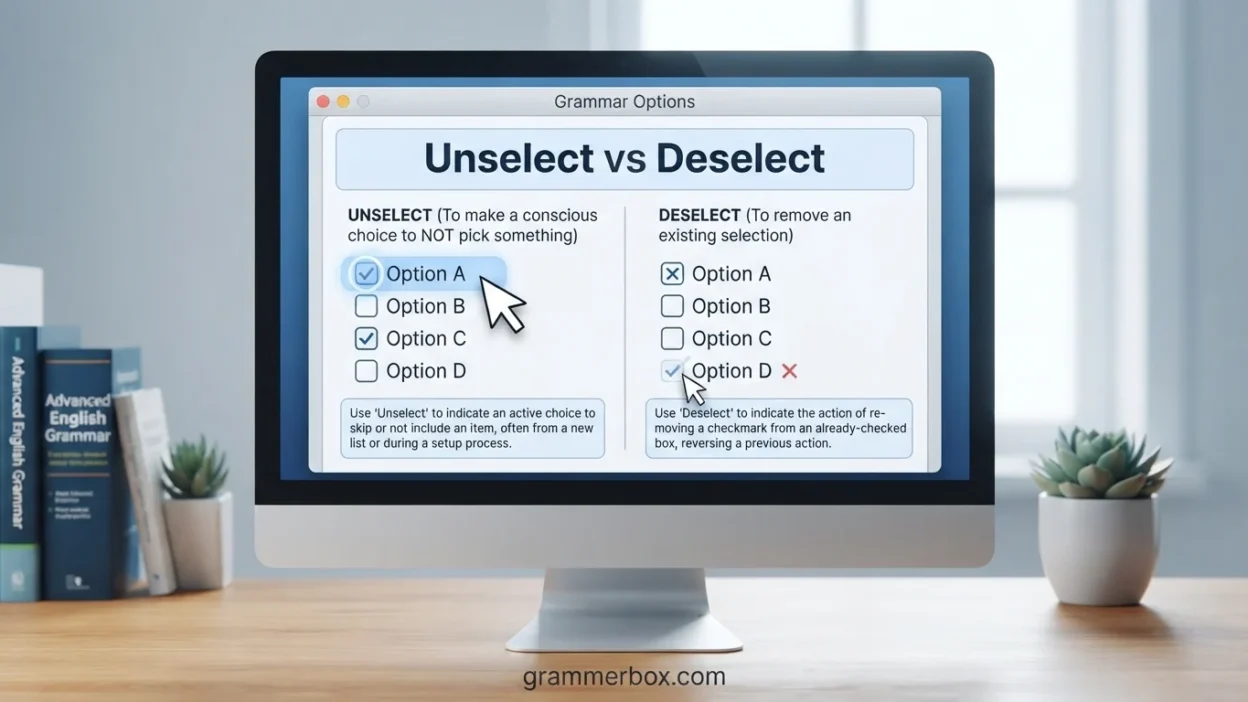
When working with software, forms, menus, or digital interfaces, you may need to describe the action of removing a selection. This often leads to a common question: should you say unselect or deselect? Although both words can communicate a similar idea, they are not equally common or natural in every context.
The verb deselect is the standard and more widely accepted choice, particularly in technical writing, user-interface instructions, and formal English. Unselect is also used, especially in everyday computing language, but it can sound less conventional in some contexts. Understanding the difference helps you write clearer instructions and avoid awkward wording. This guide explains the meanings, usage, examples, common mistakes, and subtle differences between unselect and deselect.
Quick Answer
Deselect is generally the better choice when you mean to remove something from a selection. Unselect can also be understood and is used in computing, but deselect is more standard in formal and technical contexts.
Why People Confuse It
The confusion comes from the fact that both unselect and deselect contain a prefix attached to select.
The prefixes un- and de- can both suggest reversing an action. For example:
- unlock = reverse the action of locking
- disconnect = reverse or end a connection
- deselect = remove a selection
- unselect = remove a selection
Because both forms make logical sense, speakers may wonder which one is grammatically correct.
In modern English, however, frequency and established usage matter. Deselect has become the more conventional term for reversing a selection, especially in software and technical documentation.
First Word: Unselect
Unselect is a verb meaning to remove something from a selection or to stop something from being selected.
For example:
Please unselect the items you do not want.
The word is understandable and appears in computing contexts, but it is generally less common than deselect.
Meaning of Unselect
Unselect can mean:
- To remove an item from a group of selected items
- To stop an option from being selected
- To reverse a previous selection
Examples
- Unselect the checkbox if you do not want notifications.
- You can unselect any unwanted files.
- Click the option again to unselect it.
- The user accidentally unselected the correct answer.
While these sentences are understandable, many style guides and technical writers would prefer deselect.
Second Word: Deselect
Deselect is a verb meaning to remove something from a selected state.
It is especially common in computing, software interfaces, forms, menus, and technical instructions.
Meaning of Deselect
Deselect means:
- To remove an item from a selection
- To cancel a previous selection
- To change something from selected to unselected
Examples
- Deselect the checkbox to disable the feature.
- Click the item again to deselect it.
- Deselect all files before closing the window.
- You can deselect any unwanted options.
Deselect is usually the safest choice when you are writing instructions for users.
Comparison Table
| Feature | Unselect | Deselect |
|---|---|---|
| Part of speech | Verb | Verb |
| Basic meaning | Remove from a selection | Remove from a selection |
| Grammatically valid | Yes | Yes |
| Common in computing | Yes | Yes |
| Formal/technical usage | Less preferred | More preferred |
| Natural for UI instructions | Sometimes | Usually |
| Recommended choice | Acceptable | Preferred |
When to Use Each
Use “Deselect” When:
Choose deselect when writing:
- Software instructions
- User-interface documentation
- Technical guides
- Help articles
- Formal instructions
- Product documentation
- Website or application instructions
For example:
Deselect the box next to “Send me updates.”
This sounds clear and professional.
Use “Unselect” When:
Unselect can be used when the context is informal or when a particular application or platform already uses the term.
For example:
If you change your mind, unselect the option.
The meaning is clear, but deselect would usually sound more polished.
Examples: Unselect vs Deselect
Here are examples showing how both words work:
- Deselect the checkbox if you do not agree to the terms.
- Unselect the checkbox if you do not want the feature.
- Click the highlighted file to deselect it.
- You can unselect an item by clicking it again.
- Deselect all options before starting the search.
- The user accidentally unselected the wrong file.
- Deselect the boxes you do not need.
- Please unselect any duplicate entries.
- To remove an option, deselect it from the menu.
- The application lets users unselect individual items.
- Deselect the radio button before choosing another option.
- You can unselect multiple files at once.
In most of these examples, deselect would be the preferred choice for polished technical English.
Common Mistakes
Mistake 1: Assuming “Unselect” Is Always Wrong
Unselect is not simply an impossible word. It is used and understood, particularly in computing.
Better approach:
Deselect is generally preferred, but unselect can be acceptable depending on context.
Mistake 2: Using “Deselect” When You Mean “Delete”
These words have different meanings.
- Deselect = remove from a selection
- Delete = remove or erase something
For example:
Deselect the file.
This means the file remains but is no longer selected.
Delete the file.
This means the file is removed.
Mistake 3: Confusing “Deselect” With “Uncheck”
In interface language, uncheck is often used specifically for checkboxes.
- Deselect the checkbox.
- Uncheck the checkbox.
Both can work, depending on the context.
Memory Trick
A simple way to remember the preferred term is:
Deselect = undo a selection.
Think of de- as indicating removal or reversal:
- select → deselect
- activate → deactivate
- connect → disconnect
So when you want to describe removing something from a selection, deselect is usually the best word.
American vs British English
There is no major American-versus-British distinction between unselect and deselect.
Both varieties of English can use deselect, particularly in computing and technical contexts. Unselect is also understandable in both varieties.
The main difference is not regional grammar but usage and preference. If you want wording that sounds conventional and professional in international English, deselect is the safer option.
Similar Words
Several related words can describe changing or removing a selection:
- Deselect — remove something from a selection
- Unselect — remove something from a selection
- Uncheck — remove a check mark from a checkbox
- Clear — remove a selected value or entered information
- Cancel — stop an action or operation
- Delete — permanently or temporarily remove something
- Remove — take something away from a list, group, or location
- Select — choose something
Choosing the right word depends on exactly what is happening in the interface.
FAQs:
1. Is “unselect” a correct word?
Yes. Unselect is a recognized and understandable verb, especially in computing contexts. However, deselect is generally more standard and preferred in formal or technical writing.
2. Is “deselect” better than “unselect”?
Usually, yes. Deselect is the more conventional choice when describing the reversal or removal of a selection.
3. Should I say “unselect the box” or “deselect the box”?
Deselect the box is generally more formal. Uncheck the box is also very natural when referring specifically to a checkbox.
4. What is the opposite of select?
The most common technical term is deselect. Depending on the context, unselect can also describe the opposite action.
5. Is “deselected” correct?
Yes. Deselected is the past tense and past participle of deselect.
Example:
The option was accidentally deselected.
6. Is “unselected” correct?
Yes. Unselected is the past tense and past participle of unselect.
Example:
The user unselected the wrong item.
7. Is “deselect” used in software?
Yes. Deselect is very common in software, websites, applications, forms, menus, and other user interfaces.
Final Verdict
Both unselect and deselect can mean removing something from a selection, so unselect is not necessarily grammatically wrong. However, the two words are not equally preferred.
Deselect is the stronger choice for formal English, technical documentation, software instructions, and professional writing. Unselect is understandable and can appear in informal computing language, but it is less conventional.
If you are unsure which word to choose, use deselect. It is concise, clear, widely understood, and closely associated with the action of reversing a selection.
Remember This
Deselect is usually the best choice when you mean “remove something from a selection.”
- Select → choose something
- Deselect → remove it from the selection
- Unselect → understandable alternative, but less preferred
- Uncheck → remove a check mark from a checkbox
- Delete → remove something entirely
For polished technical and professional writing, deselect is your safest choice.
Conclusion
The difference between unselect and deselect is mainly one of conventional usage rather than basic meaning. Both can describe reversing a selection, but deselect is more established in modern technical and interface language. It is therefore the better option for most formal writing and software instructions.
When writing a user guide, help article, form instruction, or professional document, choose deselect unless there is a specific reason to use unselect. Remembering this small distinction can make your English sound more natural, precise, and professional.