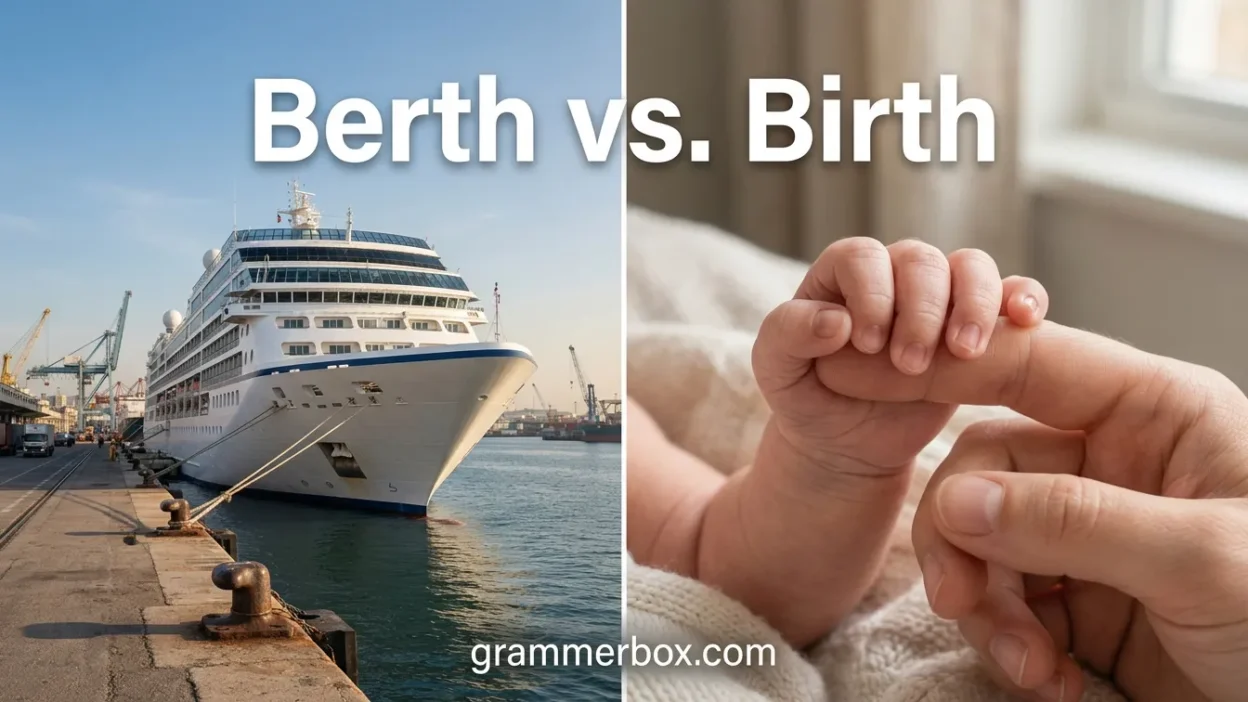
Have you ever wondered if to write “berth” or “birth”? These two English words look and sound almost identical, but they have completely different meanings. Confusing them can lead to spelling mistakes and misunderstandings, especially when writing emails, essays, or everyday messages. Although both words are pronounced the same way in most English accents, their meanings depend entirely on their spelling and context.
The main difference between berth and birth is that “berth” refers to a sleeping space, a place for a ship, or an assigned position, while “birth” refers to the process of being born or the beginning of someone’s life. Both words are nouns, but they are used in different situations. Learning their definitions, spelling patterns, and examples will help you understand when to use each word correctly and avoid common English mistakes.
Quick Answer
Berth vs. birth: “Berth” means a sleeping place on a ship, train, or other vehicle, or a designated position. “Birth” means the process of being born or the beginning of life. Both words usually sound alike but have different spellings and meanings.
Why People Confuse It
People often confuse berth and birth because these words are homophones. Homophones are words that have the same pronunciation but different meanings and spellings.
In most English accents, both words are pronounced /bɜːrθ/. This similarity makes it difficult to identify which word someone means when hearing it without additional context.
There are three main reasons for this confusion:
- Similar pronunciation: Both words sound almost exactly the same.
- Different spellings: They contain different middle letters, which can be easy to overlook when typing.
- Unrelated meanings: One word relates to sleeping spaces and positions, while the other relates to being born.
For example:
- Correct: The passenger booked a berth on the train.
- Correct: Her birth was celebrated by the entire family.
Remember that pronunciation alone cannot help you distinguish these words. You must understand the context to choose the correct spelling.
First Word: Berth
Berth (pronounced BURTH) is a noun that refers to a designated sleeping place, particularly on a ship, train, or other form of transportation. It can also mean a place where a ship is secured or a specific position assigned to someone or something.
The word is commonly used in travel, transportation, shipping, and sports.
Meanings of Berth
1. A sleeping place
A berth is a bed or sleeping space available on a ship, train, or similar vehicle.
Example: We booked a comfortable berth for our overnight train journey.
2. A place for a ship
A berth can refer to a designated space in a harbor where a ship docks.
Example: The cargo ship waited for an available berth at the port.
3. An assigned position
In sports and competitions, a berth can mean a place or position earned in an event or tournament.
Example: The team secured a berth in the national championship.
4. Space or distance
The expression “give someone a wide berth” means keeping a safe distance from someone or something.
Example: I usually give aggressive dogs a wide berth.
Example Sentences with Berth
- We reserved a private berth for our overnight journey.
- The ship entered its assigned berth early in the morning.
- Each passenger received a comfortable sleeping berth.
- The team earned a berth in the final tournament.
- The train had several empty berths available.
- The captain guided the vessel toward its designated berth.
- Please give the injured animal a wide berth.
- Our berth was located near the end of the train carriage.
- The harbor has enough berths for large vessels.
- She was excited to secure a berth in the international competition.
Quick tip: Think of “berth” whenever you are talking about a bed on transportation, a ship’s docking place, or an assigned position.
Second Word: Birth
Birth (pronounced BURTH) is a noun that refers to the process of being born or the beginning of someone’s life. It can also describe the origin, creation, or beginning of something.
It is commonly used in conversations about babies, families, celebrations, personal history, and new beginnings.
Meanings of Birth
1. The process of being born
Birth refers to the moment or process when a baby comes into the world.
Example: The family celebrated the birth of their first child.
2. The beginning of life
It can describe the start of someone’s life or existence.
Example: She has lived in London since birth.
3. The origin of something
Birth can also refer to the creation or beginning of an idea, movement, organization, or event.
Example: The invention gave birth to a new era of technology.
4. A person’s background or origin
The expression “place of birth” refers to the location where someone was born.
Example: Pakistan is his country of birth.
Example Sentences with Birth
- The birth of their daughter brought happiness to the family.
- She has been interested in music since birth.
- The hospital recorded the baby’s date of birth.
- His birth was celebrated with a family gathering.
- The birth of the internet transformed communication.
- They announced the birth of their first child.
- Her birth certificate contains important personal information.
- The idea led to the birth of a successful business.
- He was given a special gift on his birthday.
- The nurse helped the mother during childbirth.
Quick tip: Think of “birth” whenever you are talking about being born, a baby’s arrival, or the beginning of something.
Berth vs. Birth: Comparison Table
Although berth and birth have similar pronunciations, their meanings and grammatical uses are different.
| Feature | Berth | Birth |
|---|---|---|
| Meaning | Sleeping space or assigned position | Beginning of life |
| Part of speech | Noun | Noun |
| Pronunciation | BURTH | BURTH |
| Main context | Travel, ships, sports | Babies, life, beginnings |
| Common phrase | Sleeping berth | Date of birth |
| Related verb | Berth (to dock) | Birth (to give rise to) |
| Example | I booked a berth. | Her birth was celebrated. |
The easiest way to remember the distinction is that berth relates to beds and boats, while birth relates to babies and beginnings.
When to Use Each
Choosing between berth and birth becomes simple when you understand what you want to describe.
Use Berth When Talking About Sleeping Spaces
Use “berth” when referring to a sleeping place on a ship, train, or other transportation.
Examples:
- I booked a berth on the overnight train.
- The ship has several comfortable berths.
- We shared a sleeping berth during the journey.
Use Berth When Talking About Ships and Positions
Use it when discussing docking spaces or a place earned in a competition.
Examples:
- The vessel reached its assigned berth.
- The team earned a berth in the championship.
- The ship was moved to another berth.
Use Birth When Talking About Babies
Use “birth” when describing the arrival of a baby or the process of being born.
Examples:
- The parents celebrated their baby’s birth.
- Her birth took place in a small hospital.
- The family announced the birth of their son.
Use Birth When Talking About Beginnings
Use “birth” to describe the creation or beginning of something.
Examples:
- The invention marked the birth of modern technology.
- The project gave birth to a new business.
- The movement led to the birth of a new political idea.
Examples of Berth vs. Birth in Sentences
Here are 12 examples to help you understand how these words work in everyday English.
1. Berth: We reserved a berth on the train for our journey.
Birth: We celebrated the birth of our baby boy.
2. Berth: The ship arrived at its assigned berth.
Birth: Her birth certificate was issued yesterday.
3. Berth: Each passenger had a separate sleeping berth.
Birth: The hospital announced the birth of twins.
4. Berth: The team secured a berth in the final competition.
Birth: The birth of their daughter changed their lives.
5. Berth: The captain searched for an available berth.
Birth: His date of birth is written on the form.
6. Berth: I prefer a lower berth on overnight trains.
Birth: She has loved painting since birth.
7. Berth: The vessel moved into a larger berth.
Birth: The invention marked the birth of a new industry.
8. Berth: We found an empty berth near the window.
Birth: The parents shared the happy news of the birth.
9. Berth: The team earned a berth in the international tournament.
Birth: The birth of the organization inspired many people.
10. Berth: The ship remained in its berth overnight.
Birth: Her birth brought happiness to everyone.
11. Berth: Please give the barking dog a wide berth.
Birth: The baby’s birth was a memorable occasion.
12. Berth: Our sleeping berth was clean and comfortable.
Birth: The certificate confirms his place and date of birth.
Common Mistakes
Even experienced English writers sometimes confuse berth and birth because of their identical pronunciation. Here are some common mistakes and how to correct them.
1. Using berth when referring to a baby
Incorrect: We celebrated the berth of our daughter.
Correct: We celebrated the birth of our daughter.
Use “birth” when referring to the arrival of a baby.
2. Using birth when referring to a train bed
Incorrect: I booked a birth on the train.
Correct: I booked a berth on the train.
A sleeping space on a train is called a berth.
3. Confusing berth with birthday
Incorrect: My berth is in December.
Correct: My birthday is in December.
A birthday is the anniversary of someone’s birth.
4. Confusing birth with a docking place
Incorrect: The ship entered its assigned birth.
Correct: The ship entered its assigned berth.
A ship’s designated docking space is called a berth.
5. Forgetting the expression “wide berth”
Incorrect: Give that dangerous animal a wide birth.
Correct: Give that dangerous animal a wide berth.
The expression “give someone or something a wide berth” means keeping a safe distance.
Memory Trick: How to Remember Berth vs. Birth
A simple memory trick can help you remember these two confusing words.
- Berth = Bed and Boat: Remember the letter E in berth. Think of a bed or a place where a boat docks.
- Birth = Baby and Beginning: Remember the letter I in birth. Think of life, infants, and the beginning of something.
Here is another easy way to remember:
- Berth: I need a berth for my train journey.
- Birth: A baby arrives at birth.
Remember: Beds and boats need a berth, while babies and beginnings relate to birth.
American vs. British English
There is no spelling difference between berth and birth in American and British English. Both words have the same spelling and meaning in the two varieties.
Their pronunciation is also generally the same, although individual accents may produce slight differences in vowel sounds.
| Word | American English | British English |
|---|---|---|
| Berth | Berth | Berth |
| Birth | Birth | Birth |
Examples in American English
- I booked a berth on the train.
- The birth of their child was a special occasion.
Examples in British English
- We reserved a berth for the overnight journey.
- The hospital announced the birth of a baby.
Both expressions are standard in the United States and the United Kingdom.
The main difference between these words is their meaning, not their geographical usage.
Similar Words
Berth and birth belong to a larger group of English words that can be confusing because of their pronunciation, spelling, or related meanings.
Here are some useful words to learn:
| Word | Meaning |
|---|---|
| Birthday | The anniversary of someone’s birth |
| Birthplace | The place where someone was born |
| Birthright | A right someone has because of birth |
| Birthmark | A mark present on the skin from birth |
| Birth certificate | An official document recording a person’s birth |
| Birthrate | The number of births in a population |
| Childbirth | The process of giving birth |
| Bunk | A narrow sleeping bed |
| Bunk bed | A bed with one sleeping space above another |
| Mooring | A place or arrangement for securing a vessel |
Learning these related words will help you expand your vocabulary and understand the difference between travel-related and life-related terminology.
FAQs:
1. What is the difference between berth and birth?
Berth refers to a sleeping space on a ship or train, a docking place for a ship, or an assigned position. Birth refers to the process of being born or the beginning of life. Both words usually have the same pronunciation but different meanings.
2. Are berth and birth homophones?
Yes. Berth and birth are homophones in most English accents because they sound alike but have different spellings and meanings. You must understand the context to choose the correct word.
3. Is it birth or berth of a baby?
The correct word is “birth.” It refers to the process of a baby being born. For example, “The parents celebrated the birth of their baby.”
4. What does berth mean on a train?
A berth on a train is a designated sleeping space, usually found in sleeper coaches. It allows passengers to rest or sleep during long journeys.
5. What does berth mean in shipping?
In shipping, a berth is a designated place in a harbor or port where a ship can dock, load, unload, or remain secured.
6. What does “give someone a wide berth” mean?
“Give someone a wide berth” means keeping a safe or considerable distance from a person, animal, or object. For example, “I gave the aggressive dog a wide berth.”
7. Do Americans and British people spell berth and birth differently?
No. Both American and British English use the same spellings: “berth” and “birth.” Their meanings also remain the same in both varieties.
Final Verdict
The difference between berth and birth is straightforward once you understand their meanings. Berth refers to a sleeping space, a ship’s docking place, or an assigned position, while birth describes the process of being born or the beginning of life. Although these words sound alike, they cannot replace each other because they communicate completely different ideas.
When writing, always consider the context before choosing between these two homophones. If you are discussing trains, ships, sleeping spaces, or competition positions, use “berth.” If you are discussing babies, birthdays, family history, or new beginnings, use “birth.” Remembering these simple distinctions will help you avoid spelling errors and improve your everyday English writing.
Remember This
- Berth = Bed, Boat, or Position.
- Birth = Baby, Life, or Beginning.
- Both words are pronounced similarly in most English accents.
- Both are spelled the same in American and British English.
- Use context to identify the correct word.