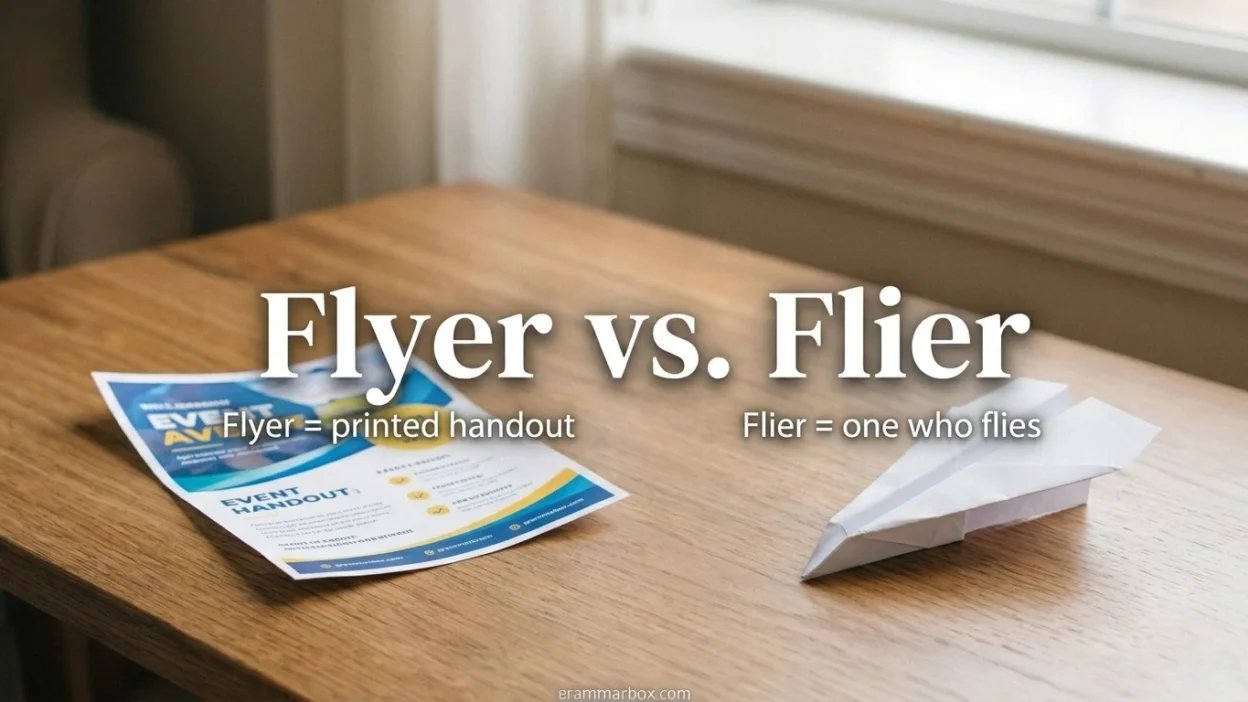
English contains many words that look almost identical but have slightly different spellings and meanings. Flyer vs flier is a common example that confuses students, writers, and English learners. Both words are correct, and both can refer to a person or thing that flies. However, they are also used in different contexts, especially when discussing printed advertisements, promotional materials, and travel.
The good news is that you do not need to memorize complicated grammar rules to understand the difference. In American English, flyer is generally the preferred spelling for a promotional handout, while flier is an alternative spelling. When referring to someone who flies, both forms are acceptable. Understanding their meanings, examples, and regional preferences will help you choose the right spelling in everyday writing.
Quick Answer: Flyer vs Flier
Flyer and flier are both correct English spellings. Flyer is the more common choice for a printed advertisement, promotional handout, or travel document. Flier is an accepted alternative, particularly for someone who flies. In modern American English, flyer is generally preferred in most contexts.
Why People Confuse It
People often confuse flyer and flier because the two words have almost identical spellings and pronunciations. They also share the same basic connection to the verb fly.
The confusion becomes greater when writers discover that both spellings can describe promotional materials or people who travel by air.
Here are the main reasons behind the confusion:
- Similar spelling: Both words differ by only one letter.
- Same pronunciation: In standard English, they sound exactly alike.
- Overlapping meanings: Both can refer to someone or something that flies.
- Regional preferences: Different dictionaries, publications, and style guides may prefer different spellings.
- Advertising usage: Flyer is especially common when describing printed promotional materials.
The easiest solution is to understand that both spellings are valid, but flyer is generally the safer choice for everyday American English.
First Word: Flyer
Flyer is a noun that commonly refers to a printed sheet of paper used to advertise an event, product, service, or announcement.
It can also describe a person who travels by airplane or someone who flies.
Meaning of Flyer
The word flyer has several common meanings:
- Promotional handout: A printed page used to advertise something.
- Air traveler: A person who travels by airplane.
- Person who flies: Someone who operates or flies an aircraft, depending on context.
Examples of Flyer in Sentences
- The company distributed a flyer to promote its new product.
- I received a flyer about the upcoming music festival.
- She designed a colorful flyer for the school fundraiser.
- The restaurant printed a flyer advertising its special offers.
- He is a frequent flyer who travels internationally every month.
When to Use Flyer
Use flyer when you are talking about:
- Advertising and promotional materials.
- Event announcements and invitations.
- Marketing handouts.
- Frequent air travelers.
- People who fly, when following the more common modern spelling.
Example: The students handed out flyers to invite people to the charity event.
In this sentence, flyers refers to printed promotional materials.
Second Word: Flier
Flier is also a correct English noun. Traditionally, it refers to someone or something that flies. It can also mean a printed advertisement or promotional handout.
Although the spelling is accepted, it is less common than flyer in many modern American English contexts.
Meaning of Flier
The word flier generally has two main meanings:
- Someone who flies: A person who travels by airplane or operates an aircraft.
- Promotional material: A printed sheet advertising an event, product, or service.
Examples of Flier in Sentences
- The young flier dreamed of becoming a professional pilot.
- My brother is a nervous flier who dislikes turbulence.
- The experienced flier knew how to handle the aircraft.
- She picked up a flier advertising a local concert.
- The airline offered special benefits to frequent fliers.
When to Use Flier
Use flier when:
- Referring to someone who flies, particularly if your chosen dictionary or style guide prefers this spelling.
- Following an established publication’s spelling preference.
- Writing in a context where flier is the established spelling.
Example: He is a nervous flier who prefers traveling by train.
Here, flier describes someone who travels by airplane.
Flyer vs Flier: Comparison Table
| Feature | Flyer | Flier |
|---|---|---|
| Part of speech | Noun | Noun |
| Pronunciation | /ˈflaɪər/ | /ˈflaɪər/ |
| Printed advertisement | Yes | Yes |
| Person who flies | Yes | Yes |
| Common in American English | More common | Less common |
| British English | Common | Accepted |
| Correct spelling | Yes | Yes |
The important distinction is not that one spelling is correct and the other is incorrect. Both are accepted, but flyer is generally the more widely preferred spelling today.
When to Use Each
Choosing between flyer and flier depends on your writing context, audience, and preferred style guide.
Use Flyer for Advertisements
When writing about promotional materials, flyer is the most familiar and widely used spelling.
Examples:
- We created a flyer for the grand opening.
- The school distributed flyers to parents.
- I saw a flyer advertising a free workshop.
Use Flyer for Frequent Travelers
The expression frequent flyer is widely established in American English.
Examples:
- My father is a frequent flyer.
- Frequent flyer programs offer travel rewards.
- She earned enough frequent flyer miles for a free flight.
Use Flier for People Who Fly
Flier is traditionally associated with someone who flies, although flyer is also correct.
Examples:
- He is an experienced flier.
- The nervous flier requested a window seat.
- Every flier must follow airline safety instructions.
Follow Your Style Guide
If you are writing for a newspaper, academic publication, business, or website, check its preferred spelling.
Consistency is more important than switching between both forms without a reason.
Flyer vs Flier Examples (15 Sentences)
The following examples show how both spellings work in everyday English.
Examples Using Flyer
- The teacher gave every student a flyer about the science exhibition.
- We designed a beautiful flyer for the community festival.
- The store distributed flyers to announce its seasonal sale.
- I found a flyer advertising a free English course.
- The marketing team created a flyer for its new campaign.
- My uncle is a frequent flyer who travels for business.
- The charity organization printed flyers to raise awareness.
- She posted a flyer on the community noticeboard.
Examples Using Flier
- My sister is a nervous flier who dislikes long flights.
- The young flier hopes to become an airline pilot.
- He considers himself an experienced flier.
- The airline provides discounts to frequent fliers.
- The flier carefully followed the aircraft safety instructions.
- I picked up a flier about the local music event.
- Every flier should understand basic travel safety guidelines.
These examples demonstrate that both spellings can be used in similar contexts.
Common Mistakes
Even though flyer and flier are both correct, writers sometimes misunderstand their usage.
Here are some mistakes to avoid:
Mistake 1: Thinking Flier Is Always Incorrect
Incorrect assumption: Flier is a misspelling of flyer.
Correction: Both are recognized English words.
Mistake 2: Thinking Flyer Only Means Advertisement
Correction: Flyer can also refer to a person who flies or travels by airplane.
Mistake 3: Thinking Flier Only Refers to Pilots
Correction: Flier can describe anyone who flies or travels by air, not just professional pilots.
Mistake 4: Switching Between Both Spellings Without Consistency
Correction: Choose one spelling according to your publication’s style and use it consistently.
Mistake 5: Assuming British and American English Have Completely Different Rules
Correction: Both spellings are understood in British and American English. The preference can vary by dictionary and publication.
Memory Trick
Remembering the difference between flyer and flier is simple with this easy trick:
- Flyer = Flyers for advertising: Think of promotional flyers handed out at stores, schools, and events.
- Flier = Someone who flies: Think of a person traveling through the air.
However, remember that these are helpful associations, not strict grammar rules. Both words can describe printed advertisements and people who fly.
Easy memory sentence:
“A flyer advertises an event, while a flier takes to the air.”
American vs British English
Both flyer and flier are recognized in American and British English. However, their popularity and preferred usage can vary.
American English
In American English, flyer is generally the preferred spelling for printed advertisements, promotional handouts, and frequent travelers.
For example:
- The company distributed flyers around the neighborhood.
- She is a frequent flyer.
Flier is also acceptable, particularly in some traditional expressions and editorial styles.
British English
British English also recognizes both spellings. Flyer is widely used for advertising materials, while flier remains an accepted alternative.
For example:
- The shop displayed a flyer announcing its new opening hours.
- He is a nervous flier.
Which Spelling Should You Choose?
If you are writing for an American audience, choose flyer as your default spelling. For British audiences, flyer is also a safe and familiar choice.
Most importantly, follow the dictionary or style guide used by your publication.
Similar Words
Understanding related words can help you improve your vocabulary and avoid spelling confusion.
| Word | Meaning |
|---|---|
| Fly | To move through the air |
| Flying | The action of moving through the air |
| Flight | A journey through the air |
| Flyer | A printed advertisement or someone who flies |
| Flier | Someone who flies or a promotional handout |
| Air traveler | A person traveling by airplane |
| Pilot | A person who operates an aircraft |
| Brochure | A small printed document providing information |
| Leaflet | A single printed sheet used to provide information |
| Handout | Printed material distributed to people |
These words are related to flying, advertising, or printed promotional materials, but they are not always interchangeable.
FAQs:
1. Is flyer or flier the correct spelling?
Both flyer and flier are correct English spellings. Flyer is generally more common in modern American English, especially for promotional advertisements and printed handouts.
2. Is flyer an American or British word?
Flyer is used in both American and British English. It is a widely accepted spelling for printed advertisements and people who fly.
3. Is flier a real English word?
Yes, flier is a real and recognized English word. It can describe someone who flies or a printed promotional handout.
4. Is it frequent flyer or frequent flier?
Both expressions are correct, but frequent flyer is the more widely established expression in American English. Airlines commonly use frequent flyer when describing customer loyalty programs.
5. Why do people spell flyer as flier?
The spelling flier follows a traditional spelling pattern in which the final -y changes to -i before certain endings. However, flyer is also an established spelling and is now more common in many contexts.
6. Should I write flyer or flier for an advertisement?
Use flyer for an advertisement because it is the more familiar and widely preferred spelling in modern usage. However, flier is also acceptable.
7. Do flyer and flier have the same pronunciation?
Yes. Both words are pronounced the same way: /ˈflaɪər/. They are homophones because they sound alike but have different spellings.
Final Verdict
The difference between flyer and flier is mainly a matter of spelling preference rather than meaning. Both words are correct, and both can refer to printed advertisements or people who fly. However, flyer is generally the more popular and widely accepted spelling in modern American English. It is particularly common in marketing, advertising, and travel-related expressions.
If you are unsure which spelling to choose, use flyer as your default option. It works naturally when discussing promotional handouts, event advertisements, and frequent air travelers. Use flier when it matches your preferred dictionary or publication style. The most important thing is to understand your audience and remain consistent throughout your writing.
Remember This
- Flyer: The more common spelling for advertisements and promotional handouts.
- Flier: An accepted alternative that traditionally refers to someone who flies.
- Both: Correct English spellings with the same pronunciation.
- Best choice: Use flyer in most everyday and professional writing.
Simple rule: When in doubt, choose flyer.