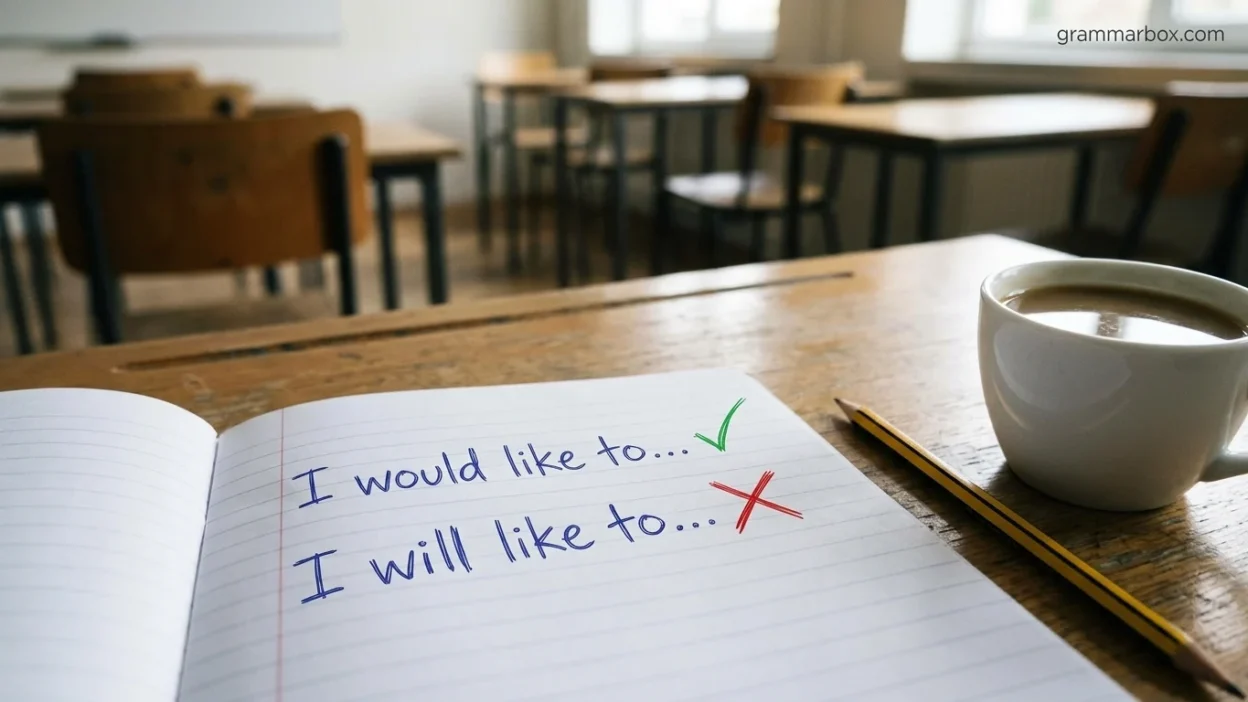
Have you ever wondered whether to say “I would like to” or “I will like to”? Both expressions use the verb “like,” but they do not communicate the same idea in everyday English. Choosing the right phrase can make your conversations, emails, and professional writing sound more natural. Although both expressions may be grammatically possible in certain contexts, “I would like to” is much more common when expressing a polite request, present desire, preference, or intention.
The confusion often arises because learners associate the word “will” with the future and assume it should be used whenever they talk about something they want to do later. However, English uses different structures to express present wishes, future intentions, and anticipated feelings. Understanding the difference between these phrases will help you avoid common grammar mistakes and communicate more confidently. In this guide, you will learn their meanings, grammatical patterns, practical usage rules, professional examples, and the difference between “I would like to,” “I will like,” and “I want to.”
Quick Answer
“I would like to” expresses a present wish, preference, or polite request, while “I will like” generally predicts a future feeling or preference. When you want to express a current desire to do something, use “I would like to + base verb.” When predicting future enjoyment, use “I will like” with an appropriate complement.
Why People Confuse It
People confuse “I would like to” and “I will like to” because both phrases contain the verb “like” and can relate to something happening in the future.
The main difference is the function of the auxiliary verbs would and will.
- Would can make a desire or request sound more polite and can also express a hypothetical preference.
- Will commonly expresses future actions, predictions, promises, decisions, and willingness.
- Like can mean to enjoy something, have a preference, or want something when used in the expression “would like.”
For example:
- “I would like to learn Spanish.” This expresses a present desire to learn Spanish.
- “I think I will like the new course.” This predicts that the speaker will enjoy the course.
- “I will want to rest after work.” This predicts a future desire.
The difference may look small, but it affects the sentence’s meaning, tone, and naturalness. Saying “I would like to meet you” expresses a present wish or polite intention. Saying “I will like meeting you” suggests a prediction about how the speaker will feel about the experience.
This distinction is particularly important in professional English, including job applications, business emails, interviews, customer service conversations, and formal requests.
First Word: I Would Like To
“I would like to” is a common English expression used to communicate a wish, preference, polite request, or present intention. It is especially useful in formal situations, workplace conversations, restaurants, academic settings, and everyday interactions.
The expression is generally more polite or less direct than “I want to.”
Meaning and Grammar
The basic grammatical structure is:
Subject + would like + to + base form of the verb
Examples:
- I would like to speak with the manager.
- I would like to improve my English.
- I would like to visit London someday.
- I would like to order a cup of coffee.
- I would like to apply for the position.
- I would like to learn more about the program.
In each sentence, the speaker expresses a desire or preference. The action may happen immediately or in the future, but the desire exists at the time of speaking.
For example, “I would like to attend the conference” expresses a present interest in attending an event that may take place next month.
“Would Like To” as a Polite Expression of Desire
The phrase “would like to” is a conventional, polite way of expressing what you want to do. It does not necessarily describe an imaginary or impossible situation.
Compare these sentences:
- “I want to speak with the manager.” This is direct and clear.
- “I would like to speak with the manager.” This sounds more courteous.
- “Could I speak with the manager?” This makes the request in question form.
All three sentences can be correct. The difference is mainly their tone and level of directness.
English often uses polite or indirect structures to make requests sound less forceful. For example, “I would like to ask a question” sounds softer than simply saying “Let me ask a question.”
This is why “would like to” is common in business correspondence, interviews, customer service, and formal conversations.
The Basic Grammar Pattern
When a verb follows “would like,” use to + the base form of the verb.
Correct examples:
- I would like to learn.
- I would like to ask.
- I would like to discuss.
- I would like to attend.
- I would like to apply.
- I would like to know.
Incorrect:
- I would like learn English.
- I would like apply for the job.
- I would like discuss the issue.
Correct:
- I would like to learn English.
- I would like to apply for the job.
- I would like to discuss the issue.
Remember that the word “to” is necessary when a verb follows this construction.
“Would Like” Can Also Take a Noun
You do not always need to use “to” after “would like.” The correct structure depends on whether you want a thing or want to perform an action.
Use would like + noun when referring to a thing:
- I would like some coffee.
- I would like a copy of the report.
- I would like another opportunity.
- I would like more information.
- I would like a glass of water.
Use would like + to-infinitive when referring to an action:
- I would like to order coffee.
- I would like to receive the report.
- I would like to discuss the opportunity.
- I would like to understand the issue.
- I would like to schedule a meeting.
| Grammatical Pattern | Example |
|---|---|
| Would like + noun | I would like some water. |
| Would like + to + verb | I would like to drink some water. |
| Would like + noun phrase | I would like a copy of the document. |
| Would like + to-infinitive | I would like to review the document. |
Both structures are grammatically correct. The key is to choose the structure that matches the meaning you intend.
When to Use “I Would Like To”
Use this phrase when you want to:
- Make a polite request.
- Express a personal preference.
- State something you wish to do.
- Describe a present desire involving a future action.
- Communicate professionally or respectfully.
- Express interest in an opportunity.
For example, “I would like to schedule a meeting for Monday” is appropriate in a professional email.
Similarly, “I would like to apply for the marketing position” expresses your current interest in a job, even though the application concerns a future opportunity.
Contractions and Short Forms
In spoken English, “I would like to” is often shortened to “I’d like to.”
Examples:
- I’d like to ask a question.
- I’d like to join your team.
- I’d like to learn more about the opportunity.
- I’d like to discuss the proposal.
- I’d like to speak with you about the project.
“I’d like to” has the same basic meaning as “I would like to.” It is particularly natural in conversations and conversational writing.
The contraction can also work well in professional emails when a friendly, natural tone is appropriate.
Second Word: I Will Like To
“I will like to” combines the future auxiliary “will” with the verb “like.” It is not the usual expression for a present desire or polite request, so it often sounds unnatural when used as a direct replacement for “I would like to.”
However, it is important not to assume that every sentence containing “will” and “like” is incorrect. The grammatical structure and intended meaning both matter.
Meaning and Grammar
The basic structure for future predictions is:
Subject + will + base form of the verb
Examples:
- I think I will like the new teacher.
- I think I will like this movie.
- I will like living in this city.
- I’m sure you will like the new office.
- She will like the new system once she gets used to it.
These sentences predict a future feeling, reaction, or preference.
Notice that the examples use “will like” rather than automatically adding “to.” The verb “like” can be followed by a noun, a gerund (an -ing form), or a suitable infinitive construction, depending on the meaning.
Is “I Will Like To” Ever Correct?
The expression “I will like to” may occur in a context where a speaker means that they will have a desire or preference in the future. However, it is uncommon as a routine way to express a present desire.
For example:
“After I finish my training, I will want to take on more responsibility.”
This is a clear way to describe a future desire.
You could also say:
“After I finish my training, I would like to take on more responsibility.”
This expresses a present wish concerning a future opportunity.
In some contexts, “I will like to” may be understandable, but a different construction will often communicate the intended meaning more naturally. Always consider whether you are expressing a current desire, a future action, or a prediction about how you will feel.
Why “Will” Does Not Simply Mean “Want”
One common mistake is assuming that will = future = anything I want to do later.
English does not work that simply.
Compare:
- “I will visit London next year.” This states a future action.
- “I would like to visit London next year.” This expresses a present desire concerning a future action.
- “I will want to visit London again.” This predicts a future desire.
The actions may relate to the same future event, but the speaker’s attitude differs.
“Will” commonly communicates a future action or prediction. “Would like to” expresses what someone wants or would prefer to do. That is the key distinction.
“I Will Like” Is Correct in Some Contexts
The phrase “I will like” is perfectly natural when predicting future enjoyment or preference.
Future Prediction
- I think I will like the new restaurant.
- I’m sure you will like this book.
- I think I will like my new school.
These sentences express expectations about future enjoyment.
Future Reaction
Imagine a friend recommends a movie you have not watched. You might say:
“I think I’ll like it.”
You are predicting your future reaction, not making a polite request.
Compare that with:
“I would like to watch the movie.”
This expresses your current desire to watch it.
Future Enjoyment
The verb “like” can also be followed by an -ing form or a to-infinitive, depending on the construction.
Examples:
- I like reading.
- I like to read before bed.
- I will like staying in London.
- I think I will like working with this team.
These examples show why “will” and “like” can appear together naturally. The problem is using “I will like to” as a routine replacement for “I would like to.”
Comparison Table
| Feature | I Would Like To | I Will Like To |
|---|---|---|
| Main function | Expresses a present desire or polite request | Uncommon as a standard request |
| Commonness | Very common | Uncommon in this structure |
| Tone | Often polite and courteous | Depends on context |
| Time reference | Present desire, possibly about a future action | Intended meaning must be clear |
| Typical use | Requests, preferences, intentions | Not the usual choice for polite requests |
| Natural alternative | I would like to join the meeting. | I will want to join the meeting. |
| Future prediction | I would like to try the new activity. | I think I will like the new activity. |
Important: “I will like” is natural when predicting enjoyment, as in “I will like this book.” The less natural construction is “I will like to” when the speaker simply means “I want to” or “I would like to.”
“I Will Like” vs. “I Would Like”
Adding a noun or pronoun after “like” makes the distinction especially clear.
- “I will like the job.” This predicts that you will enjoy the job.
- “I would like the job.” This expresses a preference or desired outcome.
- “I would like to apply for the job.” This expresses a present desire to apply.
| What You Mean | Best Structure | Example |
|---|---|---|
| Present desire | I would like to… | I would like to join. |
| Polite request | I would like to… | I would like to ask a question. |
| Direct desire | I want to… | I want to join. |
| Future prediction | I will like… | I think I will like it. |
| Future desire | I will want to… | I will want to rest. |
| Future action | I will… | I will call tomorrow. |
When to Use Each
Choosing between these expressions becomes easier when you identify what you want to communicate.
Use “I Would Like To” for Present Desires
When you already have a desire to do something, “I would like to” is generally the better choice.
Examples:
- I would like to study abroad.
- I would like to meet your parents.
- I would like to change my career.
- I would like to attend the conference.
These sentences communicate current wishes, even when the actions will happen later.
Use “I Will Like” for Future Predictions
When you predict that you will enjoy something, use “I will like” followed by an appropriate complement.
Examples:
- I think I will like this restaurant.
- I will like the new job once I settle in.
- I think I will like your suggestion.
- I’m sure you will like the new apartment.
Here, “like” means to enjoy or appreciate something.
Use “I Will Want To” for a Future Desire
If you mean that a desire will arise in the future, “I will want to” is usually clearer.
Examples:
- I will want to rest after the long journey.
- You will want to review these notes before the exam.
- She will want to discuss the offer tomorrow.
This construction describes a desire expected to exist in the future rather than a current wish.
Use “I Would Love To” for Enthusiasm
“I would love to” expresses a strong desire and often sounds warm and enthusiastic.
Examples:
- I would love to attend your wedding.
- I would love to work with your team.
- I would love to visit Japan someday.
It is especially useful when accepting invitations or expressing excitement about an opportunity.
“I Want To” vs. “I Would Like To”
Both expressions are correct, but they have slightly different tones.
| Phrase | Tone | Common Setting |
|---|---|---|
| I want to… | Direct | Casual conversation |
| I would like to… | Polite or neutral | Professional communication |
| I’d like to… | Natural and polite | Conversation and email |
| I’d love to… | Warm and enthusiastic | Invitations and positive situations |
| I intend to… | Formal and deliberate | Plans and formal writing |
For example:
“I want to discuss the issue.”
This is direct and grammatically correct.
“I would like to discuss the issue.”
This sounds more courteous and may be preferable in professional communication.
Neither expression is automatically better. Choose the tone that fits the situation. Using “would like to” in every casual conversation can sometimes sound unnecessarily formal.
Examples of “I Would Like To” vs. “I Will Like To”
The following examples demonstrate the difference between polite requests, present wishes, future predictions, and future desires.
- Polite request: I would like to speak with you privately.
- Future plan: I would like to travel to Canada next year.
- Professional setting: I would like to apply for the position.
- Personal preference: I would like to learn how to cook.
- Restaurant order: I would like to have a glass of water.
- Future prediction: I think I will like your new apartment.
- Expected enjoyment: I will like this book because I enjoy mysteries.
- Future desire: I will want to take a break after the exam.
- Hypothetical preference: I would like to live near the ocean if I could choose anywhere.
- Workplace request: I would like to arrange a meeting with the director.
- Future intention: I would like to start my own business one day.
- Predicted preference: I think I will like working with this team.
- Academic request: I would like to ask whether the deadline can be extended.
- Customer service: I would like to request a replacement for the damaged item.
- Professional follow-up: I would like to follow up regarding the proposal we discussed last week.
Incorrect or Awkward vs. Natural English
| Awkward in the Intended Context | More Natural Alternative |
|---|---|
| I will like to order a coffee. | I would like to order a coffee. |
| I will like to ask a question. | I would like to ask a question. |
| I will like to join your team. | I would like to join your team. |
| I will like to take a break after work. | I will want to take a break after work. |
| I will like to learn English. | I would like to learn English. |
| I would like apply for the position. | I would like to apply for the position. |
| I would like speak with you. | I would like to speak with you. |
These examples show which expression is more natural when the speaker is expressing a present desire or request rather than predicting a future preference.
Email Examples Using “I Would Like To”
The expression “I would like to” is particularly useful in professional writing because it communicates your purpose without sounding abrupt.
Professional email opening
Dear Ms. Johnson,
I would like to follow up regarding the proposal we discussed last week. Could you please let me know whether you have had an opportunity to review it?
Interview request
I would like to request an opportunity to discuss the position further. I am available Tuesday or Wednesday afternoon and would be happy to work around your schedule.
Academic context
I would like to ask whether the assignment deadline can be extended.
Customer service request
I would like to request a replacement for the damaged item I received.
You can also vary your language to avoid repeating “I would like to” throughout a long email. For example, “I would appreciate the opportunity to discuss the position further” is a natural alternative in a professional setting.
Quick Decision Guide
Ask yourself what you are trying to say.
- Are you expressing a present desire? Use “I would like to…”
- Are you making a polite request? Use “I would like to…”
- Are you speaking casually? Use “I want to…” when appropriate.
- Are you predicting a future reaction? Use “I will like…”
- Are you expressing a future desire? Use “I will want to…”
- Are you stating a future action? Use “I will…” without automatically adding “like.”
The easiest distinction is: “What do I want?” points toward “I would like to,” while “How will I feel?” points toward “I will like.”
Common Mistakes
English learners sometimes use “will” whenever they refer to a future event. However, English does not require the future tense simply because an action will occur later.
Mistake 1: Using “Will” for a Polite Request
Awkward for the intended meaning:
“I will like to speak to the manager.”
Better:
“I would like to speak to the manager.”
The second sentence is the standard polite request.
Mistake 2: Confusing Desire With Enjoyment
“I would like to watch this film” expresses a desire to watch it.
“I will like this film” predicts that you will enjoy it.
The expressions have different meanings, even though both use the verb “like.”
Mistake 3: Assuming “Would” Always Refers to the Past
“Would” can refer to a hypothetical situation, a polite request, or a preference. It does not necessarily describe something that happened in the past.
Example: “I would like to visit Italy” expresses a present wish about a possible future experience.
Mistake 4: Assuming “Want” Is Incorrect
“I want to” is perfectly grammatical. It simply sounds more direct than “I would like to” in many situations.
For example:
- I want to ask a question.
- I would like to ask a question.
Both are correct, but the second may sound more courteous in a formal setting.
Mistake 5: Forgetting “To”
When a verb follows “would like,” use “to” before the base verb.
- I would like to apply. Correct.
- I would like apply. Incorrect.
Mistake 6: Confusing “Would Like” and “Would Like To”
Use would like + noun when you want something:
“I would like a coffee.”
Use would like + to + verb when you want to perform an action:
“I would like to order a coffee.”
Both structures are correct.
Mistake 7: Treating Every Future-Related Sentence the Same Way
Compare:
- I will attend the conference.
- I would like to attend the conference.
The first states a future action. The second expresses a present desire about that future event.
The time of the action and the time of the desire are not necessarily the same.
Memory Trick
Use this simple trick to remember the difference:
Would = wish. Will like = future enjoyment. Will want = future desire.
- I would like to means you want to do something or are making a polite request.
- I will like means you predict that you will enjoy something.
- I will want to means you predict that you will desire to do something.
Think about these examples:
- “I would like to eat pizza.” You want pizza.
- “I will like this pizza.” You expect to enjoy its taste.
- “I will want to eat after the workout.” You expect to desire food later.
Remembering these three patterns can help you choose the right phrase in everyday English.
American vs. British English
There is no significant difference between American and British English in the basic use of “I would like to” and “I will like.”
Both varieties use “I would like to” for polite requests, preferences, and desires.
Examples in American English:
- I would like to get a cup of coffee.
- I’d like to talk about the project.
Examples in British English:
- I would like to have a cup of tea.
- I’d like to discuss the proposal.
The choice of coffee, tea, or other vocabulary may vary with context, but the underlying grammar remains the same.
In both varieties, “I will like” is appropriate when predicting future enjoyment, while “I will want to” is generally more natural when describing a desire that will arise later.
Similar Words and Expressions
Several English expressions can replace “I would like to” or “I will like,” depending on the intended meaning.
1. I Want To
This phrase expresses a direct desire.
Example: “I want to learn French.”
It is clear and natural but can sound less polite than “I would like to” in certain situations.
2. I’d Love To
This expression communicates enthusiasm or a strong desire.
Example: “I’d love to join you for dinner.”
3. I Hope To
Use this phrase to express an aspiration or something you wish to accomplish.
Example: “I hope to graduate next year.”
4. I Intend To
This phrase expresses a deliberate plan or intention.
Example: “I intend to finish the project by Friday.”
5. I Plan To
Use this expression when you have a plan to do something.
Example: “I plan to visit my grandparents this weekend.”
6. I Will Want To
This phrase describes a desire that is expected to arise in the future.
Example: “You will want to bring a jacket when the weather gets colder.”
7. I Think I Will Like
Use this construction when predicting that you will enjoy an experience or thing.
Example: “I think I will like my new school.”
8. I Would Appreciate
This expression is especially useful for polite professional requests.
Example: “I would appreciate the opportunity to discuss the proposal.”
These alternatives help you communicate the exact meaning and tone you intend.
FAQs:
1. What Is the Main Difference Between “I Will Like To” and “I Would Like To”?
“I would like to” expresses a present desire or polite request. “I will like” generally predicts future enjoyment or preference. For ordinary requests, “I would like to” is the more natural choice.
2. Is “I Would Like To” Grammatically Correct?
Yes. “I would like to” is grammatically correct and widely used to express wishes, preferences, and polite requests.
Example: “I would like to speak with the teacher.”
3. Is “I Will Like To” Ever Correct?
It may be possible in a context where a future desire is intended, but it is uncommon as a routine replacement for “I would like to.” For a polite request, use “I would like to.” For a prediction about enjoyment, use “I will like” with a suitable complement.
4. What Is the Difference Between “I Would Like To” and “I Want To”?
Both expressions communicate a desire. “I would like to” is generally softer and more polite, while “I want to” is more direct.
Example: “I want to discuss the issue” is direct, while “I would like to discuss the issue” sounds more courteous.
5. Can I Use “I Would Like To” for Future Plans?
Yes. You can use “I would like to” to describe a present desire concerning a future action.
Example: “I would like to study overseas next year.”
6. Is “I’d Like To” the Same as “I Would Like To”?
Yes. “I’d like to” is the contracted form of “I would like to.” It is very common in conversation and acceptable in many types of writing.
Example: “I’d like to ask you a question.”
7. Is “I Will Like This” Correct English?
Yes. “I will like this” is correct when predicting that you will enjoy or appreciate something.
Example: “I think I will like this new book.”
8. Is “I Would Like” Correct Without “To”?
Yes. Use “would like + noun” when referring to something you want.
Example: “I would like some water.”
When a verb follows, use “to + base verb.”
Example: “I would like to drink some water.”
9. Can “Will Like” Be Used With a Future Time?
Yes. “Will like” can express a future reaction or expectation.
Example: “I’m sure you will like the new office once you move there.”
The key is that “will like” refers to future liking; it is not the standard polite equivalent of “want to.”
Final Verdict
“I would like to” and “I will like to” are not interchangeable in ordinary English. The first is the natural choice for expressing a present wish, preference, or polite request. The second is much less common because “will like” usually describes a future feeling, and the additional “to” requires a context in which a future desire is intended.
If you want to ask politely, make a request, or describe something you hope to do, choose “I would like to.” If you are predicting enjoyment, use “I will like” followed by a suitable complement. If you are talking about a desire you expect to have later, “I will want to” is often clearer. Remember that “I want to” is also completely correct when a direct expression of desire fits the situation.
Remember This
- I would like to: A present wish, preference, or polite request.
- I will like: A prediction about future enjoyment.
- I will want to: A prediction about a future desire.
- I want to: A direct expression of desire.
- I’d like to: A natural contraction of “I would like to.”
The easiest rule is to use “I would like to” for polite requests and ordinary expressions of desire. Choose “I will like” when you mean that you expect to enjoy something.
Conclusion
Understanding the difference between “I would like to” and “I will like to” helps you express yourself more naturally in English. Although the phrases look similar, they communicate different ideas. “I would like to” is commonly used for wishes, preferences, and polite requests, while “I will like” predicts a future feeling or experience. Learning the difference between “would like,” “will like,” and “want to” also helps you avoid awkward expressions and choose a tone that suits the situation.
When you are unsure which phrase to choose, focus on your intended meaning instead of simply thinking about the future. Use “I would like to” for something you want to do, “I will like” for something you expect to enjoy, and “I will want to” for a desire you expect to develop later. With practice, these English grammar rules, sentence patterns, and examples will become easier to recognize and use correctly in conversations, emails, applications, interviews, and professional writing.