
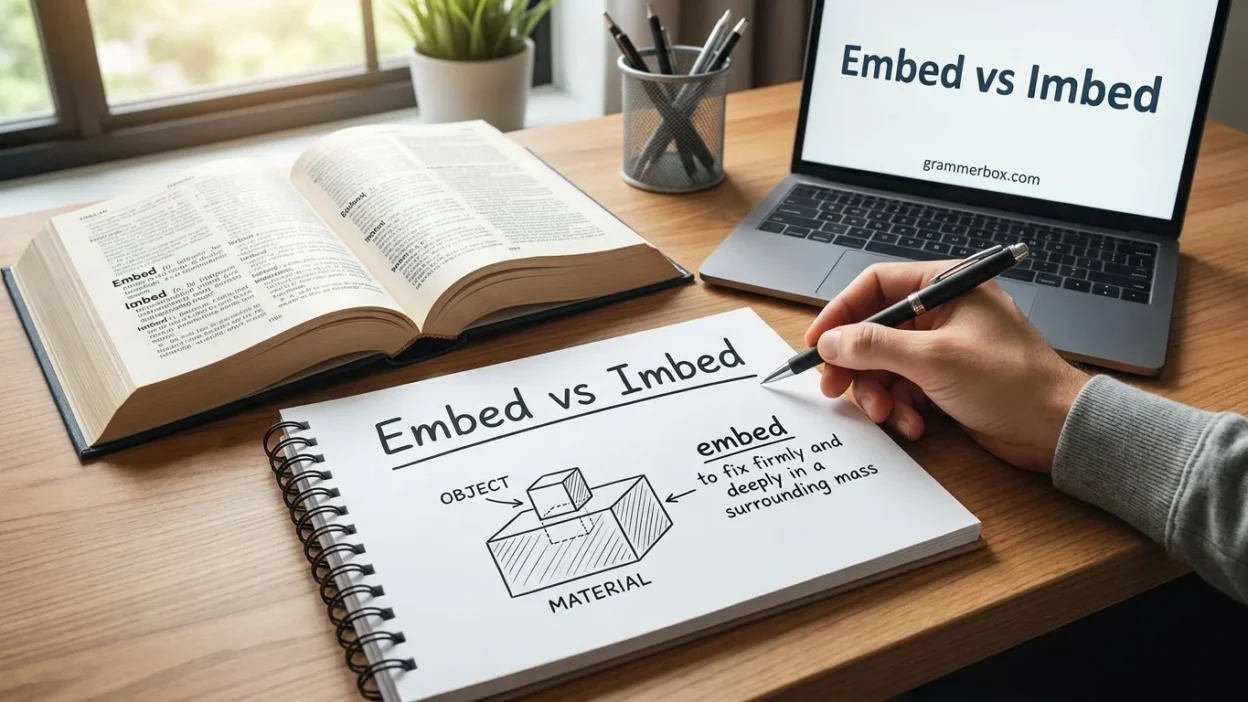
When you want to place something inside something else, you may come across both embed and imbed. At first glance, these words look like alternative spellings of the same term, so it is easy to wonder whether one is incorrect. In modern English, however, one form is far more common and widely accepted, especially in technology, education, journalism, and everyday writing.
Understanding embed vs imbed matters because choosing the more familiar spelling can make your writing clearer and more professional.
If you are talking about embedding a video on a website, inserting an image into a document, or deeply fixing something into another material, knowing which word to use helps you communicate naturally. In this guide, we will explain the meanings, differences, examples, common mistakes, and regional usage of embed and imbed so you can confidently choose the right word.
Quick Answer
Embed is the standard and much more common spelling in modern English. Imbed is also a recognized variant, but it is considerably less common. Use embed in most situations, especially in technology, academic writing, business communication, and general English.
Why People Confuse It
The confusion comes from the fact that embed and imbed have essentially the same meaning.
Both words can describe putting something firmly or deeply into something else. For example:
- A website can embed a video.
- A stone can be imbedded in concrete.
- A teacher can embed examples into a lesson.
The spelling imbed may look logical because English has the prefix im-, but embed became the dominant form in modern usage.
Today, embed is the spelling you will encounter most often, particularly in digital and technical contexts.
Embed: Meaning and Usage
Embed is a verb meaning to place something firmly, deeply, or securely within another thing.
It can be used literally or figuratively.
Literal meaning
When something is physically fixed inside another material, you can use embed.
- The jeweler embedded the gemstone in the ring.
- Small pieces of glass were embedded in the wall.
- The roots were deeply embedded in the soil.
Figurative meaning
Embed can also describe ideas, habits, or qualities that become firmly established.
- The experience was embedded in her memory.
- The teacher embedded critical-thinking skills into the course.
- Trust is embedded in the company’s culture.
Technology meaning
In modern technology, embed has a particularly important meaning: to insert digital content into another webpage, document, or application.
- We embedded the YouTube video in the article.
- You can embed an image in the presentation.
- The website allows users to embed social media posts.
This technological use makes embed especially common in contemporary English.
Word forms
- Present: embed
- Past: embedded
- Present participle: embedding
- Noun: embedding
Notice that the consonant b is doubled before -ed and -ing:
embed → embedded → embedding
Imbed: Meaning and Usage
Imbed is a legitimate variant spelling of embed. It means essentially the same thing: to place something deeply or firmly inside another thing.
For example:
- The nail was imbedded in the wooden beam.
- The artifact was imbedded in the rock.
- The idea became imbedded in the public consciousness.
Although imbed is not necessarily wrong, it is much less common than embed.
For most modern writing, especially when you are writing for an international audience, embed is the safer and more natural choice.
Word forms
- Present: imbed
- Past: imbedded
- Present participle: imbedding
- Noun: imbedding
You may encounter these forms, but they are considerably less frequent than their embed counterparts.
Embed vs Imbed: Comparison Table
| Feature | Embed | Imbed |
|---|---|---|
| Meaning | Put something firmly or deeply inside something else | Same basic meaning |
| Standard modern spelling | Yes | Recognized variant |
| Frequency | Very common | Much less common |
| Technology | Extremely common | Rare |
| Academic writing | Preferred | Less common |
| Business writing | Preferred | Less common |
| Literal use | Common | Possible |
| Figurative use | Common | Possible |
| Best general choice | Yes | Usually no |
When to Use Each
Use “embed” when:
Choose embed in almost all ordinary situations.
It is especially appropriate when:
- Writing articles or essays
- Describing websites or digital content
- Discussing videos, images, or documents
- Writing business communications
- Creating educational material
- Writing technical documentation
- Describing deeply established ideas or habits
Example:
The developer embedded a video directly into the webpage.
Use “imbed” when:
Imbed can be used when you specifically want the less common variant or are following a source’s established spelling.
For example:
The researchers found a fragment imbedded in the sample.
However, there is usually no practical reason to choose imbed over embed in contemporary general writing.
Embed vs Imbed: 12 Examples
Here are examples showing how the two spellings work in context.
- The designer embedded an image in the newsletter.
- You can embed a video directly into the webpage.
- The journalist embedded a social media post in the article.
- The stone was deeply embedded in the ground.
- Her childhood memories were deeply embedded in her mind.
- The teacher embedded practical exercises into the lesson.
- The researchers discovered an object imbedded in the rock.
- A tiny piece of metal was imbedded in the wooden surface.
- The idea became imbedded in the team’s culture.
- The application allows users to embed external content.
- The gemstone was embedded in the center of the pendant.
- The old tradition remained deeply embedded in the community.
In examples 7–9, imbed is possible, but embedded would generally be the more familiar modern choice.
Common Mistakes
1. Assuming “imbed” is always incorrect
It is not necessarily incorrect. Imbed is an established variant spelling.
Better understanding:
It is acceptable but uncommon compared with embed.
2. Using “imbed” for technology
You may technically encounter the variant, but phrases such as embed a video, embed a link, and embed an image are overwhelmingly more natural.
Prefer:
Embed the video in your blog post.
3. Forgetting the double “b”
The past tense and participle forms require a doubled b:
- embed → embedded
- embed → embedding
Not:
embededembeded video
4. Confusing “embed” with “insert”
The words can overlap, but they are not always identical.
Insert generally means putting something into something else.
Embed often suggests that the item becomes incorporated or fixed within the surrounding material.
5. Thinking the spelling changes the meaning
In most contexts, embed and imbed carry the same basic meaning. The major difference is frequency and modern preference, not definition.
Memory Trick
Use this simple trick:
EMBED = ENTER + BECOME PART OF IT
Think of embed as something entering another thing and becoming firmly connected to it.
For digital content, remember:
“Embed a video.”
That phrase is extremely common, so embed should be your default spelling.
If you see imbed, simply recognize it as a less common spelling rather than assuming it is a completely different word.
American vs British English
Both American English and British English generally use embed as the preferred spelling.
There is no major American-versus-British distinction that requires you to switch between embed and imbed.
In both varieties, embed is the spelling most readers will expect.
This is particularly clear in technology. Expressions such as:
- embedded video
- embedded content
- embedded systems
- embedded software
- embedded images
are standard across international English.
Imbed may still appear in some dictionaries, publications, or older texts, but it is not the usual modern choice.
Similar Words
Several words are related to embed, but each has its own nuance.
Insert
To put something into another thing.
Insert the card into the machine.
Incorporate
To include something as part of a larger whole.
The company incorporated customer feedback into the new design.
Integrate
To combine something so that it works as part of a larger system.
The software integrates several useful tools.
Implant
To place something inside a person, animal, or other living system, often surgically; it can also have figurative uses.
The surgeon implanted the device.
Fix
To attach or secure something in a particular position.
The technician fixed the panel to the wall.
Ingrain
To establish something so deeply that it becomes difficult to change.
The habit was ingrained in his daily routine.
These words overlap with embed, but they are not interchangeable in every sentence.
Final Verdict
If you are wondering whether to write embed or imbed, choose embed in almost every modern writing situation.
Imbed is a valid variant, but it is much less common. You may encounter it in older writing or in sources that prefer the alternative spelling, but it is not usually the best choice for contemporary communication.
For websites, essays, professional documents, technical writing, and everyday English, embed is the clear winner.
FAQs:
Is “imbed” a correct word?
Yes. Imbed is a recognized variant spelling of embed. However, it is much less common, so embed is generally preferred.
Is embed or imbed more common?
Embed is significantly more common in modern English. It is especially dominant in technology, education, business, and online content.
What does embed mean?
Embed means to place something firmly or deeply inside something else. It can also mean to incorporate digital content, such as a video or image, into another webpage or document.
Can I use “imbed” in formal writing?
You can, because it is a recognized spelling. However, embed is usually the better choice for formal and professional writing because it is more familiar to modern readers.
Is “embedded” spelled with one or two Bs?
It is spelled with two Bs: embedded.
The same applies to embedding.
What is the past tense of embed?
The past tense is embedded.
She embedded the video in the article.
Is “embedded video” correct?
Yes. Embedded video is the standard expression for a video placed directly within a webpage, application, or other digital environment.
Conclusion
The difference between embed vs imbed is mainly one of spelling preference and frequency rather than meaning. Both words can describe placing something firmly or deeply within another thing, but embed has become the overwhelmingly more common form in contemporary English. It is also the standard choice in technology, where you frequently hear phrases such as “embed a video” or “embedded content.”
If you want your writing to sound natural, clear, and familiar to modern readers, make embed your default choice. Keep imbed in mind as a legitimate but uncommon variant. Whether you are writing an essay, creating website content, or discussing digital media, choosing embed will almost always be the safest option.
Remember This
Embed = the preferred modern spelling.
Imbed = a valid but uncommon variant.
When in doubt, write embed.
Correct: “Embed the video in the article.”
Also possible, but uncommon: “Imbed the video in the article.”