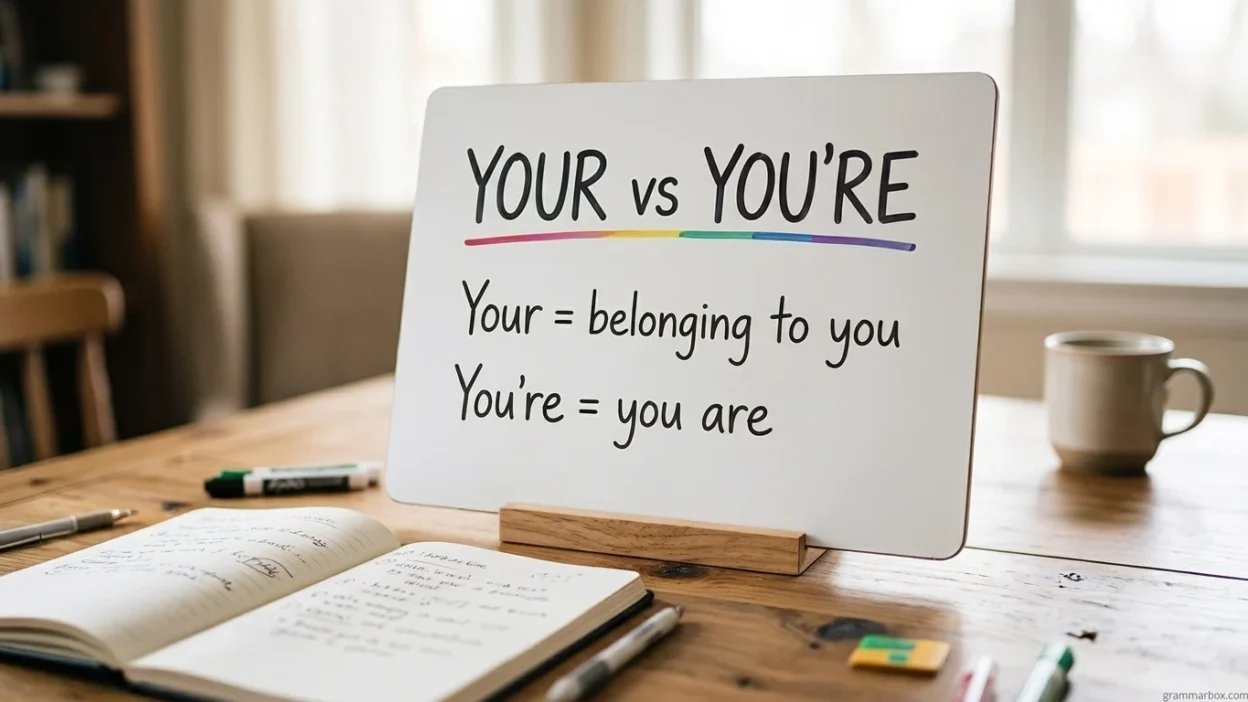
Have you ever stopped while writing a sentence because you were unsure whether to use your vs you’re? You are not alone. These two English words sound exactly alike, but they have completely different meanings. Choosing the wrong one can make your writing look careless, especially in emails, school assignments, social media posts, and professional documents. The good news is that understanding the difference between your and you’re is much easier than you might think.
The main difference is that your shows ownership, while you’re is a contraction of “you are.” For example, you would write “Your phone is ringing” because the phone belongs to someone. However, you would write “You’re doing a great job” because the sentence means “You are doing a great job.” Once you understand these simple grammar rules, you can avoid common spelling mistakes and communicate more confidently. In this guide, you will learn the meaning of each word, when to use it, practical examples, common errors, and easy tricks to remember the difference.
Quick Answer: Your vs You’re
Your is a possessive determiner that shows something belongs to you, as in “Your book is on the table.” You’re is a contraction of “you are,” as in “You’re very helpful.” Both words sound the same, but their meanings and grammatical functions are different. Use the correct form according to your sentence.
Why People Confuse It
People often confuse your and you’re because they have identical pronunciations in everyday English. This makes it difficult to distinguish between them when speaking, although their meanings become clear when written correctly.
Another reason is that the apostrophe in you’re can be overlooked when typing quickly. On social media, in text messages, and in informal conversations, people sometimes use these words interchangeably without checking their grammar.
However, the two words are not interchangeable. Each has a specific grammatical purpose.
Consider these examples:
- Your answer is correct. (The answer belongs to you.)
- You’re correct. (You are correct.)
Notice how removing the apostrophe changes the meaning of the sentence. Understanding this difference will help you use both words correctly.
First Word: Your
Your is a possessive determiner used to show that something belongs to, relates to, or is associated with the person being addressed.
It usually appears before a noun, such as a book, name, idea, opinion, or responsibility.
Meaning of Your
Your indicates possession or a relationship with the person you are speaking or writing to.
For example:
- Your bag is beautiful.
- I appreciate your advice.
- Please bring your notebook tomorrow.
- Your opinion matters to me.
- Is this your jacket?
In each sentence, your connects the person being addressed with a particular object, idea, or quality.
When to Use Your
Use your when you want to indicate ownership or a connection to the person you are addressing.
Common examples include:
1. Showing ownership
- Your keys are on the desk.
- I found your wallet in the car.
- Your shoes are near the door.
2. Referring to personal qualities or feelings
- Your kindness means a lot to me.
- Your patience is impressive.
- I admire your confidence.
3. Referring to responsibilities or activities
- Finish your homework before dinner.
- Please submit your application today.
- Remember to check your work.
Grammar Rule for Your
A simple rule is to look at the word that follows your. If it introduces a noun or a noun phrase, your may be the correct choice.
Examples:
- Your friend is waiting outside.
- Your new computer looks impressive.
- Your understanding of grammar is improving.
However, remember that the word following your does not always need to be a single noun. It can also be an adjective followed by a noun or a longer noun phrase.
Second Word: You’re
You’re is a contraction of the words “you are.” The apostrophe replaces the missing letter a in are.
You’re is commonly used in everyday conversations, emails, messages, and informal writing. It is also acceptable in most types of standard writing when a natural, conversational tone is appropriate.
Meaning of You’re
You’re means exactly the same thing as you are.
For example:
- You’re my best friend.
- You’re doing an excellent job.
- You’re welcome to join us.
- You’re always on time.
- You’re learning English quickly.
Each sentence makes sense when you replace you’re with you are.
For instance:
“You’re learning English quickly.”
Becomes:
“You are learning English quickly.”
The meaning stays the same.
When to Use You’re
Use you’re whenever you mean you are.
1. Describing someone or something
- You’re a talented writer.
- You’re a wonderful teacher.
- You’re an important member of our team.
2. Describing an action in progress
- You’re reading an interesting book.
- You’re making excellent progress.
- You’re preparing for your examination.
3. Expressing a feeling or condition
- You’re happy today.
- You’re ready for the meeting.
- You’re responsible for this task.
4. Giving advice or making observations
- You’re better off taking an umbrella.
- You’re going to enjoy this movie.
- You’re doing exactly what you need to do.
Grammar Rule for You’re
The easiest way to check you’re is to replace it with you are.
If the sentence still makes sense, you’re is probably correct.
For example:
- You’re very kind. → You are very kind. ✓
- You’re going to succeed. → You are going to succeed. ✓
- You’re my favorite person. → You are my favorite person. ✓
If replacing you’re with you are makes the sentence incorrect or unnatural, you probably need your instead.
For example:
“Your house is beautiful.”
“You are house is beautiful.”
The second sentence is grammatically incorrect, so your is the correct choice.
Comparison Table: Your vs You’re
| Feature | Your | You’re |
|---|---|---|
| Meaning | Belonging or relating to you | You are |
| Grammatical function | Possessive determiner | Contraction |
| Apostrophe | No apostrophe | Contains an apostrophe |
| Usually followed by | A noun or noun phrase | A description, noun phrase, or verb phrase |
| Shows ownership | Yes | No |
| Can be expanded to “you are” | No | Yes |
| Example | Your dog is friendly. | You’re very friendly. |
| Common mistake | Writing your instead of you’re | Writing you’re instead of your |
The most important distinction is simple: your shows possession, while you’re means you are.
When to Use Each
Choosing between your and you’re becomes easier when you focus on the meaning of the sentence instead of how the words sound.
Use Your for Possession
Choose your when you are talking about something that belongs to or is associated with the person you are addressing.
Examples:
- Your room needs cleaning.
- Your explanation was helpful.
- I like your new haircut.
- Please bring your identification card.
- Your performance was outstanding.
In each example, your connects a noun or noun phrase to the person being addressed.
Use You’re for “You Are”
Choose you’re when the sentence means you are.
Examples:
- You’re very intelligent.
- You’re making good decisions.
- You’re invited to the party.
- You’re becoming a better writer.
- You’re responsible for the final report.
In all these examples, replacing you’re with you are preserves the sentence’s meaning.
Compare Similar Sentences
Sometimes, both words can appear in sentences about the same subject.
Consider these examples:
Your work is excellent.
This sentence means that the work associated with you is excellent.
You’re doing excellent work.
This sentence means you are doing excellent work.
Another example:
Your friend is waiting outside.
This refers to a friend associated with you.
You’re waiting outside.
This means you are waiting outside.
These comparisons demonstrate why context matters when choosing the correct word.
Examples of Your vs You’re in Sentences
Here are 15 practical examples to help you understand the difference between your and you’re.
Examples Using Your
- Your presentation was clear and informative.
- I really like your new hairstyle.
- Please remember to bring your lunch.
- Your parents are waiting for you outside.
- Could you share your opinion about this book?
- I appreciate your help with my assignment.
- Is this your phone on the kitchen counter?
- Your English has improved significantly.
- Please write your name at the top of the page.
- I hope your journey goes smoothly.
Examples Using You’re
- You’re doing a fantastic job.
- You’re going to love this restaurant.
- I think you’re ready for the interview.
- You’re always welcome at our house.
- You’re becoming more confident every day.
Examples Using Both Words Together
You can also use both words in the same sentence.
Example 1: You’re doing well because your preparation is excellent.
- You’re = you are.
- Your = your preparation.
Example 2: If you’re looking for your keys, they are on the table.
- You’re = you are.
- Your = your keys.
Example 3: You’re responsible for your own decisions.
- You’re = you are.
- Your = your own decisions.
Example 4: You’re improving your writing skills every day.
- You’re = you are.
- Your = your writing skills.
Example 5: I hope you’re happy with your results.
- You’re = you are.
- Your = your results.
These examples show that both words can appear naturally in one sentence while serving different grammatical purposes.
Common Mistakes
Even experienced English speakers sometimes confuse your and you’re. Fortunately, most errors can be corrected by understanding their grammatical roles.
Mistake 1: Using Your Instead of You’re
Incorrect: Your going to enjoy the trip.
Correct: You’re going to enjoy the trip.
Why? The sentence means “You are going to enjoy the trip.” Therefore, you’re is correct.
Mistake 2: Using You’re Instead of Your
Incorrect: I love you’re new car.
Correct: I love your new car.
Why? The sentence refers to a car associated with the person being addressed. It does not mean “you are new car.”
Mistake 3: Forgetting the Apostrophe
Incorrect: Youre doing great.
Correct: You’re doing great.
Why? In standard English writing, you’re requires an apostrophe because it is a contraction of you are.
Mistake 4: Adding an Apostrophe to Your
Incorrect: Your’e very talented.
Correct: You’re very talented.
Why? The apostrophe belongs in you’re, not your. Your is already the correct possessive form without an apostrophe.
Mistake 5: Relying Only on Pronunciation
Incorrect assumption: Both words sound alike, so either spelling works.
Correct approach: Check the meaning and grammatical structure of the sentence.
Why? Homophones sound the same but have different meanings or grammatical functions. Your and you’re are common examples.
Mistake 6: Assuming Your Always Refers to Physical Ownership
Incorrect assumption: Your can only describe objects that belong to someone.
Correct understanding: Your can also describe relationships, responsibilities, feelings, opinions, and other associations.
Examples:
- Your idea is interesting.
- Your health matters.
- Your decision surprised me.
Understanding these distinctions helps you avoid mistakes in both casual and formal writing.
Memory Trick: How to Remember Your vs You’re
If you frequently confuse these words, use this simple memory trick.
The “You Are” Test
Whenever you are unsure whether to write your or you’re, replace the word with you are.
If the sentence still makes sense, use you’re.
If it does not, your is likely the correct choice.
Examples:
Sentence: You’re a great friend.
Test: You are a great friend.
Result: Correct. Use you’re.
Sentence: Your friend is a great person.
Test: You are friend is a great person.
Result: Incorrect. Use your.
Remember the Apostrophe
Think of the apostrophe in you’re as a signal that two words have been combined.
- You + are = You’re
- Your = Possession
A Simple Formula
Remember these two rules:
- YOUR = BELONGS TO YOU
- YOU’RE = YOU ARE
For example:
“Your success matters.”
“You’re going to succeed.”
Practicing this distinction with a few sentences every day can help you remember the correct spelling naturally.
American vs British English
The difference between your and you’re is the same in American English and British English.
Both varieties use your to show possession and you’re as a contraction of “you are.” Neither spelling is an American or British variant.
Examples in American English:
- Your vacation starts tomorrow.
- You’re going to have a great time.
Examples in British English:
- Your holiday starts tomorrow.
- You’re going to have a brilliant time.
Notice that vacation and holiday, as well as great and brilliant, reflect differences in vocabulary and usage. However, the meanings and grammatical rules of your and you’re remain unchanged.
Is Your vs You’re Different in Other English Varieties?
No. The same distinction applies to other major varieties of English, including Australian, Canadian, and New Zealand English.
Regardless of where you are writing, remember that your expresses possession and you’re means you are.
Similar Words: Your vs You’re and Other Commonly Confused Words
Your and you’re belong to a larger group of English words that are often confused because they sound alike or have similar spellings.
Learning these common word pairs can improve your spelling, grammar, and overall writing skills.
1. Their vs They’re
- Their shows possession: Their house is beautiful.
- They’re means they are: They’re coming home.
2. There vs Their
- There refers to a place or introduces certain statements: Put the book there.
- Their shows possession: Their books are on the shelf.
3. Its vs It’s
- Its shows possession: The dog wagged its tail.
- It’s means it is or it has: It’s a beautiful day.
4. Who’s vs Whose
- Who’s means who is or who has: Who’s coming to dinner?
- Whose asks about ownership: Whose bag is this?
5. Your vs Yours
- Your usually comes before a noun: Your book is here.
- Yours stands alone as a possessive pronoun: This book is yours.
6. You’re vs You Are
- You’re is the contraction: You’re very helpful.
- You are is the complete form: You are very helpful.
Both forms are grammatically correct. You’re is often more conversational, while you are can provide greater emphasis or suit a more formal tone.
Understanding these common confusing words will help you avoid spelling errors and write clearer English.
FAQs:
1. What Is the Main Difference Between Your and You’re?
Your shows possession or a relationship with the person being addressed. You’re is a contraction of “you are.” For example, “Your car is outside” indicates possession, while “You’re late” means “You are late.”
2. Is Your or You’re Correct?
Both words are correct, but they serve different purposes. Use your when referring to something that belongs to or is associated with someone. Use you’re when you mean you are. The correct choice depends on the sentence.
3. How Can I Easily Remember Your vs You’re?
Use the “you are” test. Replace you’re with you are. If the sentence makes sense, you’re is correct. If it does not, your may be the correct choice.
For example, “You’re amazing” becomes “You are amazing,” which is correct.
4. Can Your and You’re Be Used in the Same Sentence?
Yes. Both words can appear in one sentence because they have different meanings.
Example: “You’re improving your English every day.”
Here, you’re means you are, while your refers to the English skills associated with you.
5. Is Youre Correct Without an Apostrophe?
In standard English, youre is incorrect. The correct contraction is you’re, with an apostrophe between u and r. The apostrophe indicates that letters have been omitted from you are.
6. Is Your a Possessive Pronoun?
In traditional grammar, your is a possessive determiner because it appears before a noun, as in “your book.” Yours is the possessive pronoun that can stand alone, as in “The book is yours.”
Some grammatical descriptions use the broader term possessive adjective for your, but possessive determiner is the more precise modern term.
7. Should I Use Your or You’re in Formal Writing?
Use both forms when they are grammatically appropriate. Your is correct for possession, and you’re is correct when you mean you are. In formal writing, you may choose the complete form “you are” for emphasis or a more formal tone, but the contraction is not inherently incorrect.
Final Verdict: Your vs You’re
The difference between your and you’re is simple once you understand what each word means. Your indicates possession or a relationship, as in “Your answer is correct.” You’re means “you are,” as in “You’re absolutely right.” Although the words sound identical, their grammatical functions are different.
When writing an email, completing an assignment, publishing an article, or sending a message, take a moment to check which meaning you intend. If you can replace the word with “you are,” choose you’re. If you are referring to something associated with the person you are addressing, choose your. This small habit can prevent common grammar mistakes and make your writing clearer and more professional.
Remember This
- Your = Belonging to you: Your book, your idea, your future.
- You’re = You are: You’re smart, you’re ready, you’re learning.
- Quick test: Replace you’re with “you are.” If the sentence makes sense, you’re is correct.
- Apostrophe rule: You’re needs an apostrophe; your does not.
- Same pronunciation, different meaning: Always check the context before choosing the spelling.
The easiest way to remember the difference is to think of your as a word of possession and you’re as a shorter way of saying you are.
Conclusion
Understanding your vs you’re is an essential part of mastering English grammar. Although these words sound the same, they perform different functions in a sentence. Your indicates possession or a connection to the person being addressed, while you’re is the contraction of you are. Knowing when to use each form will help you avoid common spelling mistakes in conversations, schoolwork, emails, and professional writing.
The next time you are unsure which word to use, apply the “you are” test. If the expanded sentence makes sense, use you’re. Otherwise, consider whether your is needed to show possession. With regular practice and attention to context, you can confidently use both words and improve your everyday English writing.