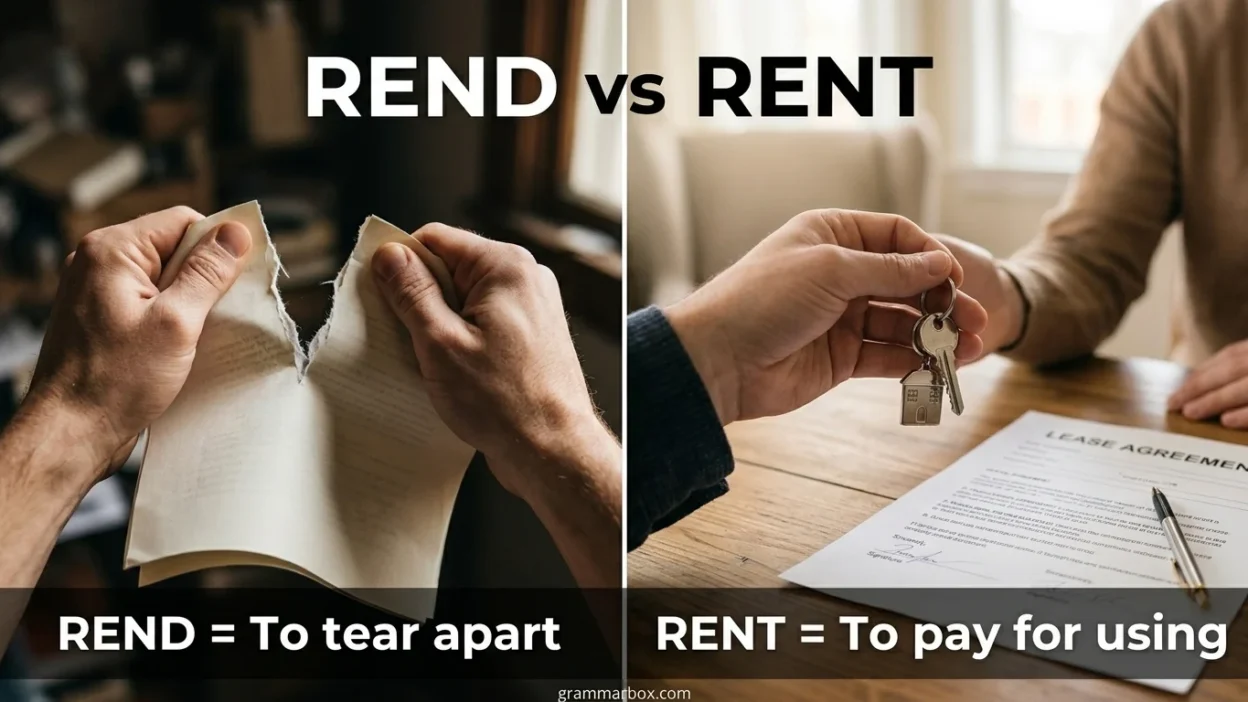
English contains many words that look or sound similar but have completely different meanings. Rend vs rent is one such confusing pair. Although these words differ by only one letter, they describe entirely different actions. One relates to tearing or pulling something apart, while the other commonly refers to paying for or allowing someone to use property.
If you have ever wondered if to write rend or rent, you are not alone. These words can confuse students, ESL learners, writers, and even native English speakers, especially when encountering less common vocabulary. Understanding their definitions, grammatical forms, and sentence structures will help you choose the correct word. In this guide, we will explain the difference between rend and rent, explore their meanings, provide practical examples, and share simple memory tricks to help you remember them.
Quick Answer: Rend vs Rent
Rend means to tear, split, or pull something apart, often with force. Rent usually means to pay money to use property or equipment temporarily. It can also mean to lease something to another person. Although their spelling is similar, their meanings and uses are different.
Why People Confuse It
People confuse rend and rent because they have nearly identical spellings. Both words contain the letters R, E, and N, with only the final letter changing. This small spelling difference can make them difficult to distinguish when reading or writing.
Another reason is that both words can function as verbs. However, their meanings, grammatical uses, and sentence contexts are completely different.
Here are some common reasons for the confusion:
- Similar spelling: Both words begin with the same three letters.
- Verb usage: Both can describe actions performed by someone.
- Unfamiliar vocabulary: Rend is less common in everyday conversations than rent.
- Different contexts: Rent is frequently used in housing and business, while rend often appears in literature and descriptive writing.
Understanding their definitions makes it much easier to use each word correctly.
First Word: Rend
Rend is a verb that means to tear, rip, or split something apart with force. It often describes physical damage to an object, material, or surface.
The word can also describe emotional pain or destruction, particularly in literary and figurative expressions.
Meaning of Rend
According to its common usage, rend means to separate something by tearing it forcefully.
For example:
- The strong wind could rend the old flag.
- The animal tried to rend the fabric with its claws.
- The heartbreaking news seemed to rend her heart.
Grammatical Forms of Rend
Rend is an irregular verb, so its past-tense forms do not follow the usual -ed pattern.
| Verb Form | Word |
|---|---|
| Base form | Rend |
| Third-person singular | Rends |
| Past tense | Rent |
| Past participle | Rent |
| Present participle | Rending |
Important: The past tense and past participle of rend are both rent. This is one reason the two words can be confusing.
When to Use Rend
Use rend when you want to describe:
- Tearing something apart forcefully.
- Splitting or ripping a material.
- Causing severe physical damage.
- Describing emotional suffering in figurative language.
- Expressing destruction in literary writing.
Examples:
- The explosion could rend the metal structure.
- His grief seemed to rend his soul.
- The sharp claws can rend thick leather.
Second Word: Rent
Rent is a word with several meanings. As a verb, it commonly means paying money to use someone else’s property, such as a house, apartment, office, or vehicle, for a specific period.
It can also mean allowing someone to use your property in exchange for payment.
As a noun, rent refers to the money paid for using a property or another item.
Meaning of Rent
Rent has two common grammatical uses:
1. Rent as a Verb
It means to pay for temporary use of property, equipment, or another item.
Examples:
- We rent an apartment near the university.
- She wants to rent a car for her vacation.
- They rent their office space to a small business.
2. Rent as a Noun
It means the payment made for using property or equipment.
Examples:
- My monthly rent is affordable.
- The landlord increased the rent this year.
- We need to pay the rent before Friday.
Grammatical Forms of Rent
When rent is used as a regular verb, its forms follow the standard -ed pattern.
| Verb Form | Word |
|---|---|
| Base form | Rent |
| Third-person singular | Rents |
| Past tense | Rented |
| Past participle | Rented |
| Present participle | Renting |
When to Use Rent
Use rent when discussing:
- Paying to live in a house or apartment.
- Temporarily using a car or other equipment.
- Leasing property to another person.
- Monthly housing payments.
- Rental agreements and property arrangements.
Examples:
- I plan to rent a house next month.
- They rented a car for their business trip.
- The landlord rents several apartments.
- Our rent is due at the beginning of each month.
Rend vs Rent: Comparison Table
Although rend and rent look almost identical, their meanings and grammatical forms are different. The following table highlights their main differences.
| Feature | Rend | Rent |
|---|---|---|
| Part of speech | Verb | Noun and verb |
| Main meaning | To tear or split apart | To pay for temporary use or lease something |
| Past tense | Rent | Rented |
| Past participle | Rent | Rented |
| Present participle | Rending | Renting |
| Common context | Tearing, destruction, emotional pain | Housing, property, equipment |
| Everyday usage | Less common | Very common |
| Example | The fabric may rend. | We rent a house. |
Key difference: Rend describes tearing something apart, whereas rent usually relates to leasing property or paying for temporary use.
When to Use Each
Choosing between rend and rent becomes easier when you understand the situation you are describing.
Use Rend When Something Is Torn Apart
Choose rend when describing forceful tearing, ripping, or splitting.
Examples:
- The powerful storm may rend the roof.
- The sharp object could rend the material.
- His emotional pain seemed to rend his heart.
In these sentences, the word describes physical or emotional destruction.
Use Rent When Discussing Property or Payment
Choose rent when talking about leasing something or paying to use it temporarily.
Examples:
- We rent a small apartment.
- She rented a bicycle for the afternoon.
- The monthly rent is increasing.
In these examples, rent relates to temporary use and payment.
Remember the Context
A useful way to distinguish them is to look at the surrounding words.
- If the sentence involves tearing, ripping, or destruction, use rend.
- If the sentence involves apartments, houses, landlords, payments, or leasing, use rent.
Examples of Rend vs Rent in Sentences
The following examples show how both words work in everyday and descriptive English.
Examples of Rend
- The wild animal used its claws to rend the thick fabric.
- The powerful explosion could rend the walls of the building.
- The storm threatened to rend the old sail.
- His tragic loss seemed to rend his heart.
- The sharp branches can rend your clothing.
- The machine was strong enough to rend the metal sheet.
- The fierce wind began to rend the damaged tent.
- The heartbreaking story could rend anyone’s heart.
- The workers watched the old material rend under pressure.
- The creature attempted to rend its prey apart.
Examples of Rent
- We rent a comfortable apartment near the city center.
- My brother wants to rent a car for his holiday.
- They rented a small office for their new business.
- The landlord collects rent at the beginning of every month.
- How much rent do you pay for your apartment?
- She is renting a room while attending university.
- We rented a bicycle to explore the town.
- The company rents equipment to construction workers.
- They plan to rent a house near the beach.
- Our monthly rent increased last year.
Examples Showing Both Words
These examples demonstrate the difference more clearly.
- The sharp claws could rend the fabric, but we decided to rent a sewing machine to repair it.
- The storm threatened to rend the tent, so we decided to rent a stronger shelter.
- The animal could rend the material, while the family continued to rent a house nearby.
Common Mistakes
Even though rend and rent have different meanings, their similar spelling can lead to several writing mistakes.
Here are some common errors to avoid.
1. Using Rent Instead of Rend
Incorrect: The powerful wind could rent the flag.
Correct: The powerful wind could rend the flag.
Explanation: The sentence describes tearing the flag, so rend is the appropriate word.
2. Using Rend Instead of Rent
Incorrect: We want to rend an apartment near the school.
Correct: We want to rent an apartment near the school.
Explanation: The sentence discusses paying to use an apartment temporarily, so rent is correct.
3. Confusing Their Past Tense Forms
The past tense of rend is rent, while the past tense of the leasing verb rent is rented.
Examples:
- The fabric rent under pressure. (Past tense of rend)
- We rented a car yesterday. (Past tense of rent)
This distinction is particularly important because the same spelling can represent different verbs.
4. Forgetting That Rent Is Also a Noun
Some learners believe rent is only a verb. However, it is also a noun.
Incorrect: My monthly rented is expensive.
Correct: My monthly rent is expensive.
Explanation: Rent is the noun referring to the payment made for using a property.
Memory Trick: How to Remember Rend vs Rent
A simple memory trick can help you distinguish these words without memorizing complicated definitions.
Remember REND = RIP
Both words relate to tearing something apart.
For example:
- Rend the paper.
- Rend the fabric.
- Rend the material.
Remember RENT = RENTAL
Both words relate to paying for temporary use of something.
For example:
- Rent a house.
- Rent a car.
- Pay the rent.
One Easy Sentence to Remember
Rend means rip, while rent means rental payment.
If you remember this simple connection, you will be less likely to confuse these words in your writing.
American vs British English
The meanings of rend and rent are generally the same in American and British English. Neither word has a major regional spelling difference.
However, their usage and frequency can vary depending on the context.
Rend in American and British English
Both American and British English use rend to describe tearing, splitting, or pulling something apart.
Examples:
- American English: The explosion could rend the structure.
- British English: The explosion could rend the structure.
The spelling and meaning remain unchanged.
Rent in American and British English
Rent is also used in both varieties of English to describe leasing property or paying for temporary use.
Examples:
- American English: We rent an apartment in Chicago.
- British English: We rent a flat in London.
One noticeable difference is that Americans commonly use apartment, while British speakers often use flat.
However, the word rent itself remains the same.
Remember: Rend and rent have the same spelling and basic meanings in both American and British English.
Similar Words
Learning related vocabulary can help you understand the difference between rend and rent more effectively.
Here are some words with similar meanings.
| Word | Meaning | Example |
|---|---|---|
| Rip | To tear something apart | Do not rip the paper. |
| Tear | To pull something into pieces | She tore the letter. |
| Split | To divide into parts | The wood split in half. |
| Shred | To cut or tear into small pieces | Shred the old documents. |
| Lease | To rent property under an agreement | They lease an office. |
| Hire | To pay to use something temporarily | We hired a car. |
| Rental | Something available for rent or the act of renting | The rental property is available. |
| Let | To allow someone to rent property | They let their apartment. |
Note: Rip, tear, split, and shred are related to rend. Lease, hire, and let are associated with renting, although their precise meanings and regional usage can differ.
FAQs:
1. What Is the Difference Between Rend and Rent?
Rend means to tear, rip, or split something apart with force. Rent usually means to pay for temporary use of property or equipment. Rent can also refer to the money paid for that use.
2. Is Rend a Real English Word?
Yes, rend is a real English word. It is an irregular verb that means to tear, rip, or pull something apart forcefully. It is commonly found in literary, descriptive, and formal writing.
3. Is Rent the Past Tense of Rend?
Yes. Rent is the past tense and past participle of rend.
For example: “The cloth rent when I pulled it.”
However, rented is the past tense of the regular verb rent, meaning to lease or pay for temporary use.
4. What Is the Past Tense of Rent?
The past tense of rent, when referring to leasing or paying for something, is rented.
Example: “We rented a house last summer.”
Do not confuse it with rent, which is the past tense of rend.
5. Can Rent Be Used as a Noun?
Yes. Rent can function as both a noun and a verb.
As a noun, it refers to the payment made for using property. As a verb, it describes the act of leasing something or paying to use it temporarily.
6. Is Rend Commonly Used in Everyday English?
No. Rend is relatively uncommon in everyday conversations. It appears more frequently in literature, formal descriptions, and figurative expressions involving tearing or emotional suffering.
7. Are Rend and Rent Pronounced the Same Way?
No. In standard English pronunciation, rend ends with a /d/ sound, while rent ends with a /t/ sound. Their similar spelling can cause confusion, but their final consonant sounds are different.
Final Verdict
Choosing between rend and rent depends entirely on your intended meaning. Rend is the correct choice when describing something being torn, ripped, or pulled apart. It is especially useful in descriptive and literary writing. Its irregular past tense is rent, which is an important grammatical detail to remember.
On the other hand, rent is the appropriate word when discussing property, apartments, houses, vehicles, payments, or temporary use of something. It can function as both a noun and a verb, and its past tense is rented. By understanding their definitions, grammatical forms, and sentence contexts, you can confidently use both words without confusing them.
Remember This
- Rend = To tear, rip, or pull something apart.
- Rent = To pay for temporary use of something or lease it to someone.
- Rent = The past tense of rend.
- Rented = The past tense of the verb rent (lease or pay for temporary use).
- Rending = The present participle of rend.
Quick tip: If you mean ripping something apart, crend. If you mean leasing a house or paying for temporary use, choose rent.