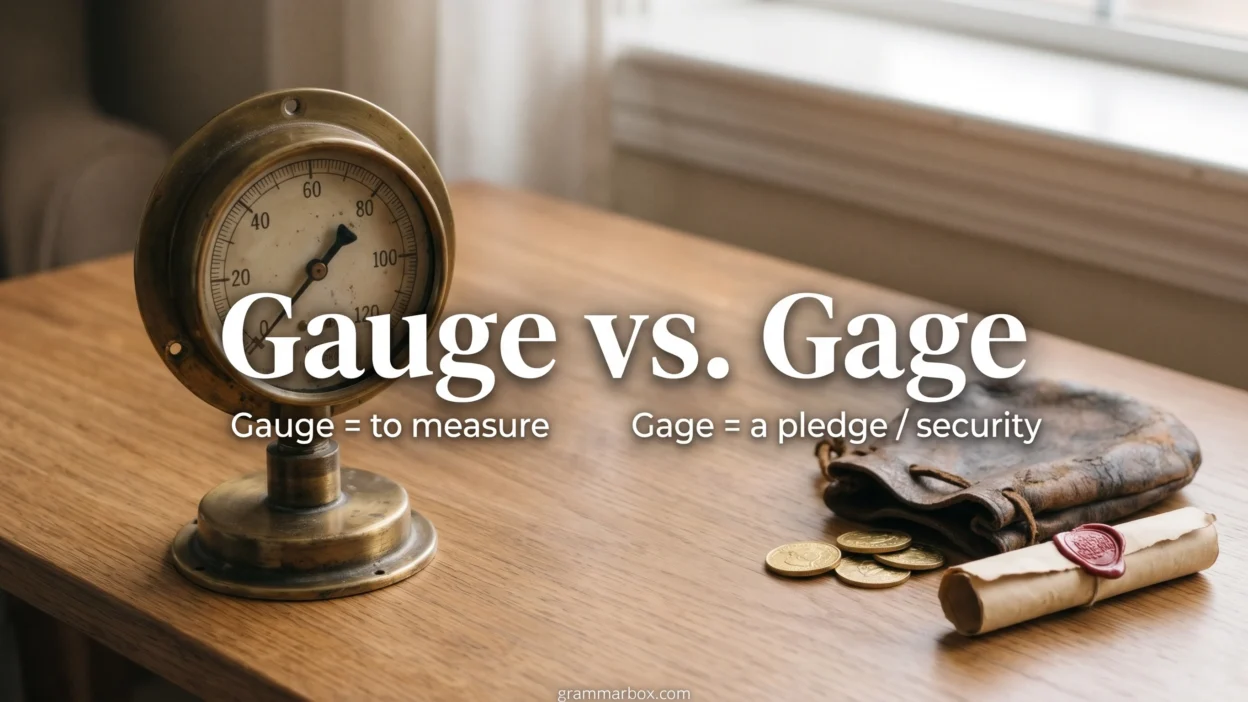
Have you ever wondered whether to write gauge or gage? These two words look almost identical and are often used in similar contexts, which makes it difficult to know which spelling is correct. If you are writing about measuring pressure, checking thickness, or evaluating someone’s feelings, choosing the right word can make your sentence clearer and more professional. Although both spellings are recognized in English, they are not equally common in everyday writing.
The main difference between gauge vs. gage is that gauge is the standard and widely accepted spelling in most situations, while gage is a less common variant. Gauge can function as a noun or verb, referring to a measuring instrument or the act of estimating something. Gage can also have these meanings, but it appears less frequently. Understanding their meanings, examples, and regional usage will help you choose the appropriate spelling and avoid common grammar mistakes.
Quick Answer
Gauge is the preferred spelling in modern English. It refers to a measuring instrument, measurement, or the act of estimating something. Gage is an accepted but less common variant, particularly in certain technical and specialized contexts. When in doubt, use gauge.
Why People Confuse Gauge and Gage
People often confuse these words because they have similar spellings and pronunciations. Both can refer to measuring instruments or the process of estimating something.
There are several reasons behind this confusion:
- Similar pronunciation: Both words are generally pronounced the same way.
- Related meanings: They can both refer to measurement or estimation.
- Spelling variations: English sometimes preserves alternative spellings of the same word.
- Technical usage: Some industries and specialized fields use gage in particular terms.
- Historical development: Both spellings have existed in English for centuries.
The easiest way to avoid confusion is to remember that gauge is the standard spelling for general writing.
Gauge
Gauge is the standard spelling in modern English. It can be used as both a noun and a verb.
Gauge as a Noun
As a noun, gauge refers to an instrument or device used to measure the amount, level, thickness, pressure, or size of something.
Examples include:
- A pressure gauge measures pressure inside a system.
- A fuel gauge shows how much fuel remains in a vehicle.
- A temperature gauge indicates temperature.
- A tire pressure gauge checks the air pressure in tires.
Example sentences:
- The mechanic checked the tire pressure with a digital gauge.
- The pressure gauge showed that the machine was operating normally.
- My car’s fuel gauge indicates that the tank is almost empty.
- The engineer used a thickness gauge to inspect the metal sheet.
- The railway uses a specific track gauge to determine the distance between rails.
Gauge as a Verb
As a verb, gauge means to measure, estimate, assess, or judge something.
It is commonly used when someone wants to understand a situation, reaction, amount, or level.
Example sentences:
- It is difficult to gauge his reaction to the news.
- The teacher tried to gauge the students’ understanding of the lesson.
- We need to gauge the project’s progress before making changes.
- The company conducted a survey to gauge customer satisfaction.
- She looked at the sky to gauge the possibility of rain.
Remember: Use gauge when referring to measuring devices or estimating and evaluating something.
Gage
Gage is an alternative spelling of gauge. It is recognized in English, but it is considerably less common in general writing.
It can function as both a noun and a verb, carrying meanings similar to gauge.
Gage as a Noun
As a noun, gage can refer to a measuring instrument or device.
Example sentences:
- The technician checked the equipment using a specialized gage.
- The machinist selected the correct gage for the measurement.
- The inspection report mentioned a precision gage.
- The manufacturer supplied a new measuring gage.
- The operator examined the gage before starting the machine.
Gage as a Verb
As a verb, gage can mean to measure, estimate, or assess something.
Example sentences:
- The engineer needed to gage the machine’s performance.
- It was difficult to gage the actual cost of the project.
- The manager tried to gage employee satisfaction.
- We must gage the situation before making a decision.
- She wanted to gage how much support the proposal would receive.
Although these sentences are understandable, gauge would generally be the better spelling choice in modern everyday English.
Gauge vs. Gage: Comparison Table
The following table highlights the main differences between these two spellings.
| Feature | Gauge | Gage |
|---|---|---|
| Meaning | To measure, estimate, or assess | To measure, estimate, or assess |
| Part of speech | Noun and verb | Noun and verb |
| Pronunciation | /ɡeɪdʒ/ | /ɡeɪdʒ/ |
| Common usage | Very common | Less common |
| Standard spelling | Preferred | Alternative spelling |
| Measuring device | Yes | Yes |
| Estimating something | Yes | Yes |
| General writing | Recommended | Usually avoided |
| Technical writing | Widely used | Used in some specialized contexts |
Key takeaway: Both spellings can be correct, but gauge is the safer and more widely accepted choice.
When to Use Each
Choosing between gauge and gage depends on the context and the writing style you are following.
When to Use Gauge
Use gauge in most everyday, academic, professional, and technical writing.
Choose this spelling when:
- Referring to a pressure-measuring instrument.
- Describing a vehicle’s fuel or temperature indicator.
- Discussing the thickness or diameter of a material.
- Estimating someone’s feelings or reaction.
- Evaluating performance, progress, or customer satisfaction.
- Writing articles, reports, emails, or educational content.
Examples:
- We installed a new pressure gauge.
- The survey helped us gauge public opinion.
- The doctor used a special instrument to measure the patient’s condition.
When to Use Gage
Use gage when:
- Following a technical document that consistently uses this spelling.
- Referring to an established product or industry-specific term written as gage.
- Preserving the original spelling in a quotation or historical document.
- Following a particular organization’s terminology or style guide.
Examples:
- The technician inspected the precision gage.
- The company ordered a replacement gage.
- The manufacturing manual refers to a specific gage.
Practical advice: Unless you have a specific reason to write gage, choose gauge. It is more familiar to readers and is the preferred spelling in most contexts.
Examples of Gauge vs. Gage in Sentences
Seeing both spellings in context makes their usage easier to understand.
| Gauge Examples | Gage Examples |
|---|---|
| The pressure gauge needs replacement. | The technician inspected the pressure gage. |
| She used a gauge to measure the thickness. | The machinist selected the correct gage. |
| I checked the fuel gauge before driving. | The operator examined the measuring gage. |
| We need to gauge the situation carefully. | We need to gage the situation carefully. |
| The survey helped gauge customer satisfaction. | The survey helped gage customer satisfaction. |
| The temperature gauge is not working. | The temperature gage needs inspection. |
| He tried to gauge her reaction. | He tried to gage her reaction. |
| The engineer checked the pressure gauge. | The engineer checked the pressure gage. |
| The company wants to gauge market demand. | The company wants to gage market demand. |
| The instrument has a digital gauge. | The instrument has a digital gage. |
| The mechanic replaced the faulty gauge. | The mechanic replaced the faulty gage. |
| We used a gauge to check the material. | We used a gage to check the material. |
Although both columns demonstrate recognized spelling variations, the gauge examples are generally more suitable for modern standard writing.
Common Mistakes
Writers sometimes use gauge and gage interchangeably without considering their differences in frequency and standard usage.
Here are some common mistakes to avoid:
1. Assuming Gage Is Always Incorrect
Gage is not necessarily a misspelling. It is an accepted alternative spelling, although it is less common than gauge.
Incorrect assumption: Gage is never a real English word.
Better understanding: Gage is recognized, but gauge is generally preferred.
2. Using Both Spellings in the Same Document
Switching between gauge and gage can make your writing look inconsistent.
Inconsistent:
- The pressure gauge is broken.
- The technician replaced the pressure gage.
Better:
- The pressure gauge is broken.
- The technician replaced the pressure gauge.
3. Confusing Gauge With a Specific Measurement
Gauge can refer to a measuring device or a measurement standard, but it does not always describe an exact measurement by itself.
For example:
- The wire has a 12-gauge thickness.
- The mechanic checked the pressure gauge.
The first sentence describes a measurement classification, while the second refers to an instrument.
4. Thinking Both Spellings Are Equally Common
Although both spellings are recognized, they do not have equal popularity.
For general writing, gauge is the more natural and widely understood option.
Memory Trick: How to Remember Gauge vs. Gage
A simple memory trick can help you remember which spelling to use.
Remember: Gauge is the go-to spelling.
Think of these common expressions:
- Pressure gauge
- Fuel gauge
- Temperature gauge
- Wire gauge
- Pressure gauge reading
These familiar combinations use gauge.
You can also remember this simple rule:
G = Gauge for General Writing.
Whenever you are unsure whether to use gauge or gage, choose gauge. It is the standard spelling in most everyday situations.
American vs. British English
One common misconception is that gauge is exclusively American English and gage is exclusively British English. This is not accurate.
Both American and British English recognize the spelling gauge.
| English Variety | Preferred Spelling | Alternative |
|---|---|---|
| American English | Gauge | Gage |
| British English | Gauge | Gage |
| Canadian English | Gauge | Gage |
| Australian English | Gauge | Gage |
American English
In American English, gauge is the standard spelling in general writing.
For example:
- Check the tire pressure gauge.
- The company wants to gauge customer interest.
Gage also appears in some American technical and industrial contexts.
British English
British English also generally prefers gauge.
For example:
- The pressure gauge needs checking.
- We need to gauge public opinion.
The spelling difference is not a straightforward American-versus-British distinction. Instead, it is mainly a matter of spelling preference and specialized usage.
Important: If you are writing for an international audience, gauge is the safest choice.
Similar Words
Several English words are related to measuring, estimating, or evaluating something. Understanding them can help expand your vocabulary.
| Word | Meaning | Example |
|---|---|---|
| Measure | To find the size, amount, or degree of something | Measure the length of the table. |
| Assess | To evaluate or judge something | The teacher will assess your progress. |
| Estimate | To calculate an approximate amount | We estimate the total cost. |
| Evaluate | To examine the quality or value of something | The manager will evaluate the results. |
| Calculate | To determine something mathematically | Calculate the final amount. |
| Determine | To establish or discover something | We need to determine the correct size. |
| Monitor | To observe or check something over time | Monitor the pressure regularly. |
| Inspect | To examine something carefully | Inspect the equipment before use. |
| Gauge | To measure or estimate something | Gauge the audience’s reaction. |
| Gage | An alternative spelling of gauge | The technician used a measuring gage. |
These words are not always interchangeable, but they can be useful alternatives depending on the sentence.
FAQs:
1. Is Gauge or Gage Correct?
Both gauge and gage are recognized English spellings. However, gauge is the standard and more widely used spelling. Gage is a less common alternative, particularly in some technical contexts.
2. What Is the Difference Between Gauge and Gage?
The main difference is spelling frequency and preference. Both can refer to a measuring instrument or the act of measuring and estimating something. Gauge is generally preferred in modern English.
3. Is Gage a Real Word?
Yes, gage is a real English word. It is an accepted spelling variant of gauge. However, it is less common in everyday writing.
4. Is Gauge American or British English?
Gauge is used in both American and British English. It is not exclusive to either variety. Both recognize gage as an alternative spelling.
5. How Do You Pronounce Gauge and Gage?
Both words are pronounced the same way: /ɡeɪdʒ/. The pronunciation sounds like the word “page” with a G at the beginning.
6. Should I Write Pressure Gauge or Pressure Gage?
You should generally write pressure gauge. This is the standard and widely recognized spelling. Pressure gage also appears in certain technical contexts, but pressure gauge is the safer choice.
7. Can Gauge Be Used as a Verb?
Yes. Gauge can be used as a verb meaning to measure, estimate, assess, or judge something.
For example: “The manager tried to gauge customer satisfaction before launching the product.”
Final Verdict
The choice between gauge and gage becomes simple once you understand their meanings and usage. Both are recognized English spellings, and both can function as nouns and verbs. However, gauge is significantly more common and is the preferred spelling in most modern English writing. It is used for measuring instruments, pressure readings, material thickness, and estimating situations or reactions.
Gage is not necessarily wrong, but it is less familiar to general readers and is usually found in specific technical or specialized contexts. If you are writing an academic paper, professional email, educational article, or everyday sentence, gauge is the best choice. When in doubt, stick with gauge to keep your writing clear, consistent, and natural.
Remember This
- Gauge: The standard and preferred spelling in modern English.
- Gage: An accepted but less common alternative spelling.
- Pronunciation: Both words sound the same.
- Meaning: Both can refer to measuring or estimating something.
- Best choice: Use gauge in everyday, academic, and professional writing.
Simple rule: When you are unsure, always choose GAUGE!