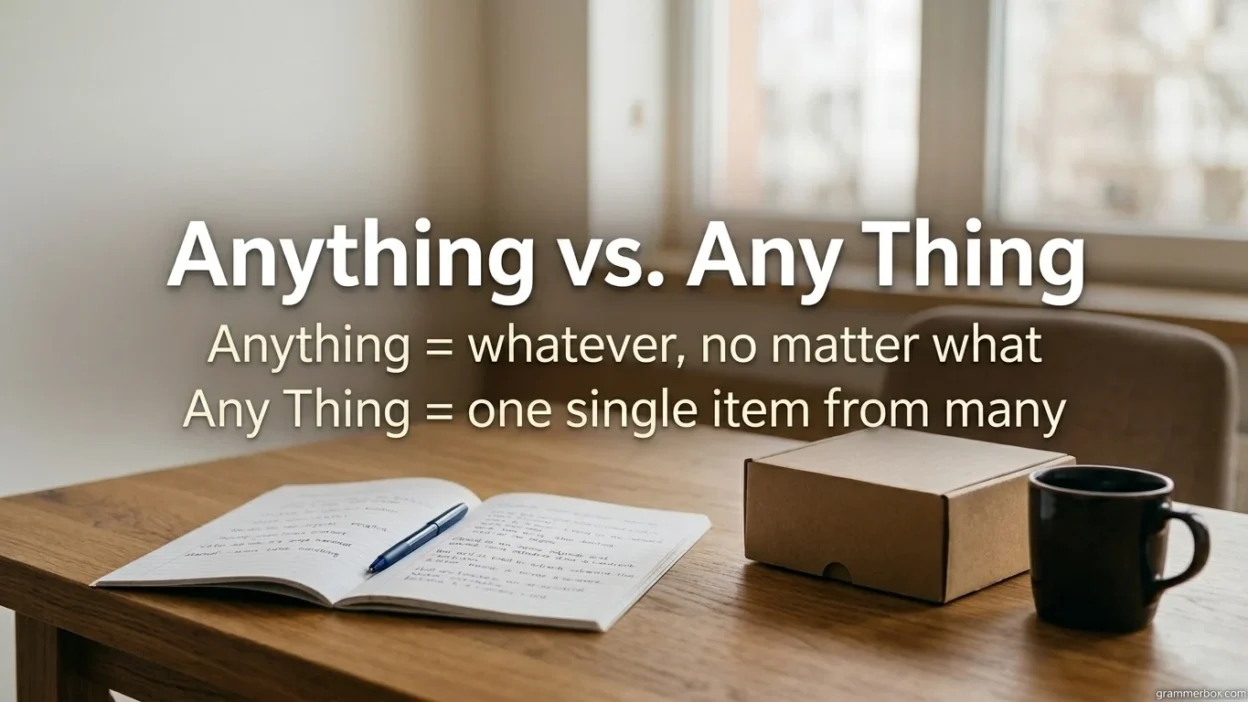
English has many word combinations that look almost identical but follow different grammar rules. Anything vs. any thing is one example that often confuses students, ESL learners, writers, and even fluent English speakers. Although both expressions are grammatically correct, they do not always communicate the same meaning.
The main difference is that anything is an indefinite pronoun meaning “something,” “whatever,” or “no matter what.” In contrast, any thing is a combination of a determiner and a noun. It refers to any individual object, item, or specific thing. Understanding this small spelling difference can help you write more naturally and avoid common grammar mistakes. Whether you are writing an academic assignment, sending a professional email, or having an everyday conversation, knowing when to use each expression will make your English clearer and more accurate.
Quick Answer
Anything is one word and works as an indefinite pronoun referring to any object, matter, or possibility. Any thing is two words and refers to any individual thing or item. Use anything in most everyday sentences, but choose any thing when you specifically emphasize an individual object.
Why People Confuse It
People often confuse anything and any thing because both expressions contain the same two elements: any and thing. They also sound almost identical when spoken, making the difference difficult to recognize in everyday conversations.
However, their grammatical functions are different.
Here are the main reasons for the confusion:
- Similar pronunciation: Both expressions usually sound the same when spoken.
- Related meanings: Both can refer to objects, matters, or possibilities.
- Different grammatical structures: Anything is an indefinite pronoun, while any thing contains a determiner and a noun.
- Writing habits: Many people automatically combine or separate the words without considering their meaning.
The easiest way to understand the difference is to examine how each expression works in a sentence.
First Word: Anything
Anything is an indefinite pronoun that refers to an object, event, matter, or possibility without identifying it specifically.
It is commonly used in questions, negative statements, and conditional sentences. It can also appear in affirmative sentences when expressing unrestricted possibilities.
Examples of Anything in Sentences
- You can ask me anything about English grammar.
- I don’t need anything from the grocery store.
- Is there anything I can do to help?
- She can achieve anything with enough determination.
- Did you hear anything unusual last night?
- We didn’t find anything interesting at the museum.
- You can choose anything from the menu.
- He would do anything to protect his family.
- I couldn’t see anything in the darkness.
- Is anything wrong with your computer?
When to Use Anything
Use anything when:
- You are referring to an unspecified object or matter.
- You are asking whether something exists.
- You are making a negative statement.
- You are expressing unlimited possibilities.
- You want to say that no particular choice or restriction applies.
Grammar Tip: Anything is already a complete pronoun. You generally do not need to add another noun immediately after it.
For example:
- Correct: I don’t want anything.
- Incorrect: I don’t want anything item.
Second Word: Any Thing
Any thing consists of two separate words: the determiner any and the noun thing.
It refers to any individual object, item, or matter. This expression is less common than anything in everyday English because writers usually prefer the one-word form when referring to something generally.
However, separating the words can be useful when you want to emphasize the individual nature of an object or distinguish one thing from another.
Examples of Any Thing in Sentences
- You can take any thing from this collection.
- I don’t believe any thing can replace genuine friendship.
- She was willing to try any thing that might solve the problem.
- Any thing made from recycled materials can be useful.
- He didn’t want any thing associated with the previous project.
- You can choose any thing that meets your requirements.
- Any thing of historical importance should be preserved.
- I wouldn’t exchange this experience for any thing in the world.
- Any thing that causes unnecessary trouble should be avoided.
- We should not throw away any thing that can be reused.
Important Usage Note
Some of these sentences could also be written with anything without changing their basic meaning.
For example:
- You can take anything from this collection.
- You can take any thing from this collection.
The first version is the natural, standard choice in ordinary writing. The second places more emphasis on the individual word thing and may sound unusual without a particular reason for separating it.
When to Use Any Thing
Use any thing when:
- You specifically want to emphasize the noun thing.
- You are distinguishing an individual object from other objects.
- The surrounding sentence makes the separate noun meaningful.
- You are discussing things as individual items rather than using an indefinite pronoun.
Comparison Table
The following table highlights the important differences between anything and any thing.
| Feature | Anything | Any Thing |
|---|---|---|
| Spelling | One word | Two words |
| Grammar | Indefinite pronoun | Determiner + noun |
| Meaning | Any object or matter | Any individual thing |
| Usage | Very common | Less common |
| Questions | Yes | Possible |
| Negative sentences | Very common | Possible |
| Everyday English | Preferred | Usually unnecessary |
| Example | I didn’t see anything. | Any thing can be useful. |
When to Use Each
Choosing between anything and any thing becomes easier when you understand the purpose of your sentence.
Use Anything for General References
When you refer to something without identifying a particular object, anything is usually the correct choice.
Examples:
- You can tell me anything.
- I haven’t eaten anything today.
- Is there anything available?
- She doesn’t want anything expensive.
Use Anything in Questions
Anything commonly appears in questions when asking about an unspecified object, event, or possibility.
Examples:
- Did you buy anything?
- Is anything missing?
- Would you like anything to drink?
Use Anything in Negative Sentences
Anything is frequently used with negative words such as don’t, didn’t, cannot, and never.
Examples:
- I don’t know anything about that subject.
- They didn’t find anything useful.
- He never says anything interesting.
Use Any Thing for Special Emphasis
When you want to emphasize the noun thing as an individual object, separating the words may be appropriate.
Examples:
- Any thing you find in this box should be returned.
- Any thing made of glass needs careful handling.
Remember that these constructions are relatively uncommon. In most situations, the one-word spelling sounds more natural.
Examples of Anything vs. Any Thing
Here are 15 examples to help you understand how both expressions work in different contexts.
Examples Using Anything
- I can eat anything except seafood.
- She didn’t tell me anything about her plans.
- Is there anything interesting on television?
- You can contact me anytime if you need anything.
- He would never do anything dishonest.
- We need anything that can help us finish this project.
- Did anyone leave anything behind?
- Nothing is more important than family, but anything can happen.
Examples Using Any Thing
- Any thing found on the property must be reported.
- You may select any thing from the display.
- Any thing made of paper should be kept away from water.
- She refused to accept any thing that was not properly documented.
- Any thing belonging to the school must be returned.
- He was willing to consider any thing that could improve the situation.
- Any thing of value should be stored securely.
Notice: Several sentences using any thing can be rewritten with anything. The separated version is most useful when the writer has a specific reason to emphasize the noun thing.
Common Mistakes
Even experienced English writers sometimes use these expressions incorrectly. Here are some mistakes worth avoiding.
1. Using Any Thing in Ordinary Sentences
Incorrect or unnatural: I don’t want any thing.
Better: I don’t want anything.
The one-word spelling is the natural choice when using an indefinite pronoun.
2. Treating Anything as an Adjective
Incorrect: Anything book is available.
Correct: Any book is available.
Anything is a pronoun, not a determiner that directly describes another noun.
3. Adding an Unnecessary Noun
Incorrect: She didn’t buy anything clothes.
Correct: She didn’t buy any clothes.
Use anything independently or use any before a suitable noun.
4. Assuming Both Spellings Are Always Interchangeable
Although both expressions can communicate similar ideas, they have different grammatical structures.
- Anything = indefinite pronoun.
- Any thing = determiner + noun.
Always consider the sentence structure before choosing a spelling.
Memory Trick
A simple memory trick can help you remember the difference between anything and any thing.
Anything = One Word, General Meaning
Think of anything as one complete word that refers to an unspecified object, matter, or possibility.
Example: You can ask me anything.
Any Thing = Two Words, Individual Object
Think of any thing as any + thing, where thing is an actual noun referring to an individual object or matter.
Example: Any thing made of wood can be damaged by fire.
Easy Rule: If you mean something in a general sense, use anything. If you deliberately want to emphasize an individual thing, consider any thing.
American vs. British English
There is no meaningful spelling difference between American and British English when it comes to anything and any thing.
Both varieties use the same standard spelling and follow the same basic grammatical rules.
| Usage | American English | British English |
|---|---|---|
| Standard spelling | Anything | Anything |
| Separated form | Any thing | Any thing |
| General meaning | Same | Same |
| Grammar | Same | Same |
| Everyday preference | Anything | Anything |
Examples in American English:
- Do you need anything from the store?
- I didn’t hear anything unusual.
Examples in British English:
- Would you like anything from the shop?
- I haven’t noticed anything different.
Remember: The distinction depends on grammatical meaning, not geographical location. Both American and British writers generally prefer anything in ordinary communication.
Similar Words
Understanding other English word combinations can help you recognize how compound words and separate expressions work.
Here are some related examples:
| Word or Expression | Meaning |
|---|---|
| Something | An unspecified object or matter |
| Anything | Any object or possibility |
| Everything | All things |
| Nothing | Not anything |
| Anyone | Any person |
| Any one | One individual person or item |
| Everyone | Every person |
| Every thing | Each individual thing |
| Somebody | An unspecified person |
| Anyplace | Any location |
| Anywhere | In or to any place |
| Any time | At any time or occasion |
These examples demonstrate that English sometimes combines words into indefinite pronouns, while other constructions keep their words separate to emphasize individual meaning.
FAQs:
1. Is anything one word or two words?
Anything is written as one word. It is an indefinite pronoun that refers to an unspecified object, matter, or possibility. For example, “You can ask me anything.”
2. Is any thing grammatically correct?
Yes, any thing is grammatically correct when any functions as a determiner and thing functions as a noun. However, it is less common than anything and generally requires a specific reason for separating the words.
3. What is the difference between anything and any thing?
Anything is an indefinite pronoun referring to an unspecified object or possibility. Any thing consists of a determiner and a noun and emphasizes an individual thing or object.
4. Should I write anything or any thing in everyday English?
You should generally write anything in everyday English. It is the standard spelling when referring to an unspecified object, matter, or possibility.
5. Can anything be used in negative sentences?
Yes, anything is frequently used in negative sentences. For example, “I don’t know anything about the situation.” It commonly appears with negative verbs and expressions.
6. Is any thing the same as anything?
Not exactly. Their meanings can overlap, but their grammatical structures are different. Anything is a single pronoun, whereas any thing is a determiner followed by a noun.
7. Do American and British English use anything differently?
No. American and British English follow the same spelling and grammatical rules for anything and any thing. The one-word form is preferred in both varieties for ordinary usage.
Final Verdict
The difference between anything and any thing comes down to spelling, grammar, and meaning. Anything is an indefinite pronoun used to refer to an unspecified object, matter, or possibility. Any thing combines a determiner with the noun thing and is useful when you specifically want to emphasize an individual object or item. Although both forms are grammatically possible, anything is much more common in everyday English.
When writing emails, academic assignments, blog posts, or casual messages, anything will usually be your best choice. Use any thing only when separating the words serves a clear grammatical or stylistic purpose. Understanding this distinction will help you avoid unnecessary spelling mistakes and communicate more naturally.
Remember This
- Anything: One word, an indefinite pronoun referring to an unspecified object or possibility.
- Any Thing: Two words, a determiner followed by the noun thing.
- Everyday Usage: Anything is the preferred form in most situations.
- Grammar Rule: Separate any and thing only when you want to emphasize the individual noun.
The easiest rule to remember is that anything is normally one word, while any thing is reserved for special contexts.