Have you ever wondered if the correct spelling is masonry or masonary? These two words look almost identical, so it is easy to mix them up when writing about construction, brickwork, or building materials. However, only one is recognized as the standard English spelling. Knowing the difference can help you avoid spelling mistakes in professional documents, school assignments, construction reports, and everyday writing.
The confusion usually comes from pronunciation and the way English spelling patterns work. Many people naturally add an extra “a” when writing the word, producing masonary. Although this incorrect spelling appears in online searches and informal writing, it is not accepted in standard English dictionaries. In this guide, you will learn why masonry is correct, what it means, how to use it in sentences, and how to remember its spelling. We will also explore related construction terms and common mistakes.
Quick Answer
Masonry is the correct spelling, while masonary is a misspelling. Masonry refers to the construction technique of building structures with materials such as bricks, stones, and concrete blocks. Use masonry in professional, academic, and everyday English writing.
Why People Confuse It
People confuse masonry and masonary because their pronunciation and letter patterns seem similar. The word contains several syllables, and writers sometimes insert an extra “a” after the letter “n.”
Another reason is the relationship between the word mason and the noun masonry. Since people recognize the word mason, they may incorrectly assume that adding “-ary” creates the correct spelling.
However, the standard spelling follows a different pattern.
Here are some common reasons for the confusion:
- Similar pronunciation: Both spellings may look phonetically reasonable to inexperienced writers.
- Spelling assumptions: People sometimes add an extra vowel when forming longer words.
- Typing mistakes: Fast typing can lead to accidental letter substitutions.
- Limited familiarity: People who do not regularly write about construction may be unfamiliar with the word.
The important thing to remember is that masonry is the only correct standard spelling.
First Word: Masonry
Masonry is a noun that refers to the craft, technique, or work of building structures using individual units such as bricks, stones, and concrete blocks.
It can also describe the finished structure or the materials and construction work involved.
For example:
- The house features beautiful stone masonry.
- Masonry is an important part of traditional construction.
- The contractor specializes in brick masonry.
- The old building needs professional masonry repairs.
Meaning of Masonry
Masonry generally has three related meanings:
- Construction technique: The process of building structures using bricks, stones, or concrete blocks.
- Building work: The work performed by a mason or masonry contractor.
- Finished structure: A wall, building, or other structure made using masonry materials.
Origin of Masonry
The word masonry comes from Old French maçonnerie, which is related to maçon, meaning a mason or stoneworker.
It developed in English as the term for the work and craft of building with stone and similar materials.
Synonyms and Related Terms
Depending on the context, related terms include:
- Brickwork
- Stonework
- Construction
- Bricklaying
- Stone masonry
- Building work
- Concrete blockwork
These words are related to masonry, but they are not always interchangeable.
Second Word: Masonary
Masonary is an incorrect spelling of masonry. It does not have an accepted independent meaning in standard English.
Writers sometimes use it when referring to brick construction, stonework, or the profession of a mason. However, the intended word should always be masonry.
For example:
- Incorrect: The company provides professional masonary services.
- Correct: The company provides professional masonry services.
More examples:
- Incorrect: We hired a masonary contractor.
- Correct: We hired a masonry contractor.
- Incorrect: The masonary wall needs repairs.
- Correct: The masonry wall needs repairs.
Is Masonary Ever Correct?
No. Masonary is not the standard spelling in American English or British English.
Although you might encounter it on websites, advertisements, or informal documents, these occurrences are spelling errors rather than accepted regional variations.
If you are writing an article, business proposal, construction estimate, or academic paper, always use masonry.
Masonry vs Masonary: Comparison Table
| Feature | Masonry | Masonary |
|---|---|---|
| Spelling status | Correct | Incorrect |
| Part of speech | Noun | No standard usage |
| Meaning | Brick, stone, or block construction | No accepted meaning |
| Dictionary recognition | Standard English word | Misspelling |
| American English | Correct | Incorrect |
| British English | Correct | Incorrect |
| Professional usage | Accepted | Not accepted |
| Example | Masonry work | Masonary work (incorrect) |
The comparison is simple: masonry is correct, and masonary is incorrect.
When to Use Each
Understanding when to use these spellings is straightforward because only one is acceptable in standard English.
When to Use Masonry
Use masonry whenever you discuss construction involving bricks, stones, concrete blocks, or similar building materials.
Common situations include:
- Construction projects: The masonry work will begin next Monday.
- Building maintenance: The property requires masonry repairs.
- Architecture: The architect designed a beautiful masonry exterior.
- Professional services: We contacted a masonry contractor.
- Educational writing: Masonry is one of the oldest construction techniques.
When to Use Masonary
You should not use masonary in standard English writing.
If you encounter this spelling in an article, construction document, or online advertisement, it is generally a typographical or spelling error.
Replace it with masonry to make your writing accurate and professional.
Examples of Masonry vs Masonary in Sentences
Here are 12 examples showing the correct spelling and common incorrect usage.
- Correct: Masonry is widely used in residential construction.
Incorrect: Masonary is widely used in residential construction. - Correct: The contractor specializes in brick masonry.
Incorrect: The contractor specializes in brick masonary. - Correct: We need a professional masonry company for this project.
Incorrect: We need a professional masonary company for this project. - Correct: The old masonry wall has developed several cracks.
Incorrect: The old masonary wall has developed several cracks. - Correct: Stone masonry gives the building a traditional appearance.
Incorrect: Stone masonary gives the building a traditional appearance. - Correct: Masonry materials include bricks, stones, and concrete blocks.
Incorrect: Masonary materials include bricks, stones, and concrete blocks. - Correct: The workers completed the masonry foundation.
Incorrect: The workers completed the masonary foundation. - Correct: Proper masonry techniques can improve structural durability.
Incorrect: Proper masonary techniques can improve structural durability. - Correct: The school offers training in masonry construction.
Incorrect: The school offers training in masonary construction. - Correct: The building requires specialized masonry restoration.
Incorrect: The building requires specialized masonary restoration. - Correct: His father has worked in the masonry industry for 25 years.
Incorrect: His father has worked in the masonary industry for 25 years. - Correct: The company provides residential and commercial masonry services.
Incorrect: The company provides residential and commercial masonary services.
These examples demonstrate that masonry is the correct choice in every context.
Common Mistakes
Even experienced writers can make spelling mistakes with unfamiliar words. Here are some common errors associated with masonry.
1. Adding an Extra A
The most common mistake is writing masonary instead of masonry.
- Incorrect: Masonary work
- Correct: Masonry work
2. Confusing Mason and Masonry
A mason is a person who works with bricks, stones, or similar materials. Masonry refers to the craft or construction work itself.
For example:
- The mason repaired the wall.
- The masonry required careful attention.
3. Treating Masonary as a British Variation
Some people assume that masonary might be an alternative British spelling. It is not. British and American English both use masonry.
4. Using the Incorrect Spelling in Business Names
Construction businesses sometimes publish advertisements or service descriptions containing spelling errors.
For professional communication, use expressions such as:
- Masonry services
- Masonry contractor
- Masonry construction
- Masonry restoration
5. Forgetting the Correct Ending
The correct spelling ends in -ry, not -ary. Remembering this small detail can prevent repeated mistakes.
Memory Trick: How to Remember Masonry
The easiest way to remember masonry is to connect it with the word mason.
Think about this simple relationship:
Mason + ry = Masonry
A mason is the person who works with bricks and stones, while masonry is the craft or construction work.
You can also remember this short sentence:
A mason performs masonry work.
Notice that masonry does not contain an extra “a” between the “n” and “r.”
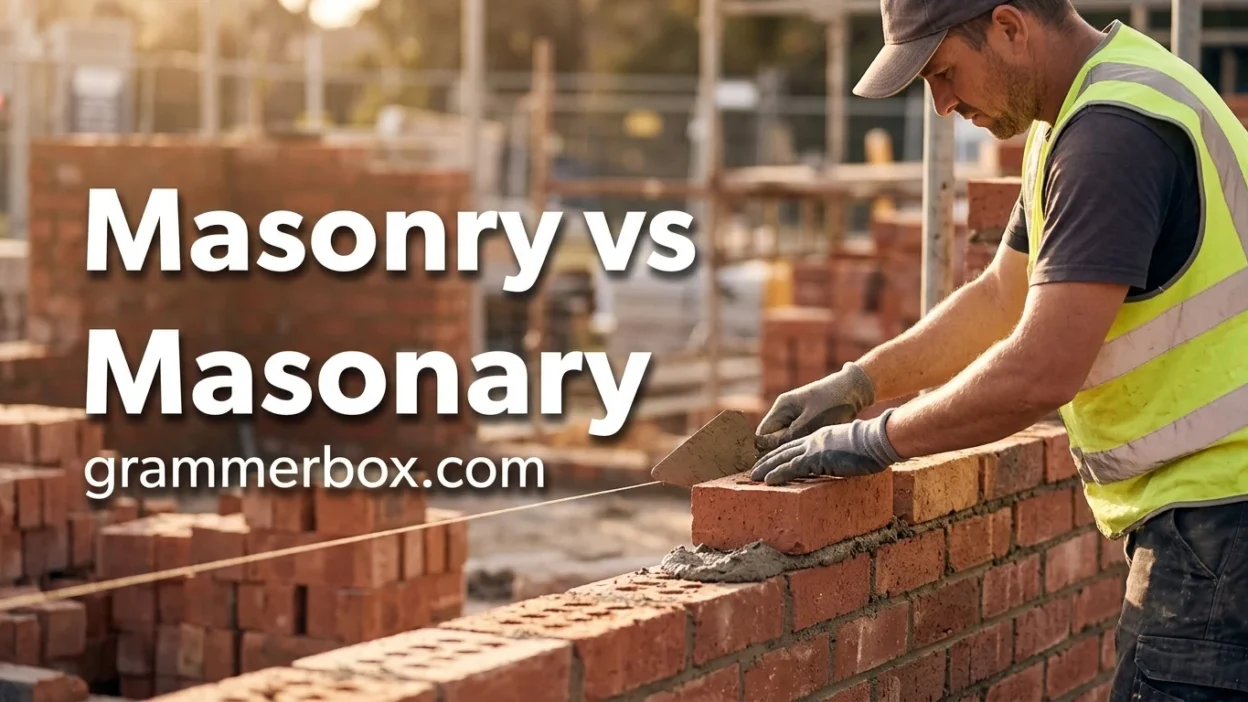
Whenever you are unsure about the spelling, think of a mason building a brick wall. This simple association will help you remember the correct word.
American vs British English
There is no spelling difference between American and British English when it comes to masonry.
Both varieties use the same spelling and meaning.
| English Variety | Correct Spelling | Incorrect Spelling |
|---|---|---|
| American English | Masonry | Masonary |
| British English | Masonry | Masonary |
| Canadian English | Masonry | Masonary |
| Australian English | Masonry | Masonary |
American English Examples
- The company offers professional masonry services.
- Masonry construction is common in many American buildings.
British English Examples
- The historic property features traditional stone masonry.
- The contractor specializes in masonry restoration.
The spelling remains the same regardless of the English variety you use.
Similar Words
Learning related words can help you understand masonry more clearly and expand your construction vocabulary.
Here are some useful terms:
| Word | Meaning |
|---|---|
| Mason | A skilled worker who builds with bricks or stones |
| Masonry | The craft or work of building with bricks, stones, or blocks |
| Brickwork | Construction or work involving bricks |
| Stonework | Construction or decorative work involving stone |
| Bricklayer | A person who lays bricks |
| Mortar | A mixture used to bind bricks or stones together |
| Concrete | A building material made from cement, water, and aggregates |
| Foundation | The structural base of a building |
| Construction | The process of building structures |
| Restoration | The process of repairing or returning something to its original condition |
These terms frequently appear in building projects, architecture, construction contracts, and home improvement discussions.
FAQs:
1. Is it masonry or masonary?
Masonry is the correct spelling. Masonary is a common misspelling and should not be used in standard English writing.
2. What does masonry mean?
Masonry refers to the craft, technique, or work of constructing structures using bricks, stones, concrete blocks, and similar materials.
3. Is masonary a real word?
No. Masonary is not recognized as a standard English word. It is generally a spelling mistake for masonry.
4. Is masonry correct in American English?
Yes. Masonry is the accepted spelling in American English and is commonly used in construction, architecture, and building-related documents.
5. Is masonry British or American spelling?
Masonry is used in both British and American English. There is no regional spelling difference between these varieties.
6. What is a person who does masonry called?
A person who performs masonry work is called a mason. A mason typically works with bricks, stones, concrete blocks, and mortar.
7. What is the difference between mason and masonry?
A mason is the person who performs the work, while masonry refers to the craft, technique, or construction work involving bricks, stones, and similar materials.
Final Verdict
When choosing between masonry and masonary, always use masonry. It is the only accepted standard spelling in English, regardless of whether you are writing in American, British, Canadian, or Australian English.
Masonry describes the craft and construction work involving bricks, stones, and concrete blocks. On the other hand, masonary is simply a misspelling without an accepted independent meaning. Remember that a mason performs masonry work, and you will have an easy way to avoid this common spelling mistake.
Remember This
- Masonry: Correct spelling and a noun referring to brick, stone, or block construction.
- Masonary: Incorrect spelling and not accepted in standard English.
- Mason: A skilled person who performs masonry work.
- American vs British English: Both use the spelling masonry.
The simple rule: Always write masonry, never masonary.
Conclusion
The difference between masonry and masonary is not a matter of meaning or regional spelling. It is simply a difference between a correct English word and a spelling mistake. Masonry is used when discussing brickwork, stone construction, building techniques, and professional construction services.
If you want to improve your English spelling, pay attention to small differences like this one. Remember the connection between a mason and masonry, practice using the correct spelling in sentences, and avoid adding an unnecessary “a.” With this simple trick, you can confidently use masonry in everyday, academic, and professional writing.