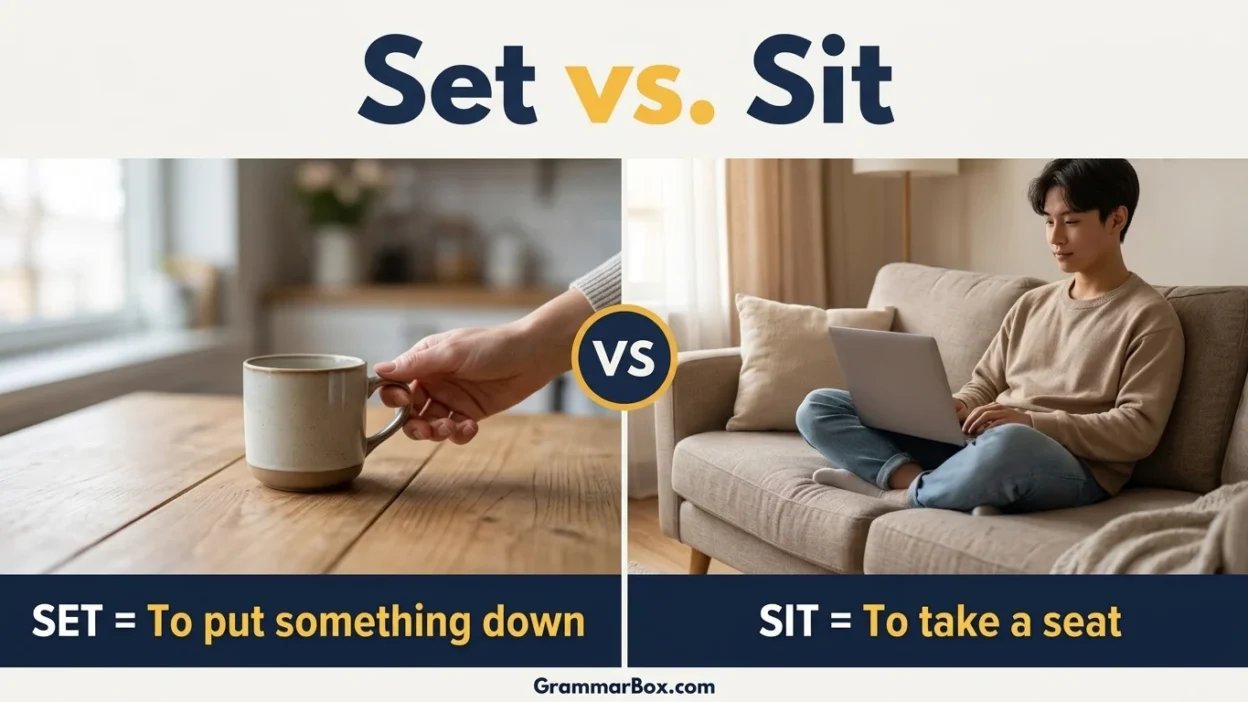
The English words set vs. sit often confuse students, English learners, and even experienced writers. Although these verbs look and sound similar, they have different meanings and grammatical uses. The main difference is that set usually means to put something in a particular place, while sit means to rest your body in a seated position. Learning when to use each word can help you avoid common grammar mistakes and communicate more clearly.
For example, you might say, “Please set the book on the table,” but “Please sit on the chair.” The first sentence describes placing an object somewhere, while the second describes a person taking a seated position. Their past-tense forms can also cause confusion because set remains the same in the past, whereas sit changes to sat. In this guide, you will learn the meanings of set and sit, their verb forms, the rules for using them, and practical examples that make the difference easy to remember.
Quick Answer: Set vs. Sit
Set means to put or place something somewhere, while sit means to rest in a seated position. For example, “Set the bag on the floor” describes placing an object, whereas “Sit on the floor” describes a person’s position. The past tense of sit is sat, but set remains unchanged.
Why People Confuse Set and Sit
People confuse set and sit because both are common English verbs associated with positions, placement, and everyday activities. Their meanings can sometimes appear similar, especially when someone is talking about furniture or objects.
However, the most important difference is the action being described.
- Set: You place something somewhere.
- Sit: You take or maintain a seated position.
- Set down: You put something down.
- Sit down: You move into a seated position.
Consider these examples:
- Correct: Please set your phone on the desk.
- Correct: Please sit at your desk.
- Incorrect: Please sit your phone on the desk.
- Incorrect in ordinary usage: Please set at your desk.
The key is to identify whether you are placing an object or describing someone sitting.
First Word: Set
What Does Set Mean?
Set is a verb that commonly means to put, place, or position something somewhere. It can also have other meanings, such as establishing a rule, adjusting a device, or arranging something.
For example:
- Please set the plates on the table.
- She set her alarm for 6 a.m.
- The teacher set clear rules for the class.
- He set the cup beside the sink.
- They set a date for the meeting.
In these examples, set describes placing, arranging, establishing, or adjusting something.
Verb Forms of Set
One useful feature of set is that its base form, past tense, and past participle are identical.
| Verb Form | Word | Example |
|---|---|---|
| Base form | Set | I set the book on the shelf. |
| Third-person singular | Sets | She sets the table every evening. |
| Present participle | Setting | He is setting the dishes out. |
| Simple past | Set | She set the keys on the counter. |
| Past participle | Set | I have set the alarm. |
This makes set relatively easy to conjugate, although its different meanings can sometimes be confusing.
When Should You Use Set?
Use set when someone places an object, arranges something, establishes a condition, or adjusts a device.
Examples:
- Placing something: Set the box beside the door.
- Arranging items: She set the table for dinner.
- Adjusting a device: Set the temperature to 70 degrees.
- Establishing a goal: They set a target for the project.
- Establishing a rule: The school set new guidelines.
Remember that set often takes a direct object: you set something somewhere.
Second Word: Sit
What Does Sit Mean?
Sit is a verb that means to rest your body in a seated position. It can describe a person taking a seat, remaining seated, or occupying a particular place.
For example:
- Please sit beside me.
- The children sit quietly in class.
- She sat on the sofa after work.
- He is sitting near the window.
- We sat together during lunch.
Unlike set, which usually involves placing an object, sit commonly describes a person’s position or posture.
Verb Forms of Sit
The verb sit changes its form depending on the tense.
| Verb Form | Word | Example |
|---|---|---|
| Base form | Sit | I sit near the window. |
| Third-person singular | Sits | She sits in the front row. |
| Present participle | Sitting | He is sitting on the bench. |
| Simple past | Sat | They sat beside the door. |
| Past participle | Sat | I have sat here before. |
The most important form to remember is sat, the simple past tense and past participle of sit.
For example:
- Present: I sit on this chair every morning.
- Past: I sat on this chair yesterday.
- Present perfect: I have sat here for an hour.
When Should You Use Sit?
Use sit when describing a person or animal taking or maintaining a seated position.
Examples:
- Taking a seat: Please sit down.
- Remaining seated: She sits here every afternoon.
- Describing a past action: We sat near the stage.
- Giving an instruction: Sit beside your brother.
- Describing a position: The cat sits on the windowsill.
In everyday English, sit usually does not require a direct object.
For example, you can say, “I sit on the chair,” but not ordinarily, “I sit the chair.”
Comparison Table: Set vs. Sit
The following table summarizes the main differences between set and sit.
| Feature | Set | Sit |
|---|---|---|
| Main meaning | To put or place something | To rest in a seated position |
| Typical subject | A person placing something | A person or animal |
| Common object | A book, bag, cup, or other item | Usually no direct object |
| Present tense | Set | Sit |
| Third-person singular | Sets | Sits |
| Present participle | Setting | Sitting |
| Simple past | Set | Sat |
| Past participle | Set | Sat |
| Example | Set the bag on the floor. | Sit on the floor. |
| Common expression | Set the table | Sit down |
| Main grammar pattern | Set something somewhere | Sit somewhere |
The easiest distinction: You set an object in a place, but you sit in a place yourself.
When to Use Each: Set or Sit?
Choosing between set and sit becomes easier when you focus on the subject and the action.
1. Use Set When You Place Something
If the sentence describes moving or positioning an object, set is usually the appropriate verb.
Examples:
- Set your books on the shelf.
- She set her purse beside the chair.
- I set the glass on the kitchen counter.
- He set the package outside the door.
In each sentence, an object is being placed somewhere.
2. Use Sit When Someone Takes a Seat
If the sentence describes a person or animal resting in a seated position, use sit.
Examples:
- Sit on the sofa.
- She sits beside her mother.
- The dog sits near the window.
- We sat in the waiting room.
Here, the subject is occupying a seated position rather than placing an object.
3. Understand the Difference Between Set Down and Sit Down
These expressions are especially easy to confuse.
Set down means to put something down.
Example: He set down his suitcase.
Sit down means to move into a seated position.
Example: He sat down beside his suitcase.
Notice that the first sentence describes what happens to the suitcase, while the second describes what happens to the person.
4. Pay Attention to the Tense
The past tense is another important distinction.
- Present: I set the cup on the table.
- Past: I set the cup on the table yesterday.
- Present: I sit near the window.
- Past: I sat near the window yesterday.
Do not write sitted as the past tense of sit. The correct form is sat.
Examples of Set vs. Sit
These examples demonstrate how to use set and sit correctly in everyday English.
Examples Using Set
- Please set your bag beside the door.
- She set the plates on the dining table.
- I set my alarm for seven o’clock.
- He sets his phone on the desk every morning.
- They set a date for their wedding.
- The teacher set a difficult assignment.
- She is setting the books on the shelf.
- We have set our goals for the new year.
- Please set the temperature to 22 degrees.
- He set the cup carefully on the counter.
- The company sets high standards for its employees.
- I set the keys beside the television.
Examples Using Sit
- Please sit beside me.
- She sits near the window every morning.
- We sat together during the movie.
- The children are sitting quietly in the classroom.
- He sat on the bench to rest.
- My cat likes to sit on the sofa.
- Please sit down and relax.
- I have sat in this chair many times.
- They sit around the table during dinner.
- She was sitting under a tree.
- The dog sat beside its owner.
- He usually sits in the front row.
Examples Showing Both Words
These sentences show how set and sit can appear in the same context.
- She set the book on the table and sat on the sofa.
- Please set the plates out before you sit down.
- He set his bag beside the chair and sat next to me.
- I set the cup on the counter before I sat at the table.
- They set their luggage down and sat in the waiting area.
Each verb describes a different action, even when both appear in one sentence.
Common Mistakes With Set and Sit
English learners often make predictable mistakes when using these verbs. Understanding the correct forms can help you improve your grammar.
Mistake 1: Using Sit Instead of Set
Incorrect: Please sit your phone on the desk.
Correct: Please set your phone on the desk.
Why? The sentence describes placing a phone somewhere, so set is the appropriate verb.
Mistake 2: Using Set Instead of Sit
Incorrect: I will set on the chair.
Correct: I will sit on the chair.
Why? The sentence describes taking a seated position, not placing an object.
Mistake 3: Writing Sitted Instead of Sat
Incorrect: She sitted beside me yesterday.
Correct: She sat beside me yesterday.
Why? Sit is an irregular verb. Its past-tense form is sat, not sitted.
Mistake 4: Changing Set to Satted
Incorrect: He satted the book on the table.
Correct: He set the book on the table.
Why? The past tense of set remains set.
Mistake 5: Confusing Set Down With Sit Down
Incorrect: I sat down my backpack.
Correct: I set down my backpack.
Why? Use set down when placing an object somewhere. Use sit down when taking a seat.
Mistake 6: Forgetting the Difference Between Objects and People
Incorrect: She set on the sofa.
Correct: She sat on the sofa.
Why? The sentence describes a person sitting. If the intended meaning is that she placed something on the sofa, the sentence needs an object and a different structure.
Memory Trick: How to Remember Set vs. Sit
A simple memory trick can help you choose the correct word quickly.
SET = Something Else There
Think of set as putting something in a particular place.
Example: Set your keys on the table.
SIT = Stay in a Seat
Think of sit as taking or maintaining a seated position.
Example: Sit on the chair.
You can also remember the past-tense forms with this short rule:
- Set → Set → Set
- Sit → Sat → Sat
Try asking yourself one question before choosing the verb:
Am I placing something, or am I taking a seat?
If you are placing an object, choose set. If you are describing a seated position, choose sit.
American vs. British English: Set vs. Sit
The meanings and standard verb forms of set and sit are essentially the same in American and British English.
Both varieties use set to mean putting or positioning something and sit to describe a seated position.
| Usage | American English | British English |
|---|---|---|
| Place a book somewhere | Set the book on the desk. | Set the book on the desk. |
| Take a seat | Sit on the chair. | Sit on the chair. |
| Past tense of sit | Sat | Sat |
| Past tense of set | Set | Set |
| Present participle of sit | Sitting | Sitting |
| Present participle of set | Setting | Setting |
There can be differences in pronunciation, accent, and regional expressions, but the basic grammar rules do not change.
For example, an American speaker might say, “Set your bag on the counter,” and a British speaker can use the same sentence with the same meaning.
Similarly, both speakers can say, “Please sit down.”
Remember: Neither sitted nor satted is the standard past-tense form of these verbs. Use sat for the past tense of sit and set for the past tense of set.
Similar Words: Set, Sit, Seat, and Lay
Understanding related words can make the difference between set and sit even clearer.
1. Set vs. Sit
- Set: To place something somewhere.
- Sit: To rest in a seated position.
Example: Set the bag down, then sit beside it.
2. Sit vs. Seat
Sit describes taking or maintaining a seated position. Seat can mean to provide someone with a place to sit or to accommodate people.
Examples:
- Please sit near the front.
- The theater can seat 500 people.
You can also say, “The host seated the guests,” meaning the host helped them take their places.
3. Set vs. Lay
Set usually means to place something in a particular position. Lay means to put or place something down and typically takes a direct object.
Examples:
- She set the vase on the shelf.
- She laid the blanket on the bed.
These verbs can sometimes describe similar actions, but their usage depends on the intended meaning and context.
4. Sit vs. Lie
Sit describes a seated position, while lie describes a reclining or horizontal position.
Examples:
- I sit on the chair.
- I lie on the bed.
Their past-tense forms are different, too:
- Sit → Sat
- Lie → Lay, when lie means to recline
These distinctions are useful for avoiding common English verb mistakes.
FAQs:
1. What Is the Main Difference Between Set and Sit?
Set means to put or position something somewhere. Sit means to rest in a seated position. For example, you set a book on a desk, but you sit on a chair.
2. Is It Set Down or Sit Down?
Both expressions are correct, but they have different meanings. Set down means to put an object down, while sit down means to take a seated position.
Examples:
- Set down your bag.
- Sit down beside me.
3. What Is the Past Tense of Sit?
The past tense of sit is sat.
Example: I sat beside my friend yesterday.
The past participle is also sat, as in, “I have sat here before.”
4. Does Set Change in the Past Tense?
No. The base form, simple past, and past participle of set are all set.
Examples:
- Present: I set the alarm.
- Past: I set the alarm yesterday.
- Present perfect: I have set the alarm.
5. Is Sitted a Correct Word?
No. Sitted is not the standard past-tense form of sit. The correct form is sat.
Incorrect: He sitted on the bench.
Correct: He sat on the bench.
6. Can You Use Set for a Person?
Yes, when the sentence describes placing or positioning a person, but the context matters. For example, “She set the child on the chair” means she placed the child there. In ordinary conversation, “She sat on the chair” means she took a seat herself.
7. Are Set and Sit Used Differently in American and British English?
Their basic meanings and grammatical forms are the same in both varieties. Both American and British English use set for placing something and sit for taking a seated position.
8. How Can I Remember When to Use Set or Sit?
Remember that set places something, while sit describes a seated position. Ask yourself whether the sentence describes putting an object somewhere or sitting down. This simple question will help you choose the correct verb.
Final Verdict: Set vs. Sit
The difference between set and sit becomes simple when you focus on what the verb describes. Use set when you put, place, arrange, or position something. Use sit when a person or animal takes or maintains a seated position. For example, “Set the book on the table” and “Sit on the chair” demonstrate the two verbs clearly.
Pay attention to their past-tense forms as well. Set remains unchanged, while sit becomes sat. Avoid mistakes such as sitted, satted, and using sit when you mean to place an object. With regular practice and attention to sentence structure, you can use these common English verbs naturally and confidently.
Remember This
- Set = Put or place something.
- Sit = Take or maintain a seated position.
- Set → Set → Set
- Sit → Sat → Sat
- Set down your bag, then sit down.
Keep these rules in mind, and you will find it much easier to distinguish set from sit in everyday conversations and writing.